Questions

[5 marks Questions]

🎯

Test yourself on this topic

4 questions · timed · auto-graded

Question 15 Marks
A non-metal A which is the largest constituent of air, when heated with $H _2$ in $1: 3$ ratio in the presence of catalyst (Fe) gives a gas B . On heating with $O _2$ it gives an oxide C . If this oxide is passed into water in the presence of air it gives an acid $D$ which acts as a strong oxidising agent.
1. Identify A, B, C and D.
2. To which group of periodic table does this non-metal belong?
Answer
  1. 1. $N _2$ is largest constituent of air, when heated with $H _2$ in the ratio of 1 : 3 .

    In the presence of catalyst $( Fe )$ gives a gas $NH _3(B)$.
$\text{N}_2\text{(g)}\ \ +\ \ 3\text{H}_2\text{(g)}\ \ \xrightarrow[\text{Fe}]{773}\ \ 2\text{NH}_3\text{(s)}\\ \ \ '\text{A}'\ \ \ \ \ \ \ \ \ \text{Hydrogen}\ \ \ \ \ \ \ \ \ \ \ \ \ '\text{B}'\\ \ \ \ \ 1\ \ \ \ \ \ \ :\ \ \ \ \ \ \ 3\ \ \ \ \ \ \ \ \ \ \ \ \ \ \ \ \text{Ammonia}\\\text{Nitrogen}$

Nitrogen reacts with oxygen on heating to form nitrogen monoxide ‘C’, which gets oxidised in the presence of $O_2$ to nitrogen dioxide. Nitrogen dioxide dissolves in water in the presence of oxygen to form nitric acid which is an oxidising agent.

$\text{N}_2\text{(g) + O}_2\text{(g)}\xrightarrow{\text{heat}}2\text{NO}\\\ \ \ \ \ \ \ \ \ \ \ \ \ \ \ \ \ \ \ \ \ \ \ \ \ \ \ \ \ \ \ \ \ \ '\text{C}'$

$2\text{NO + O}_2\rightarrow2\text{NO}_2\\\ '\text{C}'$

$4\text{NO}_2+2\text{H}_2\text{O + O}_2\rightarrow4\text{HNO}_3\\\ \ \ \ \ \ \ \ \ \ \ \ \ \ \ \ \ \ \ \ \ \ \ \ \ \ \ \ \ \ \ \ \ \ \ \ \ \ \ \ \ '\text{D}'\\\ \ \ \ \ \ \ \ \ \ \ \ \ \ \ \ \ \ \ \ \ \ \ \ \ \ \ \ \ \ \ \ \ \ \ \ \ \ \text{(Nitric acid)}$
‘A’ is $N_2$, ‘B’ is $NH_3$, ‘C’ is NO and ‘D’ is $HNO_3$.
  1. Group 15.
View full question & answer
Question 25 Marks
Explain the following.
1. Reactivity of Al decreases if it is dipped in $HNO _3$.
2. Carbon cannot reduce the oxides of Na or Mg .
3. NaCl is not a conductor of electricity in solid state whereas it does conduct electricity in aqueous solution as well as in molten state.
4. Iron articles are galvanised.
5. Metals like $Na , K , Ca$ and Mg are never found in their free state in nature.
Answer
  1. Since nitric acid is an oxidizing agent so it reacts with aluminium and forms a layer of aluminium oxide over metal surface which further reduces the reactivity of metal.
  2. Alkali and alkaline earth metals are very reactive and readily react with oxygen to form their stable oxides. The reduction of these metallic oxides with carbon requires very high temperature and at that temperature metals react with carbon to form their corresponding carbides. Hence they cannot reduce with the help of carbon as reducing agent.
  3. NaCl is an ionic compound. In solid state, oppositely charged ions are held tightly with strong metallic bond. So neither metal ions nor free electrons can move from their position. Therefore NaCl and other ionic compounds cannot conduct electricity in their solid state. In molten state or in aqueous, the free electrons and metal ions are free enough to carry charge which makes them good conductor.
  4. Galvanisation is a process of formation of thin layer over metal surface. It prevents further contact of metal surface with atmosphere and reduces the corrosion level. So iron articles are galvanized by making a thin layer of zinc over them. Since zinc is more reactive than iron so it will react first and protect iron surface.
  5. Na, K, Ca and Mg are alkali and alkaline earth metals. They are most reactive metal and readily react with atmospheric oxygen and other gases. Therefore they are found in nature in the form of their compounds.
View full question & answer
Question 35 Marks
Give the steps involved in the extraction of metals of low and medium reactivity from their respective sulphide ores.
Answer
Extraction of Metals present low in the Activity series:
Silver (Ag), gold (Au) and platinum (Pt) generally occur in the free or native state. This means that they can be isolated rather easily. Metals like copper (Cu) and mercury (Hg) are comparitively more reactive and occur in combined states. For example, the ore of mercury is cinnabar (HgS) while that of copper is copper glance ($Cu_2S$). Both are converted into metallic form upon heating in air or oxygen.

$2\text{HgS(s)}\ \ \ \ \ \ \ +\ \ \ \ \text{ 3O}_2\text{(g)}\ \ \ \ \xrightarrow{\text{heat}}\ \ \ 2\text{HgO(s) + 2SO}_2\text{(g)}\\\text{Mercuric sulphide}\ \ \ \ \ \ \ \ \ \ \ \ \ \ \ \ \ \ \ \ \ \ \ \ \ \text{Mercuric oxide}$

$2\text{HgO(s)}\xrightarrow{\text{heat}}2\text{Hg(l) + O}_2\text{(g)}$

Similarly,

$2\text{Cu}_2\text{S(s)}\ \ \ \ \ \ \ \ +\ \ \ \ \ \ \text{ 3O}_2\text{(g)}\ \ \xrightarrow{\text{heat}}\ \ 2\text{Cu}_2\text{O(s) + 2SO}_2\text{(g)}\\\text{Cuprous sulphide}\ \ \ \ \ \ \ \ \ \ \ \ \ \ \ \ \ \ \ \ \ \ \ \ \ \ \ \ \text{Cuprous oxide}$

$2\text{Cu}_2\text{O(s) + Cu}_2\text{S(s)}\xrightarrow{\text{heat}}6\text{Cu(s) + SO}_2\text{(g)}$
Extraction of Metals present in the middle of the Activity series:

The metals present in the middle of the series are zinc, iron, chromium, nickel, cobalt, lead etc. These are usually present as sulphides or carbonares in nature. However, it is quite easy to obtain a metal from its oxide form which is then reduced to the metallic state. The various steps involved in the process of extraction are briefly discussed.
  1. Calcination:
Calcination may be defined as the process of heating the ore below its melting point in the absence of air.

As a result of calcination, the following changes take place.

Moisture is driven out and the ore becomes dry.

$\text{CuSO}_4.5\text{H}_2\text{O}\xrightarrow{\text{heat}}\text{CuSO}_4+5\text{H}_2\text{O}\\\text{Blue vitriol}\ \ \ \ \ \ \ \ \ \ \ \ \ \ \text{White}$

$\text{Fe}_2\text{O}_3.3\text{H}_2\text{O}\xrightarrow{\text{heat}}\text{Fe}_2\text{O}_3\ \ \ +\ \ \ 3\text{H}_2\text{O}\\\text{Limonite}\ \ \ \ \ \ \ \ \ \ \ \ \ \ \text{Ferric Oxide}$

Some hydrated ores decompose and become anhydrous by losing molecules of water of crystallisation. For example, heat

$\text{ZnCO}_3\xrightarrow{\text{heat}}\text{ZnO}+\text{CO}_2$

$\text{PbCO}_3\xrightarrow{\text{heat}}\text{PbO}+\text{CO}_2$

$\text{CaCO}_3.\text{MgCO}_3\xrightarrow{\text{heat}}\text{CaO}+\text{MgO}+2\text{CO}_2\\ \ \ \ \ \ \ \text{Dolomite}$
  1. Roasting:
Roasting may be defined as the process of heating the ore below its melting point with excess of air.

As a result of roasting, the following changes occur:
  • Any organic matter if present, gets destroyed.
  • Impurities of non-metals such as sulphur, arsenic or phosphorus are converted into their volatile oxides which are removed. For example,
$\text{S}_8+8\text{O}_2\xrightarrow{\text{heat}}8\text{SO}_2\text{(g)}\\ \ \ \ \ \ \ \ \ \ \ \ \ \ \ \ \ \ \ \ \ \ \ \ \ \ \text{Sulphur dioxide}$

$\text{P}_4+5\text{O}_2\xrightarrow{\text{heat}}\text{P}_4\text{O}_{10}\text{(s)}\\ \ \ \ \ \ \ \ \ \ \ \ \ \ \ \ \ \ \ \ \ \ \ \text{Phosphorus (V) oxide}$

$4\text{As}+3\text{O}_2\xrightarrow{\text{heat}}2\text{As}_2\text{O}_3\text{(s)}\\ \ \ \ \ \ \ \ \ \ \ \ \ \ \ \ \ \ \ \ \ \ \ \ \ \ \text{Arsenic oxide} $
  • Sulphides of the metals are converted into their oxides. For example,
$2 ZnS+3 O_2 \rightarrow 2 ZnO+2 SO_2(g)$
$2 PbS+3 O_2 \rightarrow 2 PbO+2 SO_2(g)$
- Small amounts of sulphides may also be converted into sulphates as result of roasting. For example,
$ZnS+2 O_2 \rightarrow ZnSO_4$
$PbS+2 O_2 \rightarrow PbSO_4$
View full question & answer
Question 45 Marks
  1. Given below are the steps for extraction of copper from its ore. Write the reaction involved.
    1. Roasting of copper (1) sulphide.
    2. Reduction of copper (1) oxide with copper (1) sulphide.
    3. Electrolytic refining.
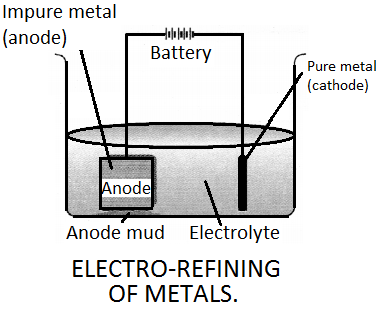
  2. Draw a neat and well labelled diagram for electrolytic refining of copper.
Answer
  1. Given below are the steps.
  1. Roasting:
$2\text{Cu}_2\text{S(s) + 3O}_2\text{(g)}\xrightarrow{\text{heat}}2\text{Cu}_2\text{O(s) + 2SO}_2\text{(g)}$
  1. Reduction:
$2\text{Cu}_2\text{O(s) + Cu}_2\text{S(s)}\xrightarrow{\text{heat}}6\text{Cu}\text{(s) + SO}_2\text{(g)}$

This reaction in which one of the reactants ($Cu_2S$) carries the reduction of the product ($Cu_2O$) is known as auto-reduction.
  1. Reactions taking place in electrorefensing are:
At cathode (reduction): $Cu ^{2+}( aq )+2 e ^{-} \rightarrow Cu ( s )$

At anode (oxidation): $Cu ( s ) \rightarrow Cu ^{2+}( aq )+2 e ^{-}$
  1. For the diagram of electro-refining,
View full question & answer
[5 marks Questions] - Science STD 10 Questions - Vidyadip