Question 15 Marks
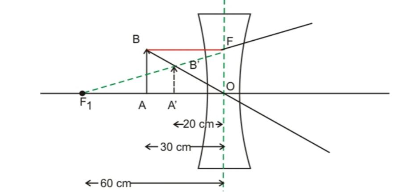
A concave lens of focal length 60 cm is used to form an image of an object of length 9 cm kept at a distance of 30 cm from it. Use lens formula to determine the nature, position and length of the image formed. Also draw labelled ray diagram to show the image formation in the above case.
Answer
View full question & answer→Concave lens-
focal length $(f)=-60 \mathrm{~cm}$
Object length $(h)=9 \mathrm{~cm}$
Object distance $(u)=-30 \mathrm{~cm}$
Lens formula, $\frac{1}{v}-\frac{1}{u}=\frac{1}{f}$
$\frac{1}{v}=\frac{1}{f}+\frac{1}{u}$
$v=\frac{-1}{60}+\left(\frac{-1}{30}\right)$
$m=\frac{v}{u}=\frac{-20}{-30}=\frac{2}{3}$
$m=\frac{h^{\prime}}{h} \Rightarrow h^{\prime}=m \times h$
$h^{\prime}=\frac{2}{3} \times 9$
$h^{\prime}=6 \mathrm{~cm}$
Image is virtual, erect and smaller than object.
focal length $(f)=-60 \mathrm{~cm}$
Object length $(h)=9 \mathrm{~cm}$
Object distance $(u)=-30 \mathrm{~cm}$
Lens formula, $\frac{1}{v}-\frac{1}{u}=\frac{1}{f}$
$\frac{1}{v}=\frac{1}{f}+\frac{1}{u}$
$v=\frac{-1}{60}+\left(\frac{-1}{30}\right)$
$m=\frac{v}{u}=\frac{-20}{-30}=\frac{2}{3}$
$m=\frac{h^{\prime}}{h} \Rightarrow h^{\prime}=m \times h$
$h^{\prime}=\frac{2}{3} \times 9$
$h^{\prime}=6 \mathrm{~cm}$
Image is virtual, erect and smaller than object.