Questions

Answer the questions.[Phy-3M]

🎯

Test yourself on this topic

3 questions · timed · auto-graded

Question 13 Marks
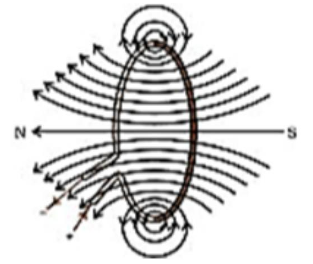
a. Draw the pattern of magnetic field lines produced by a current carrying circular loop showing the direction of current in the loop and the direction of the magnetic field lines.
b. State the rule which can be applied to know the direction of magnetic field lines in the above case.
Answer
a.
Image

b. Right Hand Thumb Rule:- When a current carrying straight conductor is held in the right hand in such a way that the thumb points towards the direction of the current, then the fingers will wrap around the conductor in the direction of the field lines of the magnetic field
View full question & answer
Question 23 Marks
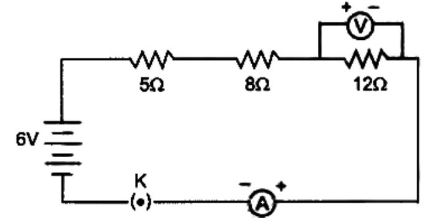
Draw a schematic diagram of a circuit consisting of a battery of three cells of 2 V each, a $5 \Omega$ resistor, an $8 \Omega$ resistor, and a $12 \Omega$ resistor and a plug key, all connected in series. Now, connect the ammeter to measure the current through the resistors and a voltmeter to measure the potential difference across the $12 \Omega$ resistors. What would be the readings in the ammeter and the voltmeter?
Answer
The total resistance of the circuit is given by
Image
$\mathrm{R}=5+8+12=25 \Omega$
We know, $\mathrm{R}=\frac{V}{I}$
Hence, $25=\frac{6}{I}$
$\mathrm{I}=\frac{6}{25}=0.24 \mathrm{~A}$
Since, resistances are connected in series, thus electric current remains the same through all resistors.
Here we have, Electric current, I = 0.24 A
Resistance, $\mathrm{R}=12 \Omega$
Thus, potential difference ( V ) through the resistor of $12 \Omega$ is given by
$\mathrm{V}=\mathrm{I} \times \mathrm{R}$
$=0.24 \times 12=2.88 \mathrm{~V}$
$\therefore$ Reading of ammeter $=0.24 \mathrm{~A}$
Reading of voltmeter through resistor of $12 \Omega=2.88 \mathrm{~V}$
View full question & answer
Question 33 Marks
What are the common defects of vision that can be corrected by the use of suitable eyeglasses or spectacles?
Answer
There are mainly four common defect of vision that can be corrected by the use of suitable eyeglasses or spectacles. There are
i. Myopia or near-sightedness,
ii. Hypermetropia or far-sightedness,
iii. Presbyopia, and
iv. Astigmatism
View full question & answer
Answer the questions.[Phy-3M] - Science STD 10 Questions - Vidyadip