Questions

[3 Mark Questions]

🎯

Test yourself on this topic

8 questions · timed · auto-graded

Question 13 Marks
$i$. An electric lamp of $100$ ohms, a toaster of resistance $50$ ohms and a water filter of resistance $500$ ohms are connected in parallel to a $220V$ source. what is the resistance of the electric iron connected to the same source that takes as much current as all the three appliances and what is the current through it?
$ii$. Which uses more energy, a $250 W \ TV$ set for $1$ hour or a $1,200 W$ toaster for $10$ minutes?
Answer
$i$. Combined resistance of $100 \Omega, 50 \Omega$ and $500 \Omega$ in parallel
i.e. $R _{ p }$ is given by $\frac{1}{R P}=\frac{1}{100}+\frac{1}{50}+\frac{1}{500}$
$=\frac{5+10+1}{500}=\frac{125}{4}=31.25$
Resistance of electric iron $=31.25 \Omega$
Current through electric iron $=\frac{V}{R}=\frac{220}{31.25}=7.04 A$
$ii$. Energy consumed $E _1= P _1 t _1=250 W \times 1 h$
$=250 \frac{J}{ S } \times 3600 s \ E_1=900000 J$
$E_2=P_2 t_2=12000 W \times 10\min$
$E_2=1200 \frac{J}{s} \times 600 s$
$E_2=720000 J$
$\therefore 250 \Omega \ TV$ set consumes more energy. 
View full question & answer
Question 23 Marks
$a.$ Calculate the resistance of a metal wire of length $2 m$ and area of cross$-$section $1.55 \times 10^{-6} m^2$ $($Resistivity of the metal is $\left.2.8 \times 10^{-8} \Omega m\right)$
$b.$ Why are alloys preferred over pure metals to make the heating elements of electrical heating devices?
Answer
Step $1:$ Given that:
Length $(1)$ of the metal wire $= 2m$
Area of cross section $(A) = 1.55 \times 10^{-6} m^2$
Resistivity$(p)$ of the metal $= 2.8 \times 10^{-8} \Omega-m$
Step $2:$ Calculation of resistance:
Resistance of a conductor is given by:
$R =\frac{\rho l}{A}$
Thus, putting all the values,
we get $R =\frac{2.8 \times 10^{-8} \Omega-m \times 2 m}{1.55 \times 10^{-6} m^2}$
$R =\frac{5.6 \times 10^{-2}}{1.55}$
$R =3.61 \times 10^{-2} \Omega$
Thus,
The resistance of the metal wire is $3.61 \times 10^{-2} \Omega$
$b.$ Alloys are used in electrical heating devices rather than pure metals because the resistivity of an alloy is more than the resistivity of pure metal.
Also, the melting point of an alloy is high,
so it does not melt or oxidize easily even at a higher temperature.
View full question & answer
Question 33 Marks
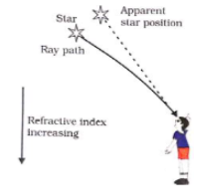
What is atmospheric refraction? Explain with the help of a labelled diagram that the position of a star as seen by us is not its true position.
Answer
Atmospheric refraction:- The refraction of light caused by the earth's atmosphere (having their layers of varying optical densities) is called atmospheric refraction.
Light from a star is refracted as it leaves space and enters the earth's atmosphere. Air higher up in the sky is rare but that near the Earth's surface is denser. So, as the light from a star comes down the dense air bends the light more. Therefore, the apparent position to the star is slightly different from its actual position.
Image
View full question & answer
Question 43 Marks
In pea plant, round seed is dominant over the wrinkled. If a cross is carried out between these two plants, give answer to the following questions
i. Mention the genes for the traits of parents.
ii. State the trait of F₁ hybrids.
iii. Write the ratio of F2 progeny obtained from this cross. What is the name of the cross?
Answer
i. RR for homozygous pure round. And rr for homozygous pure wrinkle pea plant.
ii. Rr (hybrid) - heterozygous. All are round since round is dominant over wrinkled.
iii. 3:1 (phenotypic ratio), 1:2:1 (genotypic ratio) The name of this cross is monohybrid cross.
View full question & answer
Question 53 Marks
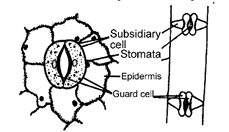
Draw the diagram of part of leaf from which transpiration takes place. Explain stomatal or foliar transpiration.
Answer
Stomatal transpiration: The epidermis has minute pores called stomata. Each stoma is surrounded by two specialised epidermal cells called guard cells. The guard cells are kidney-shaped, process chloroplasts and less elasticity. Adjacent to the epidermal cells, their walls are thin and elastic. They are thickened near the openings. The stomata remain open in light and close in darkness. Guard cells control the opening or closing of stomata.
The stomata form the chief pathway of transpiration. Though the relative total area of the stomatal pore is 1-2% of the total area of the leaf, more transpiration takes place through these stomata only.
Image
View full question & answer
Question 63 Marks
Give reasons:
a. Platinum, gold and silver are used to make jewellery.
b. Sodium, potassium and lithium are stored under oil.
c. Aluminium is a highly reactive metal, yet it is used to make utensils for cooking.
d. Carbonate and sulphide ores are usually converted into oxides during the process of extraction.
e. Lemon or tamarind juice are effective in cleaning tarnished copper vessels.
Answer
a. Platinum, gold and silver are used to make jewelry because of their bright shiny surface and high resistance to corrosion. Also they have high malleability and ductility.
b. Sodium, potassium and lithium are stored under oil to prevent their reaction with oxygen, moisture and carbon dioxide of air so as to protect them.
c. Aluminum metal forms a thin layer of aluminum oxide all over its surface under the action of moist air. This layer prevents the metal underneath from further corrosion. It is cheap, easily available, malleable and ductile. Therefore, it is used to make utensils for cooking.
d. It is easier to obtain a metal from its oxides as compared to its sulphides and carbonates. So, prior to reduction, metal carbonate and sulphides must be converted into metal oxides. A carbonate ore is converted into oxide by calcination whereas a sulphide ore is converted into oxide by roasting.
When copper vessels are exposed to moist air, they form a green coating of basic copper carbonate $\left[ CuCO _3 \cdot Cu ( OH )_2\right]$.
$2 Cu +\underset{\text { From Moistair }}{ CO _2}+ O _2+ H _2 O \rightarrow \underset{\text { Basic Copper Carbonate (Green) }}{ CuCO _3 \cdot Cu ( OH )_2}$
The sour substances such as lemon or tamarind juice contain acids. Lemon juice contains citric acid and tamarind contains tartaric acid. These acids dissolve the coating of copper oxide or basic copper carbonate present on the surface of tarnished copper vessels and make them shining red-brown again.
View full question & answer
Question 73 Marks
Name a metal/non-metal:
i. Which makes iron hard and strong?
ii. Which is alloyed with any other metal to make an amalgam?
iii. Which is used to galvanize iron articles?
iv. Whose articles when exposed to air form a black coating?
Answer
i. Carbon makes iron hard and strong.
ii. Mercury is alloyed with any other metal to make an amalgam.
iii. Zinc used to galvanize iron articles.
iv. Silver article when exposed to air from a black coating.
View full question & answer
Question 83 Marks
Nikita took Zn, Al, Cu, Fe, Mg and Na metal and put each metal in cold water and then hot water. She reacted the metal with steam
(i) Name the metal which reacts with cold water.
(ii) Which of the above metals react with steam?
(iii) Name the metal which reacts with hot water.
(iv) Arrange these metals in order of increasing reactivity.
Answer
(i) Na
(ii) Al, Zn, Fe
(iii) Mg
(iv) Na>Mg>Al>Zn>Fe>Cu
View full question & answer
[3 Mark Questions] - Science STD 10 Questions - Vidyadip