MCQ 11 Mark
A student traces the path of a ray of light passing through a rectangular glass slab for three different values of angle of incidence (i) namely $30^{\circ}, 45^{\circ}, 60^{\circ}$. He produces the incident ray and measures the perpendicular distance, $l$, between the produced incident ray and the emergent ray.
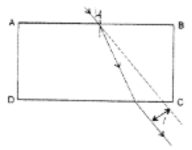
He will observe that
He will observe that
- A'I' keeps on decreasing with increase in angle of incidence.
- B' l ' is maximum for $\angle \mathrm{i}=45^{\circ}$ and is less than this value both for $\angle \mathrm{i}=30^{\circ}$ and for $\angle \mathrm{i}= 60^{\circ}$.
- C'I' remains the same for all three angles of incidence.
- ✓'l' keeps on increasing with increase in angle of incidence.
Answer
View full question & answer→Correct option: D.
'l' keeps on increasing with increase in angle of incidence.
(D) 'l' keeps on increasing with increase in angle of incidence.
Explanation:
$l \alpha \sin (i-r)$ where $r$ is the angle of refraction.
Explanation:
$l \alpha \sin (i-r)$ where $r$ is the angle of refraction.