Questions

[2 Mark Questions]

🎯

Test yourself on this topic

8 questions · timed · auto-graded

Question 12 Marks
Image
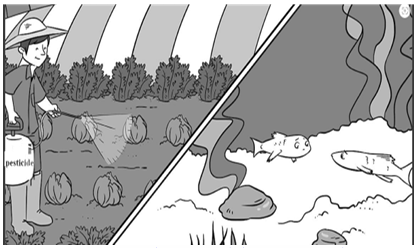
What impact will the process shown in the image have on Humans if they occupy the last trophic level? Explain.
Answer
Pesticides are non-biodegradable/ keep getting accumulated at each trophic level, / persist for longer time/ and thus last trophic level has highest concentration/ humans will have the highest concentration of pesticides/ leads to bio-magnification.
View full question & answer
Question 22 Marks
Image
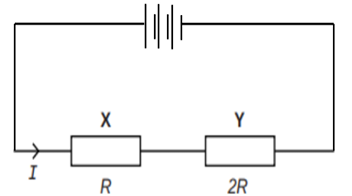
The above figure shows two resistors X and Y connected in series to a battery. The power dissipated for this combination is P1. When these resistors are connected in parallel to the same battery then the power dissipated is given by $P_2$ Find out the ratio $\frac{P_1}{P_2}$.
Answer
For series total resistance is R+2R = 3R (0.5)
$P _1=\frac{V^2}{3 R}$ (0.5)
For parallel total Resistance is $\frac{2 R}{3}$ (0.5)
$P _2=\frac{V^2}{2 R / 3}=\frac{3 V^2}{2 R}$
$\frac{P_1}{P_2}=\frac{2}{9}$ (0.5)
View full question & answer
Question 32 Marks
Image
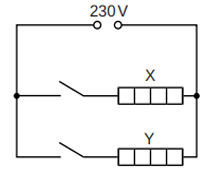
The electric circuit (above figure) in a clothes dryer contains two heaters X and Y in parallel. The above figure shows the circuit connected to a 230 V power supply. When both switches are closed, the current in X is 3.5 A.
Analyse the circuit given above and answer the following questions.
(i) Calculate the power developed in heater X.
(ii) If the resistance of X is double that of Y calculate the current in heater Y
Answer
P = VI (1)
= 230 x 3.5 = 805 W
I $\propto \frac{1}{R^{\prime}}$ so half the resistance means double the current.
Therefore, current in Y = 7.0 Α. (1)
View full question & answer
Question 42 Marks
Image
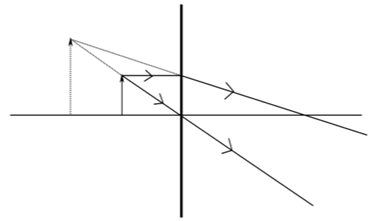
The above figure shows the formation of an image by a lens shown by a thick line.
Analyse the figure and answer the following questions.
A. What is the type of lens used?
B. What is the nature of the image?
C. If the image is formed at a distance of 30 cm from the lens and the image is twice the size of the object, then where is the object placed?
Answer
A. The lens is a convex lens.
B. The image is virtual.
C. Magnification for lens = $\frac{v}{u}=\frac{h_i}{h_o}=2$.
$\frac{-30 cm}{u}=2$
Hence u = -15 cm
View full question & answer
Question 52 Marks
Explain the role of the following enzymes in the process of digestion of food in humans:(i) Salivary amylase
(ii) Pepsin
(iii) Trypsin
(iv) Lipase.
Answer
• Salivary amylase - breaks down starch which is a complex molecule to sugar.
• Pepsin - Helps to digest proteins in stomach.
• Trypsin - It helps in digesting proteins to amino acids.
• Lipase Breaking down of emulsified fats to fatty acids and glycerol.
View full question & answer
Question 62 Marks
List the steps for the synthesis of glucose by the plants. What special feature is found in desert plants related to this process?
Answer
Steps of synthesis of glucose in plants:
• Absorption of light energy by chlorophyll
• Conversion of light energy to chemical energy and splitting of water molecules into hydrogen and oxygen
• Reduction of carbon dioxide into carbohydrates.
• Desert plants take up carbon dioxide at night and prepare an intermediate which is acted upon by the energy absorbed by the chlorophyll during the day.
View full question & answer
Question 82 Marks
Identify the type of each of the following reactions stating the reason for your answers.
A. $Fe _2 O _3+2 Al \rightarrow Al _2 O _3+2 Fe +$ heat
B. $Pb \left( NO _3\right)_2+2 KI \rightarrow PbI _2\left(\downarrow)+2 KNO _3\right.$
Answer
A. Exothermic/Displacement reaction/Redox reaction. (0.5)
Heat is evolved or a More reactive element displaces a less reactive element or aluminium reduces iron (II) oxide to iron (0.5)
B. Double displacement / Precipitation reaction (0.5)
As there is an exchange of ions between reactants and products / (Yellow) precipitate (of Lead iodide) is formed (0.5)
View full question & answer
[2 Mark Questions] - Science STD 10 Questions - Vidyadip