Questions

case /data -based (4 Marks)

🎯

Test yourself on this topic

3 questions · timed · auto-graded

Question 14 Marks
Image
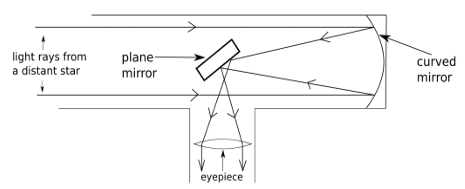
The above image is that of a reflecting telescope. Reflecting telescopes revolutionised our ways of looking into the sky. They employ mirrors to gather and focus light, rather than relying solely on lenses as in their refracting counterparts. These telescopes utilise precisely shaped and polished mirrors to capture incoming light and reflect it to a focal point, where it forms an image for observation.
A. What kind of image of the star is seen by the observer at the eyepiece?
B. What kind of mirror is used in this reflecting telescope?
Attempt either subpart C or D.
C. Explain with reason what kind of optical device (type of lens or mirror) that is used at the eyepiece.
OR
D. What is the role of the plane mirror in the telescope?
Answer
A. Real Image (the final image is formed due to the lens at the eye-piece) (1)
B. Concave Mirror
Student to attempt either subpart C or D.
C. A converging lens is used at the eyepiece to collect the rays from the plane mirror and help the viewer to see a real erect image of the star. (2)
OR
D. The plane mirror laterally inverts the image formed by the curved mirror and its position helps to direct the rays towards the eye-piece. (2)
View full question & answer
Question 24 Marks
Image
In order to help them understand the movements in the plants, answer the following questions:
Attempt either subpart A or B.
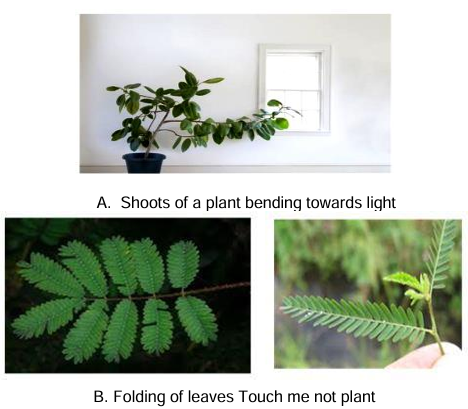
A. What causes the bending of shoots in the plants as shown in figure A?
OR
B. What causes the folding of the leaves in 'Touch me not' plant as shown
in figure B? (2)
C. Compare the movement of growth of the pollen tube towards ovule with the movements shown in part A of the above figure. (1)
D. Compare the movement shown in figure B with the movement of body parts in the animals. (1)
Answer
Students to attempt either subpart A or B.
(A). • Bending of shoots of plants is a response to the stimulus and a directional, growth-related movement.
• When growing plants detect sunlight, a hormone called auxin, synthesized at shoot tip helps the cells to grow longer.
• When light is coming from one side of the plant, auxin diffuses to the shady side of the shoot.
• This concentration of auxin stimulates the cells of the shoot to grow longer on the side of the shoot which is away from the light. Thus, plant appears to bend towards light.
OR
(B). • Leaves of 'Touch me not' plant respond to the stimulus by showing growth independent movement.
• These plants use electrical-chemical means to convey the information from cell to cell.
• Movement happens at a point different from the point of touch.
• Plant cells change shape by changing the amount of water in them, resulting in swelling or shrinking, and therefore in changing shape.
C. Growth of pollen tubes towards the ovule is an example of chemotropism whereas bending of shoots towards sunlight is an example of phototropism. (1)
D. (i) Although both plants and animals show electrical-chemical means to convey the information from cell to cell but unlike nerve cells in animals there is no specialized tissue in plants for conduction of information. (0.5)
(ii) In animal cells, change in shape occurs because of the specialized proteins found in muscle cells; plant cells change shape by changing the amount of water in them. (0.5)
View full question & answer
Question 34 Marks
Image
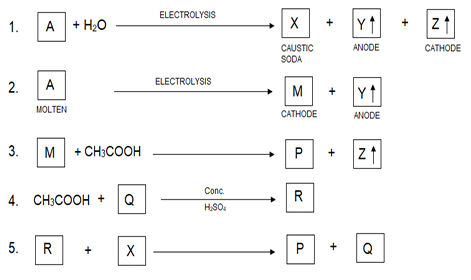
A. Derive the names of A, Y, Z, M, P & R
Attempt either subpart B or C.
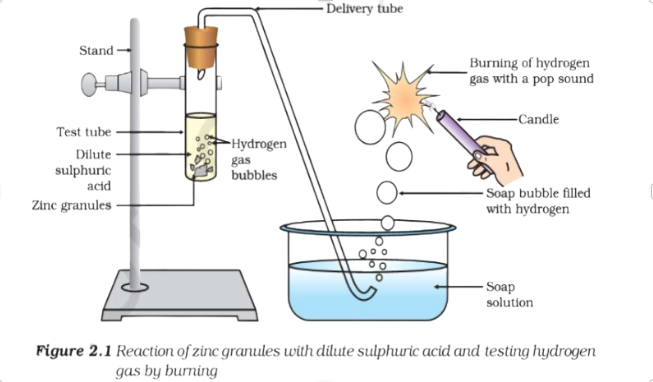
B. Improvise an activity to test Z.
OR
C. Name the process in which compounds X, Y & Z are formed from A. Justify your response.
Answer
A. A Sodium chloride
Y - Chlorine gas,
Z - Hydrogen gas,
M - Sodium metal,
P - Sodium ethanoate &
R - Ethyl ethanoate/ester
Student to attempt either subpart B or C.
B. Any activity similar to the given figure. (1)
Image
OR
C. Chlor alkali process The process is called the chlor-alkali process because of the products formed from chlorine and alkali for sodium hydroxide. (1)
View full question & answer
case /data -based (4 Marks) - Science STD 10 Questions - Vidyadip