Questions

[3 Mark Questions]

🎯

Test yourself on this topic

8 questions · timed · auto-graded

Question 13 Marks
Calculate:
$i.$ the effective resistance of the circuit and the current in the circuit
$ii.$ Potential difference across $10$ resistor of a circuit shown in the figure.
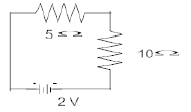
Image
Answer
$i. R =R_1+R_2$
$= 5+10=15 \Omega$
$I =\frac{V}{R}=\frac{2}{15} .$
$= 0.133 A$
$ii.$ Potential difference across $10 \Omega$
$V=IR$
$=\frac{2}{15} \times 10$
$=1.33 V$
View full question & answer
Question 23 Marks
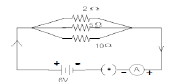
In the circuit diagram given here, calculate$-$
Image
$i.$ The total effective resistance and the total current
$ii.$ The current through each resistor
Answer
$i.$ since resistances are in parallel
$\frac{1}{R}=\frac{1}{R_1}+\frac{1}{R_2}+\frac{1}{R_3}$
$\frac{1}{R}=\frac{1}{2}+\frac{1}{5}+\frac{1}{10}=\frac{8}{10}$
$R=\frac{10}{8} \Omega$
$ii.$ Total current $I =\frac{V}{R}=\frac{6 V}{10 / 8 n}$
$=4.8 A$
$iii.$ If $I _1, I _2$ and $I _3$ be the current through $2 \Omega, 5 \Omega$ and $10 \Omega$ respectively.
Therefore, $I _1=\frac{V}{R_1}=\frac{6}{2}$
$=3 A$
$I_2=\frac{V}{R_2}=\frac{6}{5}$
$=1.2 A$
$I_3=\frac{V}{R_3}=\frac{6}{10}$
$=0.6 A$
View full question & answer
Question 33 Marks
"A concave mirror of focal length f can form a magnified, erect as well as an inverted image of an object placed in front of it." Justify this statement stating the position of object with respect to the mirror in each case for obtaining these images.
Answer
When an object is placed between Focus and Pole of concave mirror, the image formed is virtual, magnified, erect and behind the mirror.when an object is placed between Curvature and Focus of concave mirror, the image formed is real, magnified, inverted at the same side of mirror.
View full question & answer
Question 43 Marks
A child questioned his teacher that why do organisms resemble their parents more as compared to grandparents. In which way will the teacher explain to the child?
Answer
The two parents involved in sexual reproduction produce gametes which fuse together forming a zygote. It gradually develops into a young child showing certain similarities with the parents.
Since, a child inherits its characters from both the parents the resemblance with them is very close. The grandparents and the child resemble less closely because a gap of gene pool is created by the parents of the child. Since the child is immediate generation next to his parent thus to carry more similar genes as that of parents. Variations are more with grandparents.
View full question & answer
Question 53 Marks
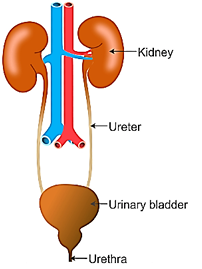
a. Draw a diagram of human excretory system and label on it the following parts:
i. Kidney
ii. Ureter
iii. Urinary bladder
iv. Urethra
b. Write one main function each of the labelled parts.
Answer
a. Diagram of human excretory system
Image

b. Functions:
Kidney →→ Filtration of blood
Ureter → Transports urine from kidney to bladder
Urinary Bladder → Stores Urine
Urethra → Throws out urine/Excrete Urin
View full question & answer
Question 63 Marks
(i) Name the metal which does not stick to glass?
(ii) Name the non-metal which is a good conductor of electricity?
(iii) Name the metal which is commonly used in thermit welding?
(iv) What gets deposited at the cathode, a pure or impure metal?
(v) What is the nature of Zinc oxide?
Answer
(i) Mercury
(ii) Graphite
(iii) Aluminum
(iv) A pure metal is always deposited at the cathode
(v) Zinc oxide (ZnO) is an amphoteric oxide.
View full question & answer
Question 73 Marks
An ore on treatment with dilute hydrochloric acid gives a smell like that of rotten eggs. What type of ore is this? How can it be concentrated? How can the metal be obtained from the concentrated ore?
Answer
The gas which smells like that of rotten eggs is $H_2S$. Hence, the ore is a sulphide ore. It is concentrated by froth$-$floatation process. The metal is obtained from the concentrated ore in the following two steps:
$i.$ Roasting: Heating the ore strongly in the presence of air. The metal sulphide is converted into metal oxide along with evolution of sulphur dioxide gas.
Metal sulphate $+ O _2 \xrightarrow{\text { Abasting }}$ Metal oxide $+ SO _2$
$ii.$ Reduction with carbon: On heating the metal oxide with carbon$,$ it is reduced to free metal.
Metal oxide $+$ Carbon $\stackrel{\text { Reduction }}{\longrightarrow}$ Metal + Carbon monoxide
View full question & answer
Question 83 Marks
P, Q and R are 3 elements which undergo chemical reactions according to the following equations
a. $P _2 O _3+2 Q \rightarrow O _2 O _3+2 P$
b. $3 RSO _4+2 Q \rightarrow Q _2\left( SO _4\right)_3+3 R$
c. $3 RO +2 P \rightarrow P _2 O _3+3 R$
Answer the following questions:
i. Which element is most reactive?
ii. Which element is least reactive?
iii. State the type of reaction listed above.
Answer
i. Q is the most reactive metal out of P, R and Q as it has replaced both P and R from their compounds.
ii. R is the least reactive element as it has been displaced by both P and Q.
iii. The type of reaction is Displacement reaction.
View full question & answer
[3 Mark Questions] - Science STD 10 Questions - Vidyadip