Questions

[5 marks Questions]

🎯

Test yourself on this topic

6 questions · timed · auto-graded

Question 15 Marks
$i.$ Draw a labelled ray diagram to show the path of a ray of light incident obliquely on one face of a glass slab.
$ii. $Calculate the refractive index of the material of a glass slab. Given that the speed of light through the glass slab is $2 \times 10^8 m / s$ and in air is $3 \times 10^8 m / s$.
$iii.$ Calculate the focal length of a lens, if its power is $- 2.5 D.$
Answer
$i.$ The ray diagram shows the path of a ray of light incident obliquely on one face of a glass slab:
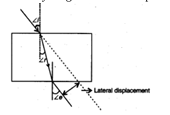
Image

$ii.$ The glass refractive index is defined as the ratio between the speed of light in the vacuum and the speed of light in the glass. Refractive index of glass $(n_g) =$ Speed of light in vacuum/speed of light in the glass.
$ n _{ g } =\frac{3 \times 10^8}{2 \times 10^3}$
$n _{ g } =1.5$
$iii P=\frac{1}{f(\text { inmeter })}$
$f=\frac{1}{P}=\frac{1}{2.5}=\frac{1}{-25}$
$\Rightarrow f=\frac{-100}{25} \ cm=-40 \ cm$
The focal length $(f)$ of a concave lens is always negative.
View full question & answer
Question 25 Marks
A student focussed the image of a candle flame on a white screen using a convex lens. He noted down the position of the candle screen and the lens as under Position of candle = 12.0 cm Position of convex lens = 50.0 cm Position of the screen = 88.0 cm
i. What is the focal length of the convex lens?
ii. Where will the image be formed if he shifts the candle towards the lens at a position of 31.0 cm?
iii. What will be the nature of the image formed if he further shifts the candle towards the lens?
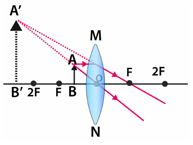
iv. Draw a ray diagram to show the formation of the image in case (iii) as said above.
Answer
Position of the candle flame = 12.0 cm
Position of the lens = 50cm
Position of the screen = 88cm
i u = 50 - 12 = 38c
Image distance v = 88 - 50 = 38cm
Focal length $=\frac{1}{v}-\frac{1}{u}=\frac{1}{u}$
f = 19 cm
ii. Object distance u50-3119 cm Here
Object distance = focal length Hence the image is formed at infinity.
iii. If he further shifts the candle towards the lens. The object comes between F and O. In this case. The image is virtual, enlarged and erect and is formed on the same side of the lens.
iv.Image
View full question & answer
Question 35 Marks
i. List three points of difference between nervous and hormonal mechanisms for control and coordination in animals.
ii. How are auxins related with the bending of plant shoot towards unidirectional light? Explain.
View full question & answer
Question 45 Marks
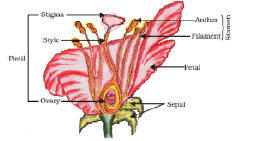
The labelled diagram of a flower is shown below:
Image

Using the above diagram, answer the following questions:
i. Where is the egg cell present in a flower?
ii. Which part of the flower produces pollen grains?
iii. What is the difference between a uni-sexual and a bisexual flower?
iv. What happens when a pollen grain falls on the stigma of the carpel?
v. How a zygote is formed in a flower?
Answer
i. The ovary contains ovules and each ovule has an egg cell.
ii. Stamen produces pollen grains that are yellowish in the colour.
iii. The unisexual flower contains either stamens or carpels whereas the bisexual flower contains both stamens and carpels.
iv. When a pollen grain falls on the stigma of the carpel, it bursts open and grows into a pollen tube downwards through the style towards the female gamete in the ovary.
v. The tip of the pollen tube bursts open and the male gamete comes out of the pollen tube that combines with the nucleus of the female gamete present in the ovule to form a fertilized egg called a zygote.
View full question & answer
Question 55 Marks
What are carboxylic acids? Give the common names, IUPAC names and structural formula of first four members of the homologous series.
Answer
Carboxylic acids are organic compounds containing carboxylic acid group:
COOH or
Image
Their general formula is CnH2n+1COOH or it may be written as RCOOH, where R is an alkyl group.
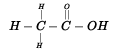
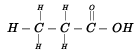
Members of the homologous series of carboxylic acids. The first four members of the homologous series of carboxylic acids are given ahead:
Molecular FormulaStructural FormulaCommon nameIUPAC name
HCOOHImageFormic acidMethanoic acid
$CH _3 COOH$ImageAcetic acidEthanoic acid
$C _2 H _5 COOH$ImagePropionic acidPropanoic acid
$C _3 H _7COOH$Imagen-Butyric acidButanoic acid
View full question & answer
Question 65 Marks
i. What is saponification? Differentiate between soaps and detergents on the basis of the following:
1. Their chemical composition
2. Their mechanism in hard water
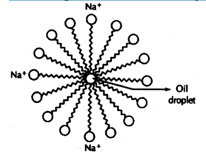
ii. Explain the formation of micelles between oily dirt and soap molecules. Also draw its diagram.
View full question & answer
[5 marks Questions] - Science STD 10 Questions - Vidyadip