Questions

[3 Mark Questions]

🎯

Test yourself on this topic

8 questions · timed · auto-graded

Question 13 Marks
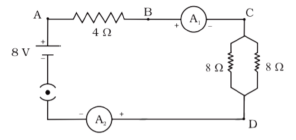
Find out the following in the electric circuit given in Figure
Image
i. The potential difference across 4Ω resistance
ii. The power dissipated in 4Ω resistor
Answer
Given :-
Resistor, $R _1=4 \Omega$
Resistor, $R _2=8 \Omega$
Resistor, $R _3=8 \Omega$
Potential Difference, $V =8$ volts.
i. The potential difference across $4 \Omega$ resistors, $V=I R=1 \times 4=4 V$
ii. Power dissipated in $4 \Omega$ resistors, $P = I ^2 R =(1 A)^2(4 \Omega)=4 W$
View full question & answer
Question 23 Marks
Calculate the total cost of running the following electrical devices in the month of September, if the rate of $1$ unit of electricity is $Rs.6.00.$
$i.$ Electric heater of $1000 W$ for $5$ hours daily.
$ii.$ Electric refrigerator of $400 W$ for $10$ hours daily.
Answer
$P_1=\frac{1000 W}{1000}=1\ kW$
$t_1=5 h$
$P_2=\frac{400 W}{1000}=0.4\ kW$
$t_2=10 h$
No. of days $n =30$
Energy consumed by heater: $
E_1=P_1 \times t_1 \times n$
$=1\ kW \times 5 h \times 30$
$=150\ kWh$
Energy consumed by refrigerator:
$E_2=P_2 \times t_2 \times n$
$=0.4\ kW \times 10 h \times 30$
$=120\ kWh$
Total energy $=(150+120)\ kWh =270\ kWh$
We know that $1\ kWh =1$ unit,
so $270\ kWh=270 \text { units }$
Cost of $1$ unit is $Rs. 6.00$
Total cost $=270 \times 6= Rs. 1620$
View full question & answer
Question 33 Marks
An object is kept at a distance of 18 cm, 20 cm and 30 cm, from a lens of power+5D. (i) In which case or cases would you get a magnified image? (ii) Which of the magnified image can we get on a screen? (b) List two widely used applications of a convex lens.
Answer
(i) Focal length = 1/power = 1/5D = 1/5m = 20cm
It is convex lens of focal length 20cm.
So, the Magnified image will be formed in all cases, 20cm is focus, 18 cm is on focal length, 22 cm and 30 cm is between focus
and focus and center of curvature. In all cases, magnified image is formed.
(ii) In case of 22 cm and 30 cm image formed is real and hence can be obtained on screen.
View full question & answer
Question 43 Marks
In a pea plant, find the contrasting trait if
i. the position of flower is terminal
ii. the flower is white in colour
iii. shape of pod is constricted
View full question & answer
Question 53 Marks
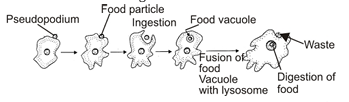
Explain nutrition in Amoeba.
Answer
Nutrition in Amoeba: Amoeba is omnivorous. i.e. it feeds on smaller animals, plants, micro-organisms and fragments of larger organisms. Nutrition is holozoic. Ingestion can occur at any place on the surface since a regular mouth is absent. Ingestion occurs through phagocytosis or engulfing the food particle in an invagination of the body. The engulfed food particle comes to lie inside a food vacuole. The latter is surrounded by a membrane.
Digestion: The digestion is intracellular and the food vacuoles act as temporary stomach for digestion.
Absorption: It occurs by diffusion and distribution takes place by cyclosis.
Assimilation: Assimilation of digested material occurs in a single cell.
Egestion: The undigested food is eliminated through the surface of the cell, where the food vacuole containing the undigested food bursts and discharges its contents to the outside.
Image
View full question & answer
Question 63 Marks
$i.$ An ore, on heating in air, give sulphur dioxide gas. Name the method in each metallurgical step, that will be required to extract this metal from its ore.
$ii.$ State which of the following reactions will take place or which will not, giving suitable reason for each?
$a.Zn ( s )+ CuSan _4( aq ) \rightarrow ZnSO _4( aq )+ Cu ( s )$
$b. Fe ( s )+ ZnSO _4( aq ) \rightarrow FeSO _4( aq )+ Zn ( s )$
Answer
$i)$ The ore is Cinnabar $(Hg_2S)$
Cinnabar is the ore of mercury $(Hg)$ which has low reactivity and can be reduced to mercury by heating alone. So to obtain mercury from cinnabar the only step required is heating strongly in the presence of oxygen called "Roasting". In the first step, cinnabar gets converted to mercuric oxide which on further heating is reduced to mercury.
$2 HgS ( s )+3 O _{2(g)}+ Heat -2 HgO ( s )+2 SO _2(g)$
$2 HgO +\text { Heat } \rightarrow 2 Hg ( l )+ O _2(g)$
$ii) a.$ This reaction will take place as $Zn$ is more reactive than $Cu,$ so $Zn$ will displace $Cu$ from its salt $CuSO_4$ and will form colourless $ZnSO_4$ solution and reddish brown particles $Cu$.
$b$. This reaction will not occur as $Fe$ is less reactive than $Zn,$ so it will not be able to displace $Zn$ from $ZnSO_4.$
View full question & answer
Question 73 Marks
What is the cause of the inertness of noble gas elements?
View full question & answer
Question 83 Marks
Pratyush took sulphur powder on a spatula and heated it. He collected the gas evolved by inverting a test tube over it.
What will be the action of gas on
$i.$ Dry litmus paper?
$ii.$ Moist litmus paper?
Write a balanced chemical equation for the reaction taking place.
Answer
The gas is sulphur$-$dioxide $(SO_2)$
$i.$ It will not react with dry litmus paper.
$ii.$ The gas will bleach moist litmus paper.
The balanced chemical equation is
$S + O _2 \xrightarrow{\text { heot }} SO _2$
View full question & answer
[3 Mark Questions] - Science STD 10 Questions - Vidyadip