Question 15 Marks
Discuss the important characteristics of covalent compounds.
Answer
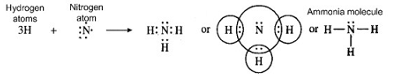
View full question & answer→1. Covalent compounds consist of molecules. Covalent compounds do not have any ions. Therefore, they consist of molecules. For example, $H _2, Cl _2, H _2 O , NH _3 etc$.
2. Covalent compounds are liquids or gases in nature. We have studied that the ionic compounds are crystalline solids. But only a few covalent compounds are solids (e.g. sugar, glucose, iodine). These are mostly liquids (water, ethyl alcohol) or gases (oxygen, hydrogen, ammonia) at room temperature. Actually, the attractive forces in covalent molecules are weak and these molecules are not as close lo one another as the ionic solids.
3. Covalent compounds have low melting and boiling points. As covalent molecules do not have ions, the attractive forces among them are weak. Therefore, the covalent molecules can be easily separated from each other. In other words, they have low melting and boiling points.
4. Covalent compounds do not conduct electricity. Covalent compounds normally do not conduct electricity. Some of them are poor conductors of electricity. The current is carried by the ions. As covalent compounds do not have ions, these are poor conductors of electricity.
5. Covalent compounds are insoluble in water. Covalent compounds generally do not dissolve in water. They are soluble in alcohol, ether, benzene etc. which are called organic solvents. However some of them such as ammonia and ethyl alcohol are water soluble.
2. Covalent compounds are liquids or gases in nature. We have studied that the ionic compounds are crystalline solids. But only a few covalent compounds are solids (e.g. sugar, glucose, iodine). These are mostly liquids (water, ethyl alcohol) or gases (oxygen, hydrogen, ammonia) at room temperature. Actually, the attractive forces in covalent molecules are weak and these molecules are not as close lo one another as the ionic solids.
3. Covalent compounds have low melting and boiling points. As covalent molecules do not have ions, the attractive forces among them are weak. Therefore, the covalent molecules can be easily separated from each other. In other words, they have low melting and boiling points.
4. Covalent compounds do not conduct electricity. Covalent compounds normally do not conduct electricity. Some of them are poor conductors of electricity. The current is carried by the ions. As covalent compounds do not have ions, these are poor conductors of electricity.
5. Covalent compounds are insoluble in water. Covalent compounds generally do not dissolve in water. They are soluble in alcohol, ether, benzene etc. which are called organic solvents. However some of them such as ammonia and ethyl alcohol are water soluble.