Questions

[2 Mark Questions]

🎯

Test yourself on this topic

8 questions · timed · auto-graded

Question 12 Marks
What happens to a beam of white light when it gets refracted through glass prism? Which colour deviates the most and the least after refraction through a prism? What is likely to happen if a second identical prism is placed in an inverted position with respect to the first prism. Justify your answer.
Answer
When white light is refracted through a glass prism, it gets split into its constituting colours at different angles. This phenomenon is called Dispersion of Light. Forming a rainbow,
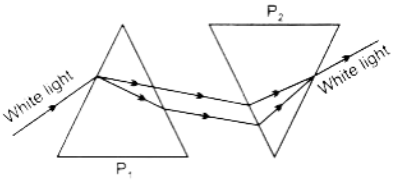
Image
Least deviated colour is red whereas most deviated colour is violet. When second identical prism is placed in an inverted position with respect to first prism, recombination of the spectrum will take place and white light will be obtained.
View full question & answer
Question 22 Marks
Mention the form of energy transfer, if a grasshopper is eaten by a frog.
Answer
In a food chain, if a grasshopper is eaten by a frog, then the energy transfer will be between primary consumer and secondary consumer.
Grasshopper feeds on producers, i.e. the grass and plants which starts the food chain. So, it occupies the level of primary consumer and stores energy in the form of biomass which is taken up by frog by eating grasshopper thus frog becomes the secondary consumer.
View full question & answer
Question 32 Marks
What is the role of decomposers in the ecosystem?
Answer
Decomposers include micro$-$organisms such as bacteria and fungi that obtain nutrients by breaking down the remains of dead plants and animals. They help in the breakdown of organic matter or biomass from the body of dead plants and animals into simple inorganic raw materials, such as $CO_2, H_2O,$ and some nutrients.
View full question & answer
Question 42 Marks
An object of size $7.0 \ cm$ is placed $27 \ cm$ in front of concave mirror of focal length $18 \ cm$. At what distance should the screen be placed so that a sharp focused image can be obtained? Find the size and nature of the image
Answer
$h_1=7 \ cm, u=-27 \ cm, v=$ ?, $f=-18 \ cm. ($concave mirror$)$
$\frac{1}{f}=\frac{1}{v}+\frac{1}{u}$, we have $\frac{1}{v}=\frac{1}{f}-\frac{1}{u}$
or $\frac{1}{v}=\frac{1}{(-18)}-\frac{1}{(-27)}=-\frac{1}{18}+\frac{1}{27}=\frac{-3+2}{54}=-\frac{1}{54}$
$m=-\frac{v}{u}=\frac{h_2}{h_1}$ or $\frac{(-54)}{(-27)}=\frac{h_2}{7}$
Now $-2=\frac{h_2}{7}$ or $h_2=-14 \ cm$
Negative sign of $h_2$ indicates that image is on the same side as that of the object. It is real, inverted and $14 \ cm$ in size.
View full question & answer
Question 52 Marks
State the function of Bowman's capsule and glomerulus.
Answer
Bowman's capsule and glomerulus have semipermeable walls. The glomerulus, is a tuft of capillaries contained in Bowman's capsule. The water and dissolved substances (wastes and useful) are filtered into the Bowman's capsule and from here they are sent into the tubule. Thus, both the structures act as filtering apparatus.
View full question & answer
Question 62 Marks
Why is diffusion insufficient to meet the oxygen requirements of multicellular organisms like humans?
Answer
In multi-cellular organisms like humans, various body parts have specialized in the functions they perform. All the cells with in different parts of human body need oxygen but all are not exposed to surrounding environment for intake of oxygen through diffusion. Therefore, process of diffusion is insufficient to meet the oxygen requirements of multi-cellular organisms like human.
View full question & answer
Question 72 Marks
What is the difference between internal & external fertilization?
Answer
• The internal fertilization process occurs within the body of female whereas, in external fertilization, fusion of sperm and egg occurs externally of the female body.
• After the internal fertilization, egg will come out of the body having a thick shell whereas, in external fertilization, eggs are produced with thin tertiary membrane or without membrane.
• External fertilization needs water, whereas internal fertilization does not need water to fertilize.
• Organisms involved in external fertilization have mobile male gametes with flagella, whereas organisms involved in internal fertilization has immobile male gametes.
• In internal fertilization, wastage of gametes is lower, whereas wastage of gametes is higher in external fertilization.
• Organisms that involved in internal fertilization produce lower number of gametes, whereas organisms involved in external fertilization produce a large number of gametes.
• Survival of organisms that involved in internal fertilization is higher than the survival of organisms involved in external fertilization.
View full question & answer
Question 82 Marks
What happens when ethanol reacts with
i. sodium
ii. potassium permanganate solution.
Answer
i. With sodium metal, sodium ethoxide is formed.
$2 CH _3 CH _2 OH +2 Na \longrightarrow 2 CH _3 CH _2 ONa + H _2$
ii. With alkaline potassium permanganate, ethanol is oxidised to ethanoic acid.
$CH _3 CH _2 OH +2[ O ] \xrightarrow{\frac{K M n O_4}{d i . H_2 SO _4}} CH _3 COOH + H _2 O$
View full question & answer
[2 Mark Questions] - Science STD 10 Questions - Vidyadip