Questions

case /data -based (4 Marks)

🎯

Test yourself on this topic

3 questions · timed · auto-graded

Question 14 Marks
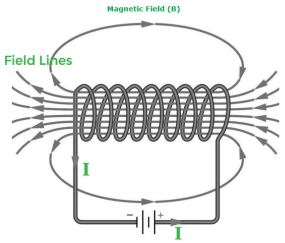
An insulated copper wire wound on a cylindrical cardboard tube such that its length is greater than its diameter is called a solenoid. When an electric current is passed through the solenoid, it produces a magnetic field around it. The magnetic field produced by a current-carrying solenoid is similar to the magnetic field produced by a bar magnet. The field lines inside the solenoid are in the form of parallel straight lines. The strong magnetic field produced inside a current-carrying solenoid can be used to magnetize a piece of a magnetic material like soft iron when placed inside the solenoid. The strength of the magnetic field produced by a current-carrying solenoid is directly proportional to the number of turns and strength of the current in the solenoid.
Image
(a) What would be the strength of the magnetic field inside a long current-carrying straight solenoid?
(b) Which end is north and which end is south pole when current flows through a solenoid?
(c) A long solenoid carrying a current produces a magnetic field B along its axis. If the current is double and the number of turns per cm is halved, then what will be the new value of the magnetic field?

OR

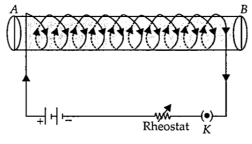
A soft iron bar is enclosed by a coil of insulated copper wire as shown in the figure. When the plug of the
key is closed, then where would the face B of the iron bar be marked?
Image
Answer
An insulated copper wire wound on a cylindrical cardboard tube such that its length is greater than its diameter is called a
solenoid. When an electric current is passed through the solenoid, it produces a magnetic field around it. The magnetic field
produced by a current-carrying solenoid is similar to the magnetic field produced by a bar magnet. The field lines inside the
solenoid are in the form of parallel straight lines. The strong magnetic field produced inside a current-carrying solenoid can be
used to magnetize a piece of a magnetic material like soft iron when placed inside the solenoid. The strength of the magnetic field produced by a current-carrying solenoid is directly proportional to the number of turns and strength of the current in the solenoid.

Image
(i) Magnetic field inside the infinite solenoid is uniform. Hence it is the same at all points
(ii) The end of the current carrying solenoid at which the current flows anti-clockwise behaves as a north pole while that end
at which the direction of current clockwise behaves as a south pole and this is according to clock wise.
(iii) For a long solenoid, magnetic field B $\propto$ In; where I is the flowing current and n is number of turns per unit length in the solenoid. Therefore, in the given case magnetic field will remain unchanged.

OR

For a solenoid, if we imagine gripping the solenoid with your right hand so that your curl fingers follow the direction of the current then your thumb will point towards the north end of the electromagnet.
View full question & answer
Question 24 Marks
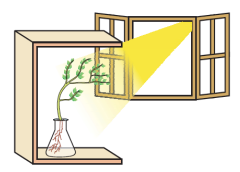
Fill a conical flask with water. Cover the neck of the flask with a wire mesh. keep two or three freshly germinated bean seeds on the wire mesh. Take a cardboard box which is open from one side. Keep the flask a wire mesh. Kin the box in such a manner that the open side of the box faces light coming from a window as shown in the given figure. After two or three days, you will notice that the shoots bend towards light and roots away from light. Now turn the flask so that the shoots are away from light and the roots towards the light. Leave it undisturbed in this condition for a few days. Plants show tropism in response to other stimuli as well. The roots of a plant always grow downwards while the shoots usually grow upwards and away from the earth. This
upward and downward growth of shoots and roots, respectively, in response to the pull of earth or gravity, is obviously, geotropism.

Image

(a) What has represented by the given activities?
(b) Do old parts of the shoot and root change direction? Is there any difference in the direction of the new growth?
(c) What can we conclude from this activity?

OR

What is geotropism?
Answer
Fill a conical flask with water. Cover the neck of the flask with a wire mesh. keep two or three freshly germinated bean seeds on
the wire mesh. Take a cardboard box which is open from one side. Keep the flask a wire mesh. Kin the box in such a manner that the open side of the box faces light coming from a window as shown in the given figure. After two or three days, you will notice that the shoots bend towards light and roots away from light. Now turn the flask so that the shoots are away from light and the roots towards the light. Leave it undisturbed in this condition for a few days. Plants show tropism in response to other stimuli as well. The roots of a plant always grow downwards while the shoots usually grow upwards and away from the earth. This upward and downward growth of shoots and roots, respectively, in response to the pull of earth or gravity, is obviously, geotropism.

Image

(i) These activities show tropic movements in plants due to their growth.
(ii) Yes, old parts of the shoot and root change direction and there is a difference in the direction of new growth.
(iii) Movement is related to stimulus i.e. plant organs either move towards the source of stimulus or away from it. Stimuli
that cause movements in plants are gravity, light, touch, water, and chemical substances.


View full question & answer
Question 34 Marks
Salt of a strong acid and strong base is neutral with a pH value of 7. NaCl common salt is formed by a combination of hydrochloride and sodium hydroxide solution. This is the salt that is used in food. Some salt is called rock salt, bed of rock salt was formed when seas of bygone ages dried up. The common salt thus obtained is an important raw material for various materials of daily use, such as sodium hydroxide, baking soda, washing soda, and bleaching powder.
(a). If given acids are phosphoric acid, carbonic acid, hydrochloric acid and sulphuric acid, then which acid
does not form an acidic salt?
(b). What is the formula of baking soda?

OR

Name the substance which on treatment with chlorine to obtain bleaching powder.
Answer
Salt of a strong acid and strong base is neutral with a pH value of 7. NaCl common salt is formed by a combination of
hydrochloride and sodium hydroxide solution. This is the salt that is used in food. Some salt is called rock salt, bed of rock salt
was formed when seas of bygone ages dried up. The common salt thus obtained is an important raw material for various materials of daily use, such as sodium hydroxide, baking soda, washing soda, and bleaching powder.
(i) Carbonic acid does not form an acidic salt.
(ii) Sodium bicarbonate, commonly known as baking soda or bicarbonate of soda, is a chemical compound with the formula NaHCO_3
OR
 $Ca ( OH )_2$ treatment with chlorine to obtain bleaching powder.
$Ca ( OH )_2+ Cl _2 \longrightarrow CaOCl _2+ H _2 O$
View full question & answer
case /data -based (4 Marks) - Science STD 10 Questions - Vidyadip