Question 14 Marks
An insulated copper wire wound on a cylindrical cardboard tube such that its length is greater than its diameter is called a solenoid. When an electric current is passed through the solenoid, it produces a magnetic field around it. The magnetic field produced by a current-carrying solenoid is similar to the magnetic field produced by a bar magnet. The field lines inside the solenoid are in the form of parallel straight lines. The strong magnetic field produced inside a current-carrying solenoid can be used to magnetize a piece of a magnetic material like soft iron when placed inside the solenoid. The strength of the magnetic field produced by a current-carrying solenoid is directly proportional to the number of turns and strength of the current in the solenoid.
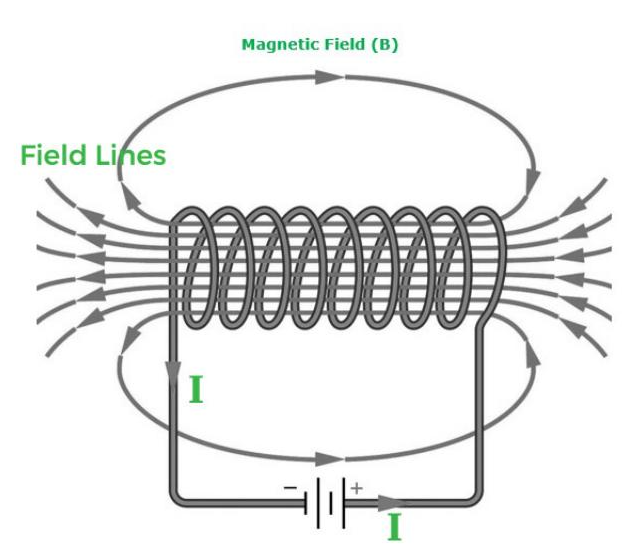
i. What would be the strength of the magnetic field inside a long current-carrying straight solenoid?
ii. Which end is north and which end is south pole when current flows through a solenoid?
iii. A long solenoid carrying a current produces a magnetic field B along its axis. If the current is double and the number of turns per cm is halved, then what will be the new value of the magnetic field?
OR
A soft iron bar is enclosed by a coil of insulated copper wire as shown in the figure. When the plug of the key is closed, then where would the face B of the iron bar be marked?
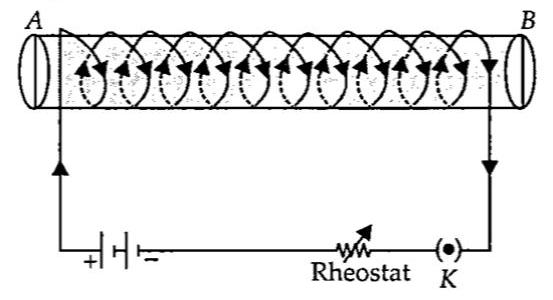
i. What would be the strength of the magnetic field inside a long current-carrying straight solenoid?
ii. Which end is north and which end is south pole when current flows through a solenoid?
iii. A long solenoid carrying a current produces a magnetic field B along its axis. If the current is double and the number of turns per cm is halved, then what will be the new value of the magnetic field?
OR
A soft iron bar is enclosed by a coil of insulated copper wire as shown in the figure. When the plug of the key is closed, then where would the face B of the iron bar be marked?
Answer
View full question & answer→ i. Magnetic field inside the infinite solenoid is uniform. Hence it is the same at all points.
ii. The end of the current carrying solenoid at which the current flows anti-clockwise behaves as a north pole while that end at which the direction of current clockwise behaves as a south pole and this is according to clock wise.
iii. For a long solenoid, magnetic field ${B} \propto {In}$; where I is the flowing current and n is number of turns per unit length in the solenoid. Therefore, in the given case magnetic field will remain unchanged.
OR
For a solenoid, if we imagine gripping the solenoid with your right hand so that your curl fingers follow the direction of the current then your thumb will point towards the north end of the electromagnet.
ii. The end of the current carrying solenoid at which the current flows anti-clockwise behaves as a north pole while that end at which the direction of current clockwise behaves as a south pole and this is according to clock wise.
iii. For a long solenoid, magnetic field ${B} \propto {In}$; where I is the flowing current and n is number of turns per unit length in the solenoid. Therefore, in the given case magnetic field will remain unchanged.
OR
For a solenoid, if we imagine gripping the solenoid with your right hand so that your curl fingers follow the direction of the current then your thumb will point towards the north end of the electromagnet.