Question 15 Marks
i. Draw the structure of the following compounds:
a. Butanoic acid
b. Chloropentane
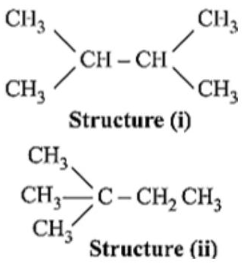
ii. How are structure (i) and structure (ii) given below related to one another? Give reason to justify your answer.
Draw one more possible structure for above case.
iii. Differentiate between saturated and unsaturated carbon compounds on the basis of their general formula.
a. Butanoic acid
b. Chloropentane
ii. How are structure (i) and structure (ii) given below related to one another? Give reason to justify your answer.
Draw one more possible structure for above case.
iii. Differentiate between saturated and unsaturated carbon compounds on the basis of their general formula.
Answer
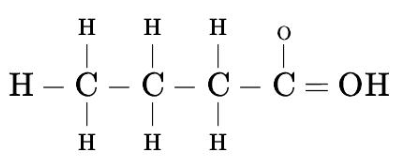
View full question & answer→i. a. Structure of butanoic acid ( $\mathrm{C}_{3} \mathrm{H}_{7} \mathrm{COOH}$ )
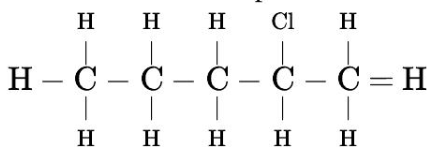
b. Structure of Chloropentane
ii. Structure (i) is 2,3-dimethylbutane, whereas Structure (ii) is 2,2-dimethylbutane. Both are isomers of the compound with the chemical formula $\mathrm{C}_{6} \mathrm{H}_{14}$.
iii. Unsaturated carbon compounds always follow the general formula $\mathrm{C}_{\mathrm{n}} \mathrm{H}_{2 \mathrm{n}}$ if there is a carbon-carbon double bond and formula $\mathrm{C}_{\mathrm{n}} \mathrm{H}_{2 \mathrm{n}-2}$ if there is a carbon-carbon triple bond. Saturated carbon compounds always follow the general formula $\mathrm{C}_{\mathrm{n}} \mathrm{H}_{2 \mathrm{n}+2}$.
b. Structure of Chloropentane
ii. Structure (i) is 2,3-dimethylbutane, whereas Structure (ii) is 2,2-dimethylbutane. Both are isomers of the compound with the chemical formula $\mathrm{C}_{6} \mathrm{H}_{14}$.
iii. Unsaturated carbon compounds always follow the general formula $\mathrm{C}_{\mathrm{n}} \mathrm{H}_{2 \mathrm{n}}$ if there is a carbon-carbon double bond and formula $\mathrm{C}_{\mathrm{n}} \mathrm{H}_{2 \mathrm{n}-2}$ if there is a carbon-carbon triple bond. Saturated carbon compounds always follow the general formula $\mathrm{C}_{\mathrm{n}} \mathrm{H}_{2 \mathrm{n}+2}$.