Question 15 Marks
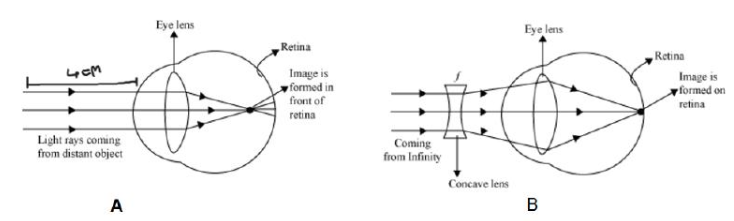
i. A person suffering from myopia (near-sightedness) was advised to wear the corrective lens of power -2.5 D . A spherical lens of the same focal length was taken in the laboratory. At what distance should a student place an object from this lens so that it forms an image at a distance of 10 cm from the lens?
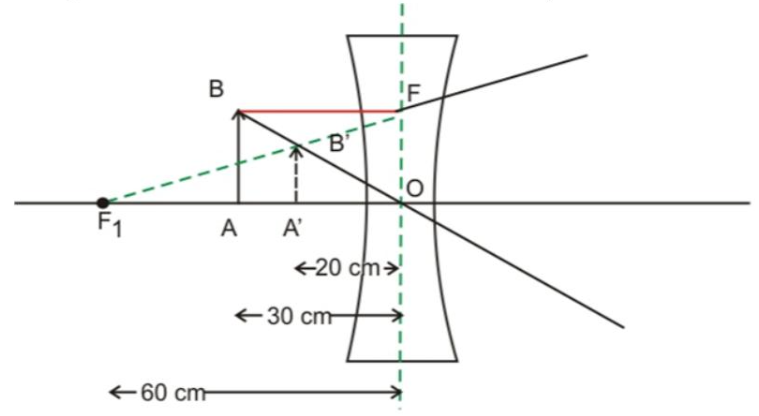
ii. Draw a ray diagram to show the position and nature of the image formed in the above case.
ii. Draw a ray diagram to show the position and nature of the image formed in the above case.
Answer
View full question & answer→i. Given:
distance of image from the lens, $\mathrm{i}=10 \mathrm{~cm}$
power of the lens, $\mathrm{P}=-25 \mathrm{D}$
Now the focus of the lens:
$P=\frac{1}{f}$
where:
$\mathrm{f}=$ focal length
$-25=\frac{1}{f}$
$\mathrm{f}=-0.04 \mathrm{~m}=-4 \mathrm{~cm}$
From the equation of lens:
$\frac{1}{f}=\frac{1}{i}+\frac{1}{o}$
where:
o = distance of the object
$-\frac{1}{4}=\frac{1}{10}+\frac{1}{o}$
$\rho=-\frac{20}{7} \mathrm{~cm}$ i.e. negative sign means that the image formed is on the same side as that of the object.
ii.
distance of image from the lens, $\mathrm{i}=10 \mathrm{~cm}$
power of the lens, $\mathrm{P}=-25 \mathrm{D}$
Now the focus of the lens:
$P=\frac{1}{f}$
where:
$\mathrm{f}=$ focal length
$-25=\frac{1}{f}$
$\mathrm{f}=-0.04 \mathrm{~m}=-4 \mathrm{~cm}$
From the equation of lens:
$\frac{1}{f}=\frac{1}{i}+\frac{1}{o}$
where:
o = distance of the object
$-\frac{1}{4}=\frac{1}{10}+\frac{1}{o}$
$\rho=-\frac{20}{7} \mathrm{~cm}$ i.e. negative sign means that the image formed is on the same side as that of the object.
ii.