Questions

M.C.Q-[Che-1M]

🎯

Test yourself on this topic

7 questions · timed · auto-graded

MCQ 11 Mark
Plaster of Paris hardens by
  • A
    Passing of $\mathrm{CO}_{2}$ gas
  • B
    Changing into $\mathrm{CaCO}_{3}$
  • Combining with water
  • D
    Releasing out a molecule of water
Answer
Correct option: C.
Combining with water
(C) Combining with water
Explanation :
When water is added to the Plaster of Paris, it sets into a hard mass due to its hydration to form crystals of gypsum.
$\mathrm{CaSO}_{4} \cdot \frac{1}{4} \mathrm{H}_{2} \mathrm{O}+1 \frac{1}{2} \mathrm{H}_{2} \mathrm{O} \rightarrow \mathrm{CaSO}_{4} \cdot 2 \mathrm{H}_{2} \mathrm{O}$
View full question & answer
MCQ 21 Mark
The correct formula of ethanol is:
  • A
    $\mathrm{C}_{2} \mathrm{H}_{6} \mathrm{OH}$
  • $\mathrm{C}_{2} \mathrm{H}_{5} \mathrm{OH}$
  • C
    $\mathrm{CH}_{3} \mathrm{OH}$
  • D
    $\mathrm{CH}_{3} \mathrm{CH}_{2} \mathrm{CH}_{2} \mathrm{OH}$
Answer
Correct option: B.
$\mathrm{C}_{2} \mathrm{H}_{5} \mathrm{OH}$
(B) $\mathrm{C}_{2} \mathrm{H}_{5} \mathrm{OH}$
Explanation :
$\mathrm{C}_{2} \mathrm{H}_{5} \mathrm{OH}$
View full question & answer
MCQ 31 Mark
Match the following with the correct response :
Column AColumn B
(i) Ionic bond(a) $\mathrm{NH}_{3}$
(ii) Polar covalent bond(b) $\mathrm{C}_{60}$
(iii) Non-polar bond(c) $\mathrm{N}_{2}$
(iv) Fullerene(d) NaCl
  • A
    (i) - (c), (ii) - (b), (iii) - (d), (iv) - (a)
  • (i) - (d), (ii) - (a), (iii) - (c), (iv) - (b)
  • C
    (i) - (b), (ii) - (d), (iii) - (a), (iv) - ©
  • D
    (i) - (a), (ii) - (c), (iii) - (b), (iv) - (d)
Answer
Correct option: B.
(i) - (d), (ii) - (a), (iii) - (c), (iv) - (b)
(B) (i) - (d), (ii) - (a), (iii) - (c), (iv) - (b)
Explanation :
- NaCl has ionic bonds between the sodium ion and the chloride ion.
- Ammonia has polar covalent bonds between the nitrogen atom and hydrogen atoms.
- Nitrogen molecule has non-polar covalent bonds between the two nitrogen atoms since the two atoms are alike.
- $\mathbf{C}_{\mathbf{6 0}}$ is a member of fullerenes (Allotropes of carbon). Buckminsterfullerene contains a cluster of 60 carbon atoms joined together to form spherical molecules.
View full question & answer
MCQ 41 Mark
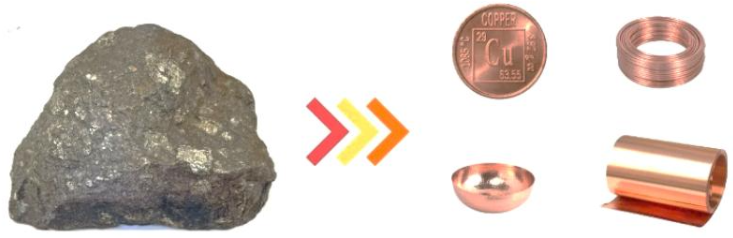
The slag obtained during the extraction of copper pyrites is composed mainly of :
Image
  • A
    $\mathrm{CuSiO}_{3}$
  • B
    $\mathrm{SiO}_{2}$
  • C
    $\mathrm{Cu}_{2} \mathrm{~S}$
  • $\mathrm{FeSiO}_{3}$
Answer
Correct option: D.
$\mathrm{FeSiO}_{3}$
(D) $\mathrm{FeSiO}_{3}$
Explanation :
The sulphide ore of copper-containing iron is mixed with silica before heating in a reverberatory furnace. Iron oxide forms a slag of iron silicate $\left(\mathrm{FeSiO}_{3}\right)$.
The reaction is: $\mathrm{FeO}+\mathrm{SiO}_{2} → \mathrm{FeSiO}_{3}$
View full question & answer
MCQ 51 Mark
The melting point of NaCl is:
  • A
    1047 K
  • B
    100 K
  • C
    1000 K
  • 1074 K
Answer
Correct option: D.
1074 K
(D) 1074 K
Explanation :
The melting point of NaCl is $801^{\circ} \mathrm{C}$ or 1074 K .
View full question & answer
MCQ 61 Mark
Soap doesn't work well with woollen garments because :
A. It is basic in nature and woollen garments have acidic dyes.
B. It is acidic in nature and woollen garments have basic dyes.
  • (A)
  • B
    (B)
  • C
    None of these
  • D
    Both (A) and (B)
Answer
Correct option: A.
(A)
(A) (A)
Explanation :
Soap is basic in nature. Acid dyes are used to dye protein fibres such as silk, wool, angora, mohair, feathers, etc. Hence, soap doesn't work well with woolen garments. The soap gets neutralized by the acidic dyes.
View full question & answer
MCQ 71 Mark
When sodium hydrogen carbonate is added to ethanoic acid a gas evolves.
Consider the following statements about the gas evolved?
A. It turns lime water milky.
B. It is evolved with a brisk effervescence.
C. It has a smell of burning sulphur.
D. It is also a by-product of respiration.
The correct statements are:
  • A
    (B) and (D) only
  • B
    (A) and (B) only
  • (A), (B) and (D)
  • D
    (A), (C) and (D)
Answer
Correct option: C.
(A), (B) and (D)
(C) (A), (B) and (D)
Explanation :
(A), (B) and (D)
View full question & answer
M.C.Q-[Che-1M] - Science STD 10 Questions - Vidyadip