Questions

[5 marks Questions]

🎯

Test yourself on this topic

6 questions · timed · auto-graded

Question 15 Marks
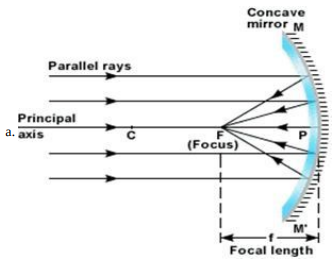
$a.$ Draw a ray diagram for showing the convergence of a parallel beam of light by a concave mirror and mark the
positions of pole and the centre of curvature in it
$b. $ An object $4 \ cm$ in size is placed at $25 \ cm$ in front of a concave mirror of focal length $15 \ cm.$ At what distance
from the mirror should a screen be placed in order to obtain a sharp image? Find the nature and size of the image.
$c.$ List any two uses of a concave mirror
Answer
$a.$Image

$b.$ Given that $f =-15 \ cm ; u =-25 \ cm ; h _{ o }=4 \ cm ; v = ?$
The mirror formula is
$\frac{1}{f}=\frac{1}{u}+\frac{1}{v}$
$\frac{1}{-15}=\frac{1}{-25}+\frac{1}{v}$
$\frac{1}{v}=\frac{1}{25}-\frac{1}{15}$
$\frac{1}{v}=\frac{3-5}{75}=\frac{-2}{75}$
$\Rightarrow v =-37.5 \ cm$
The screen should be placed $37.5 \ cm$ from the people of mirror and the image is real.
magnification
$m=\frac{h_i}{h_o}=\frac{-v}{u}$
$\frac{h_i}{4}=\frac{-(-37.5)}{-25}$
$\Rightarrow h_i=-\frac{37.5}{25} \times 4=-6 \ cm$
So the image is enlarged and inverted
$c.$ Uses of concave mirror:
It is used as a shaving mirror.
It is used as reflector in torch, head light of automobiles etc.
View full question & answer
Question 25 Marks
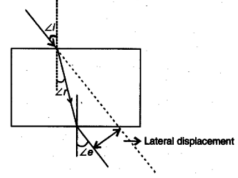
$i.$ Draw a labelled ray diagram to show the path of a ray of light incident obliquely on one face of a glass slab.
$ii.$ Calculate the refractive index of the material of a glass slab. Given that the speed of light through the glass
slab is $2 \times 10^8\ m / s$ and in air is $3 \times 10^8\ m / s$.
$iii.$ Calculate the focal length of a lens, if its power is $- 2.5 D.$
Answer
$i.$ The ray diagram shows the path of a ray of light incident obliquely on one face of a glass slab:
Image
$ii.$ The glass refractive index is defined as the ratio between the speed of light in the vacuum and the speed of light in the glass.
Refractive index of glass $(ng) =$ Speed of light in vacuum/speed of light in the glass.
$ n _{ g }=\frac{3 \times 10^8}{2 \times 10^8}$
$n _{ g }=1.5$
$iii. P =\frac{1}{f(\text { inmeter })}$
$f =\frac{1}{P}=\frac{1}{2.5}=\frac{1}{-25}$
$\Rightarrow f =\frac{-1000}{25} \ cm=-40 \ cm$
The focal length $(f)$ of a concave lens is always negative.
View full question & answer
Question 35 Marks
Why do we call pituitary gland as the master gland? Where is it located and what are its functions?
Answer
The pituitary gland has three lobes that secretes various hormones. It regulates various functions of the body i.e. growth,
metabolism, sexual development and system of reproduction. It also controls the functioning of the other endocrine glands. Hence, it is called the master endocrine gland.
Location: Pituitary gland is about the size of a pea and is located in the centre of brain, just below the hypothalamus. It is also
known as hypophysis.
Pituitary gland secretes five important hormones. The important hormones secreted by pituitary gland and their functions are
listed below:
i. Growth hormone regulates the growth and development of bones and muscles.
ii. Tropic hormone regulates the secretion from other endocrine glands.
iii. Prolactin hormone regulates the function of mammary glands in females.
iv. Vasopressin hormone regulates water and electrolyte balance in the body.
v. Oxytocin hormone regulates the ejection of milk during lactation.
View full question & answer
Question 45 Marks
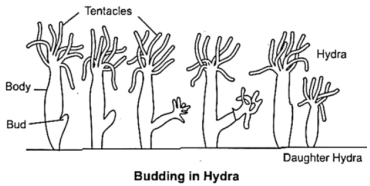
With the help of suitable diagrams explain the various steps of budding in Hydra.
Image
Answer
Budding is a form of asexual reproduction and is the process of production of new individual from an outgrowth called bud formed on the parent body. Regenerative cells present in Hydra are used for budding. Due to repeated mitotic divisions an outgrowth called bud develops from the parent body which enlarges in size and finally develops into a small hydra. After attaining suitable maturity the offspring get detached from the parent body and become an independent individuals.
View full question & answer
Question 55 Marks
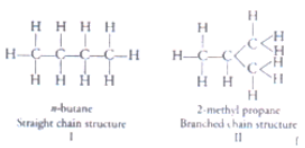
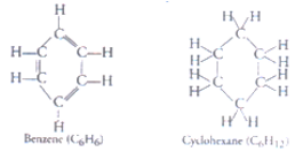
Define structural isomer and draw the isomeric structures of butane. Compare the structure of benzene and cyclohexane by drawing them.
Answer
Compounds having same molecular formula but different structural formula are called structural isomers. e.g. butane $\left( C _4 H _{10}\right)$ shows the following two structural isomers. One of which is straight chain n-butane and other is iso-butane.

Image

Structure of benzene and cyclohexane are:

Image

Benzene $\left( C _6 H _6\right)$ has six C-atoms and six H-atoms, it contains three double bonds alternately between two Carbon atoms and each carbon atoms bonds with one hydrogen. Cyclohexane $\left( C _6 H _{12}\right) $ has six C-atoms each possessing two H-atoms, thus, 12 H-atoms in total. It does not consist of any double bond it is saturated compound.
View full question & answer
Question 65 Marks
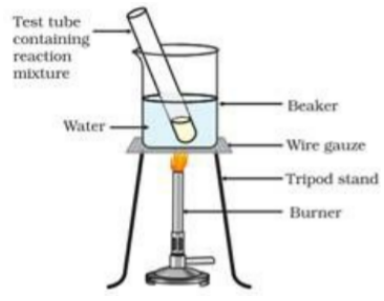
Esters are sweet-smelling substances and are used in making perfumes. Suggest some activity and the reaction involved for the preparation of an ester with a well-labeled diagram.
Answer
i. Take 1 mL ethanol and 1 mL glacial acetic acid along with a few drops of concentrated sulphuric acid in a test tube.
ii. Warm the contents in a water bath for at least 5 min.
iii. Pour into a beaker containing 20-50 mL of water and smell the resulting mixture.
iv. The sweet smell would be observed.

Image

The reaction can be given by the following equation:

Image
View full question & answer
[5 marks Questions] - Science STD 10 Questions - Vidyadip