Questions

[2 Mark Questions]

🎯

Test yourself on this topic

4 questions · timed · auto-graded

Question 12 Marks
Trace the sequence of events which occur when a bright light is focused on your eyes.
Answer
Receptor Cells of eyes/retina $\rightarrow$ Sensory Neuron $\rightarrow$ Brain / CNS $\rightarrow$ Motor Neuron $\rightarrow$ Eye Muscles $\rightarrow$ Pupil contracts / Eye lids close/blink
View full question & answer
Question 22 Marks
List two reasons to show that the existence of decomposers is essential in an ecosystem.
Answer
Microorganisms like bacteria and fungi which helps in the breakdown of organic matter or biomass of dead plants and animals into simple inorganic raw materials and replenish the environment are termed as decomposers. Their existence is thus, essential in an ecosystem because
i. They help in the natural replenishment of soil.
ii. They help in keeping the environment clean as they reduce environmental pollution.
View full question & answer
Question 32 Marks
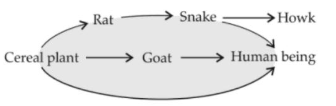
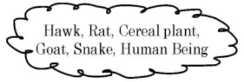
i. From the following group of organisms create a food chain which is the most advantageous for Human beings in terms of energy.
Image
ii. State the possible disadvantage if the cereal plant is growing in soil rich in pesticides.
iii. Construct a food web using the organisms mentioned above.
View full question & answer
Question 42 Marks
i. What is meant by pollination?
ii. Name and differentiate between the two modes of pollination in flowering plants.
Answer
Pollination is the process of the transfer of pollen grains from the anther to the stigma of the flower. Which is achieved by the help of either biotic or abiotic factors. Such as insects (entomophily), wind (anemophily), water (hydrophily) etc. Agent are known as pollinators.
There are two modes of pollination in flowering plants:
i. Self-pollination
ii. Cross-pollination
Difference between self-pollination and cross-pollination are:
Self-pollinationCross-pollination
In this, the pollen grain from the stamen of a flower is transferred to the stigma of the same flower which is Autogamy.
Also, pollen grains from the stamen of one flower is transferred to the stigma of another flower of the same plant which is known as Geitonogamy.
In this, the pollen grain from the stamen of a flower is transferred to the stigma of a different flower. Which is known as Xenogamy.
Which leads to development of new variety.
View full question & answer
[2 Mark Questions] - Science STD 10 Questions - Vidyadip