Questions

Answer the questions.[Phy-2M]

🎯

Test yourself on this topic

3 questions · timed · auto-graded

Question 12 Marks
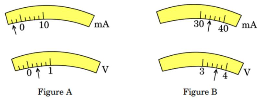
The rest position of the needles in a milliammeter and voltmeter, not in use, are as shown in Figure A. When a student uses these instruments in his experiment, the readings of the needles are in the positions shown in Figure B. Determine the correct values of current and voltage the student should use in his calculations.
Image
Answer
The correct values of current and voltage the student should use in his calculations are $38 \mathrm{~mA}, 3.2 \mathrm{~V}$
View full question & answer
Question 22 Marks
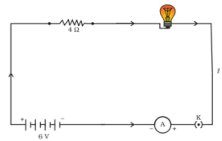
An electric lamp, whose resistance is $20 \Omega$, and a conductor of $4 \Omega$ resistance are connected to a 6 V battery. Draw the circuit diagram. Calculate (a) the total resistance of the circuit, and (b) the current through the circuit.
Answer
Figure: An electric lamp connected in series with a resistor of $4 \Omega$ to a 6 V battery.
Image
a. The resistance of electric lamp, $\mathrm{R} 1=20 \Omega$,
The resistance of the conductor connected in series, $\mathrm{R} 2=4 \Omega$.
Then the total resistance in the circuit $\mathrm{R}=\mathrm{R} 1+\mathrm{R} 2 \mathrm{Rs}=20 \Omega+4 \Omega=24 \Omega$.
The total potential difference across the two terminals of the battery $\mathrm{V}=6 \mathrm{~V}$.
b. Now by Ohm's law, the current through the circuit is given by $\mathrm{I}=\mathrm{V} / \mathrm{Rs}=6 \mathrm{~V} / 24 \Omega=0.25 \mathrm{~A}$.

View full question & answer
Question 32 Marks
A teacher gives a convex lens and a concave mirror of focal length of 20 cm each to his student and asks him to find their focal lengths by obtaining the image of a distant object. The student uses a distant tree as the object and obtains its sharp image, one by one, on a screen. The distances $\mathrm{d}_{1}$ and $\mathrm{d}_{2}$ between the lens/mirror and the screen in the two cases and the nature of their respective sharp images are likely to be
a. ( $20 \mathrm{~cm}, 40 \mathrm{~cm}$ ) and (erect and erect)
b. ( $20 \mathrm{~cm}, 40 \mathrm{~cm}$ ) and (inverted and inverted)
c. ( $20 \mathrm{~cm}, 20 \mathrm{~cm}$ ) and (inverted and inverted)
d.( $20 \mathrm{~cm}, 40 \mathrm{~cm}$ ) and (erect and inverted)
Give reason for your answer.
Answer
(c) ( $20 \mathrm{~cm}, 20 \mathrm{~cm}$ ) and (inverted and inverted)
Reason: Only real and inverted image can be obtained on the screen.
View full question & answer
Answer the questions.[Phy-2M] - Science STD 10 Questions - Vidyadip