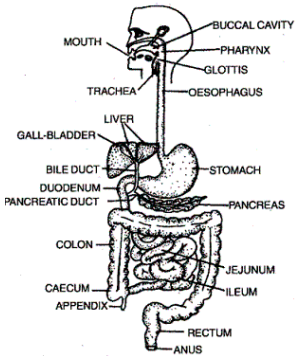
Mammalian (human) alimentary canal comprises mouth, buccal cavity, pharynx, oesophagus, stomach, small intestine
(duodenum, jejunum and ileum), large intestine (caecum, colon and rectum) and anus.
Digestive glands include salivary glands, gastric glands, intestinal glands, liver and pancreas.
Buccal cavity contains teeth and tongue, and receive saliva from 3 pairs of salivary glands (parotid, submaxillary, sublingual).
Teeth are meant for cutting and mastication of food. Teeth are the codent, heterodont and diphyodont.
Buccal cavity of man: The mouth is a slit-like aperture bounded by two lips. It leads to buccal cavity. Its roof is formed of hard
palate, continues as soft palate, and hangs as uvula. The sides of buccal cavity are formed by cheeks. At the floor is present a
musculo-sensory organ called tongue.
The oral cavity is supported by bones of jaws. The oral cavity contains the glands, tongue and teeth.
Pharynx: It is a vertical tube. It is a cross passage for food and air. It has uvula and epiglottis which closes the internal nares and glottis respectively during swallowing of food to ensure the passage of food into oesophagus (food pipe).
Oesophagus: It is 25 cm long narrow muscular straight tube. It runs downward through the chest behind heart and passes through the diaphragm into the abdomen. Here, it opens into stomach. Oesophagus propels the swallowed food into stomach.
Stomach of man: It is a sac-like structure situated in the upper part of abdominal cavity below the diaphragm. Large part of this
sac is situated left of the median line. The stomach is divisible into three parts namely cardiac, fundus or body and pylorus. At the junction of stomach and duodenum is a pyloric constriction having pyloric sphincter.
Small intestine: It is the longest part of alimentary canal. It is thin walled and highly coiled tubular structure. It is about 3-3.5
metres long and occupies most part of abdominal cavity . It is coiled upon itself. It is differentiated into three regions, viz.
duodenum, jejunum and ileum.
Duodenum is 25 cm long C-shaped. It receives the opening of bile-pancreatic duct. It also receives the opening of stomach.
Jejunum is 90 cm long. It lies above and left beyond duodenum.
Ileum is 180 cm long. Its inner lining is thrown into numerous villi.
Large intestine: The large intestine is about 1.5 metres long. It is divided into following parts, ie. the vermiform appendix, the
colon and the rectum. Caecum is blind tube and represented by vermiform appendix (5-8 cms) and is present below the junction of small and large intestine. Rectum is the last part and opens to outside by anus guarded by anal sphincter.