Questions

case /data -based (4 Marks)

🎯

Test yourself on this topic

3 questions · timed · auto-graded

Question 14 Marks
A student fixes a sheet of white paper on a drawing board using some adhesive materials. She places a bar magnet in the centre of it and sprinkles some iron filings uniformly around the bar magnet using a salt-sprinkler. On tapping the board gently, she observes that the iron filings have arranged themselves in a particular pattern.
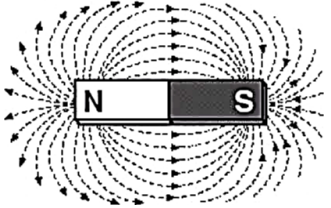
(a) Draw a diagram to show this pattern of iron filings.
(b) Draw the magnetic field lines of a bar magnet showing the poles of the bar magnet as well as the direction of the magnetic field lines.
(c) How is the direction of magnetic field at a point determined using the field lines? Why do two magnetic field lines not cross each other?OR
How are the magnetic field lines of a bar magnet drawn using a small compass needle? Draw one magnetic field line each on both sides of the magnet.
Answer
A student fixes a sheet of white paper on a drawing board using some adhesive materials. She places a bar magnet in the centre of it and sprinkles some iron filings uniformly around the bar magnet using a salt-sprinkler. On tapping the board gently, she observes that the iron filings have arranged themselves in a particular pattern.
(i)
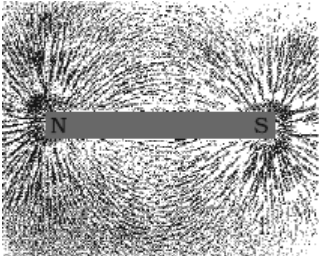
Image

(ii)
Image

(iii). he direction of a magnetic field at a point is determined by placing a small compass needle. The N - pole of compass indicates the direction of magnetic field at that point.
If magnetic field lines intersect each other, then at the intersection point there will be two directions of the same field which is not possible.

OR

Magnetic field lines can be drawn by moving a small compass from point to point around a magnet. At each point, draw a short line in the direction of the compass needle. Joining the points together reveals the path of the magnetic field lines.
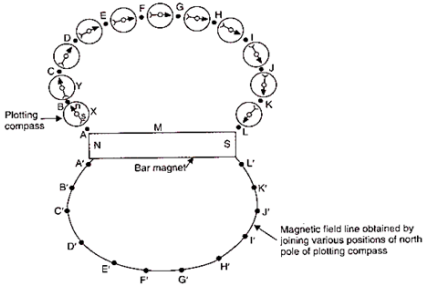
Image
View full question & answer
Question 24 Marks
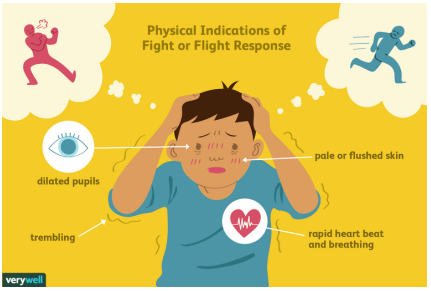
Adrenaline is secreted directly into the blood and carried to different parts of the body. The target organs or the specific tissues on which it acts include the heart. As a result, the heart beats faster, resulting in the supply of more oxygen to our muscles. The blood to the digestive system and skin is reduced due to contraction of muscles around small arteries in these organs. This diverts the blood to our skeletal muscles. The breathing rate also increases because of the contractions of the diaphragm and the rib muscles. All these responses together enable the animal body to be ready to deal with the situation. Such animal hormones are part of the endocrine
system which constitutes the second way of control and coordination in our body.

Image

(a) How does chemical coordination take place in animals ?
(b) Which hormone is called an emergency hormone?
(c) Where are the adrenal gland present in our body?

OR

How does our body respond when adrenaline is secreted into the blood ?
Answer
Adrenaline is secreted directly into the blood and carried to different parts of the body. The target organs or the specific tissues on
which it acts include the heart. As a result, the heart beats faster, resulting in the supply of more oxygen to our muscles. The blood
to the digestive system and skin is reduced due to contraction of muscles around small arteries in these organs. This diverts the
blood to our skeletal muscles. The breathing rate also increases because of the contractions of the diaphragm and the rib muscles.
All these responses together enable the animal body to be ready to deal with the situation. Such animal hormones are part of the endocrine system which constitutes the second way of control and coordination in our body.

Image
(i) In animals, chemical coordination is achieved through the agency of hormones which function as chemical messengers. Different plant hormones help to coordinate growth, development, and responses to the environment.
(ii) Adrenaline hormone is called an emergency hormone. Adrenaline hormone is released into the blood from the adrenal gland during stimulation of the nervous system.
(iii)The adrenal gland is present on the upper side of each kidney in our body.
OR
Adrenaline hormone is secreted in small amounts all the time. But in large amounts, it is secreted when a person is frightened. It increases the rate of heartbeat and breathing, raises blood pressure and allows more glucose go into the blood to give us a lot of energy so as to quickly fight or run away from the frightening situation. 
View full question & answer
Question 34 Marks
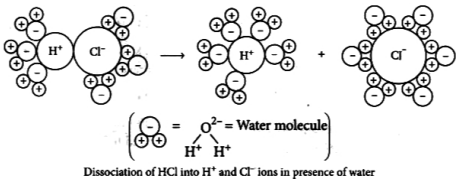
The acidic behaviour of acids is due to the presence of hydrogen $\left( H ^{+}\right)$ ions in them. They produce hydrogen ions in the presence of water. Water is a polar solvent and this property of water helps in weakening the bond between the ions and makes them soluble.
Hence, acids and bases produce ions in aqueous solutions. It may be noted that a dry $\text{HCl}$ gas or a solution of hydrogen chloride in organic, non $-$ polar solvents like toluene or benzene do not show acidic properties. This is because hydrogen chloride does not undergo ionization in toluene.
The reason why $\text{HCl}$ splits into $H ^{+}$ and $Cl ^{-}$ ions in presence of water lies in the fact that water molecules, being
polar, pull the $H ^{+}$ and $Cl ^{-}$ ons apart and thus, the bond in $\text{HCl}$ is broken.

Image

$(a)$ Which acids are present in bee sting?
$(b)$. If the $pH$ of a solution is $8,$ then find its $\left[ H ^{+}\right]$ ion.
OR
If you are given water, Hydrochloric acid, and Acetic acid, then mention increasing the order of acid strength.
Answer
The acidic behaviour of acids is due to the presence of hydrogen $\left( H ^{+}\right)$ ions in them. They produce hydrogen ions in the presence of water.
Water is a polar solvent and this property of water helps in weakening the bond between the ions and makes them soluble.
Hence, acids and bases produce ions in aqueous solutions. It may be noted that a dry $\text{HCl}$ gas or a solution of hydrogen chloride in
organic, non $-$ polar solvents like toluene or benzene do not show acidic properties.
This is because hydrogen chloride does not
undergo ionization in toluene.
The reason why $\text{HCl}$ splits into $H ^{+}$ and $Cl ^{-}$ ions in presence of water lies in the fact that water molecules, being polar, pull the $H ^{+}$ and $Cl ^{-}$ ions apart and thus, the bond in $\text{HCl}$ is broken.
Image
$(i)$ Formic acid is the common name for methanoic acid and it is present in a bee stings.
$(ii)\ pH =-\log _{10}\left[ H ^{+}\right]=8$
$\log 10\left[ H ^{+}\right]=-8$
${\left[ H ^{+}\right]=10^{-8} mol / L }$
OR
Water $ < $ Acetic acid $ < $ Hydrochloric acid
View full question & answer
case /data -based (4 Marks) - Science STD 10 Questions - Vidyadip