Questions · Page 1 of 2

[2 Mark Questions]

Take a timed test

50 questions · self-marked practice — reveal the answer and mark yourself.

Question 12 Marks
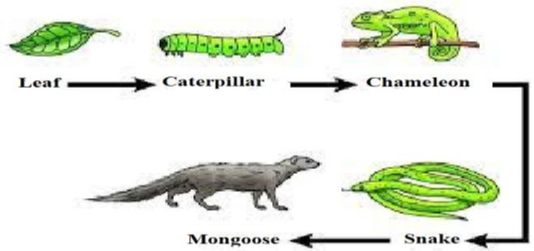
Study the food chain given below and answer the questions that follow :
Image
(a) If the amount of energy available at the third trophic level is 100 joules, then how much energy will be available at the producer level? Justify your answer.
(b) Is it possible to have 2 more trophic levels in this food chain just before the fourth trophic level? Justify your answer.
Answer
(a) $10000 J$ because only $10 \%$ of energy is avallable for the next trophic level.
(b) No, since the loss of energy at each step is so great that very little usable energy will remain after 4 trophic levels.
View full question & answer
Question 22 Marks
How are most of the solid wastes in urban areas disposed of?
Answer
Most of the solid waste in urban areas is dumped in low line areas of ground and covered with earth to level the uneven ground. This method is called landfill.
View full question & answer
Question 32 Marks
Are plants actually producers of energy?
Answer
No, plants cannot be called as producers of energy, because they have the ability to fix and convert solar energy into food produced by them, but not to produce energy. The sun is the ultimate source of energy on the earth. Energy after reaching the earth is only converted from one form to another but not produced.
View full question & answer
Question 42 Marks
What is the most characteristic feature of non-biodegradable wastes?
Answer
Example for Biodegradable materials, often referred to as “bio-waste”, include the following Human and animal waste, Plant products, wood, paper, food waste, leaves, grass clippings and Remains from the death of living creatures.
View full question & answer
Question 52 Marks
Define decomposers. Name one decomposer.
Answer
The micro-organisms which break down the complex organic compounds present in dead organisms like dead plants and animals and their products like faeces, urine, etc., into simpler substances are called decomposers.
Example: Bacteria and Fungi.
View full question & answer
Question 62 Marks

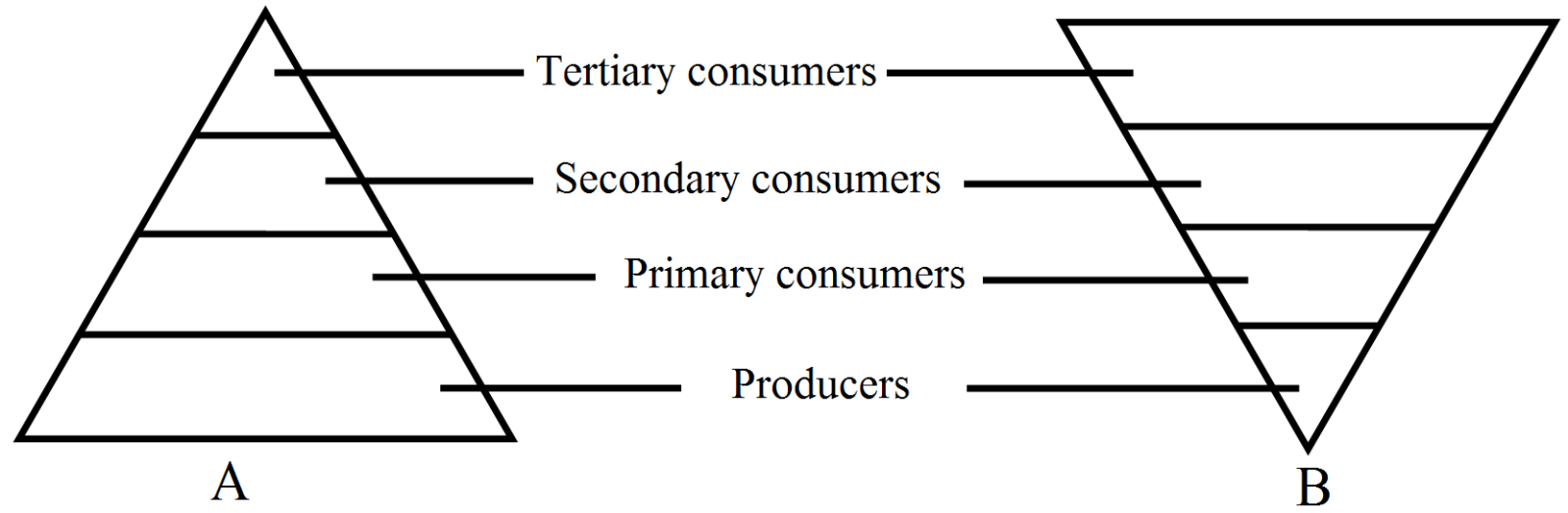
Look at the following figures. Choose the correct one and give a reason for your choice.
Answer
If there would be 4 blocks then the 1st figure is correct. The population will decrease as we move from bottom to top of a food chain. The producers will be the highest in number in a food chain because there have to be more food producers than consumers, to sustain life on earth.
View full question & answer
Question 72 Marks
What would happen if the ozone layer in the atmosphere completely disappears?
Answer
If the ozone layer in the atmosphere disappears completely, then all the extremely harmful ultraviolet radiations coming from the sun would reach the earth. These ultraviolet radiations would cause skin cancer and other ailments in men and animals, and also damage the plants.
View full question & answer
Question 82 Marks
"Industrialisation has adversely deteriorated the environment." Give four reasons in support of this statement.
Answer
  1. It leads to deforestation.
  2. It pollutes the environment by dumping its waste and affluent into rivers.
  3. It leads to loss of biodiversity.
  4. It affects the livelihood of the tribal’s.
View full question & answer
Question 92 Marks
What is a food chain? Give one example of a simple food chain.
Answer
The sequence of living organisms in a community in which one organism consumes other organisms to transfer food energy is called a food chain. The simple food chain operating in grass land is:
$\text{Plants}\ \ \ \ \ \rightarrow\ \ \ \ \ \text{Beer}\ \ \ \ \ \rightarrow\ \ \ \ \ \text{Lion}\\^\text{(Producer)}\ \ \ \ \ \ \ \ \ \ ^\text{(Harbivore)}\ \ \ \ \ \ \ \ \ \ \ ^\text{(Carnivore)}$
View full question & answer
Question 102 Marks
Write any one effect of non-biodegradable substances.
Answer
Effects of nonbiodegradable substances.
  1. They pollute water and harms the aquatic life.
  2. Non biodegradable substances like radioactive wastes, lead accumulate in the environment and cause diseases in humans and other living beings.
  3. Substances like plastics, etc enter into the food chain and harm the organisms.
View full question & answer
Question 112 Marks
Untreated sewage being disposed of in waste bodies to lead to water pollution. Suggest the practices that can be included for better disposal of sewage waste.
Answer
All this untreated sewage can be processed in Sewage treatment plants. In this, undesirable substances are removed from waste water by various physical, chemical and biological pathways. It produces semisolid waste which is nothing but manure. This product is more eco-friendly and biodegradable. This won’t cause any problem with live organisms.
View full question & answer
Question 122 Marks
Identify the organisms from the following food chain which will respectively have a maximum and minimum concentration of chemicals in its body? Peacock, frog, snake, grasshopper.
Answer
The correct order of food chain is:
Grasshopper → frog → snake → Peacock
Peacock will have maximum concentration of harmful chemicals in its body because it occupies highest tropic level.
View full question & answer
Question 132 Marks
Name one action taken by would community to reduce use of CFC.
Answer
Chlorofluorocarbons (CFCs) are nontoxic, nonflammable chemicals containing atoms of carbon, chlorine, and fluorine. They are used in the manufacture of aerosol sprays, blowing agents for foams and packing materials, as solvents, and as refrigerants.
View full question & answer
Question 142 Marks
On recycling, waste paper is converted into which product?
Answer
The separated paper is then washed with soapy water to remove inks, plastic film, staples and glue. The paper is put into a large holder where it is mixed with water to create 'slurry'. By adding different materials to the slurry, different paper products can be created, such as cardboard, newsprints or office paper.
View full question & answer
Question 152 Marks
State with reason any two possible consequences of elimination of decomposers from the Earth.
Answer
If there were no decomposers, then the dead bodies of plants and animals would keep lying as such and the elements of which plant and animals bodies are made, would never be returned to their original pools like soilair and water. In that case, the cycling process of life and death would be disrupted. All the nutrients present in soil, air and water would soon be exhausted and evolution of life would come to an end.
View full question & answer
Question 162 Marks
Define an ecosystem. Give examples of any two ecosystems.
Answer
An eco system is a self contained unit of living things(plants, animals and decomposers), and their non living environment (soil, air and water). Example – a grassland and a forest.
View full question & answer
Question 172 Marks
State two advantages of using disposable paper cups over disposable plastic cups.
Answer
The advantages of using disposable paper cups over disposable plastic cups are:
  1. Paper cups are biodegradable. So, even if paper cups are thrown away after use, they will decompose (break down) automatically by the action of micro-organisms in due course of time. On the other hand, plastic cups are non-biodegradable. They will remain as such and pollute the environment.
  2. Paper cups can be disposed off by burning without causing much air pollution. On the other hand, burning of plastic cups produces toxic gases (poisonous gases) which causes too much air pollution.
View full question & answer
Question 182 Marks
Producers are also referred to as the autotrophs. Why?
Answer
An autotroph is an organism that can produce its own food using light, water, carbon dioxide, or other chemicals. Because autotrophs produce their own food, they are sometimes called producers. Plants are the most familiar type of autotroph, but there are many different kinds of autotrophic organisms.
View full question & answer
Question 192 Marks
Construct an aquatic food chain showing four trophic levels.
Answer
$\text{Phytoplanktons} \rightarrow \text{Zooplanktons} \rightarrow \text{Small fish} \rightarrow \text{ Big fish} $
View full question & answer
Question 202 Marks
Make an aquatic food chain up to the tertiary consumer level. State the trophic level at which concentration of pesticide is maximum and why?
Answer
Phytoplankton-zooplankton- small fish-big fish
The concentration of pesticides would be maximum at the tertiary level consumer (big fish) because the pesticides that get mixed in the water are firstly taken by the phytplanktons. Then these pesticides present in the phytoplanktons are transferred to the zooplanktons, from zooplanktonsit transfers to the small fishes and from them to the big fishes. Since the big fishes occupy the top level in the food chain, so the maximum amount of harmful chemical pesticides gets accumulated in their bodies.
View full question & answer
Question 212 Marks
What is UNEP? What step has been taken by UNEP in 1987 to prevent too much damage to the ozone layer?
Answer
UNEP – United Nation Environment Program. In 1987, in an attempt to protect ozone layer, the United Nations Environment Program (UNEP) forged an agreement among its member countries to freeze CFC production at 1986 levels.
View full question & answer
Question 222 Marks
Explain why, a food chain usually cannot have more than three or four steps.
Answer
Food chain generally consists of three or four steps because after that the energy available for the next organism will be so small that it will be insufficient to sustain the life of that organism.
View full question & answer
Question 232 Marks
Give reason to justify the following:
  1. The existence of decomposers is essential in a biosphere.
  2. Flow of energy in a food chain is unidirectional.
Answer
  1. Existence of decomposer is essential because they convert the complex substance into simple this ensure that the material taken out from environment is again get into it for further use.
  2. Flow of energy is unidirectional becoz the energy that get transfer from plant to herbivores cannot get into plant again
View full question & answer
Question 242 Marks
List the products of combustion of fossil fuels. What are their adverse effects on the environment?
Answer
Fossil fuels like coal contain carbon, hydrogen, nitrogen and sulphur. When these are burnt, the products are carbon dioxide, water, oxides of nitrogen and oxides of sulphur. When burnt in an insufficient atmosphere (less oxygen), then carbon monoxide is formed instead of carbon dioxide. Of these products, the oxides of sulphur and nitrogen and carbon monoxide are poisonous at high concentrations and cause air pollution. The carbon dioxide is a greenhouse gas which results in global warming.
View full question & answer
Question 252 Marks
What are chlorofluorocarbons? How are they responsible for causing ozone hole in atmosphere? What will be the consequence of ozone hole?
Answer
Choloroflurocarbons are causing ozone hole as the chlorine react with ozone and forms oxygen.
Any of a class of compounds of carbon, hydrogen, chlorine, and fluorine, typically gases used in refrigerants and aerosol propellants. They are harmful to the ozone layer in the earth's atmosphere owing to the release of chlorine atoms on exposure to ultraviolet radiation.
View full question & answer
Question 262 Marks
Why do harmful chemicals concentrate as we go up in a food chain?
Answer
Harmful chemical concentrate in the trophic levels of food by the process of biological concentration or bio-magnification. The Process of entry of a non-biodegradable chemical into a food chain and its getting accumulated at successive trophic levels, reaching the maximum quantity in the top most level is biological magnification.
View full question & answer
Question 272 Marks
Suggest any four activities in daily life which are eco-friendly.
Answer
Following are four activities in daily life which are eco-friendly:
  1. Walking for short distance commute: This activity helps in preventing air pollution.
  2. Using bicycle for going to school: This activity prevents air pollution which can happen when we use car for this purpose.
  3. Reusing water for mopping floor: This helps in conservation of water. Water which is collected after washing clothes and vegetables should be used for mopping the floor.
  4. Using public transport for long distance commute: In a mode of public transport, many people can travel together. This helps in reducing the number of cars and bikes on roads. Thus, it helps in preventing air pollution.
View full question & answer
Question 282 Marks
Suppose you find a heap of domestic waste, in a nearby park, which is decomposing. What would you do to make the people of the surrounding area realise that such type of disposal of domestic waste is harmful to the environment?
Answer
The simple way is which we can do from our side is writing the harmful effects of it and placing it in the pace where people can see and get a wared.
View full question & answer
Question 292 Marks
List four measures that can be taken to conserve forests.
Answer
Four measures:-
  1. Reforestation of the deforested areas as soon as possible.
  2. Ban on the indiscriminate cutting of trees.
  3. Felling of trees for fuel wood should be avoided.
  4. Overgrazing in forests should be discouraged.
View full question & answer
Question 302 Marks
Give any two ways in which biodegradable substances would affect the environment.
Answer
  1. They may produce foul smell during decomposition process.
  2. They may produce some harmful gases such as ammonia, methane, carbon dioxide, etc., which can further-cause global warming.
View full question & answer
Question 312 Marks
Can the organisms of any trophic level be removed without causing any damage to the ecosystem? Will the impact of removing all the organisms in a trophic level be different for different trophic levels?
Answer
No. The impact of removing all the organisms of a trophic level will be different for different trophic levels.
View full question & answer
Question 322 Marks
What is the difference between the food habits of organisms belonging to the first and the third trophic levels? Give one example each of the organisms belonging to these two trophic levels.
Answer
The organisms belonging to the first trophic level are producers which make their own food with the help of sun’s energy. For example – Green plants. The organisms of third trophic level are carnivores that feed upon herbivores. For example – Lion and Tiger.
View full question & answer
Question 332 Marks
What is the role of decomposers in the ecosystem?
Answer
Role of decomposers in the ecosystem:
  1. They help in breaking down the complex organic into simple inorganic that go into the soil and are used up by the plants.
  2. They the nutrient pool of the putting In this way, ad as cleansing agents of nature.
  3. They help in maintaining the fertility of by adding humus content to it.
View full question & answer
Question 342 Marks
What is meant by biodegradable waste materials? Give two examples of biodegradable wastes.
Answer
The waste materials which can be broken down to non- poisonous substances in nature in due course of time by the action of micro-organisms like certain bacteria are called biodegradable waste materials. Example? Paper and wool.
View full question & answer
Question 352 Marks
What is meant by biodiversity? List two advantages of conserving forests and wildlife.
Answer
Biodiversity is the variability among living organisms from all sources, including terrestrial, marine, and other aquatic ecosystems and the ecological complexes of which they are part; this includes diversity within species, between species, and of ecosystems.
Two advantages of Conserving forest and wildlife:
  1. Forest gives us numerous things like food, fruit, wood, gum and oxygen.
  2. We should conserve wildlife to maintain the proper balance of food web.
View full question & answer
Question 362 Marks
Why is plastic bag called non-biodegradable while the paper is not?
Answer
Paper can be broken up by enzymes of the micro organisms into more simplar substances and can be decomposed while plastic cannot be decomposed by the action of microbes.
Therefore, paper is biodegradable and plastic is non-biodegradable.
View full question & answer
Question 372 Marks
How can the wastes such as paper, plastic and metal objects be disposed of?
Answer
The solid wastes like papers, plastics and metals are recycled. For example – waste paper is send to paper mills where it is reprocessed to form new paper once again.
View full question & answer
Question 382 Marks
What will be the consequence of the absence of decomposers in the ecosystem?
Answer
In the absence of decomposers, the dead bodies of plants and animals would keep lying as such and the elements of plant and animal bodies would never be returned to their original pool like soil, air and water. The cycling process of life and death would be disrupted. The nutrient pool will not be replenished and would exhaust soon.
View full question & answer
Question 392 Marks
How can pesticides be allowed in beverages?
Answer
Pesticides Found in Cold Drinks, Bottled Water in India. In a carbonated non-alcoholic beverage, water is the main ingredient. The water used to make cold drinks in Dehli is being looked at as the culprit of contaminanted drinks being sold to consumers by such companies as PepsiCo and Coca-Cola.
View full question & answer
Question 402 Marks
Zebra, jackals, lions, goat, horse, wolves and sheep. Identify the first order consumers from those given above. Give a reason to support your answer.
Answer
Zebra, goat, horses and sheep are all those organisms which eat producers (green plants) for energy and hence are herbivores. They all cannot make food by themselves hence; they feed on plants which can make food for themselves.
View full question & answer
Question 412 Marks
If a harmful chemical enters a food chain comprising snakes, hawks, mice and plants, which of these organisms is likely to have maximum concentration of the harmful chemicals in its body?
Answer
From the following organisms hawk will have highest concentration of non biodegradable chemicals.
This is because the concentrations of non biodegradable chemicals increases from 1st trophic level to the tertiary trophic level.
And this phenomenon is known as bio-magnification.
View full question & answer
Question 422 Marks
Explain why, the flow of energy in the ecosystem is said to be unidirectional.
Answer
The flow of energy in the ecosystem is said to be unidirectional because the energy lost as heat from the living organisms of a food chain cannot be reused by plants in photosynthesis.
View full question & answer
Question 432 Marks
Give two differences between food chain and food web.
Answer
 
Food chain
Food web
1.
Food chain is a straight sequence of organism.
Food web is a complex network formed of many food chain.
2.
Food chain do not have any cross linkages.
Food web has many cross linkages.
View full question & answer
Question 442 Marks
Name and state the law given by Lindeman which tells us how much energy entering a particular trophic level of organisms is available for trasnsfer to the next higher trophic level.
Answer
The law given by Lindeman is 10% law. According to 10% law, only 10% of the energy entering a particular trophic level of organisms is available for transfer to next higher trophic level.
View full question & answer
Question 452 Marks
Give proper term for each of the following:
  1. Smaller constituent operational unit of biosphere.
  2. Accumulation of non-biodegradable toxic substance in the increasing order in a food chain.
Answer
It is definitely a very interesting question to solve and do some brainstorming.
  1. The smaller constituent operation unit of biosphere is called Ecosystem.
  2. The accumulation of non-biodegradable toxic substance in the increasing order in the food chain is called Biomagnification.
View full question & answer
Question 462 Marks
State one reason to justify the position of man at the apex of most food chains.
Answer
The position of the man is at the apex of most of the food chain because in a food chain The Apex position is mostly taken by carnivorous animals and in a normal food chain herbivores are the producers some small organisms are the second consumers and some much larger animals are the third consumers but we comes at the last.
View full question & answer
Question 472 Marks
What is meant by biodiversity? List two advantages of forest and wild life.
Answer
Biodiversity refers to the variety of living organisms present in the given ecosystem. It includes all the marine and terrestrial organisms. The biodiversity of an area is measured by counting the number of species found in that particular area.
Advantages of conserving forest:
  1. It prevents soil erosion and floods.
  2. It helps to maintain the water cycle.
  3. It produces huge amounts of raw materials for the industries.
Advantages of conserving wildlife:
  1. It protects the endangered species.
  2. It preserves different kinds of species and thus, maintains the species diversity.
  3. It helps in maintaining the ecological balance that is required for supporting life.
View full question & answer
Question 482 Marks
Besides natural degradation by microbes, what are the other ways to dispose of biodegradable wastes?
Answer
besides natural degradation organic waste can be used to generate electricity.thus we can give our dumps to these agencies.apart from this we can store it in landfill or incinerate it under controlled conditions,this burning can also be used to generate electricity.in this way our waste(organic) will we disposed and is in use also.
View full question & answer
Question 492 Marks
What is sewage? How is sewage disposed of?
Answer
The dirty drain water containing urine and faeces which is carried from our homes by the underground pipes (called sewers) is called sewage. Sewage is disposed off by treating it at the sewage treatment plant (or sewage works). The treatment of sewage produces clean water which is discharged into the river. The organic matter present in sewage is ‘digested’ in the digesters of sewage treatment plant to produce ‘sewage gas’ (which is kind of biogas) and manure.
View full question & answer
Question 502 Marks
What is meant by incineration? For what purpose is it used?
Answer
Incineration means reducing to ashes. It is used to destroy the household waste, chemical waste and biological waste.
View full question & answer