Questions · Page 1 of 2

[2 Mark Questions]

🎯

Test yourself on this topic

50 questions · timed · auto-graded

Question 12 Marks
Choose from the following:$_6\text{C}, {_8\text{O}}, _{\text{ 10}}\text{Ne}, _{\text{ 11}}\text{Na}, _{\text{ 14}}\text{Si}$
  1. Elements that should be in the same period.
  2. Elements that should be in the same group.
State reason for your selection in each case.
Answer
Electronic Configuration:
C - 2, 4
O - 2, 6
Ne - 2, 8
Na - 2, 8,1
Si - 2, 8, 4
Elements in which electrons are filled in first 2 shells: C, O and Ne. So these elements lie in the same period.
Elements in which electrons are filled in first 3 shells: Na and Si. So these elements lie in the same period.
Elements with same number of 4 valence electrons: C, Si. So, these elements lie in the same group.
View full question & answer
Question 22 Marks
An element ' X ' belongs to $3^{\text {rd }}$ period and group 17 of the periodic table.State its,
i. Electronic configuration,
ii. Valency. Justify your answer with reasoning.
Answer
i. Since element $X^{\prime}$ belongs to $3^{\text {rd }}$ period, it means that the element $X$ has three valence electrons. Also, it belongs to group 17 which means that it has 7 valence electrons as Valence electrons $=17-10=7$ So, the electronic configuration of the element $X$ is $2,8,7$
ii. Since the outermost shell has 7 electrons in its outermost shell means that it requires one more electron to acquire noble gas configuration. So, the valency of $X$ is 1 .
View full question & answer
Question 32 Marks
Na, Mg and $\text{A} \ell$ are the elements having one, two and three valence electrons respectively. Which of these elements,
  1. Has the largest atomic radius.
  2. Is least reactive? Justify your answer stating reason for each.
Answer
  1. Na has the largest atomic radius as compared to Mg and Al because going along the period atomic radius decreases due to an increase of electrons and nuclear charge tends to pull the electrons closer to the nucleus and hence decrease the atomic radius.
  2. Al is smaller in size as compared to Na and Mg so it has lesser tendency to lose electron due to high effective nuclear charge.
View full question & answer
Question 42 Marks
How does the valency of elements vary (i) in going down a group, and (ii) in going from left to right in a period of the periodic table?
Answer
  1. On moving from up to down in a group there is no change in valency
  2. On moving from left to right in a period at first velency is increased from 1 to 4 and then decrease from 4 to 0.
View full question & answer
Question 52 Marks
In the modem periodic table, the element Calcium (atomic number = 20) is surrounded by elements with atomic numbers 12, 19, 21 and 38. Which of these elements has physical and chemical properties resembling those of Calcium and why?
Answer
The electronic configuration of calcium (20) = 2, 8, 8, 2.
The electronic configuration of other elements
Atomic number 12 = 2, 8, 2
Atomic number 19 = 2, 8, 8, 1
Atomic number 21 = 2, 8, 8, 3
Atomic number 38 = 2, 8, 18, 8, 2
The element having atomic number 12 and 38 resemble physical and chemical properties with calcium (20). This is because the valence electron of in these element is same as calcium (e = 2) and the physical and chemical properties depend on the number of valence electron present in the outermost shell.
View full question & answer
Question 62 Marks
An element ‘X' has atomic number 13:
  1. Write its electron configuration.
  2. State the group to which ‘X‘belongs?
  3. Is ‘X‘ a metal or non-metal?
  4. Write the formula of its bromide.
Answer
solution Since the atomic number given $=13$ The Electronic configuration of the element $=2,8,3$
Group number to which the element ' $X$ ' belongs $=10+3=13^{\text {th }}$ group.
Since ' X ' has 3 valence electrons. So, ' X ' is a metal.
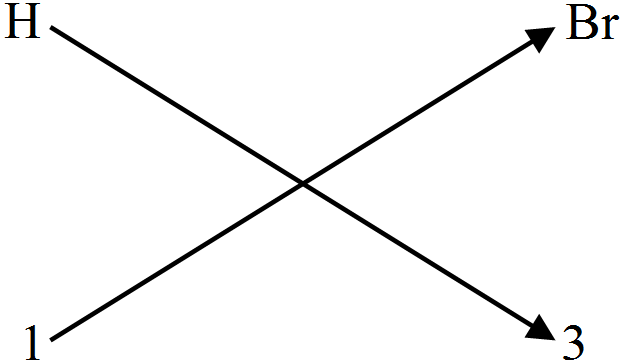
The formula for the bromide can be calculated by cross multiplication of the valences which is as follows:
So, formula of its bromide is $XBr_3$.
View full question & answer
Question 72 Marks
How can the valency of an element be determined its electronic configuration is known? What will be the valency of an element of atomic number 9(nine)?
Answer
  1. The valency of an element is determined by the number of electrons present in the last shell.
If a number of valence electrons are less than or equal to 4 then, valency = a number of valence electrons.

If, the number of valence electrons greater than 4 then, valency = 8 - number of valence electrons.
  1. The electronic configuration of element X with atomic number 9 is 2, 7
Valency of X = 8 - 7 =1

Hence, the valency of the element with atomic number 9 is 1.
View full question & answer
Question 82 Marks
How does the electronic configuration of an atom of an element relate to its position in the modern periodic table? Explain with one example.
Answer
Electronic configuration of an element tells us the no. of electron in it which is used in finding the valence electron and the atomic number of the element. The no. of electron in the outer most shell specifies the position of an element in the periodic table.
Ex. The no. of electron present in Na, K, Li, is 1 so they all are placed in group 1.
View full question & answer
Question 92 Marks
  1. How do you calculate the possible valency of an element from the electronic configuration of its atoms?
  2. Calculate the valency of an element X whose atomic number is 9.
Answer
  1. The valency of an element is determined by the number of electrons present in the last shell.
If a number of valence electrons are less than or equal to 4 then, valency = a number of valence electrons.

If, the number of valence electrons greater than 4 then, valency = 8 - number of valence electrons.
  1. The electronic configuration of element X with atomic number 9 is 2, 7
Valency of X = 8 - 7 =1

Hence, the valency of the element with atomic number 9 is 1.
View full question & answer
Question 102 Marks
How it can be proved that the basic structure of the Modern Periodic Table is based on the electronic configuration of atoms of different elements?
Answer
Modern periodic law states that the physical and chemical properties of an element in the periodic table are the periodic function of the atomic number of that element. Electronic configuration of the elements plays an important role in the placement of elements in the modern periodic table. The valence shell electron of an element decides its position in a particular group or period.
For example, if the electronic configuration of an element is 2, 1, it means that the element belongs to group I and 2nd period (valence electron is present in the 2nd shell). Similarly, if the electronic configuration of an element is 2, 8, 1, it means that the element belongs to group I and 3rd period (valence electron is present in the 3rd shell).
Thus, the modern periodic table is based on the electronic configuration of the different elements.
View full question & answer
Question 112 Marks
What happens to the image distance in the normal human eye when we decrease the distance of an object, say 10m to 1m? Justify your answer.
Answer
If the object distance is greater than 25cm the image is always formed on the retina as the focal length of the human eye lens gets adjusted depending on the object distance. This special property of human eye is called as power of accommodation. Hence, image distance will remain same if object distance changes from 10m to 1m.
View full question & answer
Question 122 Marks
Write the name, symbol and electronic configuration of an element X whose atomic number is 11.
Answer
Name - sodium
Symbol - Na
Electronic configuration - 2, 8, 1
View full question & answer
Question 132 Marks
Can the following groups of element be classified as Dobereiner's triad:
  1. Na, Si, Cl
  2. Be, Mg, Ca
Atomic mass of Be-9; Na-23, Mg-24, Si-28, Cl-35, Ca-40.
Justify your answer in each case.
Answer
  1. Na, Si, Cl - The properties of these three elements are not similar to each other, so no Doberieneir’s triads.
  2. Be, Mg, Ca - The properties are similar to each other, so it is Dobereiner’s triad.
Atomic mass of Mg $=\frac{\text{Atomic mass of Be + Atomic mass of Ca}}{2}$

$=\frac{9+40}{2}+\frac{49}{2}=24.5$
View full question & answer
Question 142 Marks
The electronic configuration of an element is 2, 8, 4. State its:
  1. Group and period in the Modern Periodic Table.
  2. Name and write its one physical property.
Answer
  1. The electronic configuration of the given element is 2, 8, 4. Since, the number of valence electrons for the given element is 4. Hence, the element belongs to group 14 (10 + 4) and the 3rd period.
  2. The atomic number of the given element is 14. Hence, the given element is Silicon. Silicon is a metalloid.
View full question & answer
Question 152 Marks
What names were given by Mendeleev to the then undiscovered elements.
  1. Scandium.
  2. Gallium, and
  3. Germanium?
Answer
  1. Eka - boron.
  2. Eka - aluminum.
  3. Eka - silicon.
View full question & answer
Question 162 Marks
From the standpoint of atomic structure, what determines which element will be the first and which the last in a period of the periodic table?
Answer
The no. of valence electrons in the atoms of elements decides which element will be the 1st element in a period and which will be the last in a period.
View full question & answer
Question 172 Marks
State how the valency of elements varies.
  1. In a group.
  2. In a period, of the periodic table.
Answer
  1. In a group, all the elements have the same valency.
  2. In a period, on moving from left to right, the valency of elements first increases from 1 to 4 and then decreases to zero.
View full question & answer
Question 182 Marks
The elements A, B and C belong to groups 1, 14 and 17 respectively of the periodic table.
  1. Which two elements will form a covalent compound?
  2. Which two elements will form an ionic compound?
Answer
  1. B and C.
  2. A and C.
View full question & answer
Question 192 Marks
An element A has an atomic number of 6. Another element B has 17 electrons in its one neutral atom.
  1. N which groups of the periodic table would you expect to find these elements?
  2. What type of bond is formed between A and B?
  3. Suggest a formula of the compound formed between A and B.
Answer
  1. A in group 14; B in group 17.
  2. Covalent bond.
  3. AB 4.
View full question & answer
Question 202 Marks
Explain why, the noble gases are placed in a separate group.
Answer
The noble gases are placed in a separate group because they are chemically very inert or unreactive (having completely filled outermost electron shells).
View full question & answer
Question 212 Marks
Which element has:
  1. Two shells, both of which are completely filled with electrons?
  2. The electronic configuration 2, 8, 2?
  3. A total of three shells, with four electrons in its valence shell?
  4. A total of two shells, with three electrons in its valence shell?
  5. Twice as many electrons in its second shell as in its first shell?
Answer
  1. Neon (2, 8)
  2. Magnesium (2, 8, 2)
  3. Silicon (2, 8, 4)
  4. Boron (2, 3)
  5. Carbon(2, 4).
View full question & answer
Question 222 Marks
Why was the position of hydrogen not fixed in Mendeleev's periodic table?
Answer
No fixed position could be given to hydrogen in Mendeleev's periodic table because:1. Hydrogen resembles alkali metals as it forms compounds with halogens that have similar formulae and alkali metals are present in group 12.Hydrogen resembles halogens as just like halogens hydrogen can form covalent bonds with metals and non- metals. Halogens are present in group 17 So there is an anomaly about the position of hydrogen.
View full question & answer
Question 232 Marks
An element Y is in second period and group 16 of the periodic table:
  1. Is it a metal or non - metal?
  2. What is the number of valence electrons in its atom?
  3. What is its valency?
  4. What is the name of the element?
  5. What will be the formula of the compound formed by Y with sodium?
Answer
  1. Non - metal.
  2. 6.
  3. 2.
  4. Oxygen.
  5. Na 2 Y.
View full question & answer
Question 242 Marks
How does the atomic radius changes as you go:
  1. From left to right in a period?
  2. Down a group in the periodic table?
Answer
  1. As we go left to right in a period atomic radius decreases as new electrons added in the same shell.
  2. As we go down the group, atomic radius increases as new electrons are added in new shells.
View full question & answer
Question 252 Marks
Lithium, sodium and potassium are all metals that react with water to liberate hydrogen gas. Is there any similarity in the atoms of these elements? Explain your answer.
Answer
The similarity in the atoms of lithium, sodium and potassium is that all of them have 1 valence electron each.
View full question & answer
Question 262 Marks
Four elements P, Q, R, and S have atomic numbers 12, 13, 14 and 15 respectively. Answer the following questions giving reasons.
What is the valency of Q?
Answer
Atomic number of q = 13
Electronic configuration = 2, 8, 3
Since 3 electrons are present in valence shell, therefore valency of q is 3
View full question & answer
Question 272 Marks
What chemical properties of elements were used by Mendeleev in creating his periodic table?
Answer
The elements having similar chemical properties form oxides and hydrides having similar formulae. Mendeleev used these properties for creating his periodic table.
View full question & answer
Question 282 Marks
An element X belongs to 3rd period and group 2 of the periodic table. State:
  1. Number of valence electrons.
  2. Valency.
  3. Metal or non - metal.
  4. Name of the element.
Answer
  1. 2.
  2. 2.
  3. Metal.
  4. Magnesium.
View full question & answer
Question 292 Marks
Consider the following elements:
Na, Ca, Al, K, Mg, Li.
  1. Which of these elements belong to the same period of the periodic table?
  2. Which of these elements belong to the same group of the periodic table?
Answer
  1. Sodium (Na), magnesium (Mg) and aluminium (Al) belong to the same (third) period of the periodic table.
  2. Lithium (Li), sodium (Na) and potassium (K) belong to the same group (group 1) of the periodic table.
View full question & answer
Question 302 Marks
The position of three elements A, B and C in the Periodic Table are shown below-
Group 16 Group 17
- -
- A
- -
B C
  1. State whether A is a metal or non-metal.
  2. State whether C is more reactive or less reactive than A.
  3. Will C be larger or smaller in size than B?
  4. Which type of ion, cation or anion, will be formed by element A?
Answer
  1. A is a non-metal.
  2. C is less reactive than A, as reactivity decreases down the group in halogens.
  3. C will be smaller in size than B as moving across a period, the nuclear charge increases and therefore, electrons come closer to the nucleus.
  4. A will form an anion as it accepts an electron to complete its octet.
View full question & answer
Question 312 Marks
Given alongside is a part of the periodic table. As we move vertically downward from Li to Fr:
  1. What happens to the size of atoms?
  2. What happens to their metallic character?
Answer
  1. The atomic size increases gradually from lithium to francium.
  2. The metallic character increases from lithium to francium.
View full question & answer
Question 322 Marks
The atomic numbers of the three elements X, Y and Z are 2, 6 and 10 respectively.
  1. Which two elements belong to the same group?
  2. Which two elements belong to the same period?
Give reasons for your choice.
Answer
  1. X and Z. X and Z have zero valency hence they belong to same group: noble gases.
  2. Y and Z. Y: 2,4 and Z: 2,8 so, both of them belong to second period with two shells filled.
View full question & answer
Question 332 Marks
Why did Mendeleev left some gaps in his periodic table?
Answer
Mendeleev left some gaps in his periodic table because he believed that in future more elements will be discovered. He predicted the existence of some elements and named them by prefixing a Sanskrit numeral, Eka (one).
View full question & answer
Question 342 Marks
Where should hydrogen be placed in the modern periodic table? Give reason for your answer.
Answer
Position of hydrogen:Hydrogen has been placed at the top of group 1, above the alkali metals in the modern periodic table because the electronic configuration of hydrogen is similar to those of alkali metals. Both, have 1 valence electron each.
View full question & answer
Question 352 Marks
Give two examples of elements of Groups 1, 2, 16 and 17.
Answer
  • Group 1: Hydrogen and lithium.
  • Group 2: Beryllium and calcium.
  • Group 16: Oxygen and sulphur.
  • Group 17: Fluorine and chlorine.
View full question & answer
Question 362 Marks
How does the atomic size vary on going down from top to bottom in a group of the periodic table? Why does it vary this way?
Answer
On going down in a group of the periodic table, the atomic size increases. When we move from top to bottom in a group, a new shell of electrons is added to the atoms at every step due to which the size of atom increases.
View full question & answer
Question 372 Marks
Did Döbereiner's triads also exist in the columns of Newlands' Octaves? Compare and find out.
Answer
Yes, Dobereiner's triads also exist in the columns of Newlands' Octaves. For example, the second column of Newlands' classification has the elements lithium (Li), sodium (Na) and Potassium (K), which constitute a Dobereiner's triad.
View full question & answer
Question 382 Marks
What is the main characteristic of the last elements in the periods of the periodic table? What is the general name of such elements?
Answer
The main characteristic of last elements in a period is that they all have 8 valence electrons in their atoms except helium. Such elements are called noble elements.
View full question & answer
Question 392 Marks
An atom has the electron structure of 2, 7.
  1. What is the atomic number of this atom?
  2. To which of the following would it be chemically similar?
${ }_7 N,{ }_{15} P ,{ }_{17} CI ,{ }_{18} Ar$.
  1. Why would you expect it to be similar?
Answer
a. 9.
b. ${ }_{17} Cl$.
c. Both |have the same number of valence electrons ( 7 electrons each) in their atoms.
View full question & answer
Question 402 Marks
State Mendeleev’s periodic law.
Answer
Mendeleev’s periodic law:The properties of elements are a periodic function of their atomic masses. It was the discovery of atomic number which led to a change in Mendeleev’s periodic law which was based on atomic mass.
View full question & answer
Question 412 Marks
InMendele′ ev’s Periodic Table the elements were arranged in the increasing order of their atomic masses. However, cobalt with atomic mass of 58.93amu was placed before nickel having an atomic mass of 58.71amu. Give reason for the same.
Answer
In Mendeleev's periodic table, the reasons for placing cobalt (Co) before nickel (Ni) though its atomic mass is higher than that of nickel, are:
  1. Cobalt was placed in the group of rhodium (Rh) and iridium (Ir) because it exhibits the properties similar to them.
  2. Similarly Nickel was placed with elements like palladium (Pd) and platinum (Pt) having properties similar to it.
View full question & answer
Question 422 Marks
How were the positions of cobalt and nickel resolved in the modern periodic table?
Answer
Position of Cobalt and Nickel:The atomic number of cobalt is 27 and that of nickel is 28. According to modern periodic law, the elements are arranged in order of increasing atomic numbers. So, cobalt with lower atomic number (27) should come first and nickel with higher atomic number (28) should come later, even if their atomic masses are in the wrong order.
View full question & answer
Question 432 Marks
Use Mendeléev's Periodic Table to predict the formulae for the oxides of the following elements: K, C, Al, Si, Ba.
Answer
$K _2 O$ - Potassium Oxide
CaO - Calcium Oxide
$Al _2 O _3$ - Aluminium Oxide
$SiO _2$ - Silicon dioxide
BaO - Barium Oxide.
View full question & answer
Question 442 Marks
What is the fundamental difference in the electronic configurations between the group 1 and group 2 elements?
Answer
The fundamental difference between the electronic configuration of group 1 and group 2 elements is that group 1 elements have 1 valence electron in their atoms whereas group 2 elements have 2 valence electrons in their atoms.
View full question & answer
Question 452 Marks
For each of the following triads, name the element with the characteristics specified below:
 
Elements
Least atomic radius
Chemically least reactive
(i)
F, Cl, Br
.....................
.....................
(ii)
Li, Na, K
.....................
.....................
Answer
 
Elements
Least atomic radius
Chemically least reactive
(i)
F, Cl, Br
F
Br
(ii)
Li, Na, K
Li
Li
View full question & answer
Question 462 Marks
The atomic numbers of three elements A, B and C are given below:
Element Atomic Number
A 5
B 7
C 10
  1. Which element belongs to group 18?
  2. Which element belongs to group 15?
  3. Which element belongs to group 13?
  4. To which period/ periods do these elements belong?
Answer
i. C $(2,8)$.
ii. B $(2,5)$.
iii. $A(2,3)$.
iv. $2^{\text {nd }}$ period ( 2 shells are filled).
View full question & answer
Question 472 Marks
What are the periods and groups in a periodic table ? Give two characteristics of each.
Answer
The horizontal rows of elements in a periodic table are called periods.Characteristics:
  1. The elements in a period have consecutive atomic numbers.
  2. The no. of elements in period is fixed by the maximum no. of electrons which can be accommodated in various shells. The vertical columns in a periodic table are called groups.
Characteristics:
  1. The elements in a group do not have consecutive atomic numbers.
  2. All the elements in a group have similar electronic configurations and show similar properties.​​​​​​​
View full question & answer
Question 482 Marks
A metal M forms an oxide having the formula $M _2 O _3$. It belongs to the third period in the modern periodic table.
Write the atomic number and valency of the metal.
Answer
An atomic number represents the number of protons in the nucleus and valency number of a metal is defined as the measure of the number of chemical bonds the atoms of a substance can form.
The atomic number of the periodic table for $M _2 O _3$ is 13 and valency number of the compound is 3 .
Hence the metal is aluminum in the periodic table.
View full question & answer
Question 492 Marks
Why did Mendeleev leave some gaps in his periodic table?
Answer
In order to make sure that the elements having similar properties fell in the same vertical column or group, Mendeleev left some gaps in his periodic table.
View full question & answer
Question 502 Marks
What is the significance of atomic number in the modern classification of elements? Explain with the help of an example.
Answer
The real significance of atomic number in the modern periodic classification is that it relates the periodicity in the properties of elements to the periodicity in their electronic configurations.
Example: The atomic number increases from 3 in lithium to 11 in sodium, there is a repetition of electronic configuration from 2, 1 to 2, 8, 1 (both having 1 valence electron).
View full question & answer
[2 Mark Questions] - Science STD 10 Questions - Vidyadip