MCQ 511 Mark
What happens to the number of valence electrons in atoms of elements as we go down a group in the periodic table?
AnswerAs we move from top to bottom in a group, the number of valence electrons remains same because a group is defined such that their valence shell configuration is same.
Hence, valence electrons remain same but valence shell changes.
View full question & answer→MCQ 521 Mark
Elements in a period have same :
- A
Number of valence electrons
- B
- ✓
- D
AnswerElements present in horizontal rows are called periods.
Elements belonging to the same period have same no. of the shell as the electrons are added in the same shell of the element.
View full question & answer→MCQ 531 Mark
The element with maximum non metallic character is :
- A
$\ce{S}$
- B
$\ce{P}$
- ✓
$\ce{Cl}$
- D
$\ce{Ag}$
AnswerCorrect option: C. $\ce{Cl}$
As we move down the group, tendency to lose electron increases and metallic character increases while as we move across a period, electronegativity increases so non $-$ metallic character increases.
So, among these $\ce{Cl}$ have highest non $-$ metallic character.
View full question & answer→MCQ 541 Mark
Which of the following statements is not a correct statement about the trends when going from left to right across the periods of periodic Table.
- A
The elements become less metallic in nature.
- B
The number of valence electrons increases.
- ✓
The atoms lose their electrons more easily.
- D
The oxides become more acidic.
AnswerCorrect option: C. The atoms lose their electrons more easily.
View full question & answer→MCQ 551 Mark
Which of the following element has only one valence electron?
AnswerThe element lithium has only one valence electron.
Oxygen, bromine, argon, and arsenic have $2, 7, 8,$ and $15$ valence electrons respectively.
View full question & answer→MCQ 561 Mark
Which of the following elements would lose an electron easily?
- A
$\ce{Mg}.$
- B
$\ce{Na.}$
- ✓
$\ce{K}.$
- D
$\ce{Ca}.$
AnswerCorrect option: C. $\ce{K}.$
The element potassium $\ce{(K)}$ with maximum size would lose electron easily.
View full question & answer→MCQ 571 Mark
The three imaginary elements $X, Y$ and $Z$ represent a Dobernener's triad. If the atomic mass of element $X$ is $14$ and that of element $Y$ is $46,$ then the atomic mass of element $Z$ will be :
AnswerThe atomic mass of the element $Z$ is $78.$
According to Dobereiner’s law of triads, atomic mass of $\text{Y}=\frac{\text{X}+\text{Z}}{2}$
Substituting the atomic masses we get:
$46=\frac{14+\text{Z}}{2}$
$92=14+\text{Z}$
$\therefore \text{Z}=78.$
View full question & answer→MCQ 581 Mark
Which of the following elements does not lose an electron easily?
- A
$\ce{Na}.$
- ✓
$\ce{F}.$
- C
$\ce{Mg}.$
- D
$\ce{Al.}$
AnswerCorrect option: B. $\ce{F}.$
Metals can easily lose electrons and exhibit electropositive nature whereas non $-$ metals have tendency to accept electrons and exhibit electronegative nature. $\ce{Na, Al}$ and $\ce{Mg}$ are metals whereas $F$ is a non $-$ metal.
View full question & answer→MCQ 591 Mark
Mendeleev classified elements in :
- A
Increasing order of atomic groups.
- ✓
Seven periods and eight groups.
- C
Seven periods and nine groups
- D
Eight periods and seven groups.
AnswerCorrect option: B. Seven periods and eight groups.
Mendeleev kept elements in increasing order of atomic weights in seven periods and eight groups.
View full question & answer→MCQ 601 Mark
An atom of an element has the electronic confi $-$ guration $2, 8, 2$. To which group does it belong?
- A
$4^{th}$ group
- B
$6^{th}$ group
- C
$3^{rd}$ group
- ✓
$2^{nd}$ group
AnswerCorrect option: D. $2^{nd}$ group
View full question & answer→MCQ 611 Mark
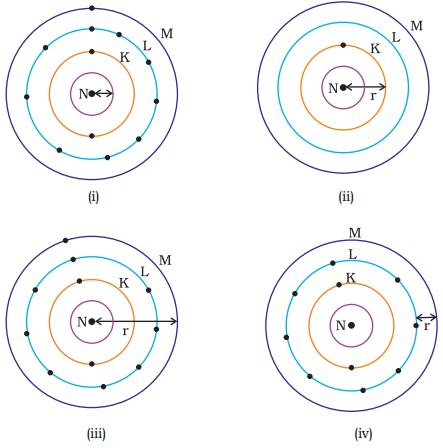
Which one of the following depict the correct representation of atomic radius $(r)$ of an atom?
- A
$(i)$ and $(ii).$
- ✓
$(ii)$ and $(iii).$
- C
$(iii)$ and $(iv).$
- D
$(i)$ and $(iv).$
AnswerCorrect option: B. $(ii)$ and $(iii).$
The distance between nucleus and outermost orbit is called atomic radius.
In fig $(iii),$ it is quite clear. In all other figures, the distance is not correctly shown.
View full question & answer→MCQ 621 Mark
Modern periodic law was proposed by :
AnswerModern periodic law was proposed by Henry Moseley in $1913.$
According to the modern periodic law, the properties of the elements and their compounds are a periodic function of their atomic numbers.
View full question & answer→MCQ 631 Mark
According to Mendeleev's Periodic Law, the elements were arranged in the periodic table in the order of :
- ✓
Increasing atomic number.
- B
Decreasing atomic number.
- C
Increasing atomic masses.
- D
Decreasing atomic masses.
AnswerCorrect option: A. Increasing atomic number.
In the modern periodic table, the elements are listed in order of increasing atomic number. The atomic number is the number of protons in the nucleus of an atom.
View full question & answer→MCQ 641 Mark
The number of elements known in Mendeleev's presented periodic table is:
AnswerIn Mendeleev’s periodic table, elements were placed based on the atomic mass, and chemical properties.
During Mendeleev’s work, only $63$ elements were found.
After studying the properties of all elements, he found that the properties of elements were related to atomic mass.
View full question & answer→MCQ 651 Mark
The type of elements present in group $18[0]$ are :
AnswerGroup $18$ elements have complete octet except He and they are inert in nature so this group represents noble gases/ inert gases.
View full question & answer→MCQ 661 Mark
The non $-$ metals are present :
- ✓
On the right hand side of the periodic table.
- B
In the middle of the periodic table.
- C
In the centre of the periodic table.
- D
On the left hand side of the periodic table.
AnswerCorrect option: A. On the right hand side of the periodic table.
View full question & answer→MCQ 671 Mark
The atomic numbers of four elements $P, Q, R$ and $S$ are $6, 8, 14$ and $16$ respectively. Out of these, the element known as metalloid is :
Answer$R\ \ce{(Si)}$ is a metalloid since its atomic number is $14$ and it has $4$ valence electrons.
View full question & answer→MCQ 681 Mark
The early attempt to classify elements as metals and non $-$ metals was made by:
AnswerThe earliest attempt to classify the elements was in $1789,$ when Antoine Lavoisier grouped the elements based on their properties into gases, non $-$ metals and metals.
View full question & answer→MCQ 691 Mark
Carbon belongs to the second period and Group $14$. Silicon belongs to the third period and Group $14$. If atomic number of carbon is $6,$ the atomic number of silicon is :
View full question & answer→MCQ 701 Mark
The arrangement of elements in the Modem Periodic Table is based on their :
- A
Increasing atomic mass in the period.
- ✓
Increasing atomic number in the horizontal rows.
- C
Increasing atomic number in the vertical columns.
- D
Increasing atomic mass in the group.
AnswerCorrect option: B. Increasing atomic number in the horizontal rows.
View full question & answer→MCQ 711 Mark
Which among the following elements has the largest atomic radii?
- A
$\ce{Na}.$
- B
$\ce{Mg}.$
- ✓
$\ce{K}.$
- D
$\ce{Ca.}$
AnswerCorrect option: C. $\ce{K}.$
$\ce{Na}$ and $\ce{K}$ belong to the same group.
i.e. Group $I. \ce{Ca}$ and $\ce{Mg}$ belong to the Group $\ce{II}$. The atomic radius decreases in moving from left to right along a period. This is due to an increase in nuclear charge which tends to pull the electrons closer to the nucleus and reduces the size of the atom. Hence $\ce{K}$ has largest atomic radii.
View full question & answer→MCQ 721 Mark
Which one of the following elements has the largest atomic radius?
- A
$\ce{Mg}$
- ✓
$\ce{Cs}$
- C
$\ce{Ba}$
- D
$\ce{Cr}$
AnswerCorrect option: B. $\ce{Cs}$
Originally Answered : Which element has the largest atomic radius? The element which has the largest atomic radius is Cesium. Atomic Radius is defined as the distance between the center of the nucleus and the outermost shell of an atom. Cesium has $6$ orbital shells, which means that it automatically is big.
View full question & answer→MCQ 731 Mark
The modern periodic table was prepared by :
AnswerThe modern periodic table of elements was prepared by Neils Bohr.
View full question & answer→MCQ 741 Mark
The correct increasing order of the atomic radii of the elements oxygen, fluorine and nitrogen is :
- A
$\ce{O, F, N}.$
- B
$\ce{N, F, O}.$
- C
$\ce{O, N, F.}$
- ✓
$\ce{F, O, N}.$
AnswerCorrect option: D. $\ce{F, O, N}.$
The increasing order of the atomic radii of oxygen, fluorine and nitrogen is fluorine, oxygen and nitrogen.
This is because the atomic radius decreases from left to right in a period.
View full question & answer→MCQ 751 Mark
The three elements having chemical symbols of $\ce{Si, B}$ and $\ce{Ge}$ are:
AnswerThe three elements having the chemical symbols $\ce{Si, B}$ and $\ce{Ge}$ are metalloids.
View full question & answer→MCQ 761 Mark
Arrange the following elements in the order of their increasing non-metallic character $\ce{Li, O, C, Be, F} :$
- A
$\ce{F < O < C < Be < Li}$
- ✓
$\ce{Li < Be < C < O < F}$
- C
$\ce{F < O < C < Be < Li}$
- D
$\ce{F < O < Be < C < Li}$
AnswerCorrect option: B. $\ce{Li < Be < C < O < F}$
These all elements belong to same period in which non $-$ metallic characters increases from left to right.
View full question & answer→MCQ 771 Mark
Which of the following statement $(s)$ about the Modern Periodic Table are incorrect:
- The elements in the Modern Periodic Table are arranged on the basis of their decreasing atomic number.
- The elements in the Modern Periodic Table are arranged on the basis of their increasing atomic masses.
- Isotopes are placed in adjoining group $(s)$ in the Periodic Table.
- The elements in the Modern Periodic Table are arranged on the basis of their increasing atomic number.
- A
$(i)$ only.
- ✓
$(i), (ii)$ and $(iii).$
- C
$(i), (ii)$ and $(iv).$
- D
$(iv)$ only.
AnswerCorrect option: B. $(i), (ii)$ and $(iii).$
The modern periodic table is tabular arrangement of elements in increasing order of their atomic number therefore isotopes are paced at same position.
View full question & answer→MCQ 781 Mark
The eighth group of Mendeleev's periodic table is divided into how many subgroups?
AnswerIn Mendeleev's, periodic table groups were divided into two subgroups.
Groups from $\ce{I}$ to $\ce{VII}$ are meant for normal elements, and group $\ce{VIII}$ is for transition elements.
Groups $\ce{I}$ to $\ce{VII}$ have been divided into two subgroups while group $\ce{VIII}$ is meant for three elements.
So the eighth group in Mendeleev's periodic table was not divided into any group.
View full question & answer→MCQ 791 Mark
An element which is an essential constituent of all organic compounds belongs to :
- A
Group $1.$
- ✓
Group $14.$
- C
Group $15.$
- D
Group $16.$
AnswerCorrect option: B. Group $14.$
Carbon is an essential element for all organic compounds and belongs to group $14.$
View full question & answer→MCQ 801 Mark
Three elements $\ce{B, Si}$ and $\ce{Ge}$ are :
AnswerThese are also called semi-metals and possess the characteristics of both metals and non-metals.
View full question & answer→MCQ 811 Mark
According to Mendleev's periodic law which properties of the elements are the periodic function of their atomic masses?
- A
- B
- ✓
Physical and chemical properties both
- D
AnswerCorrect option: C. Physical and chemical properties both
According to Mendeleev's periodic law physical and chemical properties both of the elements are the periodic function of their atomic masses
View full question & answer→MCQ 821 Mark
Which of the following statements about the Modern Periodic Table is correct?
- A
It has $18$ horizontal rows known as Periods
- B
It has $7$ vertical columns known as Periods
- ✓
It has $18$ vertical columns known as Groups
- D
It has $7$ horizontal rows known as Groups
AnswerCorrect option: C. It has $18$ vertical columns known as Groups
View full question & answer→MCQ 831 Mark
Which of the following is most reactive :
- ✓
$\mathrm{F}_2$
- B
$\mathrm{Cl}_2$
- C
$\mathrm{Br}_2$
- D
$\mathrm{I}_2$
AnswerCorrect option: A. $\mathrm{F}_2$
View full question & answer→MCQ 841 Mark
The Newland's law of octaves for the classification of elements was found to be applicable only up to the element $.............$
AnswerNewland's law of octaves for the classification of elements was found to be applicable only up to the element Calcium.
Law of octaves, in chemistry, the generalization made by the English chemist $\text{J.A.R}$. Newlands in $1865$ that, if the chemical elements are arranged according to increasing atomic weight, those with similar physical and chemical properties occur after each interval of seven elements.
Newlands was one of the first to detect a periodic pattern in the properties of the elements and anticipated later developments of the periodic law.
View full question & answer→MCQ 851 Mark
Which of the following sets of elements do not belong to the same group?
- A
$\ce{F, Cl, Br}$
- B
$\ce{Na, K, Rb}$
- ✓
$\ce{P, S, Cl}$
- D
$\ce{C, Si, Ge}$
AnswerCorrect option: C. $\ce{P, S, Cl}$
View full question & answer→MCQ 861 Mark
Which of the following is the most reactive element of the group $17\ ?$
AnswerAs we move down in a group, the size of the atoms of elements goes on increasing.
So, fluorine being on the top position in the halogen’s group, is the smallest element and has the maximum tendency to gain an electron to complete its octet.
Thus fluorine is the most reactive element of the group $17.$
View full question & answer→MCQ 871 Mark
Which of the following statement about the modern periodic table is correct?
- A
It has $18$ horizontal rows known as periods.
- B
It has $7$ vertical columns known as periods.
- ✓
It has $18$ vertical columns known as groups.
- D
It has $7$ horizontal rows known as groups.
AnswerCorrect option: C. It has $18$ vertical columns known as groups.
In the modern periodic table, there are $18$ vertical columns known as groups.
View full question & answer→MCQ 881 Mark
The atomic number of an element is $20$. In modern periodic table, this element is placed :
- A
$2^{\text {nd }}$ period.
- ✓
$4^{\text {th }}$ period.
- C
$3^{\text {rd }}$ period.
- D
$1^{\text {st }}$ period.
AnswerCorrect option: B. $4^{\text {th }}$ period.
Electronic configuration:
$\begin{matrix}\text{K}\ \ \text{L}\ \ \text{M}\ \ \ \text{N}\\2\ \ \ 8\ \ \ 8 \ \ \ \ 2\end{matrix} $
Hence, from the electronic configuration, it is clear that the outermost electron goes into the $4^{\text {th }}$ shell.
So, the element would be placed in the $4^{\text {th }}$ period.
View full question & answer→MCQ 891 Mark
How many elements are placed in lanthanide and actinide series?
- A
$57, 89$
- ✓
$14, 14$
- C
$89, 57$
- D
$14, 16$
AnswerCorrect option: B. $14, 14$
View full question & answer→MCQ 901 Mark
Where would you locate the element with electronic configuration $2, 8$ in the modern periodic table?
- A
Group $8.$
- B
Group $2.$
- ✓
Group $18.$
- D
Group $10.$
AnswerCorrect option: C. Group $18.$
The element with an electronic configuration of $(2, 8)$ belongs to group $18\ ($noble or inert gases$)$ of the periodic table, as the elements in this group have their valence shell completely filled with electrons.
Group number $=$ valence shell $+\ 10$
$= 8 + 10 = 18.$
View full question & answer→MCQ 911 Mark
Which group elements are called transition metals?
AnswerCorrect option: C. Group number $3$ to $12$
The elements occurring in the group $3$ to $12$ are named as transition metals because they are metallic elements that form a transition between the main group elements, which occur in groups $1$ and $2$ on the left side, and groups $13\ – 18$ on the right side of the periodic table.
View full question & answer→MCQ 921 Mark
Arrange the following elements in the order of their decreasing metallic character $\ce{Na, Si, Cl, Mg, Al} :$
- A
$\ce{Cl > Si > Al > Mg > Na}.$
- ✓
$\ce{Na > Mg > Al > Si > Cl}.$
- C
$\ce{Na > Al > Mg > Cl > Si}.$
- D
$\ce{Al > Na > Si > Ca > Mg}.$
AnswerCorrect option: B. $\ce{Na > Mg > Al > Si > Cl}.$
The metallic character of the elements decreases along a period.
These elements are present in third period.
View full question & answer→MCQ 931 Mark
Dobereiner’s triad arranged the elements with similar properties into :
MCQ 941 Mark
The Newland's law of octaves for the classification of elements was not found to be applicable only up to the element :
AnswerThe Newlands' law of octaves for the classification of elements was applicable only up to the element calcium.
View full question & answer→MCQ 951 Mark
Newlands relation is called :
MCQ 961 Mark
$\ce{K}$ has a larger atomic radius than $\ce{Li}$. This confirms:
- A
Atomic radius decreases down a group.
- ✓
Atomic radius increases down a group.
- C
Atomic radius decreases across a period.
- D
Atomic radius increases across a period.
AnswerCorrect option: B. Atomic radius increases down a group.
Atomic radius increases down a group.
$\ce{K}$ and $\ce{Li}$ are in the same group, and $\ce{K}$ lies below $\ce{Li}.$
$\ce{K}$ has a larger atomic radius than $\ce{Li}.$
This happens because as we move down the group new shells are added and this increases the distance between the outermost electron and the nucleus.
View full question & answer→MCQ 971 Mark
Which of the following has maximum non $-$ metallic character?
- ✓
$\ce{F}$
- B
$\ce{Cl}$
- C
$\ce{Br}$
- D
$\ce{I}$
AnswerCorrect option: A. $\ce{F}$
$\ce{F}$ has maximum non $-$ metallic character among the given non $-$ metals.
View full question & answer→MCQ 981 Mark
In Mendeleev’s Periodic Table, gaps were left for the elements to be discovered later. Which of the following elements found a place in the Periodic Table later?
MCQ 991 Mark
Chlorine $(17)$ belongs to which group and period :
- A
$7, 3$
- ✓
$17, 3$
- C
$1, 3$
- D
$16, 3$
AnswerCorrect option: B. $17, 3$
View full question & answer→MCQ 1001 Mark
Which of the following is the outermost shell for elements of second period?
- A
$\ce{K}$ shell
- ✓
$\ce{L}$ shell
- C
$\ce{M}$ shell
- D
$\ce{N}$ shell
AnswerCorrect option: B. $\ce{L}$ shell
View full question & answer→