Question types

The Human Eyes And The Colourful World question types

506 questions across 14 question groups — pick any mix to generate a Science paper with step-by-step answer keys.

506
Questions
14
Question groups
5
Question types
Sample Questions

The Human Eyes And The Colourful World questions

One sample from each question group in this chapter. Select any group above to see the full set with answer keys.

Q 1M.C.Q1 Mark
The change in focal length of an eye-lens is caused by the action of the:
  • A
    Pupil.
  • B
    Retina.
  • Ciliary muscles.
  • D
    Iris.

Answer: C.

View full solution
Q 3M.C.Q1 Mark
Which of the following colour of white light has the least wavelength?
  • A
    Red.
  • B
    Orange.
  • Violet.
  • D
    Blue.

Answer: C.

View full solution
Q 5M.C.Q1 Mark
The splitting up of white light into seven colours on passing through a glass prism is called:
  • A
    Refraction.
  • B
    Deflection.
  • Dispersion.
  • D
    Scattering.

Answer: C.

View full solution
Fill in the following blanks with suitable words:
To bring light from a distant object to a focus on the retina of the eye, the convex eye-lens needs to be made ____.
View full solution
Q 11True-False1 Mark
State whether the following statements are true or false:
  1. The scattering away of red light makes the sky appear blue during the day time.
  2. The scattering away of blue light makes the sun appear red at sunset.
View full solution
Q 13True-False1 Mark
State whether the following statement is true or false:
The planets twinkle at night due to atmospheric refraction of light.
View full solution
Complete the following statements:
When the sun is setting, the light from it has to travel a ____ thickness of the earth's atmosphere and only ____ wavelength _____ light is able to reach us. Sunset is therefore ___.
View full solution
A student claims that because of atmospheric refraction, the sun can be seen after it has set, and the day is, therefore, longer than if the earth had no atmosphere.
  1. What does the student mean by saying that the sun can be seen after it has set?
  2. Do you think that the students conclusion is correct?
View full solution
A person suffering from the eye-defect myopia (short-sightedness) can see clearly only up to a distance of 2 metres. What is the nature and power of lens required to rectify this defect?
View full solution
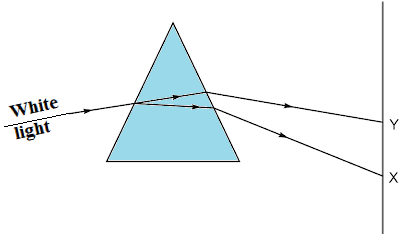
In the figure given alongside, a narrow beam of white light is shown to pass through a triangular glass prism. After passing through the prism, it produces a spectrum YX on the screen:
State the colour seen.
  1. At X, and
  2. At Y​​​​​​​​​​​​

​​​​​​​​​​​​
  1. violet.
  2. Red
  1. ​​​​​​​Why do different colours of white light bend through different angles with respect to the incident beam of light?
View full solution
The descriptions of five kinds of images are given below:
  1. Diminished and virtual.
  2. Enlarged and real.
  3. Enlarged and erect.
  4. Real and inverted.
  5. Virtual and the same size.
Which one of these describes the image formed:
  1. On the retina of the eye?
  2. By a magnifying glass?
  3. By a convex driving mirror on a car?
  4. By a plane mirror?
  5. on the screen of a slide projector?
View full solution
What is short-sightedness? State the two causes of short-sightedness (or myopia). With the help of ray diagrams, show:
  1. The eye-defect short-sightedness.
  2. Correction of short-sightedness by using a lens.
View full solution
What is long-sightedness? State the two causes of long-sightedness (or hypermetropia). With the help of ray diagrams, show:
  1. The eye-defect long-sightedness.
  2. Correction of long-sightedness by using a lens.
View full solution
Differentiate between myopia and hypermetropia. What type of spectacles should be worn by a person having the defects of myopia as well as hypermetropia? How does it help?
View full solution
Q 35M.C.Q-[Phy-1M]1 Mark
Which of the following is not caused by the atmospheric refraction of light?
  1. Twinkling of stars at night.
  2. Sun appearing higher in the sky than it actually is.
  3. Sun becoming visible two minutes before actual sunrise.
  4. Sun appearing red at sunset.
View full solution
Fill in the following blanks with suitable words:
We can see the sun about _____ minutes before the actual sunrise and about ______ minutes after the actual sunset because of atmospheric _____.
View full solution
State whether the following statements are true or false:
  1. The scattering away of red light makes the sky appear blue during the day time.
  2. The scattering away of blue light makes the sun appear red at sunset.
View full solution
Your friend can read a book perfectly well but cannot read the writing on blackboard unless she sits on the front row in class.
  1. Is she short-sighted or long-sighted?
  2. What type of lenses-converging or diverging-would an optician prescribe for her?
View full solution
What is short-sightedness? State the two causes of short-sightedness (or myopia). With the help of ray diagrams, show:
  1. The eye-defect short-sightedness.
  2. Correction of short-sightedness by using a lens.
View full solution
What is long-sightedness? State the two causes of long-sightedness (or hypermetropia). With the help of ray diagrams, show:
  1. The eye-defect long-sightedness.
  2. Correction of long-sightedness by using a lens.
View full solution
The descriptions of five kinds of images are given below:
  1. Diminished and virtual.
  2. Enlarged and real.
  3. Enlarged and erect.
  4. Real and inverted.
  5. Virtual and the same size.
Which one of these describes the image formed:
  1. On the retina of the eye?
  2. By a magnifying glass?
  3. By a convex driving mirror on a car?
  4. By a plane mirror?
  5. on the screen of a slide projector?
View full solution

Generate a The Human Eyes And The Colourful World paper free

Pick question groups from the list above, set marks and difficulty, and export a branded PDF with step-by-step answer keys. First 3 chapters free — no signup.

Download App