Question types

MODEL PAPER - 1 [2026] question types

44 questions across 20 question groups — pick any mix to generate a Social Studies paper with step-by-step answer keys.

44
Questions
20
Question groups
5
Question types
Sample Questions

MODEL PAPER - 1 [2026] questions

One sample from each question group in this chapter. Select any group above to see the full set with answer keys.

Q 1MCQ (1 Mark)1 Mark
Regarding the idea of Satyagraha, Arrange the following sentences in the correct order :
i. Mahatma Gandhi successfully organised satyagraha movements in various places.
ii. Mahatma Gandhi returned to India in January 1915.
iii. The idea of satyagraha emphasised the power of truth and the need to search for truth.
iv. Mahatma Gandhi believed that this dharma of non-violence could unite all Indians.
  • A
    ii, iii, iv, i
  • B
    i, iii, iv, ii
  • C
    iv, i, ii, iii
  • D
    i, ii, iv, iii
View full solution
Q 2MCQ (1 Mark)1 Mark
Choose the correct option, related to the founders of the Swaraj Party within the Congress.
  • A
    Acharya Kripalani and Jayaprakash Narayan
  • B
    Mahatma Gandhi and Sardar Patel
  • C
    C.R. Das and Motilal Nehru
  • D
    Subhas Chandra Bose and Jawaharlal Nehru
View full solution
Q 3MCQ (1 Mark)1 Mark
Study the picture and answer the question that follows : 
Image
Which of the following correctly describes the above picture?
  • A
    It is a page from the Gita Govinda of Jayadeva
  • B
    It is a page from the traditional Chinese ‘accordion book’
  • C
    It is a page from Rigveda.
  • D
    It is page from Panchtantra.
View full solution
Q 4MCQ (1 Mark)1 Mark
Match the following :
(a) 1797(i) Revolt against economic hardships
(b) 1821(ii) Napoleon invades Italy
(c) 1848(iii) Slav nationalism gathers force in the Habsburg and Ottoman Empires
(d) 1905(iv) Greek struggle for independence begins
  • A
    (a) - (iii), (b) - (iv), (c) - (i), (d) - (ii)
  • B
    (a) - (ii), (b) - (iii), (c) - (i), (d) - (iv)
  • C
    (a) - (ii), (b) - (i), (c) - (iv), (d) - (iii)
  • D
    (a) - (ii), (b) - (iv), (c) - (i), (d) - (iii)
View full solution
On 13th April the infamous Jallianwalla Bagh incident took place. On that day a large crowd gathered in the enclosed ground of Jallianwalla Bagh. Some came to protest against the government’s new repressive measures. Others had come to attend the annual Baisakhi fair. Dyer entered the area, blocked the exit points, and opened fire on the crowd, killing hundreds. As the news of Jallianwalla Bagh spread, crowds took to the streets in many north Indian towns. There were strikes, clashes with the police and attacks on government buildings. Seeing violence spread, Mahatma Gandhi called off the movement. While the Rowlatt satyagraha had been a widespread movement, it was still limited mostly to cities and towns. Mahatma Gandhi now felt the need to launch a more broad-based movement in India.
i. How did Mahatma Gandhi react to the Rowlatt Act?
ii. What made Mahatma Gandhi call off Rowlatt Satyagraha?
iii. Why did Rowlatt Act enrage people?
View full solution
In 2018, India was the second largest producer of fruits and vegetables in the world after China. Which of the following process is involved in the production of Horticulture Crops?
i. Cultivation and harvesting of grapes.
ii. Growing and marketing flowers and ornamental plants.
iii. Breeding, rearing and transplantation of fish under controlled conditions.
iv. Cultivating silkworms and extracting silk from them.
  • A
    Statement ii, iii & iv are correct.
  • B
    Statement i, ii, & iii are correct.
  • C
    Statement ii is correct.
  • D
    Statement i and ii are correct.
View full solution
Which of the following options validates the nature worship and existence of sacred groves?
i. Certain societies revere a particular tree that they have preserved from time immemorial.
ii. Some patches of forest or parts of large forests are left untouched by the local people and any interference with them is banned.
iii. The Mundas and the Santhal of Chota Nagpur region worship mahua and kadamba trees.
iv. Sacred qualities are ascribed to springs, mountain peaks and animals like langurs.
  • A
    Statement ii, iii & iv are correct.
  • B
    Statement i and ii are correct.
  • C
    Statement i, ii, & iii are correct.
  • D
    Statement ii is correct.
View full solution
Read the given data and identify which Indian state has the highest share in the production of Bauxite.
Production of Bauxite in 2016-17Percentage
Jharkhand9
Chhattisgarh8
Gujarat24
Karnataka10
Odisha49
Maharashtra8
  • A
    Maharashtra
  • B
    Gujarat
  • C
    Odisha
  • D
    Jharkhand
View full solution
Two friends Ram and Lakhan engaged in a lively conversation about different types of soils. Ram, eager to challenge Lakhan, started giving clues to help identify arid soil. Which of the following clues provided by Ram would be most useful in identifying the arid soil?
Clues :
i. They are generally sandy in texture and saline in nature.
ii. These soils are mostly deep to very deep and acidic ( $\mathrm{pH}<6.0$ ).
iii. In some areas, the salt content is very high, and common salt is obtained by evaporating the water.
iv. This is the most widely spread and important soil.
  • A
    Clue i and iii
  • B
    Clue ii
  • C
    Clue iv
  • D
    Clue iii and iv
View full solution
Challenges faced by the Jute industry include stiff competition in the international market from synthetic substitutes and from other competitors like Bangladesh, Brazil, Philippines, Egypt and Thailand. However, the internal demand has been on the increase due to the Government policy of mandatory use of jute packaging. To stimulate demand, the products need to be diversified. In 2005, National Jute Policy was formulated with the objective of increasing productivity, improving quality, ensuring good prices to the jute farmers and enhancing the yield per hectare. The main markets are U.S.A., Canada, Russia, United Arab Republic, U.K. and Australia. The growing global concern for environment friendly, biodegradable materials, has once again opened the opportunity for jute products.
i. Mention any two challenges faced by jute industry in India.
ii. What was the main objective of National Jute Policy formulated in 2005?
iii. How has jute industry once again opened the new opportunities for its products? Name some countries that purchase the jute products from India.
View full solution
On the same outline map of India locate and label the following with suitable symbols :
I. Any one of the following :
i. Nuclear Power Plant located on the Coromandel coast near Chennai in Tamil Nadu.
ii. India's largest single-location steel-producing facility in Karnataka.

II. Any two of the following :
iii. Noida - Software Technology Park
iv. Paradeep - Sea Port
v. Sardar Sarovar - Dam
View full solution
Which of the following statements will be considered as the criteria for judging any democratic country?
Statement i : Expectations from democracy.
Statement ii : Complaints from democracy.
Statement iii : A public expression of dissatisfaction with democracy.
Statement iv : Equal recognition of all individuals in a democracy.
  • A
    Statement iii is right.
  • B
    Statement i, ii and iii are right.
  • C
    Only statement iv is right.
  • D
    Statement i and ii are right.
View full solution
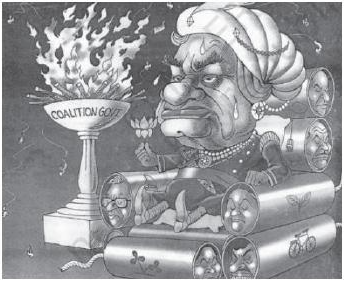
Image
Which of the following options best signifies the given cartoon?
  • A
    One Leader, One Party
  • B
    Perils of Running a Coalition Government
  • C
    The Coalition Government Pleads for More Powers
  • D
    Merits of Running a Coalition Government
View full solution
  • A
    Statement iii is right.
  • B
    Statement i and ii are right.
  • C
    Only statement iv is right.
  • D
    Statement i, ii and iii are right.
View full solution
Assertion (A) : The word scheduled is used for scheduled castes and scheduled tribes.
Reason (R) : These groups include hundreds of castes or tribes whose names are listed in an official Schedule.
  • A
    Both A and R are true and R is the correct explanation of A.
  • B
    Both A and R are true but R is not the correct explanation of A.
  • C
    A is true but R is false.
  • D
    A is false but R is true.
View full solution

Panchayati Raj


"We need to give more power to the panchayats to realise the dream of Mahatma Gandhi and the hopes of the makers of our Constitution, Panchayati Raj establishes true democracy. It restores power to the only place where power belongs in a democracy - in the hands of the people. Giving power to Panchayats is also a way to reduce corruption and increase administrative efficiency. When people participate in the planning and implementation of developmental schemes, they would naturally exercise greater control over these schemes. This would eliminate the corrupt middlemen. Thus, Panchayati Raj will strengthen the foundations of our democracy."
i. How does giving power to Panchayats relate to the vision of Mahatma Gandhi?
ii. Explain the primary objective of giving power to the Panchayats.
iii. How does the establishment of Panchayati Raj contribute to democracy? Explain.

View full solution
Rajesh, an ambitious entrepreneur, opened a wholesale store to sell locally-made textiles. He relied on the services of Priya, a skilled logistics coordinator, who efficiently organized the transportation and storage of the goods. Additionally, Rajesh sought assistance from Ankit, a knowledgeable banker, who provided financial support to expand his business. Together, they exemplified the vital role of tertiary sector activities in supporting the production and trade of goods. Which sector of the economy includes activities such as transportation, storage, communication, banking, and trade?
  • A
    Primary sector
  • B
    Quaternary sector
  • C
    Secondary sector
  • Tertiary sector

Answer: D.

View full solution
Match the following :
(a) An institution that mediates between the depositor and the borrowers(i) Micro-finance
(b) Debt trap(ii) Mode of payment
(c) The mode through which the borrower will repay the loan(iii) Credit(loan)
(d) Self Help Group(iv) Banks
  • (a) - (iv), (b) - (iii), (c) - (ii), (d) - (i)
  • B
    (a) - (iv), (b) - (ii), (c) - (iii), (d) - (i)
  • C
    (a) - (i), (b) - (iii), (c) - (ii), (d) - (iv)
  • D
    (a) - (iv), (b) - (i), (c) - (ii), (d) - (iii)

Answer: A.

View full solution
Choose the incorrect option from column A and column B :
Column A Category of personColumn B Developmental goals/Aspirations
(a) Landless rural labourers(i) More days of work and better wages
(b) Prosperous farmers from Punjab(ii) Availability of other sources of irrigation
(c) Farmers who depend only on rain for growing crops(iii) Assured a higher support price for their crops
(d) A rural woman from a landowning family(iv) Regular job and high wages to increase her income
  • A
    Only C
  • Only B
  • C
    All of these
  • D
    Both B and D

Answer: B.

View full solution
Fill in the blank :
FINAL PRODUCTINTERMEDIATE GOODS
BiscuitFlour, Sugar, Oil
Shirt?
  • A
    Yarn, Cloth, Machine
  • B
    Tailor, Sewing machine, Yarn
  • C
    Needle, Sewing machine, Yarn
  • Yarn, Fabric, Button

Answer: D.

View full solution
Read the information given below and select the correct option :
Swapna, a small farmer, grows groundnut on her three acres of land. She takes a loan from the moneylender to meet the expenses of cultivation, hoping that her harvest would help repay the loan. Midway through the season, the crop is hit by pests and the crop fails. She is unable to repay the moneylender and the debt grows over the year into a large amount. Next year, Swapna takes a fresh loan for cultivation. It is a normal crop this year. But the earnings are not enough to cover the old loan. She is caught in debt. She has to sell a part of the land to pay off the debt. Which situation is Swapna facing?
  • Situation of debt trap
  • B
    Situation of barter system
  • C
    Situation of lack of double coincidence of wants
  • D
    Situation of no collateral security

Answer: A.

View full solution
Two places A and B have been marked on the given outline map of India. Identify them and write their correct names on the lines marked on the map.
a. The place where the Indian National Congress Session was held.
b. The place from where Gandhiji organized Satyagraha in favour of Indigo planters.
View full solution

Generate a MODEL PAPER - 1 [2026] paper free

Pick question groups from the list above, set marks and difficulty, and export a branded PDF with step-by-step answer keys. First 3 chapters free — no signup.

Download App