Questions

MCQ (1 Mark)

🎯

Test yourself on this topic

4 questions · timed · auto-graded

MCQ 11 Mark
Arrange the following events of Indian National Movement in chronological order and choose the correct option.
I. Formation of Swaraj Party
II. Lahore Session of the Indian National Congress
III. Gandhi-Irwin Pact
IV. Formation of Depressed Class Association
  • A
    II, III, I and IV
  • B
    I, II, IV and III
  • C
    IV, III, II and I
  • D
    I, III, II and IV
Answer
(B) I, II, IV and III
Explanation:
I, II, IV and III
View full question & answer
MCQ 21 Mark
Indians boycotted the Simon Commission because:
  • A
    It was an all-British Commission.
  • B
    It was set up to oppose the nationalist Movement.
  • C
    It was formed in Britain.
  • D
    It was only for the privileged class of Indians.
Answer
(A) It was an all-British Commission.
Explanation:
A Statutory Commission under Sir John Simon set up in response to the nationalist movement, the commission was to look into the functioning of the constitutional system in India and suggest changes. The problem was that the commission did not have a single Indian member. They were all British.
View full question & answer
MCQ 31 Mark
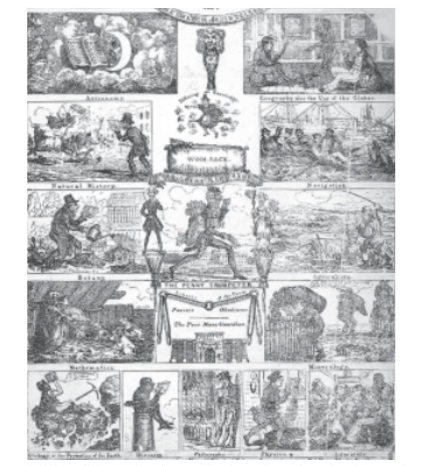
Study the picture and answer the question that follows:
Image
Which of the following option best describes the above picture?
  • A
    Frontispiece of Biliotheque Bleue
  • B
    Frontispiece of Penny Magazine
  • C
    Frontispiece of Accordion Book
  • D
    Frontispiece of Chap books
Answer
(B) Frontispiece of Penny Magazine
Explanation:
Penny Magazine was published between 1832 and 1835 in England by the Society for the Diffusion of Useful Knowledge. It was aimed primarily at the working class
View full question & answer
MCQ 41 Mark
Match the following:
(a) When an abstract idea is expressed through a person or a thing.(i) Ethnic
(b) It relates to a common racial, tribal, or cultural origin or background that a community identifies with or claims(ii) Ideology
(c) It is a system of ideas reflecting a particular social and political vision(iii) Conservatism
(d) A political philosophy that stressed the importance of tradition, established institutions and customs, and preferred gradual development to quick change(iv) Allegory
  • A
    (a) - (iv), (b) - (iii), (c) - (ii), (d) - (i)
  • B
    (a) - (iv), (b) - (iii), (c) - (i), (d) - (ii)
  • C
    (a) - (iii), (b) - (i), (c) - (ii), (d) - (iv)
  • D
    (a) - (iv), (b) - (i), (c) - (ii), (d) - (iii)
Answer
(D) (a) - (iv), (b) - (i), (c) - (ii), (d) - (iii)
Explanation:
(a) - (iv), (b) - (i), (c) - (ii), (d) - (iii)
View full question & answer
MCQ (1 Mark) - Social Studies STD 10 Questions - Vidyadip