Questions

CASE BASED QUESTIONS(4 Mark)

🎯

Test yourself on this topic

13 questions · timed · auto-graded

Question 14 Marks
Maharashtra is a state located in western India, with a population of over 110 million people. The state is home to several large cities, including Mumbai, and has a significant agricultural sector. However, the state is facing a severe water crisis, with its water resources coming under increasing pressure due to climate change, industrialization, and urbanization. The main challenges faced by water resource management in Maharashtra are:
i.Overexploitation of groundwater: Maharashtra is one of the most groundwaterstressed states in India, with the demand for water exceeding the supply. Overexploitation of groundwater for agriculture and urban use has led to a declinein water levels, which has severe implications for the sustainability of water resources.
ii. Pollution of surface water: Industrialization and urbanization have led to the pollution of surface water bodies such as rivers and lakes. The pollution has led to water quality degradation, which poses risks to human health and the environment.
iii. Inefficient irrigation practices: The agricultural sector is the largest user of water in Maharashtra, accounting for around 80% of total water use. However, traditional irrigation practices such as flood irrigation are inefficient and lead to the wastage of water.

Q.1. Mention any two reasons for the water crisis faced by the state of Maharashtra.
Q.2. Despite being the second highest rainfall-receiving state of the country, Maharashtra still faces water crisis. Substantiate this statement in 40 words.
Q.3. Propose any one solution to mitigate the water crisis faced by Maharashtra state.
Answer
A-1 Two reasons for Maharashtra facing a water crisis are overexploitation of groundwater and pollution of surface water bodies due to industrialization and urbanization.
A-2 Despite receiving the second-highest rainfall in the country, traditional irrigation practices like flood irrigation leading to water shortages in Maharashtra. This is because flood irrigation involves excessive water use, and the water gets lost due to runoff, leading to less water available for other uses.
A-3 To mitigate the water crisis in Maharashtra, one solution could be to promote the adoption of more efficient irrigation practices, such as drip irrigation and sprinkler systems, that use less water and are more targeted in their delivery. The state can also use rain water harvesting system to improve ground water levels along the western side of western Ghats which receive maximum rain fall. This will increase the efficiency of water use in the state of Maharashtra
View full question & answer
Question 24 Marks
Read the text given below and answer the questions that follow:
Sustained uses of land without compatible techno-institutional changes have hindered the pace of agricultural development. Inspite of development of sources of irrigation, most of the farmers in large parts of the country still depend upon monsoon and natural fertility in order to carry on their agriculture. For a growing population, this poses a serious challenge. Agriculture, which provides livelihood for more than 60 per cent of its population, needs some serious technical and institutional reforms. Thus, collectivisation, consolidation of holdings, cooperation, and abolition of zamindari, etc. were given priority to bring about institutional reforms in the country after Independence. ‘Land reform’ was the main focus of our First Five-Year Plan. The right of inheritance had already lead to fragmentation of land holdings, necessitating consolidation of holdings. The laws of land reforms were enacted, but the implementation was lacking or lukewarm. The Government of India embarked upon introducing agricultural reforms to improve Indian agriculture in the 1960s and 1970s. The Green Revolution based on the use of package technology and the White Revolution (Operation Flood) were some of the strategies initiated to improve the lot of Indian agriculture. But, this too led to the concentration of development in few selected areas. Therefore, in the 1980s and 1990s, a comprehensive land development programme was initiated, which included both institutional and technical reforms. Provision for crop insurance against drought, flood, cyclone, fire and disease, establishment of Grameen banks, cooperative societies and banks for providing loan facilities to the farmers at lower rates of interest were some important steps in this direction.
  1. In order to tackle the various problems faced by the Indian agriculture especially the pressure of growing population, various __________ and _____________ reforms have been initiated.
  1. Political, institutional.
  2. Technological, institutional.
  3. Administrative, judicial.
  4. Executive, organisational.
  1. Which of the following is associated with Operation flood?
  1. Green revolution.
  2. White revolution.
  3. Gene revolution.
  4. Blood revolution.
  1. This soil is mainly good for cultivation of.
  1. Improvement in the conditions of the farmers.
  2. Increase in irrigated area.
  3. Increase in the agricultural production.
  4. Mechanisation of farming.
  1. Which of the following measures is not introduced by the government to improve agriculture.
  1. Abolition of zamindari system.
  2. Consolidation of land holdings.
  3. Crop insurance.
  4. Maximum support price.
Answer
  1. (b) Technological, institutional.
  2. (b) White revolution.
  3. (c) Increase in the agricultural production.
  4. (d) Maximum support price.
View full question & answer
Question 34 Marks
Read the text given below and answer the questions that follow:
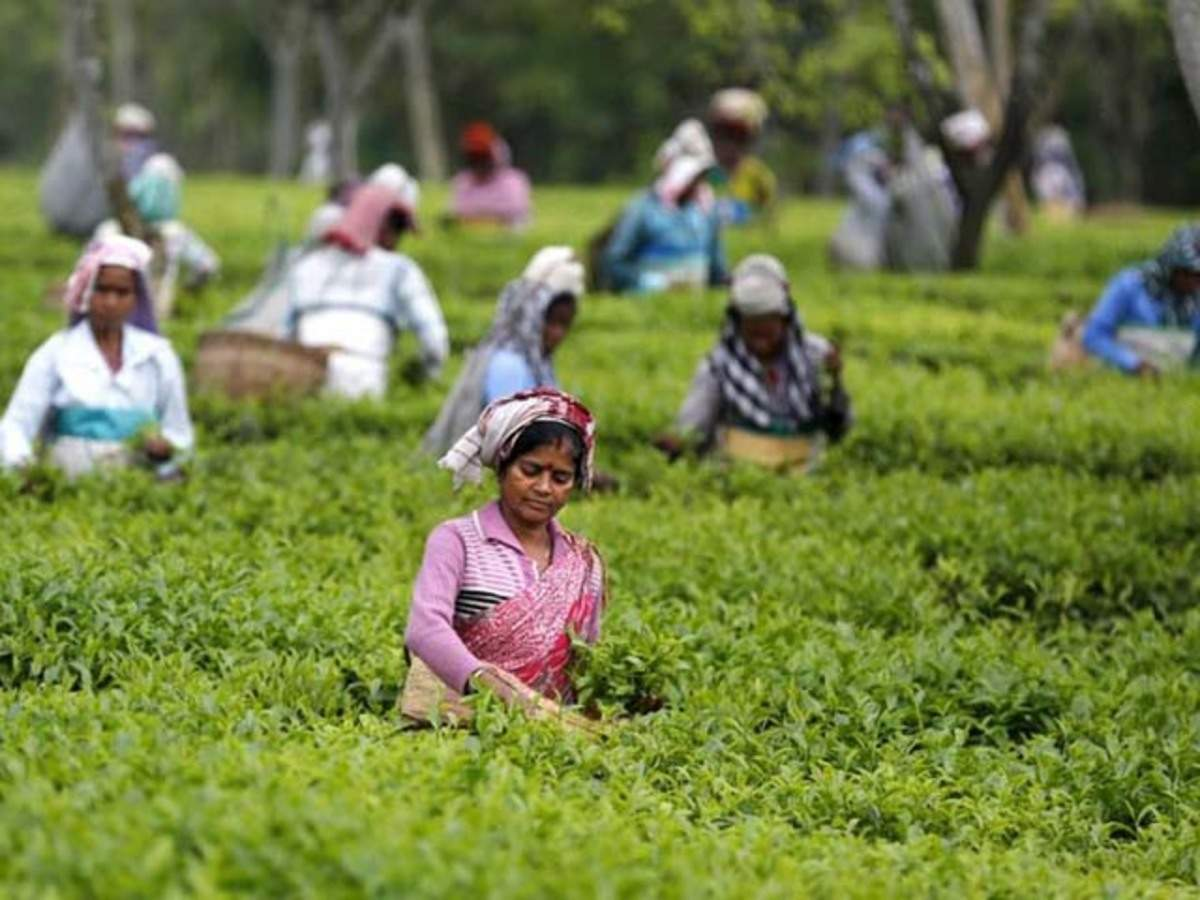
Tea cultivation is an example of plantation agriculture. It is also an important beverage crop introduced in India initially by the British. Today, most of the tea plantations are owned by Indians. The tea plant grows well in tropical and sub-tropical climates endowed with deep and fertile well -drained soil, rich in humus and organic matter. Tea bushes require warm and moist, frost -free climate all through the year. Frequent showers evenly distributed over the year ensure continuous growth of tender leaves. Tea is a labour-intensive industry. It requires abundant, cheap and skilled labour. Tea is processed within the tea garden; to restore its freshness. Major tea producing states are Assam, hills of Darjeeling and Jalpaiguri districts. West Bengal, Tamil Nadu and Kerala. Apart from these, Himachal Pradesh, Uttarakhand, Meghalaya, Andhra Pradesh and Tripura are also tea – producing states in the country. In 2017 India was the second largest producer of tea after China. Indian coffee is known in the world for its good quality. The Arabica variety initially brought from Yemen is produced in the country. This variety is in great demand all over the world. Initially its cultivation was introduced on the Baba Budan Hills and even today its cultivation is confined to the Nilgiris in Karnataka, Kerala and Tamil Nadu.
  1. What is common between Tea and Coffee?
  1. They are Beverages.
  2. They are plantation crops
  3. They grow in Hilly regions.
  4. All of the above
  1. Which of the following conditions can spoil tea crops?
  1. Frequent rains widespread throughout the year.
  2. Clayey soil, which has a high-water holding capacity.
  3. Deep fertile well -drained soil.
  4. Warm, moist and frost-free climate.
  1. India competes with ____ for its ____ of tea.
  1. China, consumption.
  2. Yemen, production.
  3. China, Production.
  4. Yemen, consumption.
  1. Taking a hint from the given picture: identify what are these women doing?
  1. Sowing the tea and coffee seeds.
  2. Plucking coffee beans.
  3. Pruning tea bushes.
  4. Plucking tea leaves.
Answer
  1. (d) All of the above.
  2. (b) Clayey soil, which has a high-water holding capacity.
  3. (c) China, Production.
  4. (d) Plucking tea leaves.
View full question & answer
Question 44 Marks
Read the text given below and answer the questions that follow:
Sustained uses of land without compatible techno-institutional changes have hindered the pace of agricultural development. In spite of development of sources of irrigation, most of the farmers in large parts of the country still depend upon monsoon and natural fertility in order to carry on their agriculture. For a growing population, this poses a serious challenge. Agriculture, which provides livelihood for more than 60 per cent of its population, needs some serious technical and institutional reforms. Thus, collectivisation, consolidation of holdings, cooperation and abolition of zamindari, etc. were given priority to bring about institutional reforms in the country after Independence. ‘Land reform’ was the main focus of our First Five-Year Plan.
  1. Institutional reforms are.
  1. Changes brought by State governments to improve agriculture.
  2. Changes brought by Central government to improve agriculture.
  3. Changes brought by both Central and State government from time to time to improve agriculture.
  4. Green Revolution.
  1. Grouping of small land holdings into a bigger one is called.
  1. The ceiling on land holdings.
  2. Collectivisation.
  3. Co-operation farming.
  4. Consolidation of land holdings.
  1. Which of the following isn’t included in the comprehensive land development programme of the 1980s and 1990s?
  1. Kisan credit card.
  2. Personal accident insurance scheme.
  3. Minimum Support Price
  4. Fragmentation of land holdings.
  1. Land reform included-
  1. Abolition of Zamindari
  2. Fragmentation of land holdings.
  3. Irrigation.
  4. Land ceiling
  1. i and ii.
  2. ii and iii.
  3. i and iv.
  4. iii and iv.
Answer
  1. (c) Changes brought by both Central and State government from time to time to improve agriculture.
  2. (d) Consolidation of land holdings.
  3. (c) Minimum Support Price.
  4. (d) iii and iv.
View full question & answer
Question 54 Marks
Read the text given below and answer the questions that follow:
India has three cropping seasons — rabi, kharif and zaid. Rabi crops are sown in winter from October to December and harvested in summer from April to June. Some of the important rabi crops are wheat, barley, peas, gram and mustard. Though these crops are grown in large parts of India, states from the north and north-western parts such as Punjab, Haryana, Himachal Pradesh, Jammu and Kashmir, Uttarakhand and Uttar Pradesh are important for the production of wheat and other rabi crops. Availability of precipitation during winter months due to the western temperate cyclones helps in the success of these crops. Kharif crops are grown with the onset of monsoon in different parts of the country and these are harvested in September-October. Important crops grown during this season are paddy, maize, jowar, bajra, tur (arhar), moong, urad, cotton, jute, groundnut and soyabean. Some of the most important rice-growing regions are Assam, West Bengal, coastal regions of Odisha, Andhra Pradesh, Telangana, Tamil Nadu, Kerala and Maharashtra, particularly the (Konkan coast) along with Uttar Pradesh and Bihar. In between the rabi and the kharif seasons, there is a short season during the summer months known as the Zaid season. Some of the crops produced during ‘zaid’ are watermelon, muskmelon, cucumber, vegetables and fodder crops. TERM-1, 2021
  1. Availability of ______________ during winter months due to western temperate cyclones help in the success of the Green Revolution.
  1. Sunshine.
  2. Precipitation.
  3. Cold climate.
  4. Hot climate.
  1. Crops grown during Rabi season are ______________ and ____________.
  1. Tea and Coffee.
  2. Cotton and Jute.
  3. Wheat and Peas.
  4. Aus and Aman.
  1. Kharif crops are harvested in:
  1. September and October.
  2. June and July.
  3. April and June.
  4. December and January.
  1. Crops which are grown in states like Assam, Bengal and Odisha during kharif season are –
  1. Rice, Wheat and Maize.
  2. Bajra, Rice and Wheat.
  3. Aus, Aman and Boro.
  4. Pulses, Cotton and Jute.
Answer
  1. (b) Precipitation.
  2. (c) Wheat and Peas.
  3. (a) September and October.
  4. (c) Aus, Aman and Boro.
View full question & answer
Question 64 Marks
Read the text given below and answer the questions that follow:
Rabi crops are sown in winter from October to December and harvested in summer from April to June. Some of the important rabi crops are wheat, barley, peas, gram, and mustard. Though, these crops are grown in large parts of India, states from the north and North-western parts such as Punjab, Haryana, Himachal Pradesh, Jammu and Kashmir, Uttarakhand and Uttar Pradesh are important for the production of wheat and other rabi crops. Availability of precipitation during winter months due to the western temperate cyclones helps in the success of these crops. However, the success of the green revolution in Punjab, Haryana, western Uttar Pradesh and parts of Rajasthan has also been an important factor in the growth of the above-mentioned rabi crops. Kharif crops are grown with the onset of monsoon in different parts of the country and these are harvested in September-October. Important crops grown during this season are paddy, maize, jowar, bajra, Tur (arhar), moong,urad, cotton, Jute, groundnut and soyabean. Some of the most important rice growing regions are Assam, Andhra Pradesh, Telangana, Tamil Nadu, Kerala and Maharashtra, particularly the (Konkan coast) along with Uttar Pradesh and Bihar. Recently, paddy has also become an important crop of Punjab and Haryana. In states like Assam, West Bengal and Odisha, three crops of paddy are grown in a year. These are Aus, Aman and Boro. In between the rabi and the Kharif seasons, there is a short season during the summer months known as the Zaid season. Some of the crops produced during ‘Zaid’ are the watermelon, muskmelon, cucumber, vegetables and fodder crops. Sugarcane takes almost a year to grow.
  1. Read the combination showing the cropping season (Sown).
X: June – July

Y: October- December

Z: Around March
  1. X-Rabi, Y-Kharif, Z-Zaid.
  2. X-Zaid, Y-Rabi, Z-Kharif.
  3. Kharif, Y-Zaid, Z-Rabi.
  4. X-Kharif, Y-Rabi, Z-Zaid.
  1. The three major cropping seasons of India are.
  1. Aus, Aman, Boro.
  2. Rabi, Kharif. Zaid.
  3. Bhadva, Shravan, Vasant.
  4. Summer. Winter, Monsoon.
  1. In between the two major seasons, Indian farmers take a break during the summer season and grow _______ crops.
  1. Kharif
  2. Rabi.
  3. Zaid.
  4. All of the above.
  1. The key word today is “gene revolution” which includes genetic engineering. Which of the following is recognized as genetic engineering?
S.no
Column I
S.no
Column II
a.
Peas & Mustard.
1.
Harvested September-October.
b.
Arhar and Bajra.
2.
Harvested in April-June.
 
  3. Harvested July - October.
  1. a-3, b-1.
  2. a-1, b-3.
  3. a-2, b-1.
  4. a-3, b-2.
Answer
  1. (d) X-Kharif, Y-Rabi, Z-Zaid.
  2. (b) Rabi, Kharif. Zaid.
  3. (c) Zaid.
  4. (c) a-2, b-1.
View full question & answer
Question 74 Marks
Read the text given below and answer the questions that follow:
Globalisation is not a new phenomenon. It was there at the time of colonisation. In the nineteenth century when European traders came to India, at that time too, Indian spices were exported to different countries of the world and farmers of south India were encouraged to grow these crops. Till today, it is one of the important items of export from India. During the British period cotton belts of India attracted the British and ultimately cotton was exported to Britain as a raw material for their textile industries. Under globalisation, particularly after 1990, the farmers in India have been exposed to new challenges. Despite being an important producer of rice, cotton, rubber, tea, coffee, jute and spices, our agricultural products are not able to compete with the developed countries because of the highly subsidised agriculture in those countries. Today, Indian agriculture finds itself at the crossroads. To make agriculture successful and profitable, proper thrust should be given to the improvement of the condition of marginal and small farmers. The green revolution promised much. But today it’s under controversies. It is being alleged that it has caused land degradation due to overuse of chemicals, drying aquifers and vanishing biodiversity. The keyword today is “gene revolution”, which includes genetic engineering. In fact, organic farming is much in vogue today because it is practised without factory made chemicals such as fertilisers and pesticides. Hence, it does not affect environment in a negative manner.
  1. The given extract throws light on _____________.
  1. Globalisation and the colonisation in agriculture
  2. Impact of globalisation on agriculture.
  3. New Economic policy pertaining to agriculture.
  4. None of these.
  1. Which of the following has been a direct disadvantage of globalisation to the farmer?
  1. Increase in global competition with the developed countries.
  2. Degradation of land due to the overuse of chemicals.
  3. Increased expenditure on buying HYV seeds.
  4. All the above.
  1. The method of farming done without using any type of chemical fertiliser, urea, insecticides is known as _____________.
  1. Mixed farming.
  2. Organic farming.
  3. Sustainable farming.
  4. Inorganic farming.
  1. The key word today is “gene revolution” which includes genetic engineering. Which of the following is recognized as genetic engineering?
  1. Powerful supplement in inventing insecticides and pesticides.
  2. Powerful supplement in inventing biological inputs and fertilisers.
  3. Powerful supplement in inventing new hybrid varieties of seeds.
  4. Powerful supplement in inventing organic and inorganic farming.
Answer
  1. (b) Impact of globalisation on agriculture.
  2. (d) All the above.
  3. (b) Organic farming.
  4. (c) Powerful supplement in inventing new hybrid varieties of seeds.
View full question & answer
Question 84 Marks
Read the passage given below and answer the following questions.

Groundwater in India

"Recent evidence suggests that the groundwater is under serious threat of overuse in many parts of the country. About 300 districts have reported a water level decline of over 4 meters during the past 20 years. Nearly one-third of the country is overusing their groundwater reserves. In another 25 years, 60 per cent of the country would be doing the same if the present way of using this resource continues. Groundwater overuse is particularly found in the agriculturally prosperous regions of Punjab and Western U.P., hard rock plateau areas of central and south India, some coastal areas and the rapidly growing urban settlements."
Q.1. Why ground water is overused?
Q.2. Can there be development possible without overusing of ground water

Answer
Q.1. Some of the reasons for the overuse of
groundwater are as follows: (a) Industrialisation and Urbanisation lead to pumping of large amounts of underground water.
(b) Introduction of food crops that use underground water (cultivation of rice in Punjab and Haryana). This is aggravated by poor irrigation facilities in many areas. (c) In some areas, wrong species of plants have been selected for afforestation projects which use large amounts of underground water.
Q.2. Yes, the development is possible without the overuse of ground water. This can be possible through sustainable development. In this kind of development, resources are used judiciously and wastage is minimized to ensure that the future generation does not suffer.
View full question & answer
Question 94 Marks
Read the case given below and answer the questions that follow:
Jhumming: The 'slash and burn' agriculture is known as 'Milpa' in Mexico and Central America, 'Conuco' in Venezuela' 'Roca' in Brazil, 'Masole' in Central Africa, 'Ladang' in Indonesia, "Ray' in Vietnam. In India, this primitive form of cultivation is called 'Bewar' or 'Dahiya' in Madhya Pradesh, 'Podu' in Andhra Pradesh, 'Pama Dabi' or 'Koman' or 'Bringa' in Odisha, 'Kumari' in Western Ghats, 'Valre' or 'Waltre' in South-eastern Rajasthan, "Khil' in the Himalayan belt, "Kuruwa' in Jharkhand, and 'Jhumming' in the North-eastern region.
Q.1. How is Primitive Subsistence Agriculture related with Jhumming?
Q.2. The 'slash and burn' agriculture is known as 'Conuco' and 'Roca' in which countries?
Q.3. What is the major problem of Jhumming cultivation?
Answer
Q.1. Primitive Subsistence Agriculture is a slash and burn agriculture, also known as Jhumming in north - eastern states like Assam, Meghalaya, Mizoram and Nagaland and is based on shifting cultivation.
Q.2. Venezuela and Brazil
Q.3. Productivity in Jhumming cultivation is low because farmers do not use fertilisers or other modern inputs.
View full question & answer
Question 104 Marks
Read the passage given below and answer the following questions:
In the early years, the cotton textile industry was concentrated in the cotton growing belt of Maharashtra and Gujarat. Availability of raw cotton, market, transport including accessible port facilities, labour, moist climate, etc. contributed towards its localisation. This industry has close links with agriculture and provides a living to farmers, cotton boll pluckers and workers engaged in ginning, spinning, weaving. dyeing, designing, packaging, tailoring and sewing. The industry by creating demands supports many other
industries, such as; chemicals and dyes, packaging materials and engineering works. While spinning continues to be centralised in Maharashtra, Gujarat and Tamil Nadu, weaving is highly decentralised to provide scope for incorporating traditional skills and designs of weaving in cotton, silk, zari embroidery, etc. India has world class production in spinning, but weaving supplies low quality of fabric as it cannot use much of the high quality yarn produced in the country. Weaving is done by handloom, powerloom and in mills.
Q.1. Which group of states has the largest number of cotton textile centres?
Q.2. How is cotton industry interlinked with agriculture?
Q.3. Why is it important for us to improve our weaving sector instead of exporting in large quantities?
Answer
Q.1. Gujarat and Maharashtra have the largest number of cotton textile centres.
Q.2. Cotton industry has close links with agriculture
as it gets raw materials from agriculture.
Q.3. India exports yarn in large quantities because our weaving sector cannot use much of the high quality yarn produced in the country. If home weaving sector is developed it could earn much benefits through proper utilisation of cotton yarn.
View full question & answer
Question 114 Marks
Read the passage given below and answer the following questions:
Agriculture has been the backbone of the Indian economy though its share in the Gross Domestic Product (GDP) has registered a declining trend from 1951 onwards; According to Census of India 2011 about 54.6 per cent of the total work force was employed by the farm sector which makes more than half of the Indian Population dependent on agriculture for sustenance. The declining share of agriculture in the GDP is a matter of serious concern because any decline and stagnation in agriculture will lead to a decline in other spheres of the economy having wider implications for society. Considering the importance of agriculture in India, the Government of India made concerted efforts to modernise agriculture. Establishment of Indian Council of Agricultural Research (ICAR), agricultural universities, veterinary services and animal breeding centres, horticulture development, research and development in the field of meteorology and weather forecast, etc. were given priority for improving Indian agriculture.
Q.1. What steps are taken by the government to modernise agriculture?
Q.2. What is the purpose of establishment of ICAR?
Q.3. Why is the declining share of agriculture a matter of concern?
Answer
Q.1. (a) Establishment of ICAR
(b) Veterinary services
(c) Horticulture development
(d) Weather forecast
Q.2. The purpose of establishment of ICAR is to modernise agriculture.
Q.3. Any decline and stagnation in agriculture will lead to a decline in other spheres of the economy.
View full question & answer
Question 124 Marks
Read the case given below and answer the questions that follow:
The other major source of cheap credit in rural areas are the cooperative societies (or cooperatives). Members of a cooperative pool their resources for cooperation in certain areas. There are several types of cooperatives possible such as farmers cooperatives, weavers cooperatives, industrial workers cooperatives, etc. Krishak Cooperative functions in a village not very far away from Sonpur. It has 2300 farmers as members. It accepts deposits from its members. With these deposits as collateral, the Cooperative has obtained a large loan from the bank. These funds are used to provide loans to members. Once these loans are repaid, another round of lending can take place. Krishak Cooperative provides loans for the purchase of agricultural implements, loans for cultivation and agricultural trade, fishery loans, loans for construction of houses and for a variety of other expenses.
Q.1. List the various sources of cheap credit in Sonpur.
Q.2. How 'Krishak cooperative' functions?
Q.3. Can everyone in Sonpur get credit at a cheap rate?
Answer
Q.1. Various sources of cheap credit in Sonpur are commercial banks and cooperative societies.
Q.2. Krishak Cooperative has 2300 farmers as members, it accepts deposits from its members and uses that deposits as collateral to obtain a loan from the bank. These funds are used to provide loans to members.
Q.3. No, only the following people in Sonpur can get credit at a cheap rate:
(a) Those who have collateral.
(b) Those who have organised themselves into cooperative society.
(c) Those who can fulfill the documentation requirements of banks.
View full question & answer
Question 134 Marks
Read the source given below and answer the questions that follows:
Many thought that given the disadvantages and rising resistance against the multipurpose projects, water harvesting system was a viable alternative, both socio-economically and environmentally. In ancient India, along with the sophisticated hydraulic structures, there existed an extraordinary tradition of water- harvesting system. People had in-depth knowledge of rainfall regimes and soil types and developed wide C ranging techniques to harvest rainwater, groundwater, river water and flood water in keeping with the
local ecological conditions and their water needs. In hill and mountainous regions, people built diversion channels like the 'guls' or 'kuls' of the Western Himalayas for agriculture. "Rooftop rainwater harvesting' was commonly practiced to store drinking water, particularly in Rajasthan. In the flood plains of Bengal, people developed inundation channels to irrigate their fields. In arid and semi-arid regions, agricultural fields were converted into rain fed storage structures that allowed the water to stand and moisten the soil like the "khadins' in Jaisalmer and 'Johads' in other parts of Rajasthan.
Q.1. Which type of water harvesting system is practiced in Rajasthan and why?
Q.2. Why people of Bengal have developed inundation channels?
Q.3. What are 'Khadins' and 'Johads' in Rajasthan?
Answer
Q.1. Rajasthan is a state which faces water shortage due to low rainfall. People use rooftop rainwater harvesting to meet their demands.
Q.2. People of Bengal have developed inundation channels in the flood plains to irrigate their fields.
Q.3. Khadins and Johads are rain fed storage structures in agricultural field and in arid and semi- arid regions.
View full question & answer
CASE BASED QUESTIONS(4 Mark) - Social Studies STD 10 Questions - Vidyadip