Questions

LONG ANS. QUESTIONS(5 Mark)

🎯

Test yourself on this topic

42 questions · timed · auto-graded

Question 15 Marks
Classify resources on the basis of the status of development into four groups. Explain the main features of each group.
Answer
On the basis of development, resources can be classified into four main groups: Potential resources, developed resources, stock resources and reserve resources. Their main features are
  1. Potential resources: Potential resources are those resources which are found in the region but have not been used. For example, the states of Gujarat and Rajasthan have tremendous potential for the development of solar energy, but it has not been fully used till yet.
  2. Developed resources: Developed resources are those resources whose quality and quantity have been determined for utilisation.
  3. Stock: These are resources which can satisfy human needs, but humans do not have the technical know-how to utilise these resources.
  4. Reserves: Humans have the technology of harnessing the reserve resources, but their use has not been started.
View full question & answer
Question 25 Marks
What are public facilities? Give exaples.
Answer
The following points:
  1. Public facilities includes facilities like health, electricity, water, sanitation, schools provided by the government.
  2. Since these facilities are provided by government, the latter has to ensure that they are within everybody's reach and are affordable.
  3. These facilities are must for a person to live a dignified life.
  4. Government must ensure universal access to such facilities.
  5. Denial of such facilities would amount to violation of fundamental rights.
  6. These facilities are important for the growth and development of the society and country at large.
  7. It is imperative that such services reach to all, transcending all differences.
  8. These facilities uphold the values of justice, equality in terms of having universal access to these services and fairness.
  9. They also uphold freedom to use such services.
  10. These services underline the value of leading a dignified life.
View full question & answer
Question 35 Marks
Mention the aspirations or development goals for the following:
  1. A boy from rich urban family.
  2. A girl from rich urban family.
  3. Landless rural labourers.
  4. Urban employed youth.
Answer
  1. A boy from rich urban family:
  1. Good education.
  2. A motor car.
  3. Full facilities for going abroad.
  1. A girl from rich urban family:
  1. To get as much freedom as her brother enjoys.
  2. Freedom to decide her own future including her marriage.
  3. If possible, to go abroad to get higher education.
  1. Landless rural labourers:
  1. More days of work and better wages.
  2. Educational facilities to provide quality education to their children.
  3. No social discrimination so that their children could become leaders in the village.
  1. Urban employed youth:
  1. To get a better job at the earliest.
  2. Banks should provide him loans at cheaper rates.
  3. Government should provide him social security as in foreign lands.
View full question & answer
Question 45 Marks
Discuss the value associated with public facilities.
Answer
Public facilities are services provided by the government to its citizens. Some of the important public facilities include infrastructure, sanitation, public transport, health care, water, etc. The government's main objective is to provide these public facilities to citizens and businesses to manage social and economic activities more smoothly. some of the public facilities in India are:
Infrastructure: Infrastructure includes public roads, bridges, highways, dams and electricity. The government is proposing various initiatives and programs to put this infrastructure in place. The provision of this basic infrastructure ensures the safe movement of people and materials in all regions of the country. India has come a long way in infrastructure development, but much work remains to be done as some remote areas of the country are still not connected to other developed regions.
Public transport: Good public transportation is an essential facility that allows citizens of the country to travel locally and across the country faster, safer and more affordable. Public transport includes railways, buses, airlines, etc. The connectivity of the different regions of the country between them is taken into consideration when planning public transport. Railways and buses have good connectivity in India however, air connectivity remains a problem for some regions but slowly the situation is improving.
Health care: Health is one of the most important public facilities that must be provided by the government. Planning and implementation of government medical facilities such as hospitals, health centres and affordable drugs should be carried out in all regions of the country. In India, the government has set up civilian hospitals and medical centres in various parts of the country, which provide basic services to advance medical aid to citizens. In addition to this, the government has also set up research and development centres that are constantly working to develop medical solutions for some of the modern diseases.
View full question & answer
Question 55 Marks
With the help of an example show two groups may have different notions of development.
OR
"What may be development for one may not be development for the other?” Explain by giving examples.
Answer
  1. Sustainability of development means that development which is not only for the present time but is also for the future generations. Sustainability is the capacity to use the resources judiciously and maintain the ecological balance.
  2. Every generation wants to get the maximum benefits from the available resources but such a thing would be quite disastrous because the available resources shall be exhausted within a short time and the coming generations will be deprived of such resources.
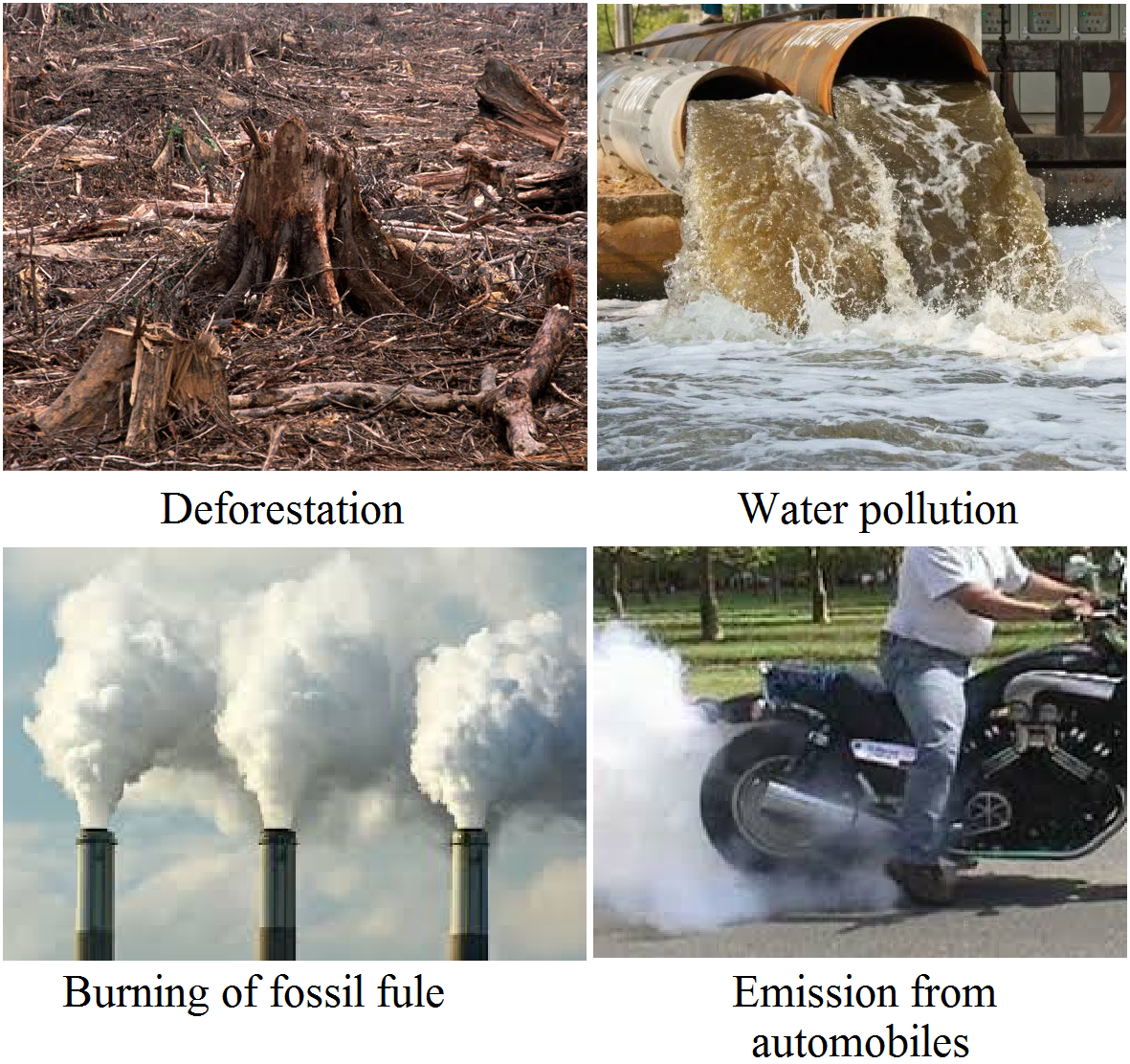
  3. Environmental degradation can be observed in different ways. Deforestation, falling levels of groundwater, soil erosion, water pollution, burning of fossil fuels, the hole in the ozone layer and combustion from automobiles causing extreme air pollution especially in urban areas are some of the examples of environmental degradation.

Sustainable development can be achieved by judicious use of both renewable and non-renewable resources and without disturbing the balance of environment keeping in mind the requirement for present and future generations.
View full question & answer
Question 65 Marks
Suggest some of the measures for sustainable development.
Answer
  1. Using natural resources properly and scientifically.
  2. Reducing pollution or environmental degradation.
  3. Protecting flora and fauna from human exploitation.
  4. Using even inexhaustible resources (wind, solar energy, etc.) in a cautious manner.
  5. Using land for cultivation wisely so that its fertility is maintained.
  6. Controlling over uses and creating an awareness to provide sustainable development.
  7. Increased use of renewable resources.
  8. Less use of fossil fuels.
  9. Introduction of organic farming.
  10. Adopting measures to reduce global warming.
View full question & answer
Question 75 Marks
Identify different thrust areas of Human Development.
Answer
Major thrust areas for Human Resource Development (HRD) are:
  1. Education in India and development of human resources: To improve the pace of capital formation, human resource development is essential in the form of change in the existing educational system and also by increasing expenditure on education. The changes should include elementary education especially universalisation of free and compulsory education up to the age of 14, to regulate with new facilities being created for deprived sections such as girls, SCs and STs in rural areas, thrust to vocationalisation of secondary education a centrally sponsored scheme was launched in February, 1998, thrust for higher education etc.
  2. Health and nutrition: Based on Health Survey and Development Committee, 1946 and the Health Survey Planning Committee, the Government of India raised the health standard provisions to ensure the control of epidemics, better health services to control various diseases, to train employees in health department and primary health center development in the rural sector. During the planning period, Government of India initiated family welfare and nutritional programmes for vulnerable groups, a special health scheme to provide a few medical facilities to relatively neglected sections of the society, to raise the number of hospital beds in urban areas and rural hospitals, improv­ing the health status of the population by full coverage and quality of care in infrastructure, manpower, equipment etc.
  3. Gender equality: Removal of gender disparity in the educational system, improved working condition, equal treatment and secured environment for women to take up jobs in the society. In a nation, the empowered women contribute to health, nutrition and productivity of family which helps to improve the whole community prospects for the future generation.
View full question & answer
Question 85 Marks
Write were limitations of the average value.
Answer
Averages are used because to classify the countries based on only their total income is not correct as different countries have different populations. However, calculations based on average income have its own limitation because it does not tell us about whether the distribution of income in a country is distributed equally or unequally.
For example, there are two countries X and Y with five citizens each. Following table tells us about the income of these citizens.
Country
Citizen A (Monthly income in Rs)
Citizen B (Monthly income in Rs)
Citizen C (Monthly income in Rs)
Citizen D (Monthly income in Rs)
Average Income
X
20,000
2,000
1,000
1,000
Rs. 6,000
Y
2,000
3,000
3500
3500
Rs. 3000
In the above example, the average income of country X and Y is Rs. 6000 and Rs. 3,000 respectively. But we see that while the average income of country X is the double of country Y, there is more disparity of income in country X than in country Y.
View full question & answer
Question 95 Marks
Why do different people have different notions of development? Explain with examples.
OR
Why do different individuals have different as well as conflicting notions of development goals?
Answer
  1. Ideologies of different people regarding different notions of development could be at times conflicting.
  2. Developmental goals are the aspirations and desires of the people. They are different for different individuals. Since people come from different situations, therefore, their developmental goals differ.
  3. They seek things that are most important for them, i.e., that which can fulfil their aspirations or desires. In fact, at times, two persons or groups of persons may seek things which are conflicting.
  4. A girl expects as much freedom and opportunity as her brother, and that he also shares in the household work. Her brother may not like this.
  5. Similarly, to get more electricity, industrialists may want more dams. But this may submerge the land and disrupt the lives of people who are displaced such as tribals. They might resent this and may prefer small check dams or tanks to irrigate their land.
  6. The Sardar Sarovar Dam is an example of conflicting developmental goals for the people who are being affected by it. While the people of Gujarat are happy as they will get water for irrigation and drinking in the areas which are deficient in water but the people of Madhya Pradesh are disappointed as their villages and large part of land will submerge in water thereby leaving them landless, uprooted from their place of work with insufficient compensation and no source of job at the place of their living.
View full question & answer
Question 105 Marks
What is the necessity of comparing different countries or states? Give one example of a recent model of comparison.
Answer
Different countries in the world are compared in order to find the developmental rates of each country or a state. How can we find that which country has the highest percapita income or in which country the literacy rates are high? It is only by compariong various countries we come to know about which country offer better job opportunities or better working conditions. Based on the development reports also, many investors invest in the country which has better infrastructure, technology and have politically stable government.
Generally we use a model of comparison which uses per capita income of the country, the literacy rates and the general health levels of the people as the criteria for comparing the notion of development among the countries.
View full question & answer
Question 115 Marks
Distinguish between developed countries and developing countries.
Answer
S. No
Developed Countries
Developing countries
1
The rates of saving, investment, capital information are also very high and the commodities are produced on a large scale with the help of modern technology.
They are on the path of development, and the level of income is on rise along with the advancement of technology.
2
The standard of living of the people is very high.
The standard of living of the people is not very high.
3
Life expectancy is high due to good health facilities.
Life expectancy is low due to less health facilities.
4
Literacy rates are high due to better education.
Literacy rates are low due to less educational facilities.
5
Example- USA
Example- India.
View full question & answer
Question 125 Marks
The following table shows the proportion of undernourished adults in India. It is based on a survey of various states for the year 2001. Look at the table and answer the following questions.
State
Male (%)
Female (%)
Kerala
Karnataka
Madhya Pradesh
22
36
43
19
38
42
All States
37
36
  1. Compare the nutritional level of people in Kerala and Madhya Pradesh.
  2. Can you guess why around 40 per cent of people in the country are undernourished even though it is argued that there is enough food in the country? Describe in your own words.
Answer
  1. The nutritional level of people of Kerala is quite higher than the people of Madhya Pradesh. Their ratio of the under-nourished is less than that of Madhya Pradesh.
Kerala has only 22% male and 19% female adults living undernourished whereas percentage of undernourished in Madhya Pradesh is 43% adult males and 42% adult females.
  1. There is enough food in the country, even then 40% of the people in the country are undernourished because:
  1. A large number of people are so poor that they cannot afford nutritious food. There is lack of educational and health facilities in many parts of the country.
  2. In most of the states, the Public Distribution System (PDS) does not function properly and the poor people cannot get cheap food items.
View full question & answer
Question 135 Marks
What do you understand by sustainability of development? What can be done to make development sustainable?
Answer
Sustainability of development means economic development without any damage to the environment.
However, since the second half of the twentieth century, a number of scientists have been warning that the present type, and levels of development are not sustainable.
To make development sustainable, non-renewable sources of energy are to be saved for the future generation. The development of the country would continue but the technology has to be made eco-friendlyso that it does not harm the environment.
View full question & answer
Question 145 Marks
The average person in Punjab has more income than the average person in Kerala but lags behind in other crucial areas. Why?
OR
Explain with reasons why state of Punjab with a very high per capita income has a very low literacy rate.

OR
How is it that the average person in Punjab has more income than the average person in Kerala but it lags behind many other crucial areas? Explain.
Answer
  1. Per capita income of Punjab is higher than Kerala.
  2. Literacy rate of Punjab according to 2011 census is 75.84% and Kerala is 94%, i.e., Punjab lags behind Kerala.
  3. Therefore, income by itself is not a completely adequate indicator of material goods and services that citizens are able to use.
  4. Over the past decade, health and education indicators have come to be widely used along with income as a measure of development.
  5. Kerala has a low infant mortality rate as it has adequate provision of basic health and educational facilities.
View full question & answer
Question 155 Marks
Distinguish between total income and average income. Which one is a better incident of economic development and why?
Answer
Total Income is the income on which tax liability is determined. Total income is also know as the sum of money recieved by an individual or an organization. It measures the size of the economy.
Average income or Per capita income measures the average income earned per person in a given area (city, region, country, etc.) in a specified year. It measures the prosperity of the country.
Average income is the better indicator of economic development, because it divides total income by total population and it adds up-to the countries economy.
View full question & answer
Question 165 Marks
Find out present sources of energy used by people in India. What could be possibilities fifty years from now?
Answer
The present sources of energy that are used by the people of India are electricity, coal, crude oil, cowdung and solar energy. At present, consumption of energy in India is too high in comparison to its production and reserves. India's known reserves of oil are expected to last about 30-40 years only. So therefore other possibilities fifty years from now, could include ethanol, bio-diesel, nuclear energy and a better utilisation of wind energy, especially with the imminent danger of oil resources running out.
View full question & answer
Question 175 Marks
  1. Mention two developmental goals of prosperous farmers from Punjab.
  2. Why has Kerala a higher Human Development Index than Punjab in spite of low per capita income?
Answer
  1. Two developmental goals of prosperous farmers from Punjab:
  • High family income through higher support prices for their crops and through hardworking and cheap labourers.
  • Ability to get their children settled abroad.
  1. Per capita income of Punjab is higher than Kerala as:
  • Literacy rate of Punjab according to 2011 census is 75.84% and Kerala is 94%, i.e., Punjab lags behind Kerala.
  • Therefore, income by itself is not a completely adequate indicator of material goods and services that citizens are able to use.
  • Over the past decade, health and education indicators have come to be widely used among with income as a measure of development.
  • Kerala has a low infant mortality rate as it has adequate provision of basic health and educational facilities.
View full question & answer
Question 185 Marks
Kerala, with lower per capita income has a better human development ranking than Punjab. Hence, per capita income is not a useful criterion at all and should not be used to compare states. Do you agree? Discuss.
Answer
Some Comparative Datas on Punjab and Kerala.
States
Infant Mortality Rate per 1,000 (2003)
Literacy Rate (%) (2001)
Net-Attendance Ratio for class l-V (1995-96)
Per Capita Income for 2000 (in Rs.)
Punjab
49
70
81
26,000
Kerala
11
91
91
22,800
I do agree in full with it.
Discussion:
  1. No doubt Kerala’s per capita income is lower than Punjab as given in table. But the other factors such as infant mortality rate per 1,000 (year 2003) is 11 in Kerala while it is 49 in Punjab. It indicates health facilities are neglected in Punjab.
  2. Another criterion of net attendance ratio is also more favourable in Kerala than Punjab.
  3. Total literacy rate of Kerala is also more favourable than Punjab.
View full question & answer
Question 195 Marks
Why is literacy essential for the economic development? Explain.
Answer
Literacy is an essential element for the economic development since:
  1. Education only gives us vast knowledge.
  2. A literate person is eligible to get suitable employment.
  3. Education develops the ability to implement modern technology.
  4. With the knowledge of professionals, technology can develop and help in the development of the country.
  5. Literate people understand the importance of remaining healthy and stay away from the deadly disease.
View full question & answer
Question 205 Marks
In Tamil Nadu, 75 percent of the people living in rural areas use a ration shop, whereas in Jharkhand only 8 percent of rural people do so. Where would people be better off and why?
Answer
In Tamil Nadu, 75% people are living in rural areas and they use ration shop, whereas in Jharkhand only 8% of rural people are living there use a grocery store, so clearly we can see that people are doing better in Tamil Nadu as there are 75% of people are being provided the facilities by the Public Distribution System. And on the second hand people of Jharkhand are not in good condition.
View full question & answer
Question 215 Marks
Name some allied-agricultural activities to need to be promoted to solve the problem of unemployment.
Answer
Agricultural sector often faces underemployment or disguised unemployment in India. To eradicate such disadvantages, There are many allied agricultural activities that need to be promoted to solve the problem of unemployment like Dairy farming that can give employment to various people.
Promoting small and medium enterprises that are dependent or related to agriculture like cottage industries etc.
These include a multi-cropping system, promotion and location of agro-based industries in semi-rural and rural areas.
View full question & answer
Question 225 Marks
What are the developmental goals of landless rural labourers, prosperous farmers and, farmers who depend only on rains?
Answer
Developmental goals and aspirations for these farmers are different:
  1. Landless Rural Labourers: They would like to have more days of work and better wages; local schools to provide quality education to their children; there should not be any social discrimination so that they too can become leaders in the village.
  2. Prosperous Farmers: They should have assurance of high family income through higher support prices for their crops through hardworking and cheap labourers. They also want that they should be able to settle their children abroad.
  3. Farmers who depend Only on Rains: These kind of farmers’ main goal is to have irrigational facilities, crop insurances on less premium and better facilities of life for them as well as their children.
View full question & answer
Question 235 Marks
What is the criterion used by the UNDP for classifying countries?
Answer
United Nations Development Programme (UNDP) has used the criterion of Human Development Index to measure the development of countries.HDI is calculated on the basis of:
  1. Per capita income: When the total national income of the country is divided by its population, we get the per capita income.
  2. Life expectancy: It measures the average age of a person in a country. It helps us to know the health facilities of a country.
  3. Literacy rate: Education is also one of the most important criteria for the development of a country.
  4. Gross enrolment ratio: It measures the education gained at three levels—at the primary, secondary and higher education level.
Per capita income is also calculated in dollars for all countries so that it can be compared easily. HDI has been calculated for about 177 countries. According to it, the rank of India is 131 and the rank of Sri Lanka is 73, which is much better than that of India. We are required to make progress in the education and health sectors as yet.
View full question & answer
Question 245 Marks
What is the implication of having high HDI for the country?
Answer
Human Development Index is known as HDI.
It determines the development of a countries population looking through the per capita income, health, education and many other social factors.
Through the HDI a countries social health in large and economic health, in general, is reflected. The real development is reflected through this index.
When a country has a high HDI, it essentially means that the lifespan is higher, the education levels are higher along with higher per capita income. This makes the country a developed country. Countries like USA, France Japan have high HDIs’ making them developed countries.
View full question & answer
Question 255 Marks
What does sustainability of develop ment mean? How can sustainable development be achieved?
Answer
  1. Sustainability of development means that development which is not only for the present time but is also for the future generations. Sustainability is the capacity to use the resources judiciously and maintain the ecological balance.
  2. Every generation wants to get the maximum benefits from the available resources but such a thing would be quite disastrous because the available resources shall be exhausted within a short time and the coming generations will be deprived of such resources.
  3. Environmental degradation can be observed in different ways. Deforestation, falling levels of groundwater, soil erosion, water pollution, burning of fossil fuels, the hole in the ozone layer and combustion from automobiles causing extreme air pollution especially in urban areas are some of the examples of environmental degradation.

Sustainable development can be achieved by judicious use of both renewable and non-renewable resources and without disturbing the balance of environment keeping in mind the requirement for present and future generations.
View full question & answer
Question 265 Marks
“The Earth has enough resources to meet the needs of all but not enough to satisfy the greed of even one person”. How is this statement relevant to the disscusion of development? Discuss.
Answer
Consequences of environmental degradation do not respect national or state boundaries; this issue is no longer region or nation specific. Our future is linked together.
The reckless exploitation of resources which are limited in stock may lead to their exhaustion. The reckless use of fossil fuels and minerals may disturb the balance in nature. Therefore, it is necessary to use resources judiciously and adopt the environment friendly strategies of development.
View full question & answer
Question 275 Marks
Why do we use averages? Are there any limitations to their use? Illustrate with your own examples related to development
Answer
We use averages because they are useful for comparing differing quantities of the same category. For example, to compute the per capita income of a country, averages have to be used because there are differences in the incomes of diverse people. However, there are limitations to the use of averages. Even though they are useful for comparison, they may also hide disparities. For example, the infant mortality rate of a country does not differentiate between the male and female infants born in that country. Such an average tells us nothing about whether the numbers of children dying before the age of one are mostly boys or girls.
View full question & answer
Question 285 Marks
Explain the meaning of HDI. Mention three components of measuring HDI.
Answer
HDI stands for Human Development Index. It may be defined as the process of widening people’s choice as well as raising the level of well-being. The concept of HDI goes beyond income and growth to cover all human choices. It puts the people at the centre stage and covers all aspects of human development with the object of improving the conditions of people from all angles. It is a broader approach to development.Components of Measuring HDI:
  1. Life Expectancy: It is the average expected length of life of a person at the time of birth.
  2. Per Capita Income: Mean income of the people is an economic unit. It is calculated by dividing the total national income of a country by population. It is calculated in dollars for all the countries so that it can be compared.
  3. Gross Enrolment Ratio for Three Levels: It means enrolment ratio for primary schools, secondary schools and higher education beyond secondary level.
View full question & answer
Question 295 Marks
Mention the differences between developed countries and developing countries.
Answer
Comparison Chart
Basis
Developed Countries
Developing Countries
Definition
A country having an effective rate of industrialisation and individual income
A country which has a slow rate of industrialisation and low per capita income.
Status
Independent and Prosperous
Dependent and impoverished.
Available Resources
Effectively utilised
Ineffectively utilized.
Dependency
Self-contained and flourished
Dependent and emerging to be developed.
Literacy Rate
High
Low
Infrastructure
High standard of living and a better environment in terms of health and safety
Moderate standard of living in terms of health and safety.
Growth
High Industrial Growth.
They rely on the developed countries for their growth.
Rates
Low infant mortality rate, death rate and birth rate while high life expectancy rate
High infant mortality rate, death rate and birth rate, along with low life expectancy rate.
Poverty and Unemployment
Low
High.
Generates more revenue from
Industrial sector
Service sector.
Distribution of Income
Equal
Unequal.
HDI (Human Development Index)
High
Low.
GDP
High
Low.
View full question & answer
Question 305 Marks
Distinguish between the following:
  1. National income and per capita income.
  2. Renewable and non-renewable resources.
  3. Developed and underdeveloped countries.
Answer
  1. The sum total of all goods and services produced within a country during a period of one year plus net income from abroad is called national income. It is the ratio of income of the country for a particular year to the population of that country of that year whereas per capita income is the total income of the country divided by its total population.
  2. Resources that are replenished by nature are known as renewable resources, e.g. groundwater. Resources that are not replenished that is those which will get exhausted after some time are known as non-renewable resources, e.g., crude oil.
  3. A developed country is one which possesses the characteristics of higher standard of living of the people, fuller utilisation of resources, and a modern technology whereas an underdeveloped country is one which lacks the use of modern technology, has low per capita income of the people, and under-utilisation of the resources.
View full question & answer
Question 315 Marks
"Money cannot buy all the goods and services that a person may need to live well." Explain the statement with suitable examples.
Answer
  1. Income by itself is not a completely adequate indicator of material goods and services that citizens are able to use.
  2. Our money cannot buy for us a pollution-free environment or ensure that you get unadulterated medicines, unless we can afford to shift to a community that already has all these things.
  3. Money may also not be able to protect us from infectious diseases, unless the whole of our community takes preventive steps.
  4. The average person in Punjab has more income than the average person in Kerala but lags behind, many crucial areas such as literacy rate, infant mortality rate, etc.
View full question & answer
Question 325 Marks
What is national development? What are the aspects covered under the national development?
Answer
National development means the ideology of different persons regarding countries' development. These ideologies could be at times conflicting. It is measured by average income and per capita income.The following aspects or points are covered under the national development:
  1. If there are conflicts how does one decide?
  2. We also have to think whether there is a better way of doing things.
  3. Would the idea benefit a large number of people or only a small group?
View full question & answer
Question 335 Marks
What is the main criterion used by the World Bank in classifying different countries? Describe its limitations.
Answer
The main criterion used by the World Bank in classifying different countries:Countries with per capita income of US$ 12616 per annum and above in 2012, are called rich countries and those with per capita income of US$ 1035 or less are called low-income countries. India comes in the category of low middle income countries because its per capita income in 2012 was just US$ 1530 per annum. The rich countries, excluding countries of Middle East and certain other small countries, are generally called developed countries.
Limitations:
Limitations of this criterion are that while average income is useful for competition, it does not tell us how this income is distributed among people. A country may have more equitable distribution. People may be neither very rich nor extremely poor. But in another country with same average income, one person may be extremely rich, while others may be very poor. So, the method of average income does not give correct picture of a country.
This criterion hides disparities among people.
View full question & answer
Question 345 Marks
Compare the level of development in India taking at least three states on the basis of various aspects other than income.
Answer
According to the UNDP, human development-or the human development approach-is about expanding the richness of human life, rather than simply the richness of the economy in which human beings live. The United Nations Development Programme (UNDP) uses three attributes to measure the Human Development Index (HDI) of a country.
  1. Levels of wealth within the country as measured by GDP per capita and adjusted in purchasing power parity (PPP).
  2. Health: measured by average life expectancy.
  3. Education: measured by the percentage of the population in education at a particular age (primary, secondary and tertiary) and literacy levels (educational attainment).
The above three attributes present an all-round development picture for respective countries. In India, the HDI for states can also be calculated in a similar fashion. Since different states have different populations, total income does not work as a good comparative measure. Average value of income is derived by dividing the total income of the state by the total population and is also called per capita income. Although average income is used for comparison purposes, it is not an absolute measure as it can hide disparities as it does not state whether the income distribution is equitable or not. For the purpose of comparison, we are taking the Infant Mortality Rate, Literacy Rate and Net Attendance Ratio for the states of Haryana, Kerala, and Bihar.The following table gives the relevant details:
State Infant Mortality Rate per 1000 live briths (2015-16) Literacy Rate % (2011) Net Attendance Ratio (per 100 persons) secondary stage (age 14 and 15 years) 2013-14
Haryana 36 82 61
Kerala 12 94 83
Bihar 42 62 43
On the basis of the above table, we can come to the following conclusions-
  • Kerala is the most developed between all three states, as not only does it have a low infant mortality rate, it has high levels of literacy along with a higher ratio of its population invested in secondary education.
  • Haryana comes next and measures should be taken to develop the state further.
  • Bihar is the least developed of all states. It has a high infant mortality rate showing that the population does not have access to proper healthcare. Lower levels of literacy along with low attendance for secondary education is halting its development process.
If we had only considered the state per capita incomes to judge the level of development in the states, Haryana would have been the most developed state and Bihar the least developed. But when we compare the other parameters of development, it is evident that although Haryana has the money, development processes are not being implemented in a manner which would aid its overall betterment. Kerala, with a lower per capita income, is managing its development better and thus outranking Haryana. Bihar, on the other hand, seems to be stuck in a vicious cycle where lower per capita income is lowering the development, while lower education and health levels are lowering the ability of its population to earn more. Thus, Bihar needs better policies to develop itself.
View full question & answer
Question 355 Marks
Explain three attributes for comparing notions of development between different countries.
Answer
Three attributes for comparing the notions of development among the countries are:
Per capita Income: It is the average income of the people of the country in a year. According to the World Development Report, countries with the percapita income of more than Rs. 4,53,000 per year are called rich or the developed countries. The countries with the per capita income of less than 37,000 are known as low income countries or the poor countries.
Literacy Level: It is an important criteria of development as high literacy level of the people gradually leads the countries on the path of development.
General Health Standards: Better health standard of the people of country increases the productivity of the workers. Improved nutrition and reduced diseases in childhood leads to the development of a healthy individual who is an asset to the nation.
View full question & answer
Question 365 Marks
What is the significance of sustainable development for a human being?
Answer
Sustainable development is development that meets the needs of the present without compromising the ability of future generations to meet their own needs. Sustainable development has continued to evolve as that of protecting the world’s resources while its true agenda is to control the world’s resources. Environmentally sustainable economic growth refers to economic development that meets the needs of all without leaving future generations with fewer natural resources than those we enjoy today.
The essence of this form of development is a stable relationship between human activities and the natural world, which does not diminish the prospects for future generations to enjoy a quality of life at least as good as our own.
Thus, for human beings’ sustainable development is significant as it aims to balance their economic, environmental and social needs.
View full question & answer
Question 375 Marks
Why are countries of the Middle east not called ‘developed’ in spite of high per capita income?
Answer
The countries of the Middle East are not called developed in spite of high per capita income because of the following reasons.
  1. Middle Eastern countries have become rich only with the resources available and they have high per capita income due to the oil production. So, they have only one major source of income.
  2. Although, these countries have very high per capita income, but there is unequal distribution of wealth. The gap between the rich and the poor is very high in these countries.
  3. High per capita income alone is not a criterion of a developed nation as there are many other non-materialistic valuable things like equality, freedom, security. Without these things, development of a country is not possible.
  4. These countries are not considered developed because they lack other basic facilities such as health care and education. Without these basic facilities people of a country cannot contribute much to the national income and thus no development takes place.
View full question & answer
Question 385 Marks
Explain two reasons for the need for environment-friendly economic growth and one suggestion achieve it.
Answer
Reasons for the need of environment friendly economic growth:
  1. Present production technology has polluted atmosphere and waterbodies with garbage, smoke and poisonous gases.
  2. Rapid economic growth and industrialisation have led to reckless exploitation of natural resources (like fossil fuels).
Suggestions to achieve it:
  1. Increased use of renewable and clean sources of energy, less use of fossil fuels, organic farming.
  2. Measures to reduce global warming and global limits on carbon emission, etc.
View full question & answer
Question 395 Marks
Suggest some idea to make development more sustainable in nature.
Answer
Sustainable development aims for maintaining the natural resources for the present as well as the future generations for consistent economic development. Methods through which development can be made sustainable include the following:
  1. Substitution: Development of substitutes is a major principle of sustainable development. Non -renewable energy resources like fossil fuels may be substituted with renewable energy resources.
  2. Recycling: Certain resources can be recycled up to a certain limit and hence the declining trend in its quantity can be arrested for a time span. Iron is such a resource. If iron scraps are recycled in the iron and steel industry it can lower the dependence on raw iron.
  3. Reduction of wastage: if wastages are reduced, a greater quantity of resources are available for consumption and it will lead to resource conservation.
  4. Development of awareness: No conservation programme with regards to sustainable development can be successful if the people are not involved. Awareness regarding the importance of resources is imperative for its conservation.
  5. Increased efficiency: Increased resource demand is met by the increased functional resource value from the same quantity of resource input. For e.g., modern fuel-efficient cars can cover longer distances for the same amount of petrol.
View full question & answer
Question 405 Marks
Which states or regions are fast depleting their groundwater reserves?
Answer
The water that is found under the ground in the cracks and spaces in the soil, sand or rocks is called groundwater. It is utilized as drinking water, for crop irrigation, and in industries. Around 300 districts in India have reported a lowering in the level of the groundwater by over 4 meters in the past 20 years. This decline is particularly observed in the agriculturally prosperous regions of Punjab and western Uttar Pradesh, hard rock plateau areas of central and south India, certain coastal areas as well as the rapidly growing urban centres.
View full question & answer
Question 415 Marks
For each of the items given in Table 1.6, find out which country is at the top and which is at the bottom.
Country
Per Capita Income in US $
Life expectancy at birth
Literacy rate for 15+yrs. Population
Gross enrolment ratio for three levels
HDI rank in the world
Sri Lanka
India
Myanmar
Pakistan
Nepal
Bangladesh
4390
3139
1027
2225
1490
1870
74
64
61
63
62
63
91
61
90
50
50
41
69
60
48
35
61
53
93
126
130
134
138
137
Answer
  1. In view of per capita income, Sri Lanka is at the top while Myanmar is at the bottom.
  2. As far as life expectancy at birth is concerned, Sri Lanka is at top and Myanmar is at bottom.
  3. As far as literacy rate for 15 + yrs. population is concerned, Sri Lanka is at the top and Bangladesh is at the bottom.
  4. As far as gross enrolment ratio for three levels is concerned, Sri Lanka is at the top and Pakistan is at the bottom.
  5. As far as HDI rank in the world is concerned, Sri Lanka is at top and Nepal is at the bottom.
View full question & answer
Question 425 Marks
Give examples to prove that there are other important developmental goals than income.
Answer
Example 1: If you get a job in a far off place, before accepting it, you would try to consider many factors, apart from income such as facilities for your family, school for your children, working atmosphere or opportunity to learn.
Example 2: A job may give you high pay but no job security and also no time for your family. This will reduce your sense of security and freedom.
Example 3: If women are engaged in paid work, their dignity in the household and society increases. However, it is also the case that if there is respect for women, there would be more sharing of housework and a greater acceptance of women working outside. A safe and secure environment may allow more women to take up a variety of jobs or run a business.
Hence, the developmental goals that people have are not only about better income but also about other important things in life like sense of security, freedom, opportunities, etc.
View full question & answer