Questions

3 Marks Question

🎯

Test yourself on this topic

14 questions · timed · auto-graded

Question 13 Marks
Give one example of each of the following transactions:
  1. Increase in an asset and a liability.
  2. Decrease in an asset and a liability.
  3. Increase in assets and capital.
  4. Decrease in assets and capital.
Answer
 
Effect of Transaction
Example
i.
Increase in an asset and a liability.
Goods purchased on credit.
ii.
Decrease in an asset and a liability.
Cash paid to creditors.
iii.
Increase in assets and capital.
Additional capital brought in by the proprietor.
iv.
Decrease in assets and capital.
Salary paid in Cash.
View full question & answer
Question 23 Marks
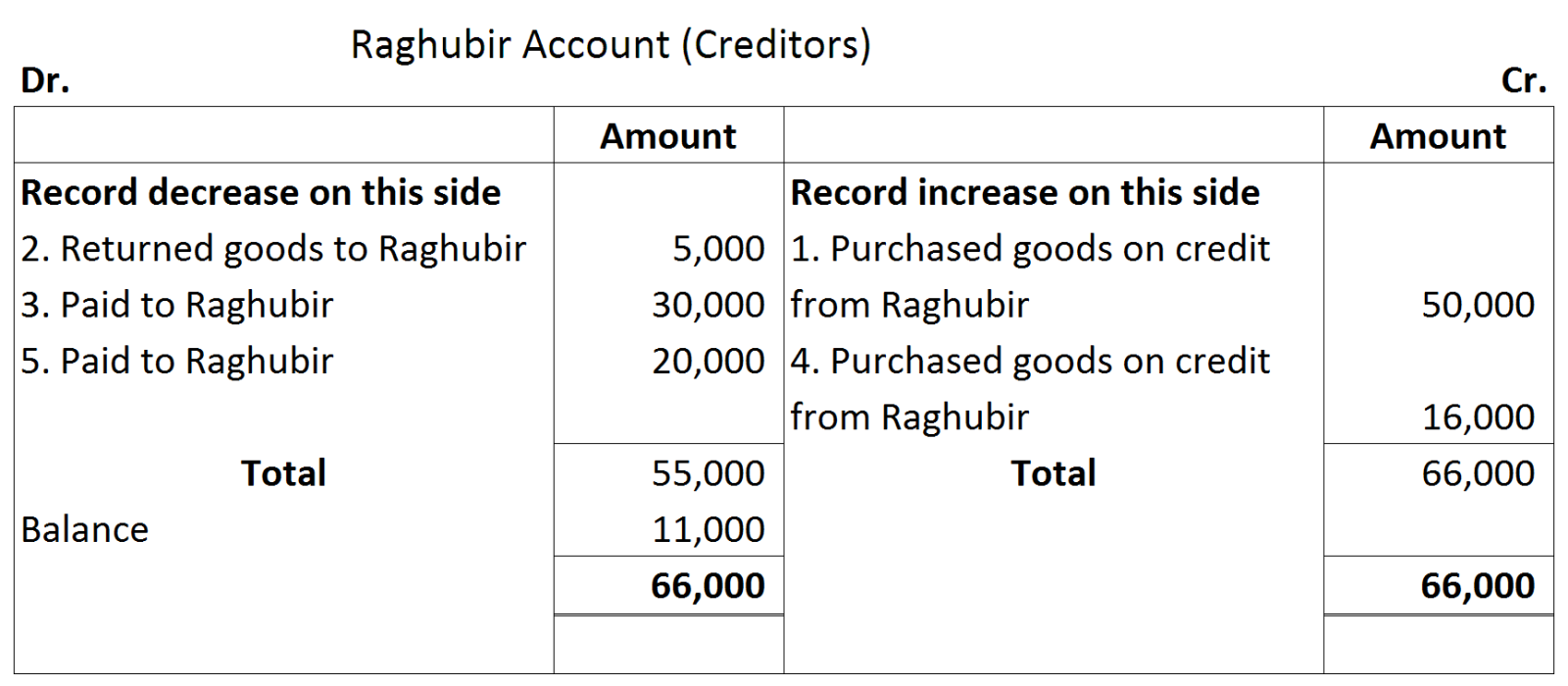
Open 'T' shape account of our creditor 'Raghubir' and write the following transactions on the proper side:
  1. Purchased goods from Raghubir on credit for ₹ 50,000.
  2. Returned goods to Raghubir for ₹ 5,000.
  3. Paid to Raghubir ₹ 30,000.
  4. Purchased goods from Raghubir on credit for ₹ 16,000.
  5. Paid to Raghubir ₹ 20,000.
Answer
Raghubir is a creditor, which means, it is a liability for the business. As we know, increase in liability is recorded on the credit side while decrease in liability will be shown on the debit side of the concerned liability account.
View full question & answer
Question 33 Marks
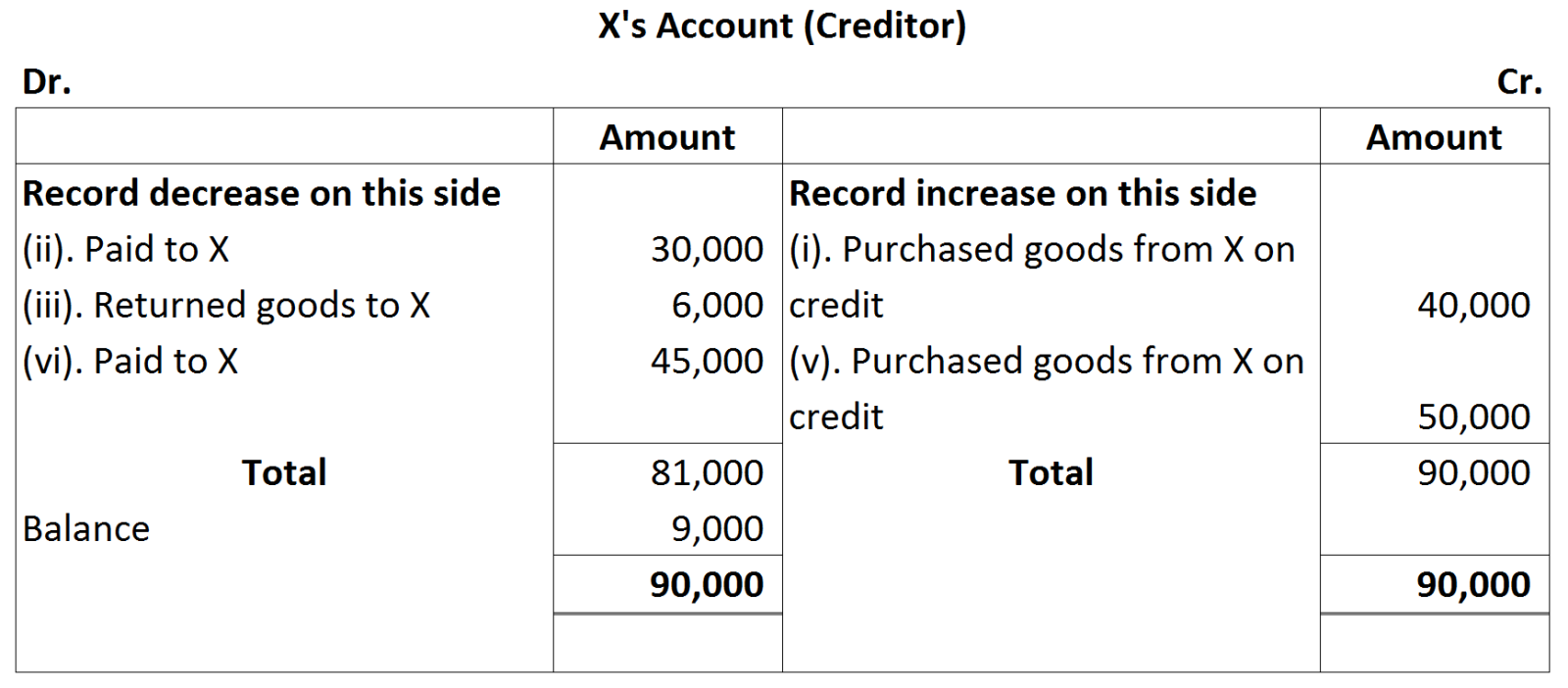
Open 'T' shape account of our Creditor 'X' and write the following transactions on the proper side:
    (₹)
1. Purchased goods from X on Credit 40,000
2. Paid to X 30,000
3. Returned goods to X 6,000
4. Purchased goods from X for Cash 20,000
5. Purchased goods from X on Credit 50,000
6. Paid to X 45,000
Answer
Increase in Creditors (being a liability) will be shown on the credit side and decrease in the creditors will be recorded on the debit side of the Creditors Account.

Note: Transaction Number (4) will not be recorded in Creditors Account as goods are purchased for cash. Thus, there will be no impact on Creditors Account.
View full question & answer
Question 43 Marks
On which side the increase in the following accounts will be recorded? Also mention the nature of account:
  1. Furniture
  2. Rent Paid
  3. Commission Received
  4. Salary Paid
  5. Proprietor's Account
  6. Debtor
  7. Creditor
Answer
 
Accounts
Increase Recorded at Side
Nature
i.
Furniture
Debit
Asset
ii.
Rent Paid
Debit
Expense
iii.
Commission Received
Credit
Income
iv.
Salary Paid
Debit
Expense
v. Proprietor’s Account Credit Capital
vi. Debtor Debit Asset
vii. Creditor Credit Liability
View full question & answer
Question 53 Marks
On which side will the increase in the following accounts be recorded? Also mention the nature of account:
  1. Furniture
  2. Wages paid
  3. Rent Received
  4. Cash
  5. Proprietor's Account
  6. Debtor
  7. Prepaid Insurance
  8. Outstanding Salary.
Answer
  Accounts Increase Recorded at Side Increase Recorded at Side
i. Furniture Debit Asset
ii. Wages Paid Debit Expense
iii. Rent Received Credit Income
iv. Cash Debit Asset
v. Proprietor’s Account Credit Capital
vi. Debtor Debit Asset
vii. Prepaid Insurance Debit Asset
viii. Outstanding Salary Credit Liability
View full question & answer
Question 63 Marks
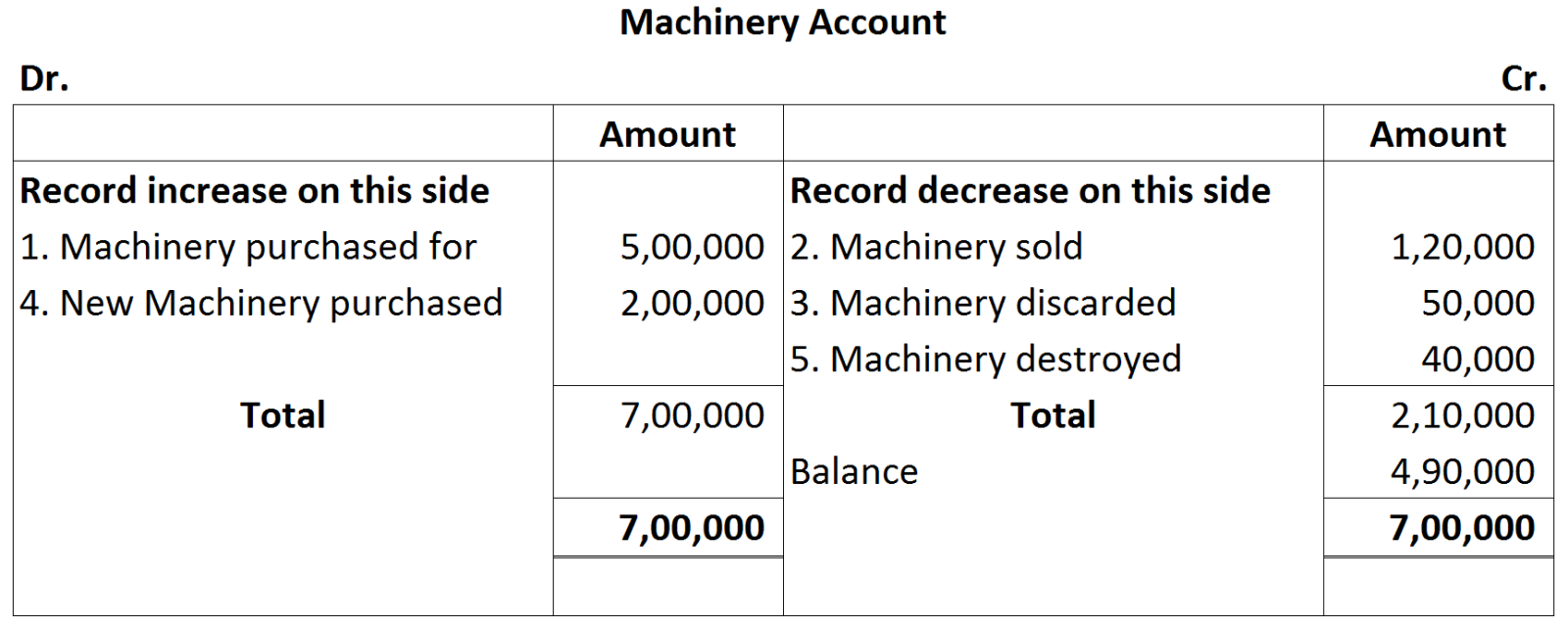
Open 'T' shape account for Machinery and write the following on the proper side:
    (₹)
i. Machinery purchased for 5,00,000
ii. Machinery sold 1,20,000
iii. Machinery discarded 50,000
iv. New Machinery purchased 2,00,000
v. Machinery destroyed 40,000
Answer
As we know, Machinery Account is an asset, so, increase in machinery will be recorded on the debit side while decrease in machinery will be recorded on the credit side of the Machinery Account.
View full question & answer
Question 73 Marks
Describe the fundamental accounting equation. How are revenue and expenses related to it?
Answer
The elements of fundamental accounting equation are Capital, Assets and Liabilities. Assets = Things that a business owns Liabilities = Things that a business owes Capital = Amount invested by the owner in the businessThe equation is:
Capital = Assets + Liabilities Expenses and Revenue are related to capital; increase in revenue leads to increase in capital while expenses leads to decrease in capital. It is because any income/ expense belongs to the owner and thus his capital in the business gets affected with the amount of expenses incurred and revenue earned.
  • Revenue: Owner's equity (Capital) is increased by the amount of revenue.
  • Expenses: Owner's equity (Capital) is increased by the amount of revenue.
Income = Revenue - Expense Income is the profit earned during an accounting period. Profit increases the owner's equity (Capital) and loss decreases the owner's equity (Capital).
View full question & answer
Question 83 Marks
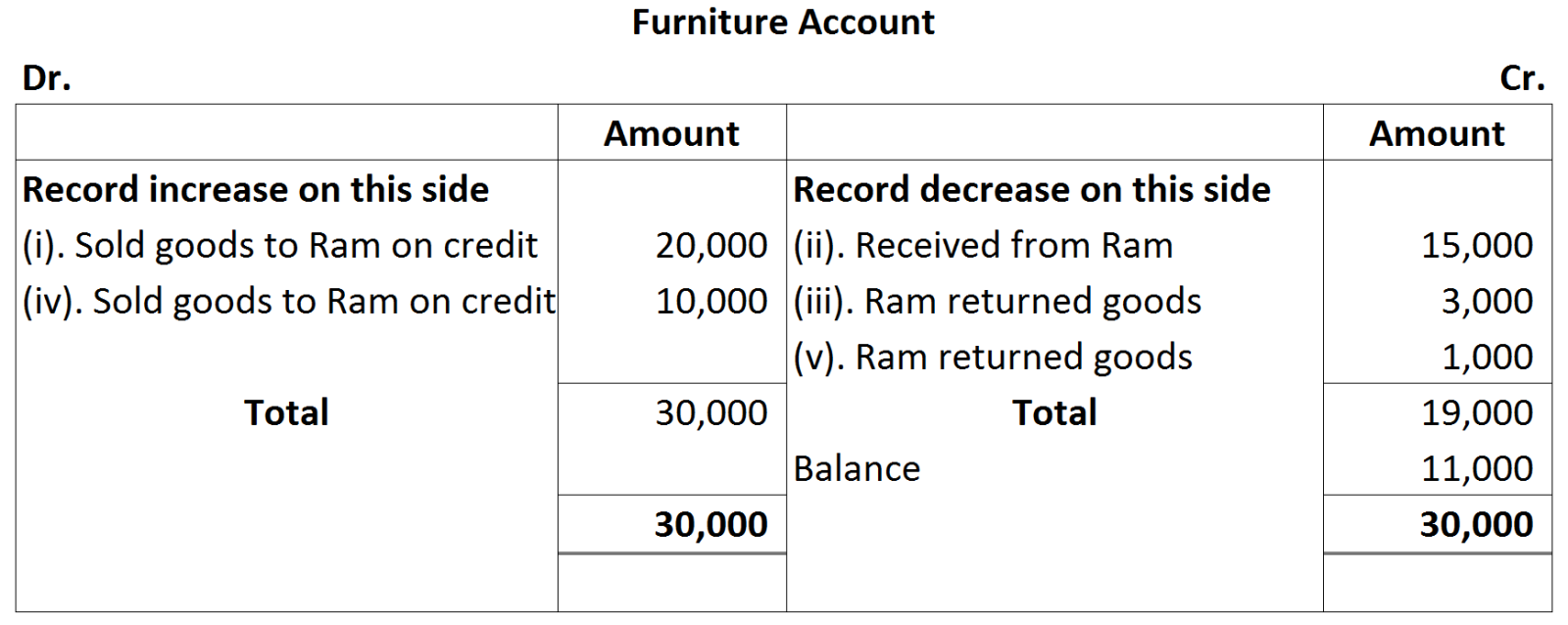
Open 'T' shape account of our Debtor 'Ram' and write the following transactions on proper side:
    (₹)
i. Sold goods to Ram on Credit 20,000
ii. Received from Ram 15,000
iii. Ram returned goods to us 3,000
iv. Again sold goods to Ram on Credit 10,000
v. Ram returned goods to us 1,000
Answer
Increase in Debtors (being an asset) will be shown on the debit side and decrease in them will be recorded on the credit side of the Debtors Account.
View full question & answer
Question 93 Marks
From the following transactions prepare the Proprietor's Account in 'T' shape:
2013   (₹)
April 1 Commenced business with Cash 5,00,000
August 1 Introduced additional Capital 1,00,000
Dec. 31 Drawings 40,000
2014    
Feb. 28 Drawings 20,000
March 31 Net Profit shown by Profit & Loss A/c 1,25,000
View full question & answer
Question 103 Marks
'A' commenced his cloth business on 1st April, 2011 with a capital of ₹ 3,00,000. On 31st March, 2012 his assets were worth ₹ 5,00,000 and liabilities ₹ 1,00,000. Find out his closing capital and profits earned during the year.
Answer
Opening Capital (Capital as on March 31, 2011) = ₹ 3,00,000 Calculation of Closing Capital (Capital as on March 31, 2012)Assets = Liabilities + Capital
5,00,000 = 1,00,000 + Capital
Capital = ₹ 4,00,000
Calculation of Profit Earned during the year
Closing Capital = Opening Capital + Additional Capital + Profit - Drawings
4,00,000 = 3,00,000 + 0 + Profit - 0
Profit = 4,00,000 - 3,00,000
= ₹ 1,00,000
View full question & answer
Question 113 Marks
$X$ started a business on $1^{\text {st }}$ April, $2013$ with a Capital of $₹ 1,00,000$ and a loan of $₹ 50,000$ from the bank. On $31^{\text {st }}$ March, $2014$, his assets were ₹ $1,75,000$. Find out his Capital as on $31^{\text {st }}$ March, $2014$ and profit earned during the year $2013-14.$
Answer
Opening Capital (Capital as on $1^{\text {st }}$ April, 2013) $=₹ 1,00,000$
Calculation of Closing Capital (Capital as on March 31, 2014)
Assets $=$ Liabilities + Capital
$1,75,000=50,000+$ Capital
Capital = ₹ 1,25,000
Calculation of Profit Earned during the year
Closing Capital = Opening Capital + Additional Capital + Profit - Drawings
$= 1,25,000=1,00,000+0+\text { Profit }-0 $
$ \text { Profit }=1,25,000-1,00,000 $
$ =₹ 25,000$
View full question & answer
Question 123 Marks
On which side the decrease in the following accounts will be recorded? Also mention the nature of account:
  1. Cash
  2. Bank Overdraft
  3. Rent Paid
  4. Salary Paid
  5. Outstanding Rent
  6. Prepaid Insurance
  7. Manoj, Proprietor of the business.
Answer
 
Accounts
Decrease Recorded at Side
Nature
i.
Cash
Credit
Asset
ii.
Bank Overdraft
Debit
Liability
iii.
Rent Paid
Credit
Expense
iv.
Outstanding Rent
Debit
Liability
v. Prepaid Insurance Credit Asset
vi. Manoj, Proprietor of the business Debit Capital
View full question & answer
Question 133 Marks
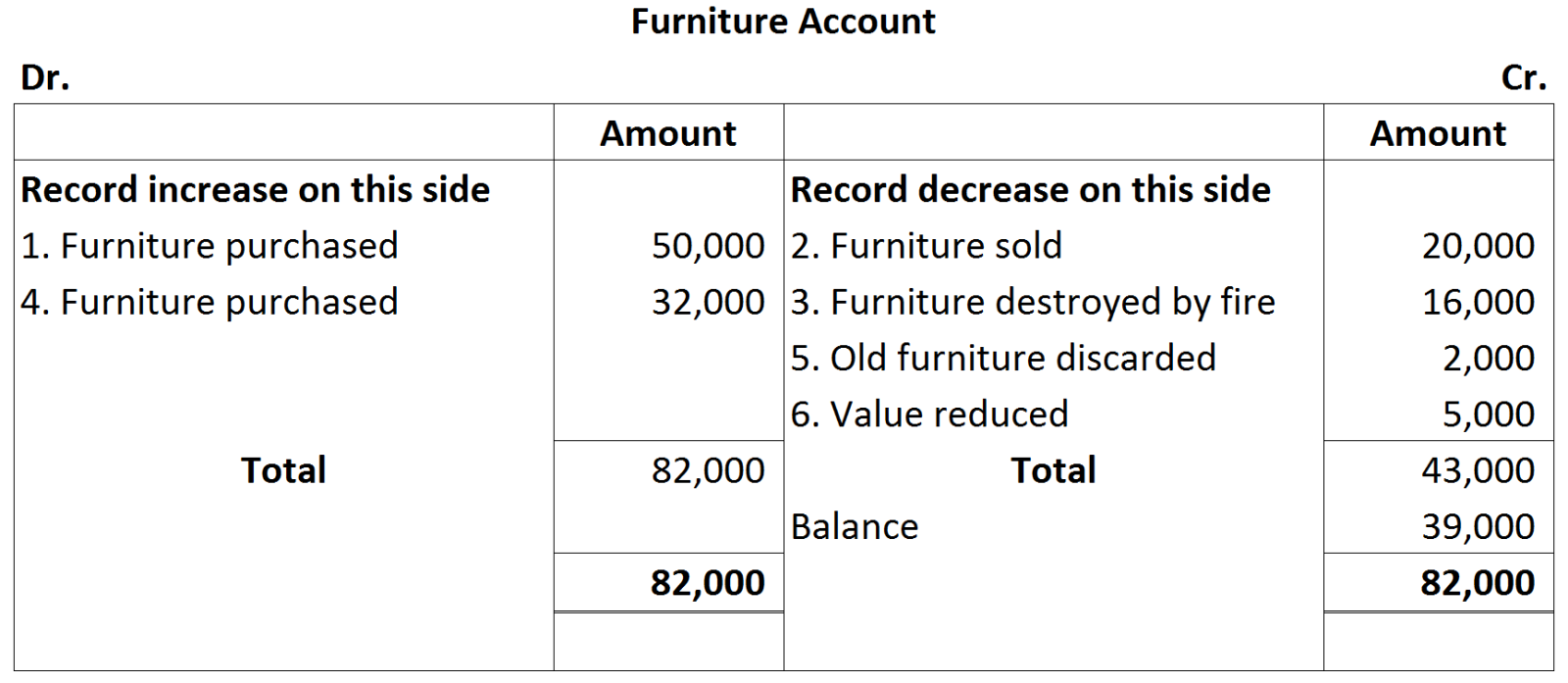
Open 'T' shape account for Furniture and write the following on the proper side∶
  1. Furniture purchased for ₹ 50,000
  2. Furniture sold costing ₹ 20,000
  3. Furniture destroyed by fire ₹ 16,000
  4. Furniture again purchased ₹ 32,000
  5. Old furniture discarded ₹ 2,000
  6. Value of furniture was reduced by ₹ 5,000
Answer
As we know, Furniture is an asset, so, increase in furniture will be recorded on the debit side while decrease in furniture will be recorded on the credit side of the Furniture Account.
View full question & answer
Question 143 Marks
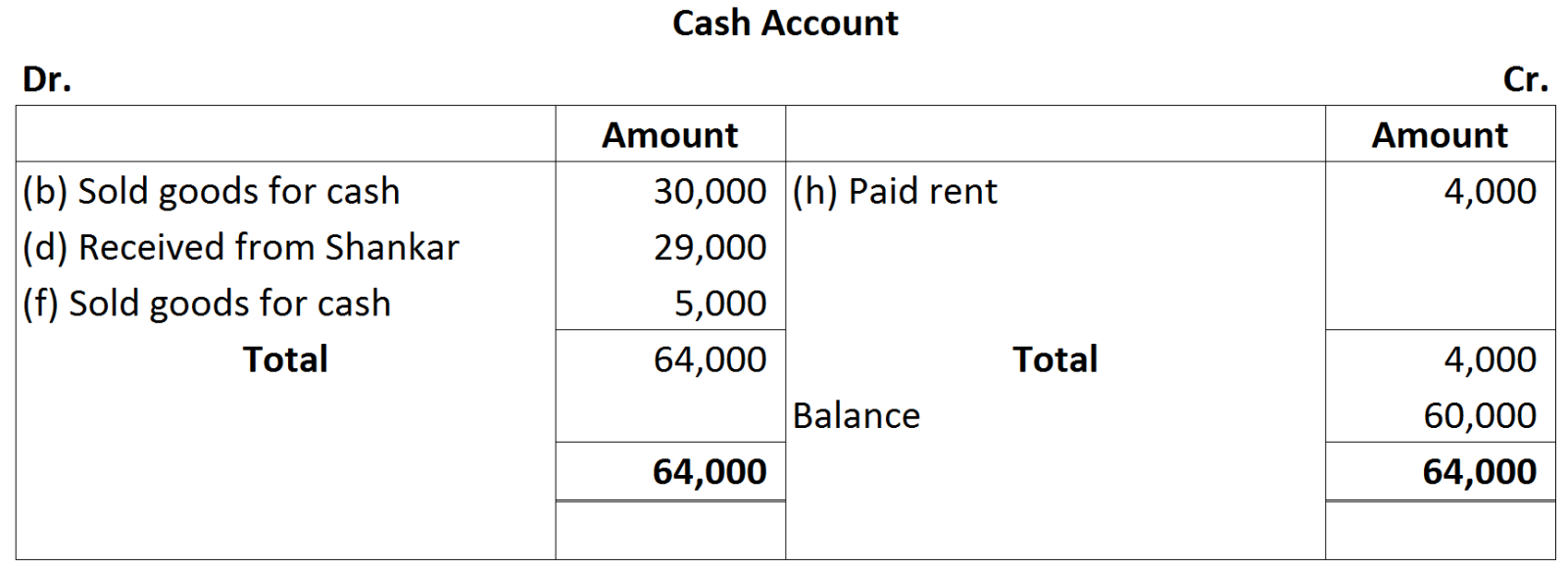
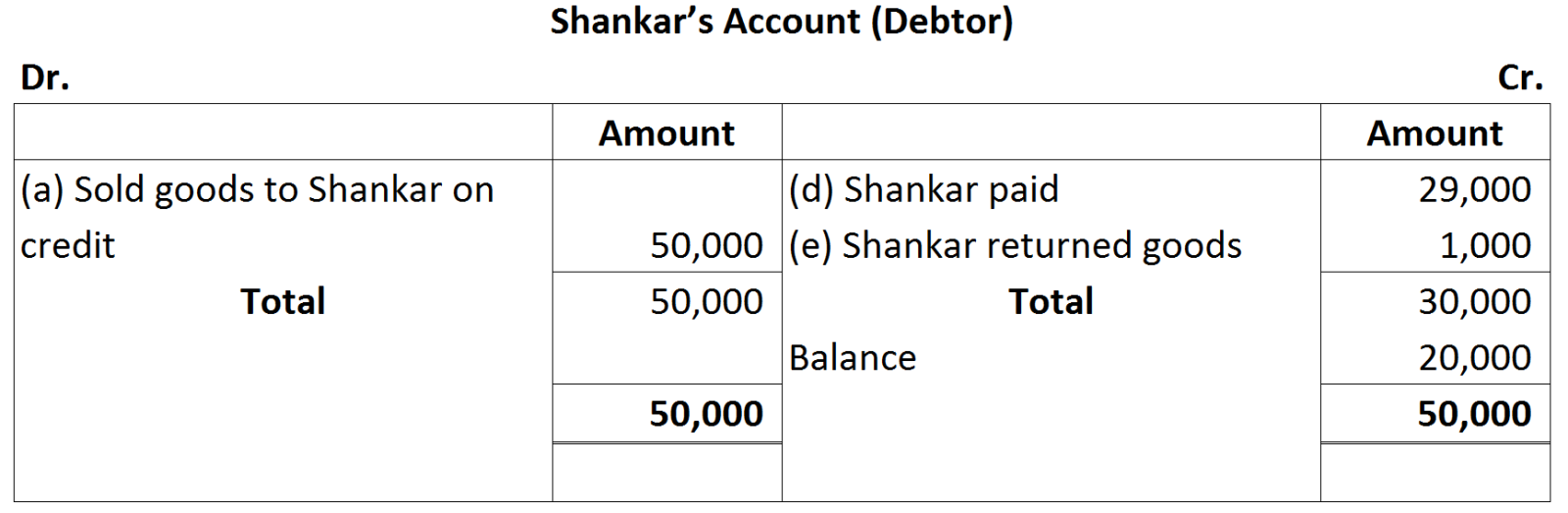
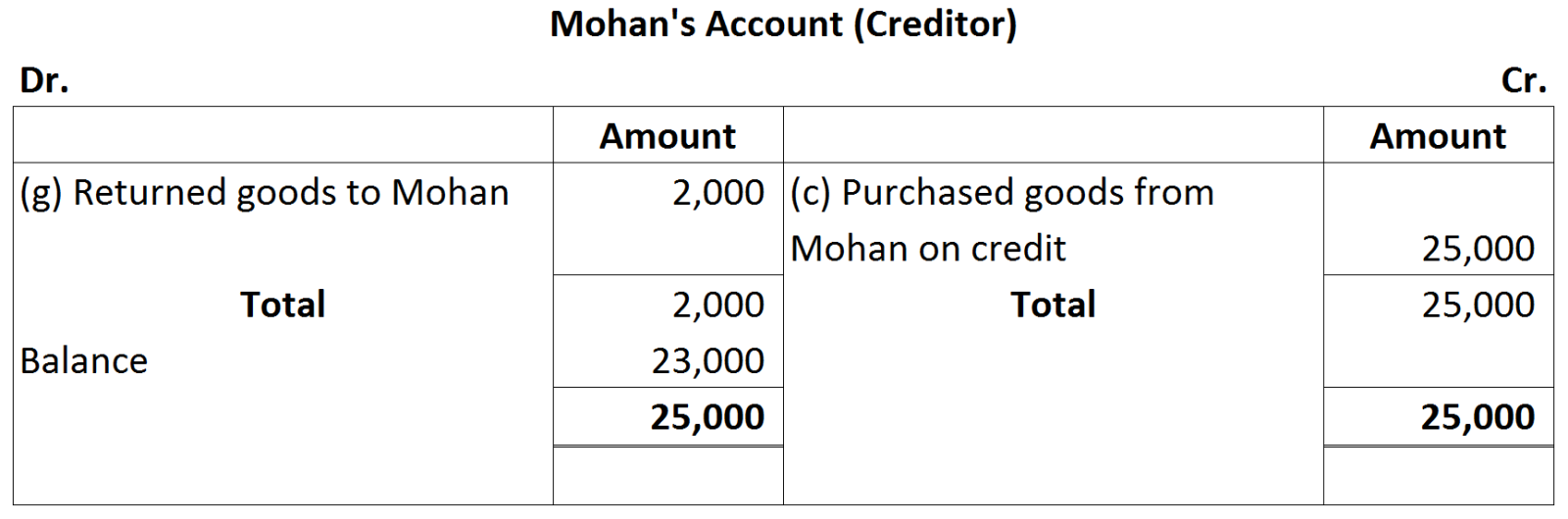
Put the following on the proper side of Cash Account, Debtors's Account and Creditor's Account:
    (₹)
a. Sold goods to Shankar on Credit 50,000
b. Sold goods to Ghanshyam for Cash 30,000
c. Purchased goods from Mohan on Credit 25,000
d. Received from Shankar 29,000
e. Shankar returned goods 1,000
f. Sold goods to Shankar for Cash 5,000
g. Returned goods to Mohan 2,000
h. Paid Rent 4,000
Answer
  1. Increase in Cash (being an asset) will be shown on the debit side and decrease in cash will be recorded on the credit side of the Cash Account.
  1. Increase in Debtors (being an asset) will be shown on the debit side and decrease in them will be recorded on the credit side of the Debtors Account.
  1. Increase in Creditors (being a liability) will be shown on the credit side and decrease in the creditors will be recorded on the debit side of the Creditors Account.
View full question & answer
3 Marks Question - Account STD 11 Commerce Questions - Vidyadip