Questions

1 Marks Question

🎯

Test yourself on this topic

23 questions · timed · auto-graded

Question 11 Mark
In the Single Entry System which two method are used to ascertain profit or loss?
Answer
  1. Statement of Affairs Method.
  2. Conversion Method.
View full question & answer
Question 21 Mark
Give one reason for keeping incomplete records.
Answer
It is an easy and simple method of recording business transactions because it does not require any special knowledge of the principles of double entry system.
View full question & answer
Question 31 Mark
What is the common objective of Single Entry System and Double Entry System?
Answer
Common objective of the two systems is to ascertain the net profit or loss of the business for a particular period.
View full question & answer
Question 41 Mark
Can a limited company maintain its account under Single Entry System?
Answer
No. A limited company cannot maintain its accounts under single entry system due to legal restrictions.
View full question & answer
Question 51 Mark
Which accounting principle is ignored under single entry and followed under double entry system?
Answer
Dual Aspect Concept.
View full question & answer
Question 61 Mark
Why are drawings added to Closing Capital in a statement of profit or loss?
Answer
Drawings are added to the closing capital on the logic that if the drawings had not been made, closing capital would have been higher by this amount.
View full question & answer
Question 71 Mark
Give two features of incomplete records.
Answer
  1. Maintenance of Personal Account only.
  2. Maintenance of Cash Book.
View full question & answer
Question 81 Mark
It is possible to prepare a trial balance and check the arithmetical accuracy of books of accounts under single entry system?
Answer
The method does not record both the aspects of a transaction. As such, a trial balance cannot be prepared to check the arithmetical accuracy of the books of accounts.
View full question & answer
Question 91 Mark
Write a note on method of calculating profit under Single Entry System.
Answer
Ascertainment of Profit or Loss from Incomplete Records
Despite the records being incomplete, the businessman would like to know the trading results as also the financial position of his business at the end of a particular period. This is done by adopting one of the two methods mentioned below:
  1. Statement of Affairs Method
According to this method, the profits are ascertained by comparing the capital at the end and capital at the beginning of the accounting period. If the capital at the end of an accounting period is more than that at the beginning (with the necessary adjustments), the difference is treated as profit. If, on the other hand, the capital at the end is less than that of beginning, the difference is treated as a loss.
  1. Conversion into Double Entry Method
Or

Preparation of Trading and Profit & Loss A/c and Balance Sheet

If a businessman who keeps incomplete records, wants to ascertain the profit or loss by preparing Trading and Profit & Loss Account, it is essential for him to convert his incomplete records into Double Entry records. Following steps are necessary for such conversion:
  1. Opening Statement of Affairs: First of all, a statement of affairs at the beginning should be prepared to calculate the capital at beginning of the year and the accounts for all items appearing in statement of affairs are opened in the ledger through "opening entries in the Journal.
  2. Cash Book: As a second step, a Cash Book should be prepared and all accounts whether Personal, Real or Nominal, appearing either on the debit side or on the credit side of the Cash Book are opened in the ledger and posting is made in these accounts.
  3. Subsidiary Books: After this, the subsidiary books should be checked and their totals should be posted to their respective Accounts. Also, the necessary posting should be made in Personal Accounts with the help of subsidiary books.
  4. Other Accounts: There may be certain other transactions too, of which no record is kept in the books. All such transactions must be journalised and posted.
  5. Final Accounts: Lastly, a Trial Balance is prepared with the help of ledger balances and Trading and Profit & Loss A/c and Balance Sheet are prepared on the basis of it.
View full question & answer
Question 101 Mark
Which accounting principle is certainly followed under single entry as well as double entry system?
Answer
Money Measurement concept.
View full question & answer
Question 111 Mark
What is meant by incomplete records system of accounting?
Answer
It is an accounting system which ignores two-fold aspects of a transaction.
View full question & answer
Question 121 Mark
Name the two main accounts maintained in 'Accounts from Incomplete Records'.
Answer
  1. Personal Account.
  2. Cash Account.
View full question & answer
Question 131 Mark
Why do big business houses not maintain their accounts under single entry system?
Answer
Big business houses not maintain their accounts under single entry system because:
  1. Financial Position of the Business cannot be Assessed: In the absence of assets accounts, it is difficult to determine correct financial position of the business on any particular day by preparing a Balance Sheet.
  2. Difficult to Ascertain the Value of Business: The records being inadequate, it is difficult to value the business, especially goodwill.
View full question & answer
Question 141 Mark
State one point of difference between Incomplete Records and Double Entry System.
Answer
S.No.
Basis of Difference
Double Entry System
Incomplete Records
1.
Recording of both aspects
Both the aspects of every transaction are recorded in it.
Under this system, both the transaction are recorded in it. aspects of very few transactions are recorded. For some other transactions one aspect and yet for others no aspect at all is recorded.
2.
Type of Accounts
All accounts - personal, real and nominal are maintained under it.
Only personal accounts and a and nominal are maintained cash book are maintained under under it.
View full question & answer
Question 151 Mark
From the following particulars, ascertain the value of Closing Stock :
 
 
Opening Stock
40,000
Sales
4,80,000
Purchase
2,50,000
Carriage Outward
4,000
Carriage Inwards
6,000
 
 
Wages
52,000
Rate of Gross Profit on sales
$33\frac{1}{3}\% $
Answer
Coming soon:
View full question & answer
Question 161 Mark
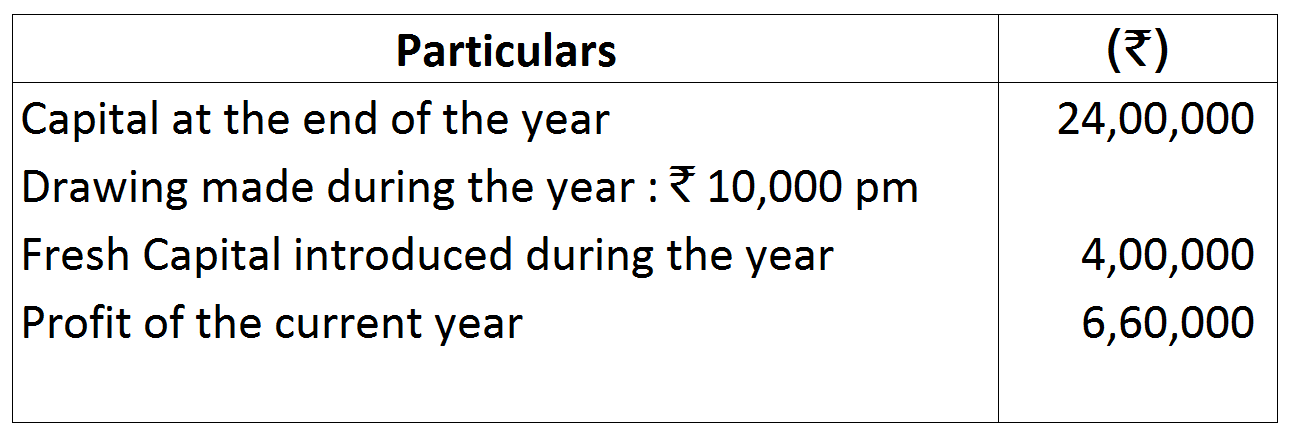
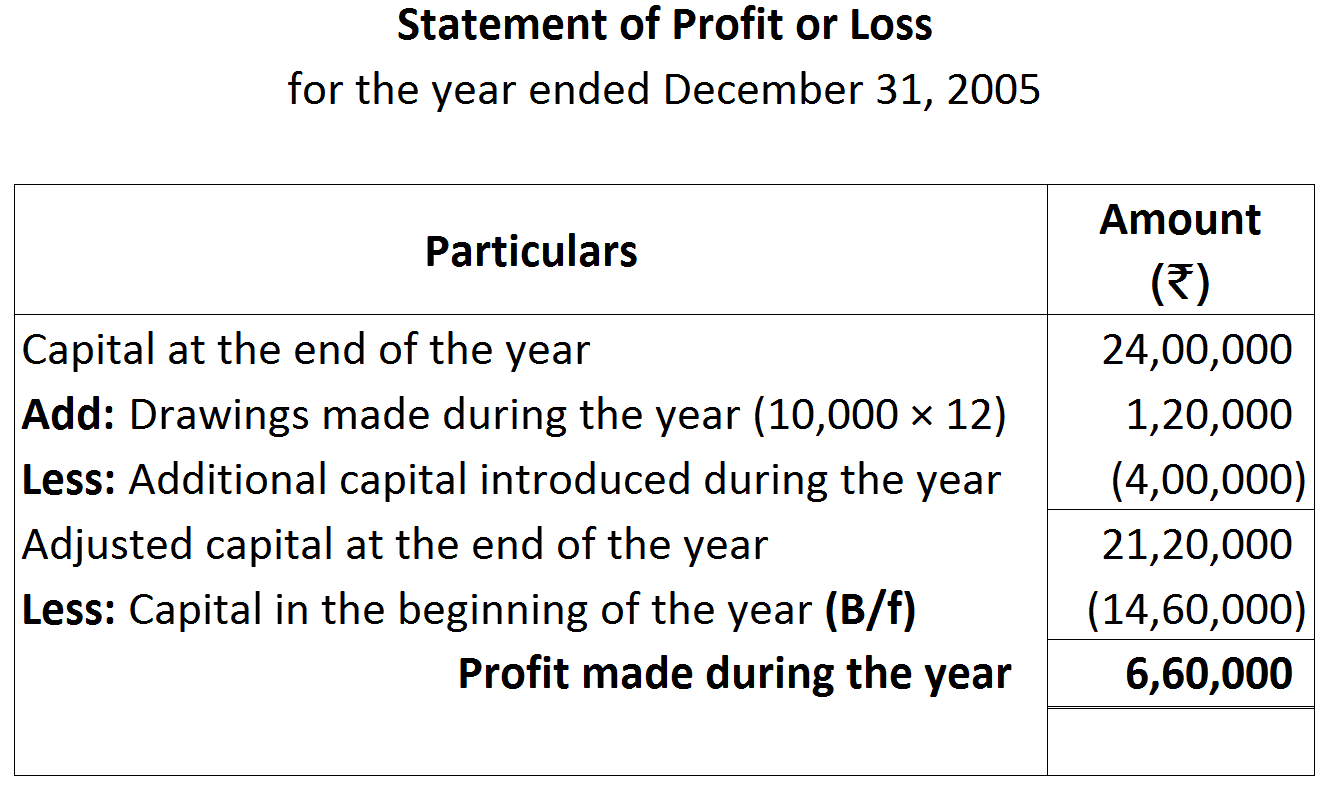
Ravi, who keeps his books on Single Entry System, had his capital on $31^{\text {st }}$ March, 2016 ₹ 20,000 and on $1^{\text {st }}$ April, $2015$ was $₹ 16,700$. He further informs that during the year, he withdrew for his personal expenses ₹ $9 , 4 0 0$. He also sold his personal investment of ₹ $10,000$ at $15 \%$ premium and brought that money into the business.
Prepare a statement of Profit or Loss.
View full question & answer
Question 171 Mark
Why is statement of affairs prepared under single entry system not called a balance sheet?
Answer
  1. Because a statement of affairs is not prepared with the list of ledger balances kept on the basis of double entry system.
  2. Value of assets and liabilities shown in statement of affairs are only the estimates and not the actual values.
View full question & answer
Question 191 Mark
Ascertain the value of Opening Stock from the following:
 
 
Purchase
1,20,000
Closing Stock
30,000
Sales
1,90,000
Carriage Inwards
7,000
Return Inward
10,000
Rate of Gross Profit on Sales
40%
Return Outward
4,000
   
Answer
Coming soon:
View full question & answer
Question 211 Mark
From the following particulars, ascertain the value of Closing Stock :
 
 
Stock in the beginning
40,000
Purchase
4,60,000
Cah sales
2,20,000
Purchase Return
5,000
Credit Sales
4,10,000
Carriage Inwards
8,000
Sales Return
30,000
Rate of Gross Profit on Cost
$\frac{1}{3}$
Answer
Coming soon:
View full question & answer
Question 221 Mark
State any two limitations of incomplete records.
Answer
  1. True profit or Loss cannot be ascertained.
  2. Balance Sheet does not disclose true financial position.
View full question & answer
Question 231 Mark
From the following particulars, ascertain the value of Opening Stock:
 
 
Purchase
5,00,000 Productive Expenses 30,000
Sales 8,40,000 Unproductive Expenses 10,000
Closing Stock 80,000 Rate of Gross Profit on cost of good sold 50%
Answer
Coming soon:
View full question & answer
1 Marks Question - Account STD 11 Commerce Questions - Vidyadip