Questions

4 Marks Question

🎯

Test yourself on this topic

42 questions · timed · auto-graded

Question 14 Marks
On 31st December, 2014 my Cash Book showed a credit balance of ₹ 8,800. I had paid into Bank three cheques amounting to ₹ 6,000 on 24th December of which I found ₹ 3,200 have been credited in the Pass Book under date 5th January 2015. I had issued cheques amounting to ₹ 8,000 before 31st December of which I found ₹ 2,500 have been debited in the Pass Book after 1st January 2015. I find a debit of ₹ 50 in respect of bank charges in the Pass Book which I have adjusted in the Cash Book on 31st Dec. There is a credit of ₹ 360 for interest on securities in the Pass Book which remains to be adjusted. A cheque of ₹ 1,200 deposited into bank has been dishonoured.
Prepare Bank Reconciliation Statement as on 31st Dec. 2014.
View full question & answer
Question 24 Marks
My bank Pass Book showed an overdraft of ₹ 6,500 on 31st March, 2017. This does not agree with the Cash Book balance. From the following particulars ascertain the Cash Book balance:-
Cheques amounting to ₹ 15,000 were paid into bank in March, out of which, it appears, only cheques amounting to ₹ 4,500 were credited by bank. Cheques issued during March amounted in all to ₹ 11,000. Out of these cheques for ₹ 3,000 were unpaid on 31st March, 2017. The Pass Book stands debited with ₹ 150 for interest and with ₹ 30 for bank charges. The bank had paid the annual subscription of ₹ 100 to my club according to my instructions. The entries for interest, bank charges and subscription have not yet been made in Cash Book.
View full question & answer
Question 34 Marks
How is a Bank Reconciliation Statement prepared?
Answer
Following points should be kept in mind, while preparing Bank Reconciliation Statement:
  1. Date: The date on which Bank Reconciliation Statement is prepared.
  2. Balance: Which balance, i.e., that of Cash Book or of Bank Statement or Bank Pass Book, is the basis of bank reconciliation. In this regard it should also be kept in mind that:
  1. Balance as per Cash Book means the balance as per bank column of Cash Book.
  2. Debit balance or favourable balance in Cash Book means that the amount is lying deposited in the bank. It is an asset of the firm.
  3. Credit balance in the Cash Book means overdraft balance, i.e., withdrawals are in excess of deposits. It is a liability of the firm.
  4. Credit balance or favourable balance as per Bank Statement or Bank Pass Book means that the amount is lying deposited in the bank, it is an asset of the firm.
  5. Debit balance as per Bank Statement or Bank Pass Book means overdraft balance, i.e., withdrawals are in excess of deposits. It is a liability of the firm.
Besides the above, following should also be kept in mind:
  1. Debiting an item in the Cash Book increases Cash Book balance and crediting decreases it.
  2. Debiting an item in the Bank Statement or Bank Pass Book decreases the Bank Statement or Bank Pass Book balance or increases the overdraft balance and crediting increases the balance or decreases the overdraft balance.
  1. Preparing Bank Reconciliation Statement: After deciding which entries are to be added to the balance of the concerned book (i.e., the starting balance of Bank Reconciliation Statement) and which entries are to be subtracted, Bank Reconciliation Statement is prepared in a statement form.
View full question & answer
Question 44 Marks
Prepare Bank Reconciliation Statement from the following particulars on June 30, 2016:
Bank Statement showed a favourable balance of ₹ 9,214.
  1. On 29th June, the bank credited the sum of ₹ 1,650 in error.
  2. Certain cheques, valued at ₹ 4,500 issued before June 30, were not cleared.
  3. A hire purchase payment of ₹ 950, made by a standing order was not entered in the cash book.
  4. A cheque of ₹ 600 received, deposited and credited by bank, was accounted as a receipt in the cash column of the cash book.
  5. Other cheques for ₹ 8,500 were deposited in June but cheques for ₹ 6,000 only were cleared by the bankers.
View full question & answer
Question 54 Marks
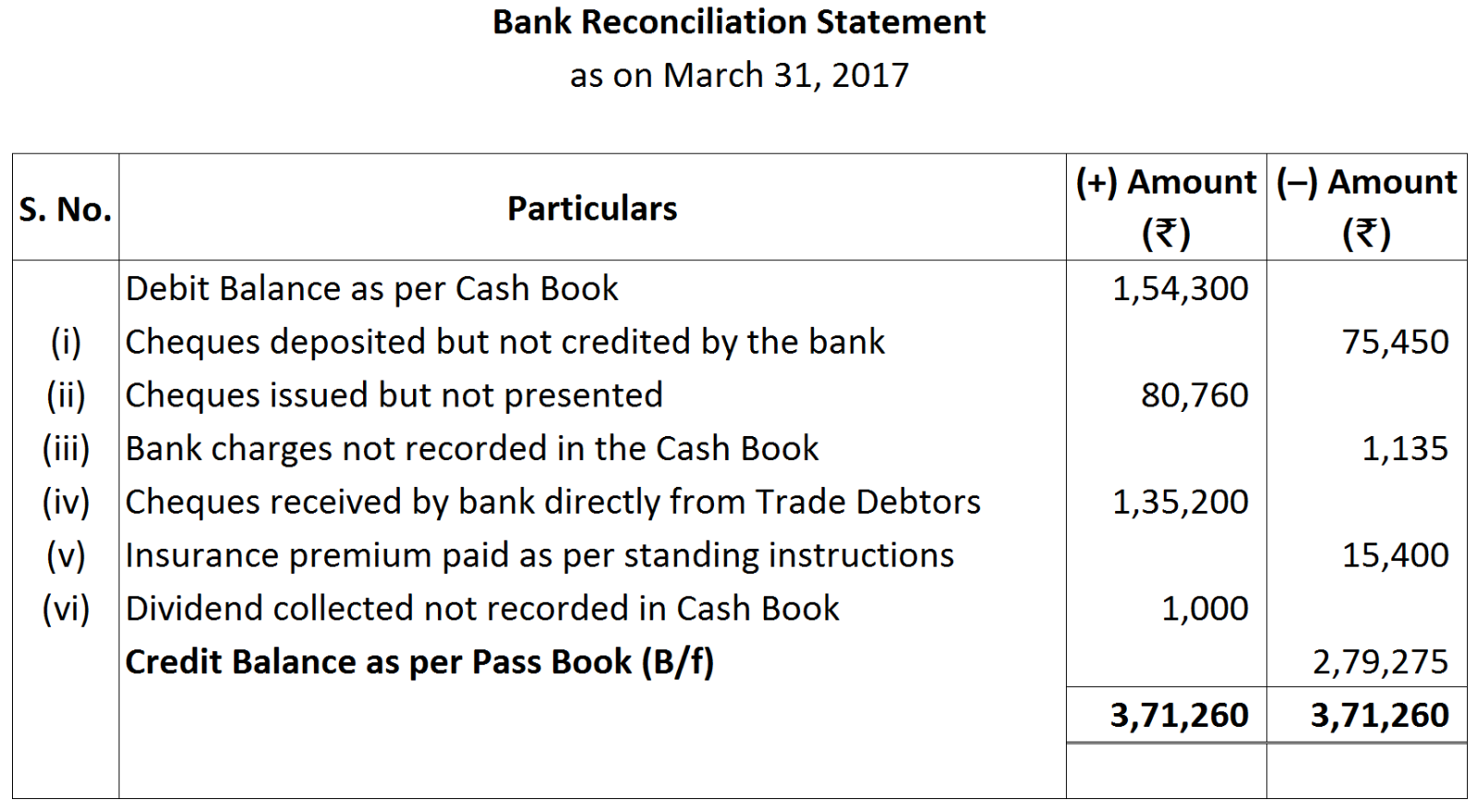
Rim Zim Ltd. maintains a current account with the State Bank of India. On 31st March, 2017, the bank column of its cash book showed a debit balance of ₹ 1,54,300. However, the bank statement showed a different balance as on that date. The following were the reasons for the difference:
(i)
Cheques deposited, but not yet credited by the bank
75,450
(ii)
Cheques issued, but not yet presented for payment
80,760
(iii)
Bank charges not yet recorded in the cash book
1,135
(iv)
Cheques received by the bank directly from trade debtors
1,35,200
(v)
Insurance premium paid by the bank as per standing instructions, but not yet recorded in the cash book
15,400
(vi)
Dividend collected by the bank, but not yet recorded in the cash book
1,000
Find out the balance as per the bank statement as on 31st March, 2017.
Answer
Solution is as follows.
View full question & answer
Question 74 Marks
On 30th June, 2014 the Pass Book of Sh. Mahabir Prashad showed a balance of ₹ 22,000. On comparing the Pass Book with Cash Book the following differences were found:-
  1. Mahabir Prashad had paid into the Bank on 26th June four cheques for ₹ 3,000; ₹ 6,000; ₹ 8,000 and ₹ 10,000. Of these, the cheque for ₹ 6,000 was credited by the bank in July 2014.
  2. On 23rd June three cheques were drawn for ₹ 12,000; ₹ 13,000 and ₹ 16,000. The first two cheques were presented to the bank for payment in June and the third in July 2014.
  3. Cheques amounting to ₹ 3,600 were deposited in the bank but no entry was passed in the Cash Book.
  4. Bank charges entered in Cash Book twice ₹ 50.
  5. Cheque received entered twice in the Cash Book ₹ 3,200.
Prepare a Bank Reconciliation Statement as on 30th June 2014.
View full question & answer
Question 84 Marks
Balance as per passbook of Mr. Kumar is 3,000.
  1. Cheque paid into bank but not yet cleared Ram Kumar ₹ 1,000 Kishore Kumar ₹ 500
  2. Bank Charges ₹ 300
  3. Cheque issued but not presented Hameed ₹ 2,000 Kapoor ₹ 500
  4. Interest entered in the passbook but not entered in the cash book ₹ 100 Prepare a bank reconciliation statement.
View full question & answer
Question 94 Marks
Explain any two reasons on account of which the balance as shown by the Pass Book does not agree with the balance as shown by the bank column of the Cash Book.
Answer
  1. Difference Due to Timing:
There is always a time gap between recording a transaction in the books of account and it being recorded by the bank. For example, a cheque issued is recorded in the Cash Book immediately but the bank records it on being presented for payment which is on a later date. Similarly, a cheque deposited is recorded in the Cash Book immediately whereas the bank credits it on it being cleared, i.e., when bank has collected the amount. If Band: Reconciliation Statement is prepared in between the two dates, differences will exist.
  1. Transactions Recorded by the Bank:
Sometimes transactions are recorded by the bank, which become known to the account holder on receiving the Bank Statement or Bank Pass Book. For example, interest charged or allowed, bank charges, etc., are known to the account holder after receivinę the Bank Statement or Bank Pass Book. Such transactions in the Bank Statement lead to a difference between the balance as per Cash Book and balance as per Bank Statement or Bank Pass Book.
View full question & answer
Question 104 Marks
From the following particulars prepare a bank reconciliation statement of Govil as on 31st December, 2014.
Balance as per Pass Book on 31st December 2014 is ₹ 8,500. Cheques for ₹ 5,100 were issued during the month of December but of these cheques for ₹ 1,200 were presented in the month of January 2015 and one cheque for ₹ 200 was not presented for payment. Cheques and cash amounting to ₹ 4,800 were deposited in bank during December but credit was given for ₹ 3,800 only. A customer has deposited ₹ 800 into bank directly. The bank credited the merchant for ₹ 200 as interest and has debited him for ₹ 30 as bank charges for which there are no corresponding entries in Cash Book.
View full question & answer
Question 114 Marks
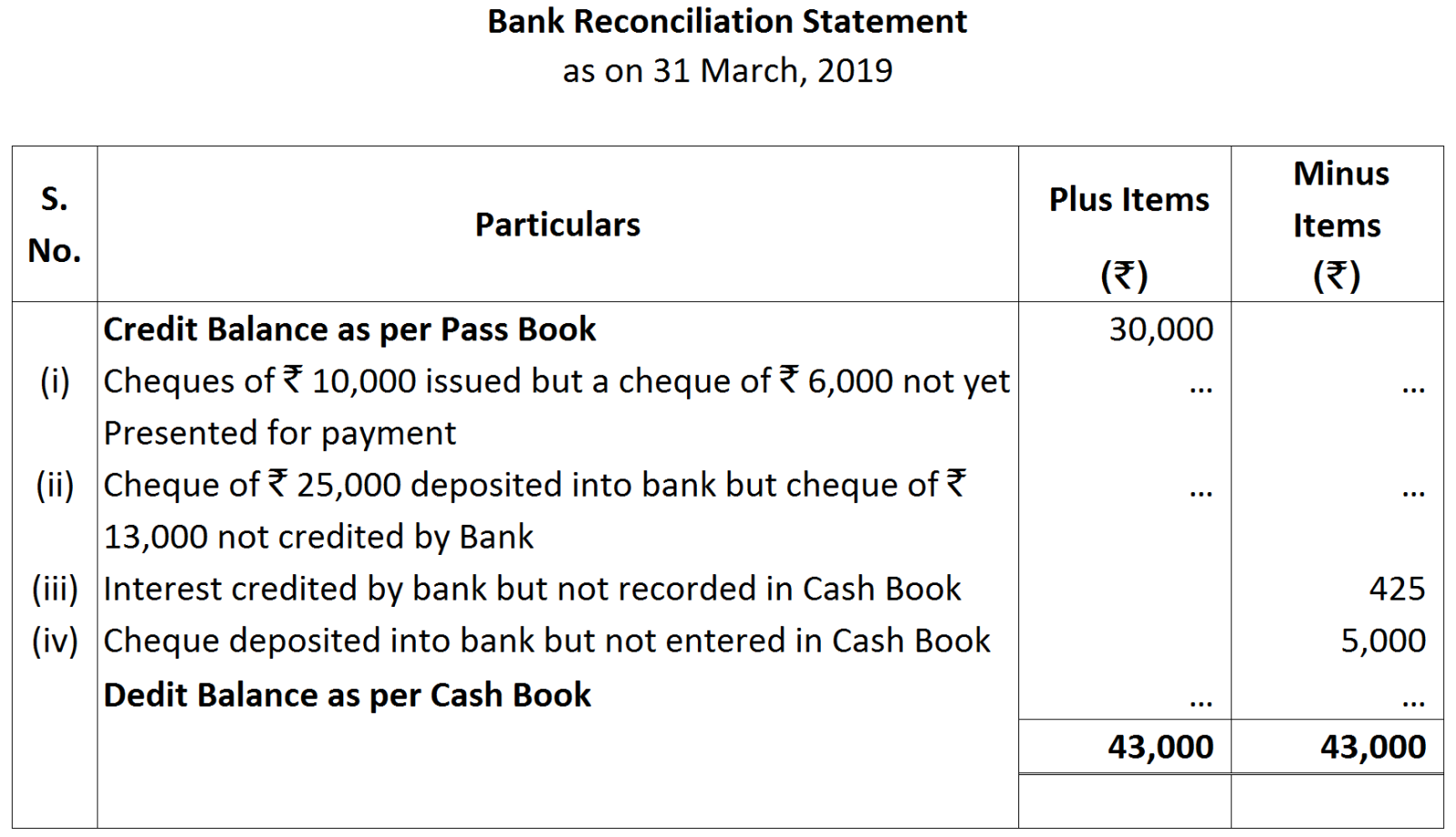
On 31st March, 2017, Pass Book showed a balance of ₹ 25,000. Prepare a Bank Reconciliation Statement from the following particulars:
  1. Cheques of ₹ 20,000 were deposited in Bank on 27th March, 2017, out of which cheques of ₹ 5,000 were cleared on 1st April, 2017. Rest are not cleared.
  2. On 28th March, 2017, cheques were issued amounting to ₹ 15,000, out of which cheques of ₹ 3,000 were presented in March, ₹ 4,000 on 2nd April and rest were not presented.
  3. Cheques of ₹ 10,000 were deposited in Bank on 28th March, 2017, out of which cheques of ₹ 4,000 were cleared on 2nd April, 2017 and rest are dishonoured.
  4. Interest on investment collected by bank does not appear in the Cash Book ₹ 800.
  5. A B/R of ₹ 9,000 previously discounted from the bank was dishonoured on 30th March, 2017 but no intimation was received from the bank till 31st March.
  6. Bank has debited ₹ 1,500 and credited ₹ 1,200 in our account.
View full question & answer
Question 124 Marks
State the need for the preparation of bank reconciliation statement?
Answer
The need to prepare Bank Reconciliation Statement are given below.
  1. It helps in finding out the errors and omissions committed in the Cash Book and the Pass Book.
  2. It shows uncleared cheques, which have already been debited in the Cash Book but have not been yet recorded in the Pass Book.
  3. It helps in checking embezzlement of money from the bank account.
  4. It helps in measuring the accuracy of the transactions recorded in the Cash Book.
  5. It facilitates in preparing revised Cash Book that reflects true bank balance.
View full question & answer
Question 134 Marks
On 31st March, 2015 the Pass Book shows a credit balance of ₹ 9,000. Prepare a Bank Reconciliation Statement from the following particulars:-
 
 
1.
Cheques issued but not yet presented for payment
7,000
2.
Cheques issued but omitted to be recorded in the Cash Book
3,800
3.
Cheques paid into bank but not yet collected by the bank
2,600
4.
Premium on Life Policy paid by the bank on standing advice
360
5.
Payments received from customers direct by the bank
2,000
View full question & answer
Question 144 Marks
On 31st December, 2014 the Cash Book of Basu showed an overdraft of ₹ 18,000 with the Bank of India. The balance did not agree with balance as shown by the Bank Pass Book and you find that Basu had paid into the Bank on 26th December four cheques for ₹ 10,000; ₹ 12,000; ₹ 6,000 and ₹ 8,000. Of these the cheque for ₹ 6,000 was credited by the bank in January, 2015. Basu had issued on 24th December three cheques for ₹ 15,000, ₹ 12,000, and ₹ 7,000. The first two cheques were presented to the bank for payment in December and the third in January, 2015.
You also find that on 31st December, 2014, the bank had debited Basu's Account for ₹ 500 for interest and ₹ 20 for charges but Basu has not recorded these amounts in his books.
You are required to prepare a Bank Reconciliation Statement as on 31st December, 2014 and ascertain the balance as per bank Pass Book.
View full question & answer
Question 154 Marks
On 30th June 2014 Pass Book showed a balance of ₹ 5,200. Prepare Bank Reconciliation Statement from the following particulars:-
  1. Out of total cheques amounting to ₹ 16,000 deposited, cheques amounting to ₹ 9,000 were credited in June 2014, Cheques amounting to ₹ 3,000 were credited in July 2014, and the rest have not been collected so far.
  2. Out of total cheques amounting to ₹ 45,000 drawn, cheques amounting to ₹ 7,500 were presented in June 2014, Cheques amounting to ₹ 18,000 were presented in July 2014, and the rest have not been presented so far.
  3. Amount wrongly credited by bank ₹ 3,400.
  4. Payment side of the Cash Book has been undercast by ₹ 200.
  5. Cheques recorded in the Cash Book in June 2014 but sent to bank in July 2014 ₹ 2,500.
  6. A cheque of ₹ 20,000 deposited in the bank has been dishonoured but no intimation was received till June 2014.
View full question & answer
Question 164 Marks
Raghav & Co. have two bank accounts, Account No. I and Account No. II. From the following particulars relating to Account No. I, find out the balance on that account on December 31, 2016 according to the Cash Book of the firm.
  1. Cheques paid into bank prior to December 31, 2016, but not credited until after that date for ₹ 10,000.
  2. Transfer of funds from Account No. II to Account No. I recorded by the bank on December 31, 2016 but entered in the Cash Book after that date for ₹ 8,000.
  3. Cheques issued prior to December, 31 2016 but not presented until after that date for ₹ 7,429.
  4. Bank charges debited by bank not entered in the Cash Book for ₹ 200.
  5. Interest debited by the bank not entered in the Cash Book ₹ 580.
  6. Overdraft as per Pass Book ₹ 18,990.
View full question & answer
Question 174 Marks
On 31st December, 2014, pass book shows debit balance of ₹ 7,500. From the following particulars, prepare a Bank Reconciliation Statement:
  1. Cheques paid in for collection amounted to ₹ 20,600 but cheques of ₹ 7,800 were credited on 3rd January, 2015.
  2. A cheque of ₹ 1,000 debited in cash book was omitted to be banked.
  3. Cheques of ₹ 7,800 were drawn on 27th December of which cheques of ₹ 2,400 were cashed upto 31st December.
  4. A cheque of ₹ 800 was banked and credited, but omitted to be recorded in cash book.
  5. Bank charged interest on Overdraft ₹ 650.
View full question & answer
Question 184 Marks
Prepare the Bank Reconciliation Statement from the following particulars for the period ending 31st December, 2012.
  1. Overdraft as per Pass Book on 31-12-2012 ₹ 7,600.
  2. Cheques deposited but not collected by the bank ₹ 8,560.
  3. Incidental charges not recorded in Cash Book ₹ 80.
  4. Cheques were issued for ₹ 7,800 but only ₹ 4,400 were presented for payment.
  5. Insurance premium paid by bank not recorded in the Cash Book ₹ 4,200.
  6. On 31st December, 2012 cash was deposited in bank ₹ 385 but the cashier debited the bank column with ₹ 485 by mistake.
View full question & answer
Question 194 Marks
On checking the Bank Pass Book it was found that it showed an overdraft of ₹ 5,220 as on 31.12.2014, while as per Ledger it was different to Bank Debit. The following differences were noted:
  1. Cheques deposited but not yet credited by bank ₹ 6,000.
  2. Cheques dishonoured and debited by bank but not given effect to it in the Ledger ₹ 800.
  3. Bank charges debited by bank but Debit Memo not received from bank ₹ 50.
  4. Interest on overdraft excess credited in the Ledger ₹ 200.
  5. Wrongly credited by bank to account, deposit of some other party ₹ 900.
  6. Cheques issued but not presented for payment ₹ 400.
View full question & answer
Question 204 Marks
On 31st December, 2014 the Cash Book of Gopal showed debit balance of ₹ 12,000. On comparing the Cash Book with the Pass Book, the following discrepancies were noted:-
  1. Cheques were issued for ₹ 15,000, but of them cheques for ₹ 7,700 have not yet been presented.
  2. Cheques for ₹ 8,000 were deposited in bank but of these cheques for ₹ 2,000 were not recorded in the Cash Book.
  3. Cheques deposited in bank but not credited ₹ 3,800.
  4. A cheque for ₹ 350 was paid into bank but bank credited the amount with ₹ 530 by mistake.
  5. Bank received interest on debentures on behalf of Gopal amounting to ₹ 300.
  6. It was also found that the total of one page on the payment side of the Cash Book was ₹ 4,520 but it was written on the next page as ₹ 5,420.
Prepare a Bank Reconciliation Statement.
View full question & answer
Question 214 Marks
From the following particulars, prepare a, bank reconciliation statement as at March 31, 2017.
  1. Balance as per cash book ₹ 3,200
  2. Cheque issued but not presented for payment₹ 1,800
  3. Cheque deposited but not collected upto March 31, 2014 ₹ 2000
  4. Bank charges debited by bank ₹ 150
View full question & answer
Question 224 Marks
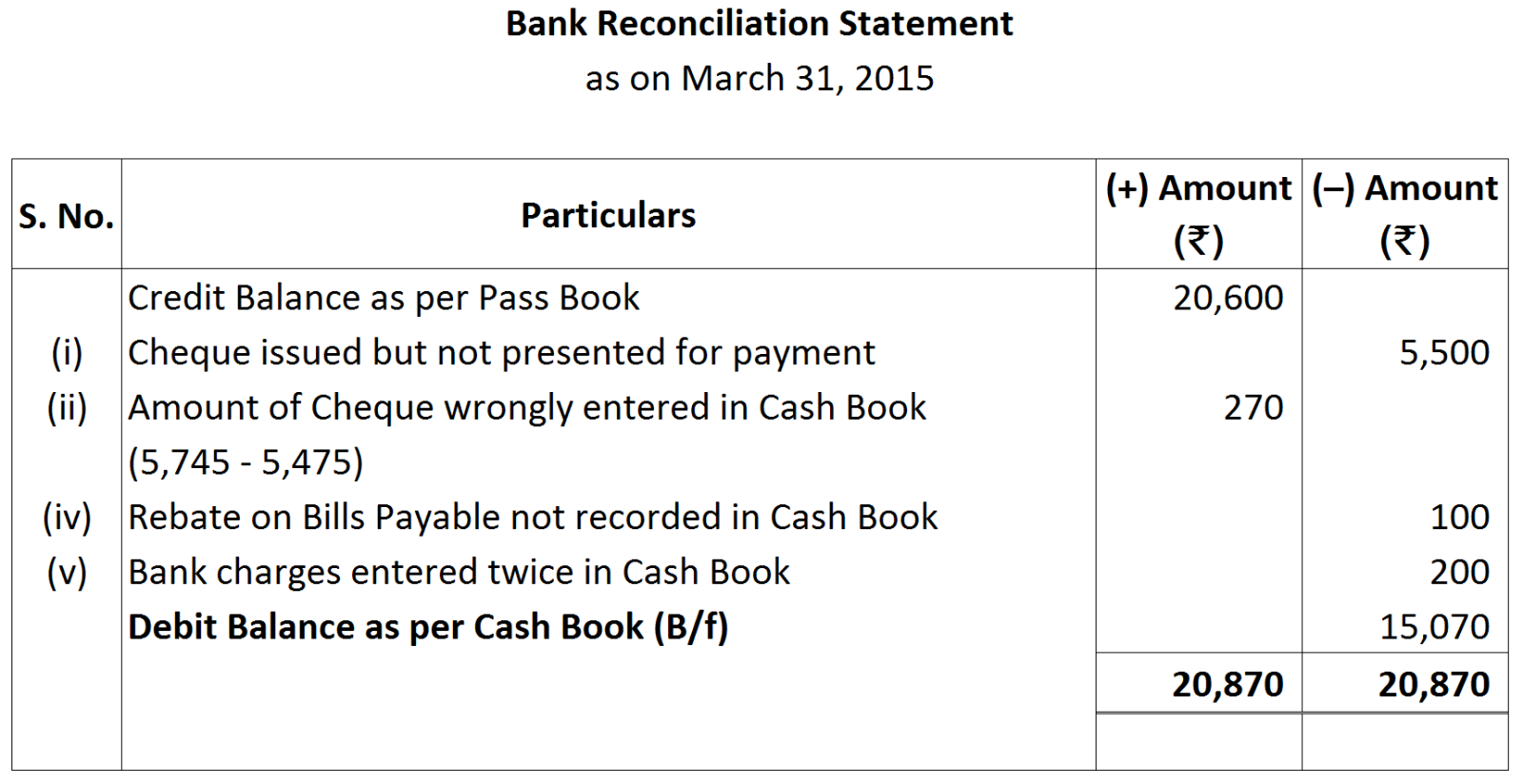
On 31st March, 2015 the Pass Book of Mr. Janaki Dass showed a credit balance of ₹ 20,600. Prepare a Bank Reconciliation Statement from the following information:
  1. Cheques amounting to ₹ 15,000 were drawn in March 2015, out of which cheques for ₹ 5,500 were presented for payment on 3rd April.
  2. A cheque for ₹ 5,475 was deposited into the bank, but wrongly entered in the Cash Book as ₹ 5,745.
  3. A cheque of ₹ 5,000 which was received from a customer was entered in the cash column of the Cash Book in March 2015 but was omitted to be banked in the month of March.
  4. A B/P of ₹ 10,000 was retired by the bank under a rebate of ₹ 100 but the full amount of the bill was credited in the Cash Book.
  5. Bank charges entered in the Cash Book twice ₹ 200.
Answer

Note:
Transaction no. (iii) will have no effect on the bank balance as the cheque was recorded in the cash column and was not banked till the date of preparation of Bank Reconciliation Statement.
View full question & answer
Question 234 Marks
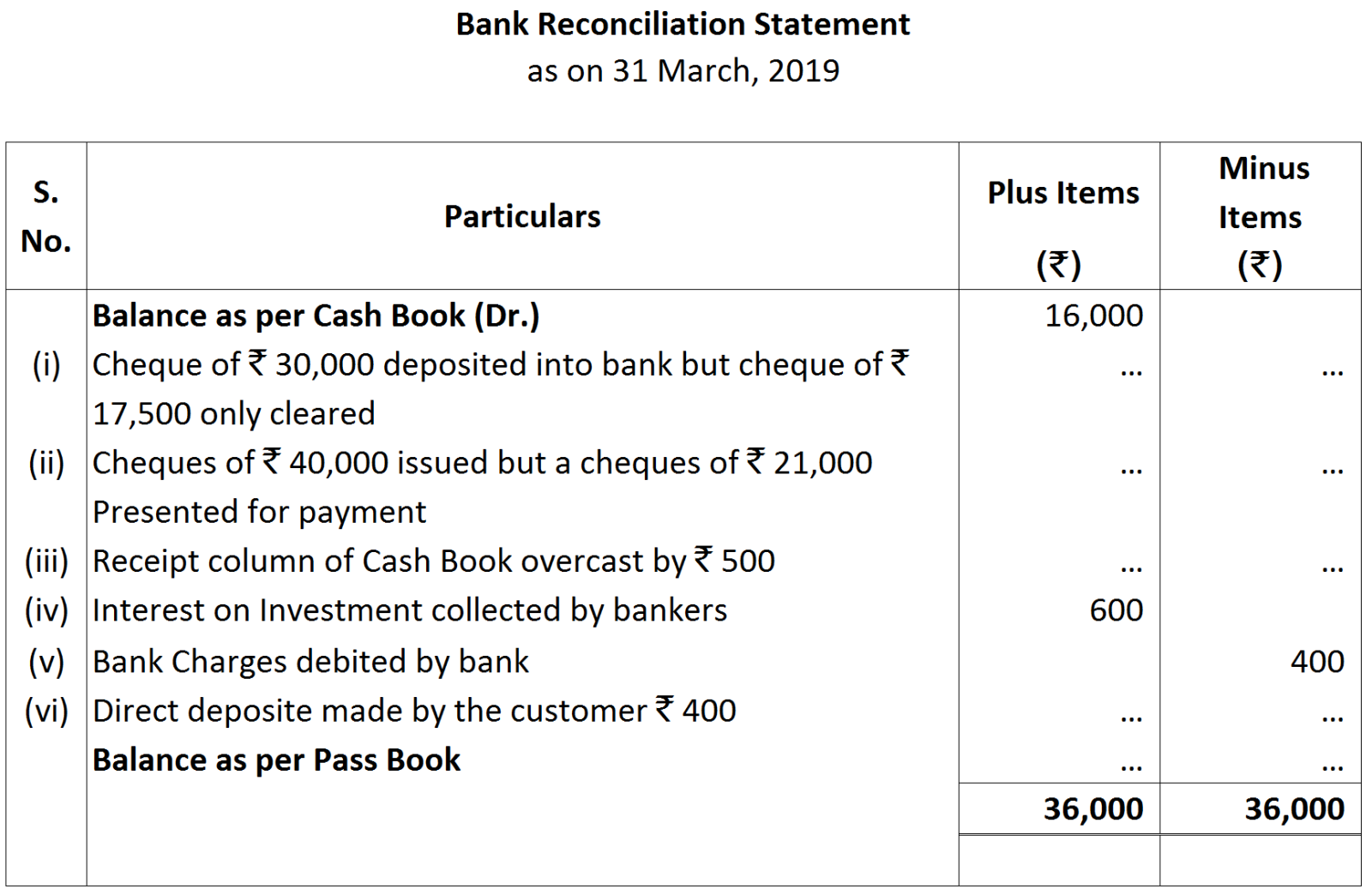
Tiwari & Sons find that the bank balance shown by their Cash Book on 31st March, 2019 is ₹ 40,500 (credit) but the Pass Book shows a difference due to the following reasons:
  1. A cheque for ₹ 5,000 drawn in favour of Manohar has not yet been presented for payment.
  2. A post-dated cheque for ₹ 900 has been debited in the bank column of the Cash Book but it could not have been presented in any case.
  3. Cheques totalling ₹ 10,200 deposited with the bank have not yet been collected and a cheque for ₹ 4,000 has been dishonoured.
  4. A bill for ₹ 10,000 was retired by the Bank under a rebate of ₹ 150 but the full amount of the bill was credited in the bank column of the Cash Book.
Prepare Bank Reconciliation Statement and find out the balance as per Pass Book.
View full question & answer
Question 244 Marks
Prepare a Bank Reconciliation Statement from the following particulars:-
On 31st December 2014, I had an overdraft of ₹ 750 as shown by my Pass Book. I had issued cheques amounting to ₹ 250 of which ₹ 200 worth only seem to have been presented for payment. Cheques amounting to ₹ 100 had been paid in by me on 30th December, but of these only ₹ 75 were credited in the Pass Book. I also find that a cheque for ₹ 10 which I had debited to bank account in my books has been omitted to be banked. There is a debit of ₹ 25 in my Pass Book for interest.
An entry of ₹ 30 of a payment by a customer direct into the bank appears in the Pass Book. My Pass Book also shows a credit of ₹ 60 to my account for interest on investments directly collected by my bankers.
View full question & answer
Question 254 Marks
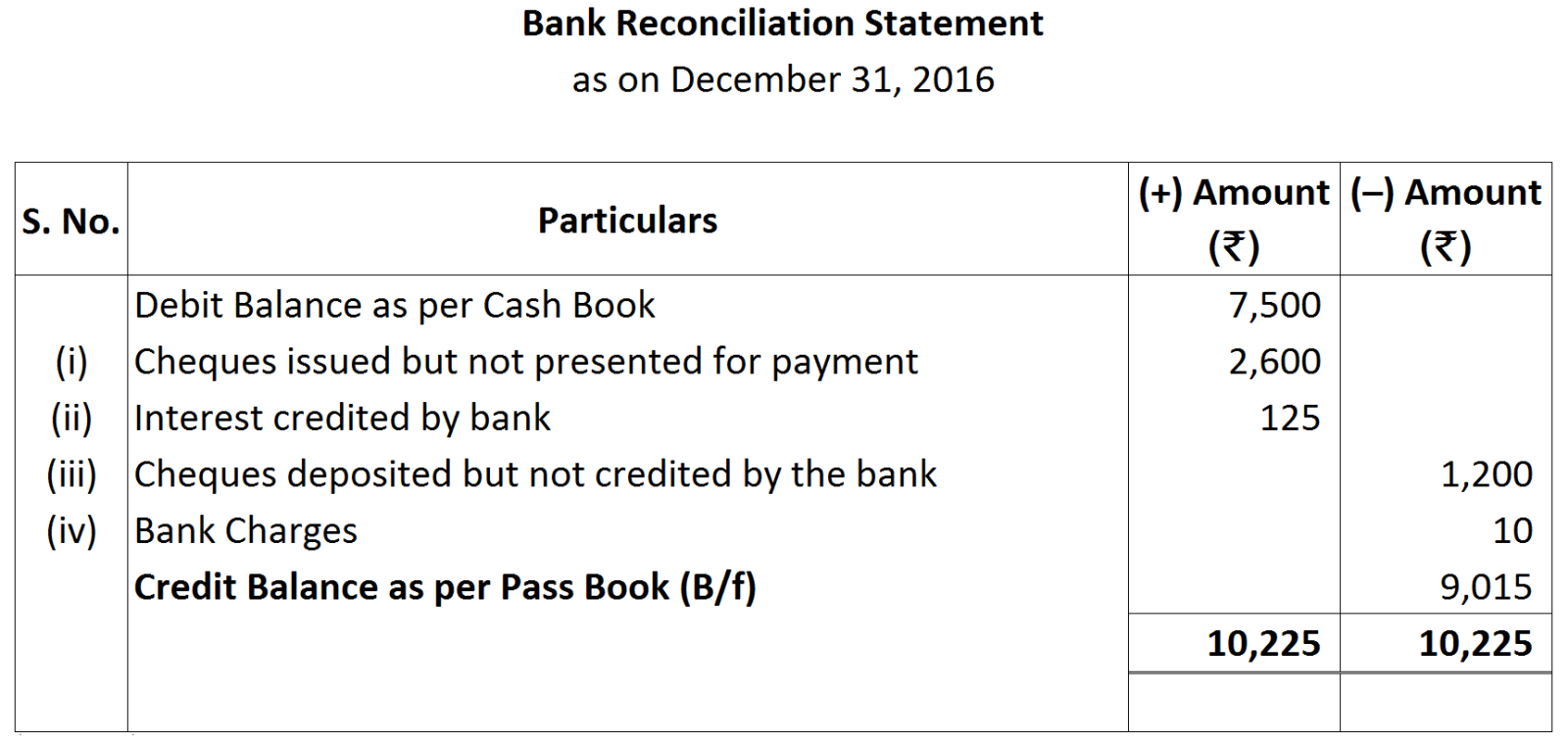
The balance of cash at bank as shown by the Cash Book of Pan & Co. on 31st December, 2016, was ₹ 7,500. On checking the entries in the Cash Book with the Pass Book, it was ascertained that cheques of ₹ 500 and ₹ 700 respectively paid in on 30th December, were not credited until the 2nd January following and three cheques of ₹ 600, ₹ 800 and ₹ 1,200 issued on the 28th December were not presented until the 3rd of January. There was a credit of ₹ 125 in the Pass Book in respect of interest under date 31st December, which was not entered in the Cash Book. There were also Bank Charges debited in the Pass Book amounting in all to ₹ 10 which were not entered in the Cash Book. Prepare a Bank Reconciliation Statement as at 31st December, 2016.
Answer
Solution is as follows.
View full question & answer
Question 264 Marks
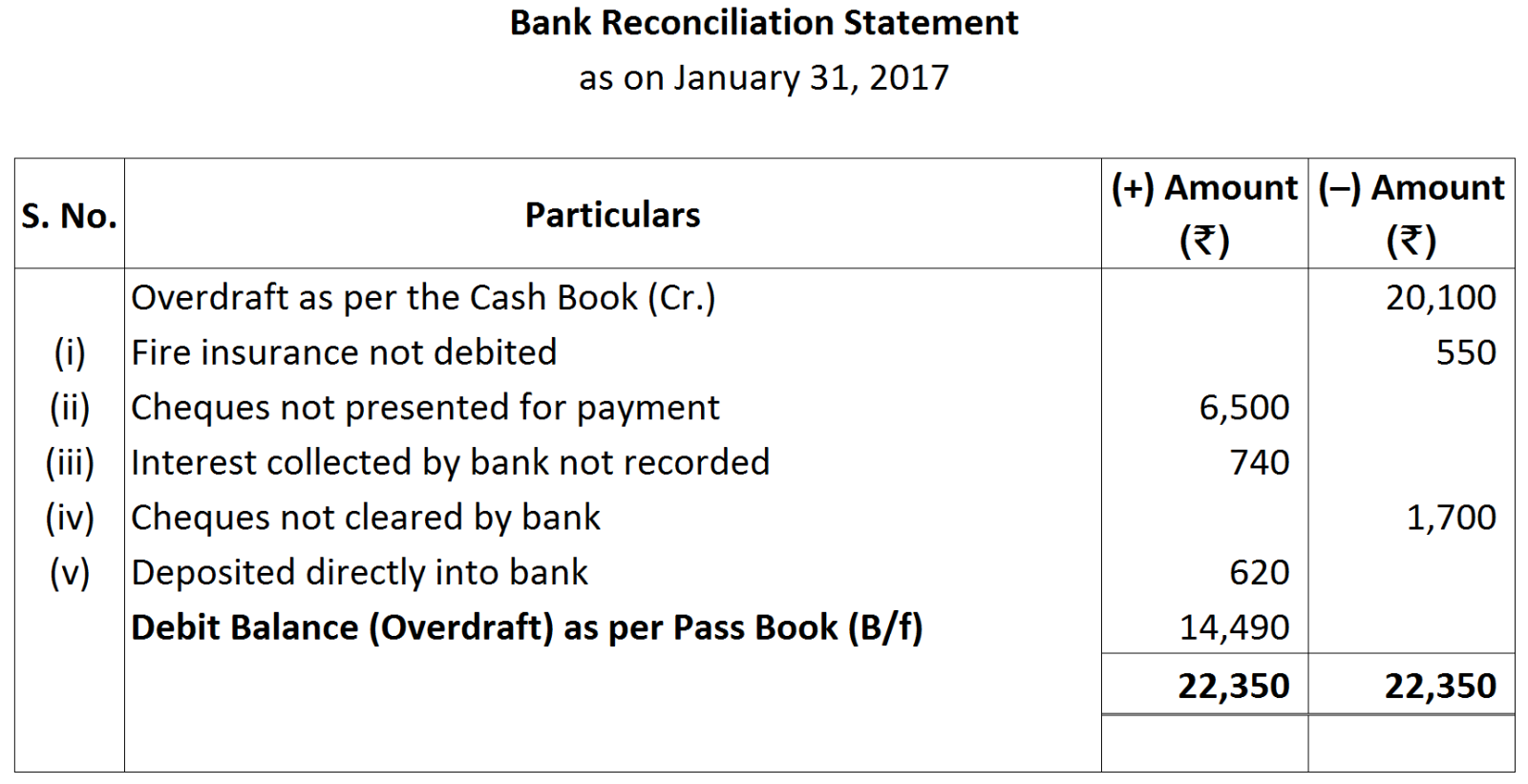
Prepare Bank Reconciliation Statement as on 31st January, 2017, if Cash Book of Mr. Sanjay showed a credit balance of ₹ 20,100.
  1. The bank had paid fire insurance premium of ₹ 550 which does not appear in the Cash Book.
  2. Cheques for ₹ 25,000 issued during January, but cheques for only ₹ 18,500 were presented for payment.
  3. Interest collected by bank ₹ 740.
  4. Cheques of ₹ 8,700 were deposited into bank, but cheques for ₹ 7,000 were cleared till 31st January, 2017.
  5. A customer deposited ₹ 620 directly into bank without informing Mr. Sanjay.
Answer
Solution is as follows:
View full question & answer
Question 274 Marks
When you proceed to reconcile the Bank Account starting with 'Debit' Cash Book balance. how is the following dealt with and why?
  1. Cheques issued but not presented for payment.
  2. Cheques deposited but not yet credited.
  3. Bank charges charged by the bank not recorded in the Cash Book.
  4. Interest allowed by the bank not recorded in the Cash Book.
Answer
  1. Cheques issued but not yet presented for payment are added because the bank will show higher balance since the cheques have not been paid.
  2. Cheques deposited but not credited are deducted because the bank will show lower balance as the cheques have not been realised by the bank.
  3. Bank charges are deducted because the bank has already debited the account and thus, Cash Book shows higher balance.
  4. Interest allowed is added because the bank has already credited the account and thus, Cash Book shows lower balance
View full question & answer
Question 284 Marks
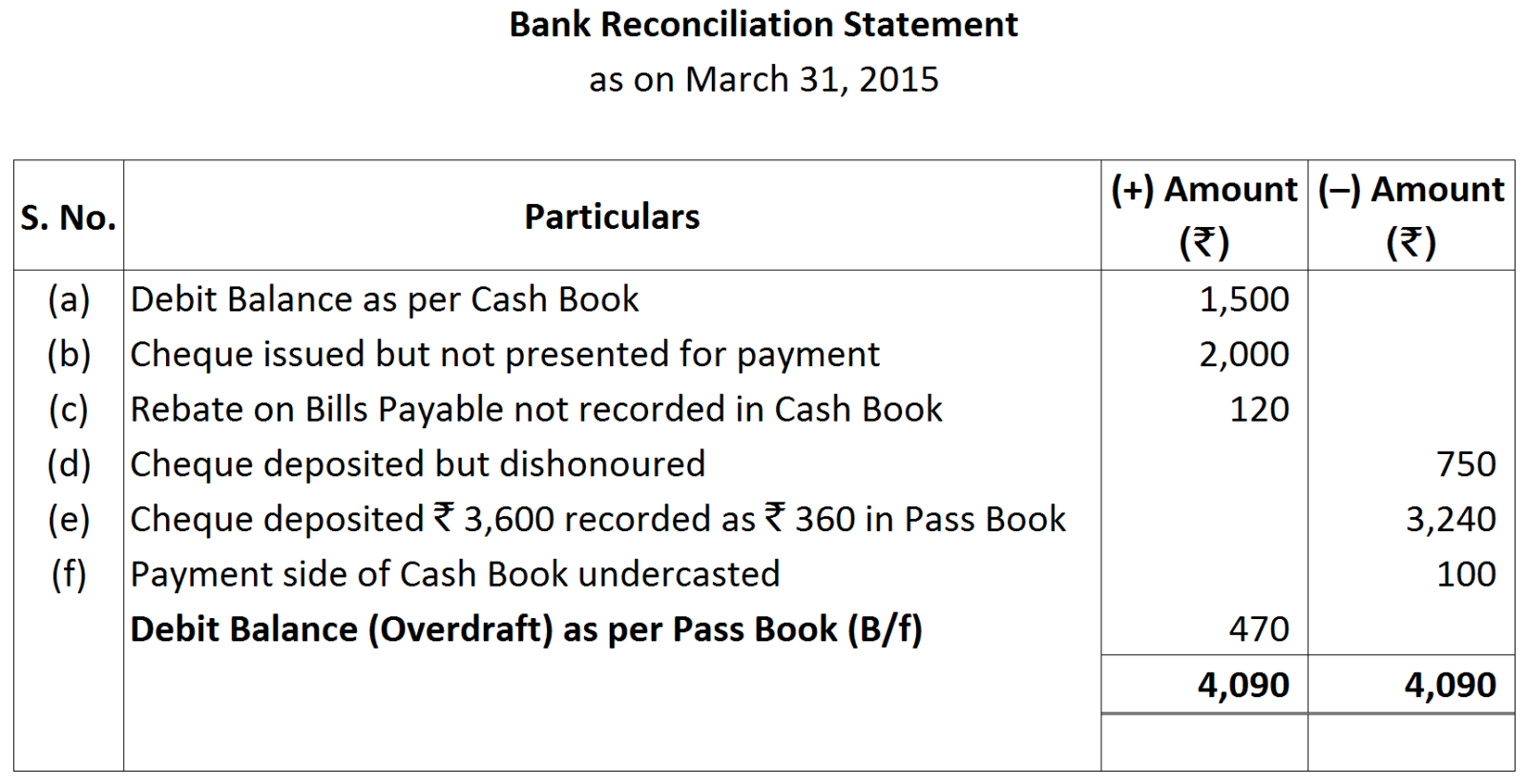
From the following particulars prepare bank reconciliation statement as on 31st March 2015:
  1. Debit balance as per Cash Book ₹ 1,500.
  2. A cheque for ₹ 2,000 issued in favour of X has not been presented for payment.
  3. A bill for ₹ 4,000 retired by bank under a rebate of ₹ 120. The full amount of the bill was credited in Cash Book.
  4. A cheque for ₹ 750 deposited in bank has been dishonoured.
  5. A sum of ₹ 3,600 deposited in the bank has been credited as ₹ 360 in the Pass Book.
  6. Payment side of Cash Book has been undercast by ₹ 100.
Answer
Solution is as follows.
View full question & answer
Question 294 Marks
Tiwari and Sons find that the bank balance shown by their Cash Book on December 31, 2016 is ₹ 40,500 (Credit) but the Pass Book shows a difference due to the following reasons:
  1. A cheque for ₹ 5,000 drawn in favour of Manohar has not yet been presented for payment.
  2. A post-dated cheque for ₹ 900 has been debited in the bank column of the Cash Book but it could not have been presented in any case.
  3. Cheques totalling ₹ 10,200 deposited with the bank have not yet been collected and an another cheque for ₹ 4,000 deposited in the account has been dishonoured.
  4. A Bill Payable for ₹ 10,000 was retired by the Bank under a rebate of ₹ 150 but the full amount of the bill was credited in the bank column of the cash book.
Prepare a Bank Reconciliation Statement and find out the balance as per Pass Book.
View full question & answer
Question 304 Marks
The following facts were extracted as at 31st December 2014 from the books of Rajesh Dogra who keeps a double column Cash Book:
 
Bank balance as per Cash Book (overdrawn)
32,000
Balance as per bank statement (in favour)
24,000
₹ 200 commission charged by bank on outstation cheques yet to be taken into account.
A cheque for ₹ 11,000 paid to Shashi Bhushan wrongly entered in the cash column.
Debit side of Cash Book (bank column) undercast by ₹ 1,000. Cheques received from customers ₹ 10,400 deposited on 31-12-2014 but credited by the bank on 2-1-2015.
Cheques issued to suppliers ₹ 76,600 during 2014 not yet presented for encashment.
Prepare a Bank Reconciliation Statement as at 31-12-2014.
View full question & answer
Question 314 Marks
Enumerate the steps to ascertain the correct cash book balance.
Answer
Generally, differences between the Cash Book and the Pass Book arise due to the reason that items have not been recorded in the Cash Book. In order to ascertain the correct Cash Book balance, we need to prepare Corrected (Adjusted) Cash Book. The below given steps are involved in the preparation of Corrected (Adjusted) Cash Book.
Step 1: Note down the bank balance as per the Cash Book.
Step 2: Rectify all the errors committed in the Cash Book.
Step 3: Enter those transactions in the debit of the Cash Book, which are only in the credit of the Pass Book.
Step 4: Enter those transactions in the credit of the Cash Book that are only in the debit of the Pass Book.
Step 5: The Cash Book is totalled and balancing figure is calculated. This balancing figure is use for preparing BRS.
View full question & answer
Question 324 Marks
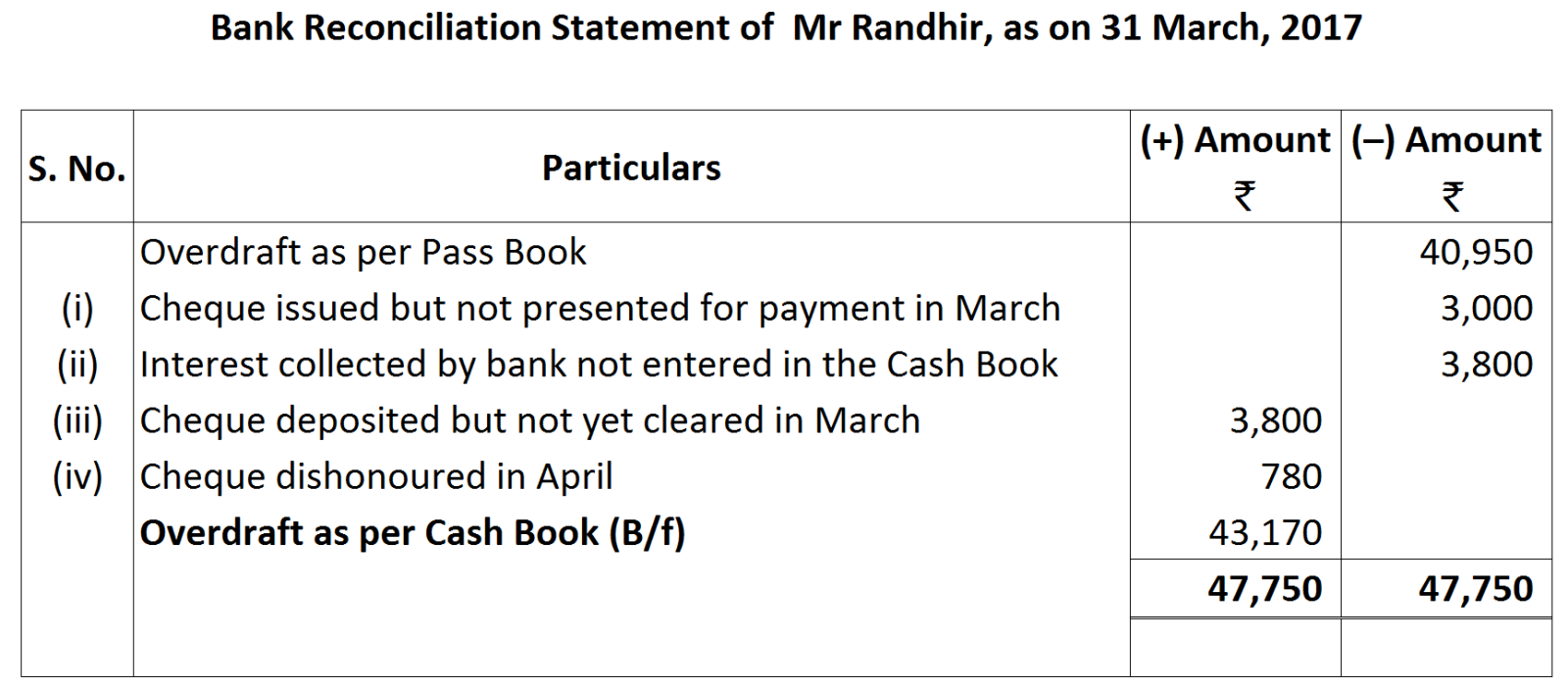
The passbook of Mr. Randhir showed an overdraft of ₹ 40,950 on March 31, 2017. Prepare bank reconciliation statement on March 31, 2017.
  1. Out of cheques amounting to ₹ 8,000 drawn by Mr. Randhir on March 27 a cheque for ₹ 3,000 was encashed on April 2017.
  2. Credited by bank with ₹ 3,800 for interest collected by them, but the amount is not entered in the cash book.
  3. ₹ 10,900 paid in by Mr. Randhir in cash and by cheques on March, 31 cheques amounting to ₹ 3,800 were collected on April, 07.
  4. A Cheque of ₹ 780 credited in the passbook on March 28 being dishonoured is debited again in the passbook on April 01, 2017. There was no entry in the cash book about the dishonour of the cheque until April 15.
Answer
Solution is as follows:
View full question & answer
Question 334 Marks
On Ist January 2017, Rakesh had an overdraft of ₹ 8,000 as showed by his cash book. Cheques amounting to ₹ 2,000 had been paid in by him but were not collected by the bank by January 01, 2017. He issued cheques of ₹ 800 which were not presented to the bank for payment up to that day. There was a debit in his passbook of ₹ 60 for interest and ₹ 100 for bank charges. Prepare bank reconciliation statement for comparing both the balance.
View full question & answer
Question 344 Marks
The following information relate to the business of Mohit Raina, who requests you to prepare his amended Cash Book and reconcile his Cash Book balance with his Pass Book balance:
 
Balance as per Cash Book (Cr.)
40,000
Unpresented cheques
72,000
Uncredited cheques
13,000
You have been given the following additional information:
  1. The debit side of the Cash Book (Bank Column) has been undercast by ₹ 25,000.
  2. A cheque for ₹ 10,000 paid to a creditor has been wrongly entered in the Cash Column.
  3. Bank commission and other charges ₹ 4,000 have not been recorded in the Cash Book.
View full question & answer
Question 354 Marks
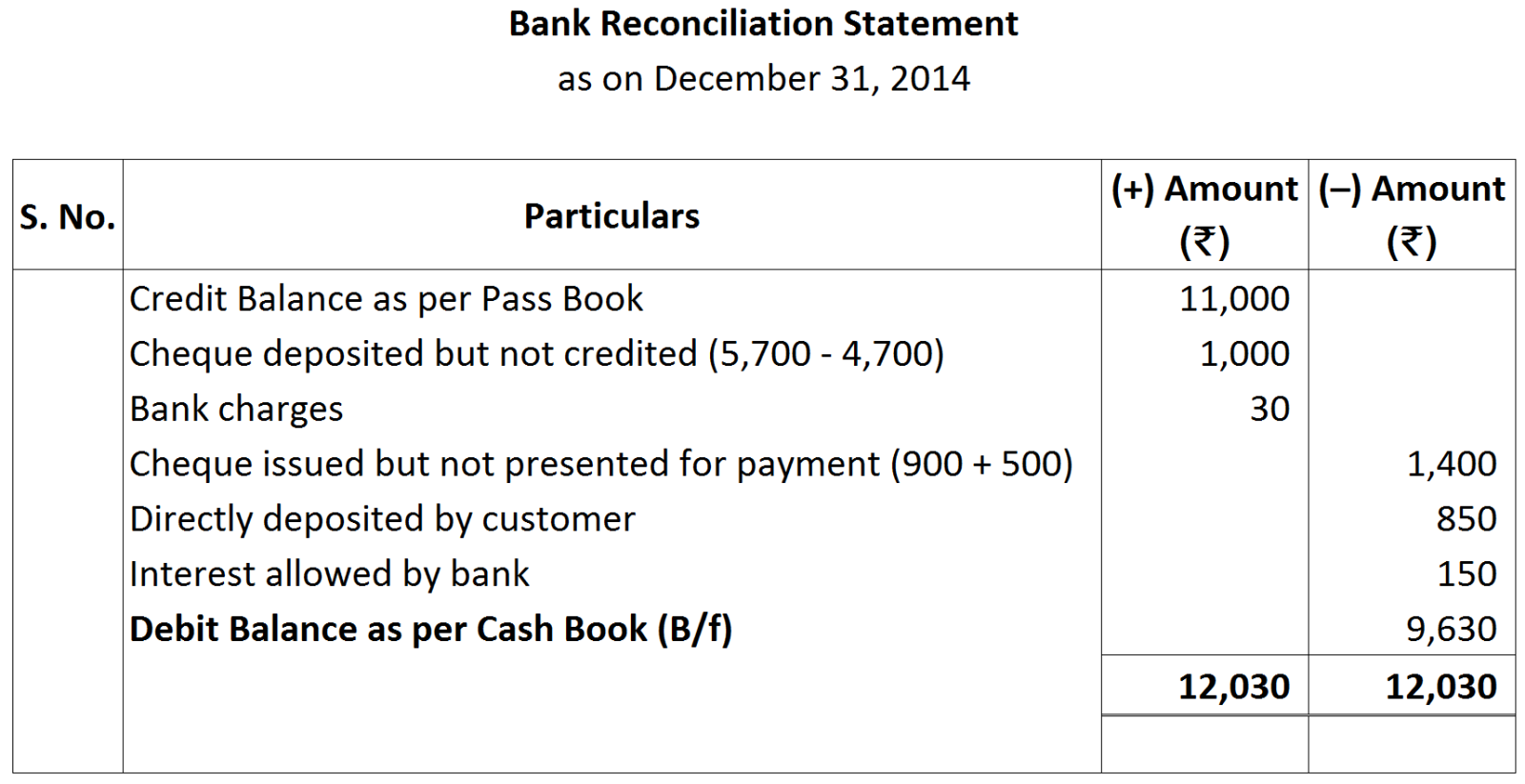
From the following particulars, prepare a Bank Reconciliation Statement of Sh. Yadav on 31st December 2014:- Balance as per Pass Book on 31st December, 2014 is ₹ 11,000. Cheques for ₹ 6,200 were issued during the month of December but of these cheques for ₹ 900 were presented in the month of January, 2015 and one cheque for ₹ 500 was not presented for payment. Cheque and cash amounting to ₹ 5,700 were deposited in bank during December but credit was given for ₹ 4,700 only. A customer had deposited ₹ 850 into the bank directly. The bank has credited the merchant for ₹ 150 as interest and has debited him for ₹ 30 as bank charges, for which there are no corresponding entries in Cash Book.
Answer
Solution is as follow:
View full question & answer
Question 374 Marks
On 31st March 2015 your bank Pass Book showed a balance of ₹ 6,000 to your credit. Before that date you had issued cheques amounting to ₹ 1,500 of which cheques worth ₹ 900 only have been presented. You also deposited cheques worth ₹ 2,000 of which cheque of ₹ 800 paid by you into bank on 29th March is not yet credited in Pass Book. You had also received a cheque for ₹ 160 which although entered by you in the bank column of the Cash Book, was omitted to be paid into the bank. On 31st March a cheque of ₹ 250 received by you was paid into the bank but the same was omitted to be entered in the cash book. There was a credit of ₹ 85 for interest on current account and debit of ₹ 10 for bank charges. Draw up a Reconciliation Statement showing adjustment between your Cash Book and pass book.
View full question & answer
Question 384 Marks
Kumar find that the bank balance shown by his cash book on December 31, 2017 is ₹ 90,600 (Credit) but the passbook shows a difference due to the following reason:
A cheque (post dated) for ₹ 1,000 has been debited in the bank column of the cash book but not presented for payment. Also, a cheque for ₹ 8,000 drawn in favour of Manohar has not yet been presented for payment. Cheques totaling ₹ 1,500 deposited in the bank have not yet been collected and cheque for ₹ 5,000 has been dishonoured.
View full question & answer
Question 394 Marks
Prepare a Bank Reconciliation Statement in the books of Bharti as on 31st January 2017:
  1. Balance as per Pass Book as on 31st January, 2017 was ₹ 62,500.
  2. Cheque of ₹ 17,800 was issued by her on 28th January 2017 but this was not presented for payment till 31st January 2017.
  3. A cheque of ₹ 4,000 issued to Mr. Rahim, was taken in the cash column.
  4. A cheque of ₹ 15,000 was paid into bank but was omitted to be entered in the cash book.
  5. The bank has charged ₹ 55 as its commission and has allowed interest ₹ 50.
View full question & answer
Question 404 Marks
From the following particulars prepare a bank reconciliation statement showing the balance as per cash book on December 31, 2016.
Two cheques of ₹ 2,000 and ₹ 5,000 were paid into bank in October, 2016 but were not credited by the bank in the month of December.
A cheque of ₹ 800 which was received from a customer was entered in the bank column of the cash book in December 2016 but was omitted to be banked in December, 2016.
Cheques for ₹ 10,000 were issued into bank in November 2016 but not credited by the bank on December 31, 2016.
Interest on investment ₹ 1,000 collected by bank appeared in the passbook.
Balance as per Passbook was ₹ 50,000
View full question & answer
Question 414 Marks
What is a Bank Reconciliation Statement? Explain briefly any four points regarding need and importance of preparing a Bank Reconciliation Statement.
Answer
Bank Reconciliation Statement is a prepaed by the account holder on a particuar dare to reconcile the bank balance as per cash Book with the balance as per bank statenment or bank pass book showing entries because of which differnces between the two balance exist.Bank Reconciliation statement is prepared because of following reasons:
  1. It brings out the errors if any, committed either in the cash book or in the bank statement or pass book.
  2. Undue delay in the clerance of cheques deposited is know form the reconciliation.
  3. Regular reconciliation discourages embezzlements.
  4. Reconciliation helps in verifying the accuracy of entries recorded inthe cash book.
  5. It shows actual bank blaance.
View full question & answer
Question 424 Marks
From the following items prepare a Bank Reconciliation Statement on 31st May 2015:
  1. Bank balance as per Cash Book on 31st May 2015 ₹ 17,600.
  2. Cash and cheques totalling ₹ 36,000 were sent to bank during May but one cheque of ₹ 11,800 was shown in the Pass Book on 2nd June.
  3. As per instructions bankers have directly collected ₹ 4,100 from a customer but there is no mention of it in the Cash Book.
  4. Three cheques for ₹ 10,000, ₹ 12,000 and ₹ 4,800 respectively were drawn on 27th May but the cheque for ₹ 4,800 was encashed on 1st June.
  5. On 31st May bankers had debited ₹ 45 as bank charges but had intimated it on 3rd June.
  6. ₹ 16,200 were withdrawn from bank on 25th May but there is no entry for it in the Cash Book.
View full question & answer
4 Marks Question - Account STD 11 Commerce Questions - Vidyadip