Questions

4 Marks Question

🎯

Test yourself on this topic

34 questions · timed · auto-graded

Question 14 Marks
On 1st January, 2019, A sold goods to B for ₹ 5,000 plus IGST @ 18%. A received ₹ 900 by cheque from B and drew on him a bill for the balance amount payable 3 months after date. The bill was duly accepted by B. A retained the bill till due date. On due date, the bill was paid.
Pass Journal entries in the books of A and B. Also, show necessary accounts in the books of both the parties.
View full question & answer
Question 24 Marks
Explain any three of the following:
  1. Retiring of a bill of exchange.
  2. Discounting of a bill of exchange.
  3. Bill sent to bank for collection.
  4. Noting Charges.
Answer
  1. Retirement of a Bill: When the Drawee pays the bill before its due date It is called Retirement of a Bill. The holders allow him a rebate of certain amount calculated at a certain rate per cent per annum, from the date of retirement to the date of maturity.
  2. Discounting of a Bill: A bill may be presented to a bank and amount received against it. It is known as Discounting of a Bill. The bank deducts its charges (Discounting charges) from the bill amount and disburses the balance amount.
  3. Bill Sent for Collection: A bill received may be retained till the date of maturity. But, it may be deposited with the bank, with instructions that the bill be retained till maturity and realised on its due date. It is known as Bill Sent for Collection.
  4. Noting Charges: Noting Charges is the fee paid to the Notary Public for noting and protesting the Bill of Exchange of its dishonour.
View full question & answer
Question 34 Marks
Give a definition of Bill of Exchange and give its four characteristics.
Answer
"A Bill of Exchange is an instrument in writing containing an unconditional order signed by the maker, directing a certain person to pay a certain sum of money only to, or to the order of, a certain person or to the bearer of the instrument.” -Section 5 of the Negotiable Instruments Act, 1881.
On the basis of the above definition following are the main characteristics of bill of exchange:
  1. A bill of exchange must be in writing.
  2. It must contain an order (and not a request) to make payment.
  3. The order must be unconditional.
  4. The amount of bill of exchange must be definite.
  5. The date of payment must be a fixed one.
  6. It must be signed by the maker (drawer) of the bill.
  7. It must be signed by the acceptor (drawee).
View full question & answer
Question 44 Marks
On Jan 01, 2016, Shankar purchased goods from Parvati for ₹ 8,000 and immediately drew a promissory note in favour of Parvati payable after 3 months. On the date of maturity of the promissory note, the Government of India declared holiday under the Negotiable Instrument Act 1881. Since, Parvati was unaware about the provision of the law regarding the date of maturity of the bill, she handed over the bill to her lawyer, who duly presented the bill and received the payment. The amount of the bill was handed over by the lawyer to Parvati immediately. Recore the necessary Journal entries in the books of Parvati and Shankar.
View full question & answer
Question 54 Marks
Distinguish between an accomodation bill and a trade bill.
Answer
  Basis for Distinction Trade Bills Accommodation Bills
1. Object These bills are drawn against trade transaction of sale and purchase. These bills are drawn for financial assistance.
2. Consideration These bills are drawn against proper consideration. These bills are drawn without consideration.
3. Proof of Dedt These bills are proof of debt. The drawee is a debtor. These bills are not a proof of debt because the drawee is not a debtor.
4. Distribution of the proceeds When these bills are discounted, the full proceeds remain with the drawer. When these bills are discounted, the proceeds may be share by drawer and drawee in pre-determined ratio.
View full question & answer
Question 64 Marks
Distinguish between Bills of Exchange and Promissory Note on the following basis:
  1. Order or Promise and Parties.
  2. Acceptance.
  3. Payee.
  4. Noting.
Answer
Coming Soon
View full question & answer
Question 74 Marks
Amar sells goods to Bhola for ₹ 10,000 and draws upon him a bill for the amount payable 3 months after date. The bill is accepted by Bhola. Amar discounts the bill with his bankers at a discount of ₹ 150 inclusive of all charges. Bhola fails to meet this bill on maturity. Amar pays off his banker and his expenses amounting to ₹ 100. Bhola gives a fresh bill, 2 months' date to Amar for ₹ 10,250, which he met at maturity.
Show the necessary Journal entries in Amar's books.
View full question & answer
Question 84 Marks
On 10th March, 2019, A draws on B a bill at 3 months for ₹ 20,000 which B accepts immediately and returns to A. The bill is honoured due date.
​Pass necessary Journal entries in the books of both the parties.
View full question & answer
Question 94 Marks
On 10th January, 2017, A sells goods to B for ₹ 12,000. On that date, B accepted a bill drawn upon him by A at two months for ₹ 12,000. A retains the bill till due date and on due date sends the bill to the Banker for collection. In due course, A receives the information from the Bank that the bill has been duly met.
Pass Journal Entries in the books of A and B.
View full question & answer
Question 104 Marks
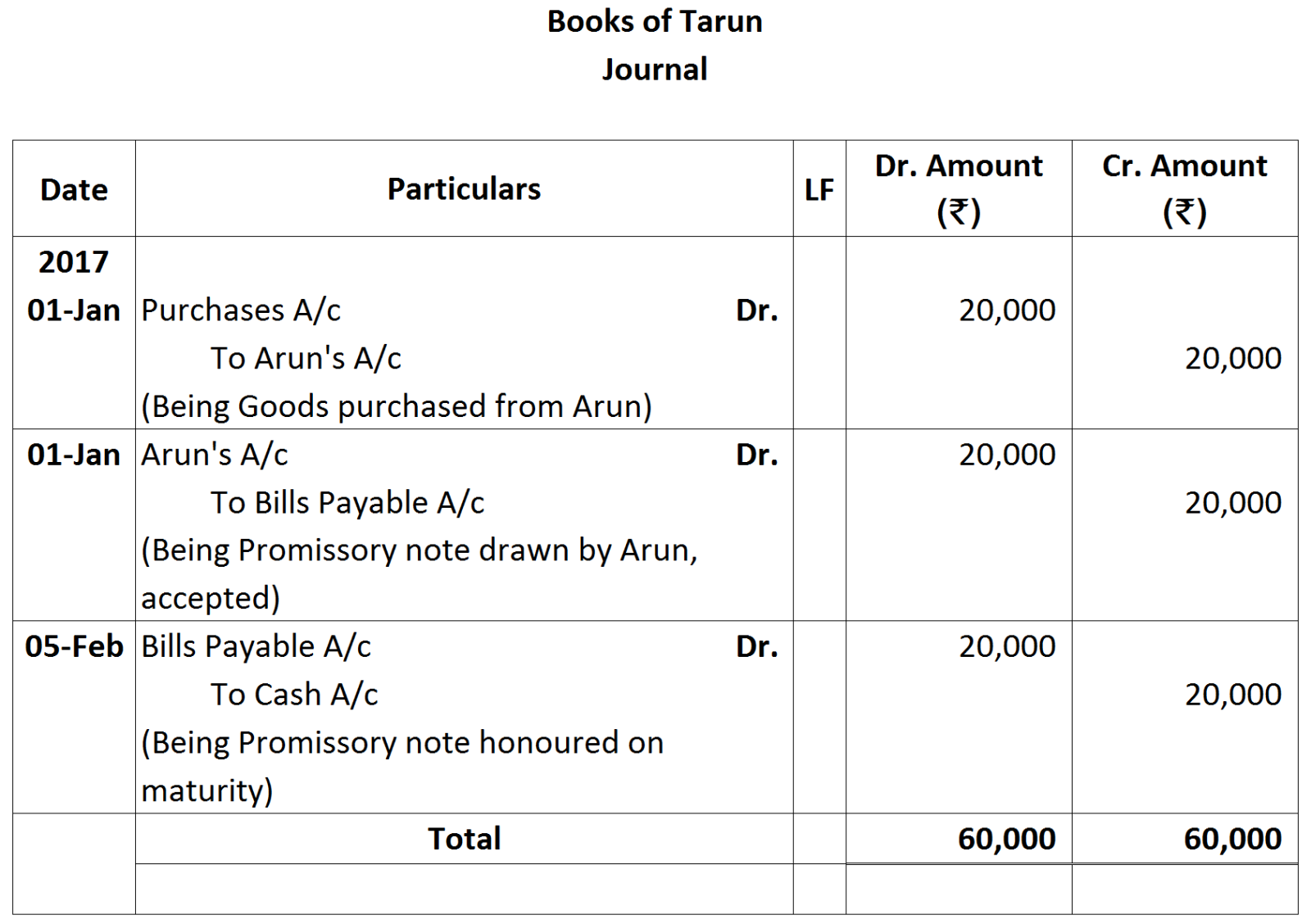
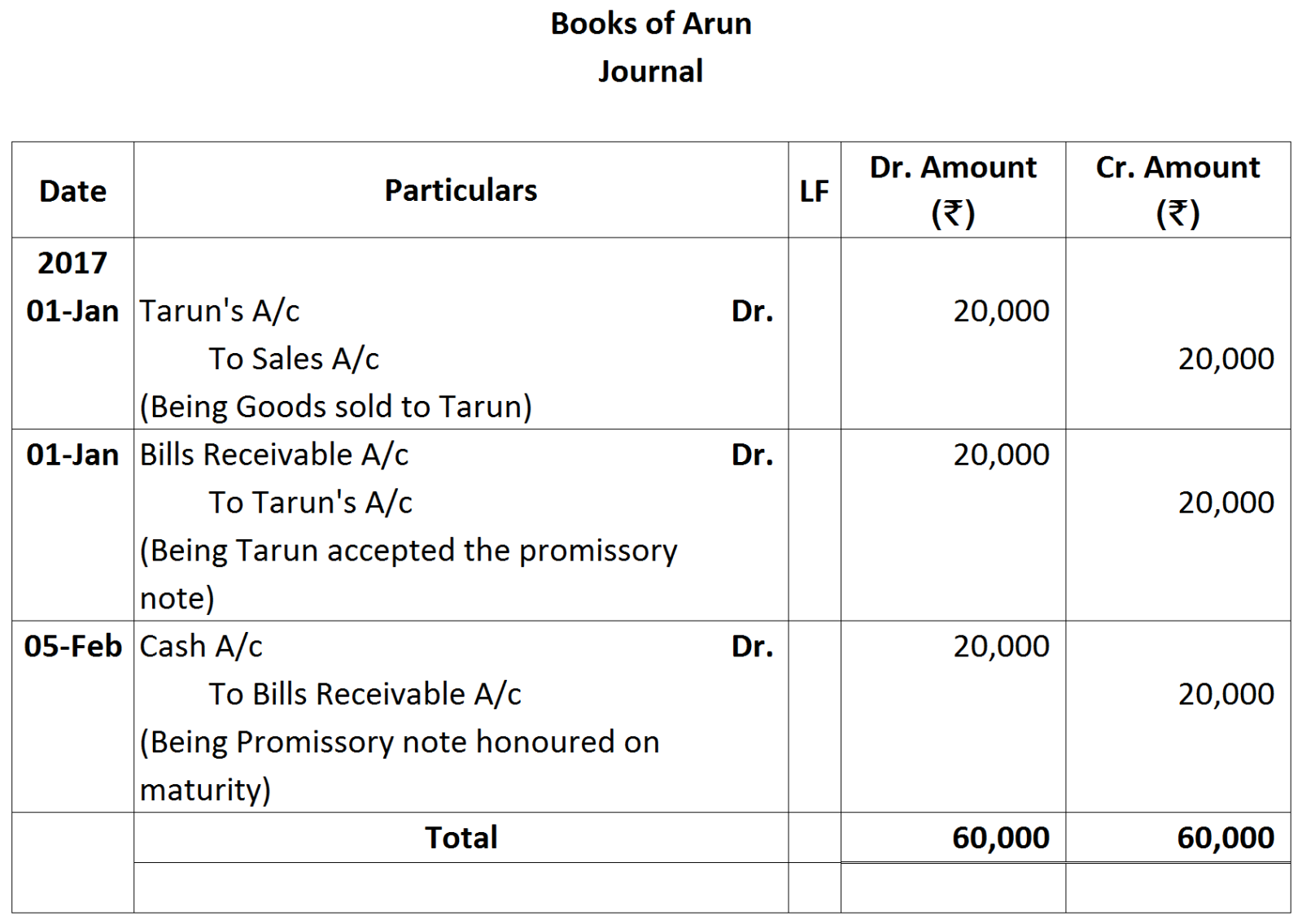
On Jan. 1, 2017, Tarun purchased goods from Arun for ₹ 20,000 and immediately drew a promissory note in favour of Arun payable after 1 month. Date of maturity of the promissory note was declared emergency holiday by the Government of India under the Negotiable Instrument Act 1881. Tarun met the promissory note according to the provisions of law.
Pass the necessary Journal entries in the books of Arun and Tarun.
Answer


Note: When due date falls on Emergency holiday (here February 04, 2017), then due date is succeeding date i.e. February 05, 2017.
View full question & answer
Question 114 Marks
Explain in brief the meaning of the following terms:
  1. Endorsement of a bill.
  2. Renewal of a bill.
  3. Dishonour of a Bill.
  4. Date of Maturity.
Answer
  1. Endorsement of Bill: Endorsement means transfer of Bill of Exchange or Promissory Note to another person. The person receiving the Bill of Exchange or Promissory Note becomes authorised to receive the payment. The person who transfers the Bill of Exchange in favour of other person is called endorser. The person to whom the Bill of Exchange is endorsed is called the endorsee.
  2. Renewal of a Bill: When the acceptor of a bill is not in a position to meet the bill on its due date, he may, with the consent of the holder accept a fresh bill in place of the old bill (after cancelling the old bill), it is called Renewal of a Bill.
  3. Dishonour of a Bill: Dishonour means that the bill is not paid by the Drawee on its due date. It arises when the acceptor refuses or is unable to pay the amount of the bill, i.e., Bill of Exchange, Promissory Note or cheque, (say because of insolvency).
  4. Date of Maturity: The date which comes after adding three days to the due date of a bill, is called Date of Maturity.
View full question & answer
Question 124 Marks
Distinguish between Bills of Exchange and Promissory Note on the basis of:
  1. Drawer.
  2. Acceptance.
  3. Payee.
  4. Number of parties.
Answer
  Basis Bill of Exchange Promissory Note
(i) Drawer Creditor is the Drawer Debtor is the drawer.
(ii) Acceptance It needs acceptance by the Drawee. It not need acceptance by the Drawee.
(iv) Parties It has three parties namely-Drawer, Drawee and Payee. It has two parties namely-Promisor and payee
Note:
  1. Payee.
Payee is the person in bills of exchange.
In promissory note there is note payee.
View full question & answer
Question 134 Marks
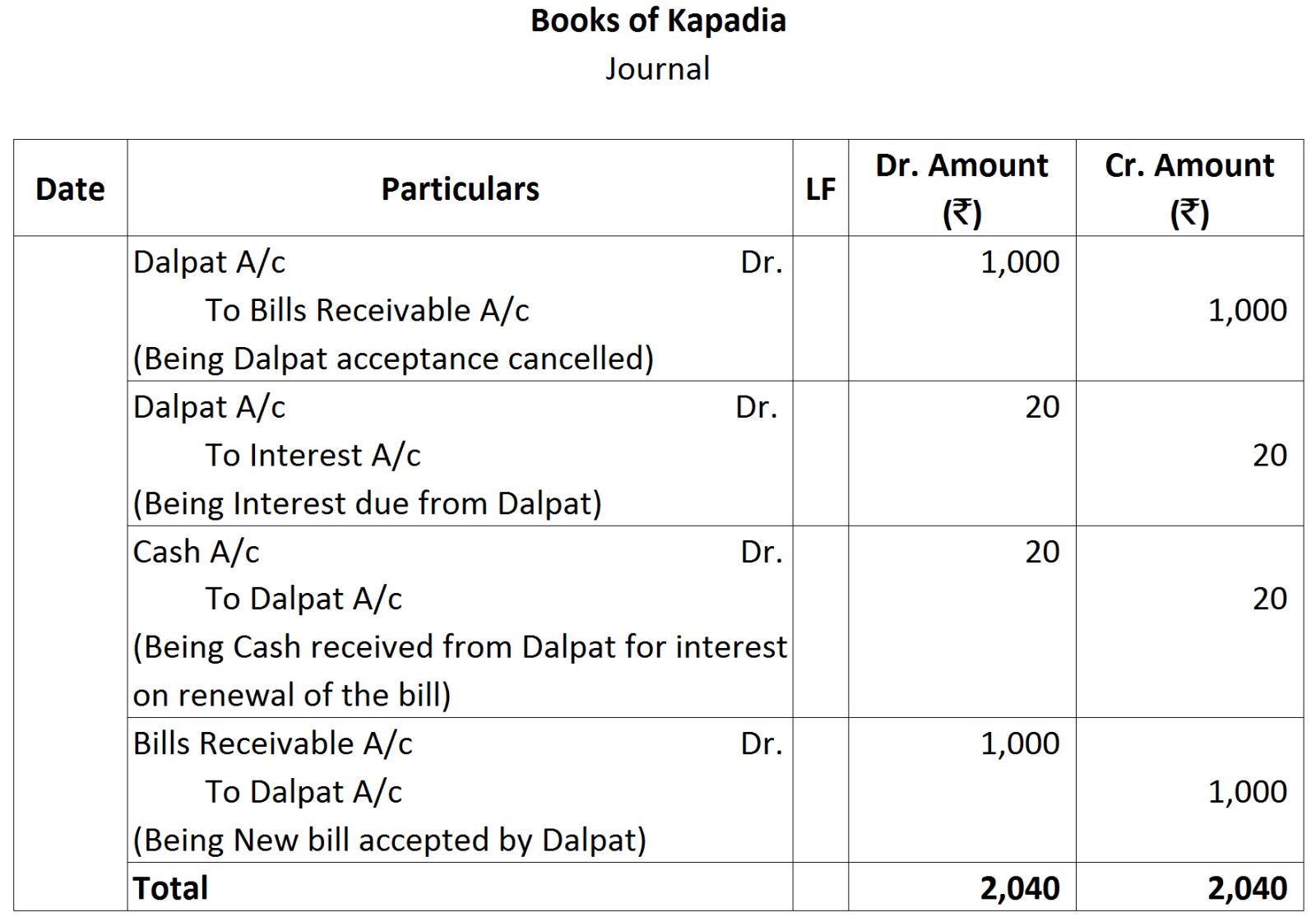
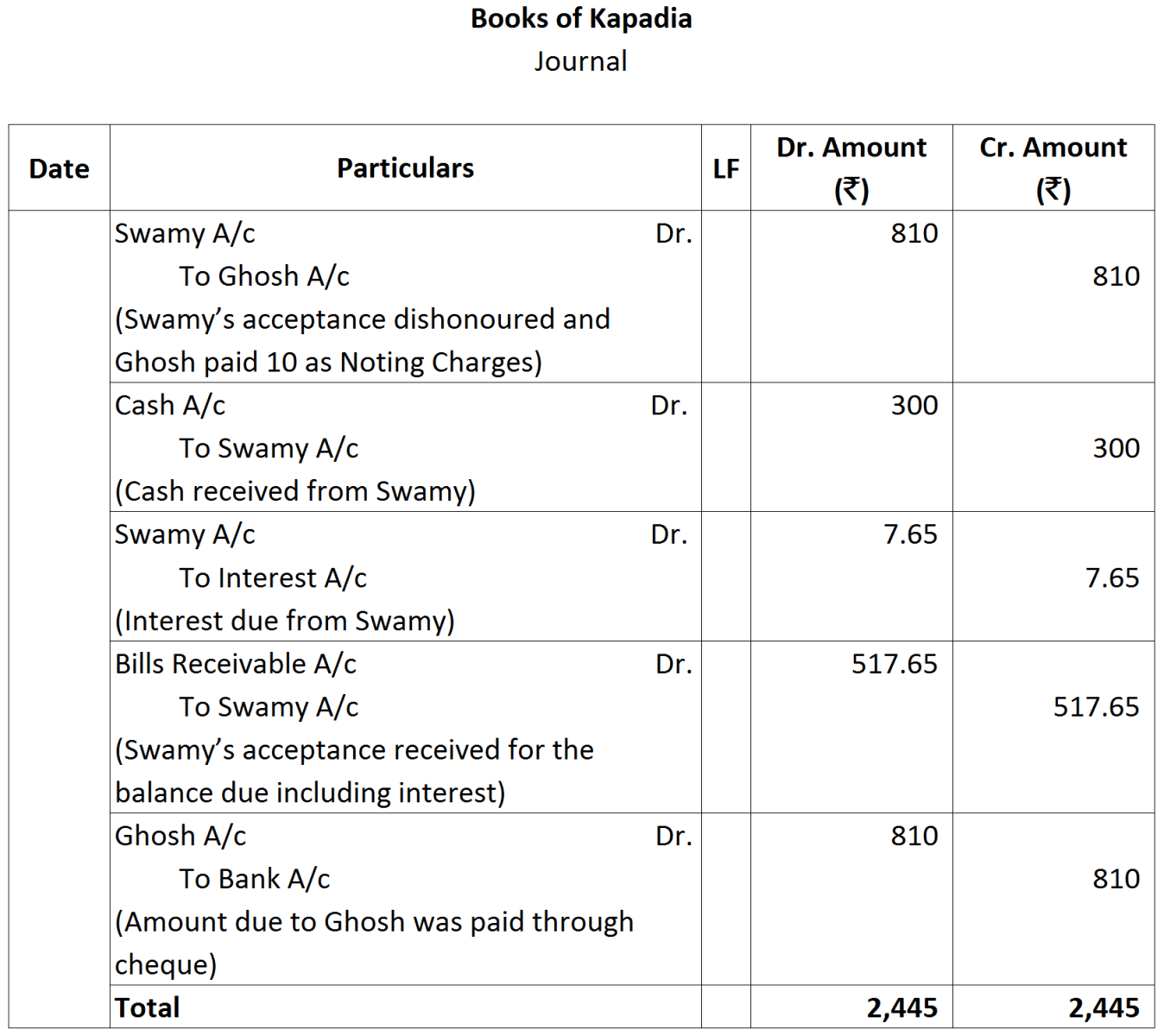
How will you record the following transactions in the books Kapadia?
  1. A bill received from Dalpat for ₹ 1,000 has to be renewed, Dalpat agrees to pay ₹ 20 as interest.
  2. Swamy's bill for ₹ 800 endorsed in favour of Ghosh dishonoured, Ghosh pays ₹ 10 as noting charges. Swamy pays ₹ 300 immediately and agrees to accept a new bill for 3 months for the balance together with interest at 6% p.a. Ghosh's Account is settled by cheque.
Answer
  1.  
  1.  
View full question & answer
Question 144 Marks
Give four differences between a Bill of Exchange and a Promissory Note.
Answer
Differences between a Bill of Exchange and a Promissory Note.
 
Basis
Bill of Exchange
Promissory Note
1.
Drawer
Creditor is the Drawer.
Debtor is the Drawer.
2.
Orther/ Promise
It is an order to pay.
It is a promise to pay.
3.
acceptance
It needs acceptance by the Drawee.
It does not need acceptance by the Drawee.
4.
Parties
It has three paeties namely-Drawer, Drawee and Payee.
It has two parties namely-Promisor and Payee.
5.
Liability
Liability of the drawer arises only if the acceptor does not pay.
Promisor has the primary liability to pay.
6.
Copies
In case of foreign bills, three copies are made but otherwise only one copy is prepared.
Only one copy is prepared whether it is foreign or local.
7.
Stamp
Bill payable on demand need not to be stamped but otherwise stamps would be necessary.
It has to be stamped in any case.
View full question & answer
Question 154 Marks
On 1st January, 2019, Ajay sold goods to Bhushan for ₹ 50,000. Ajay draws a bill of exchange for two months for the amount due which Bhushan accepts and returns it to Ajay. Bhushan met the bill on the due date. Pass Journal entries in the books of Ajay and Bhushan.
View full question & answer
Question 164 Marks
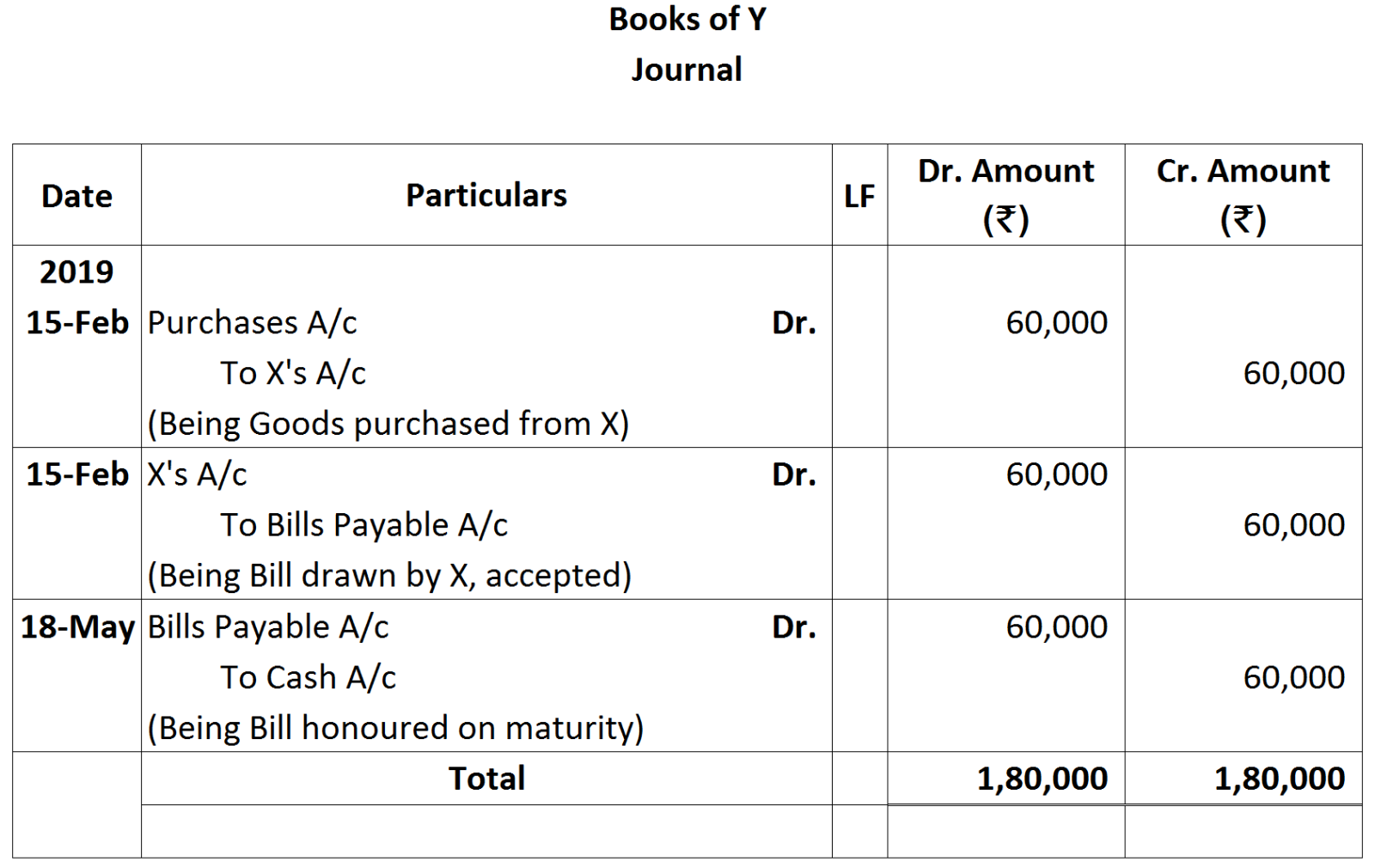
Y purchased goods for ₹ 6,000 on 1st June, 2011 from X and on the same date accepted a bill payable after three months. 3 days later, X endorsed the bill to Z. On maturity, the bill was dishonoured for non-payment and Z had to pay ₹ 50 as noting charges. Two days after the dishonour of bill, Y paid ₹ 2,000 to X and requested him to draw a second bill for the balance plus ₹ 90 for the amount of interest, payable after two months. X accepted the proposal and draws the bill on Y, which was accepted by Y and was duly met on maturity. Pass Journal entries for the above transactions in the books of X.
View full question & answer
Question 174 Marks
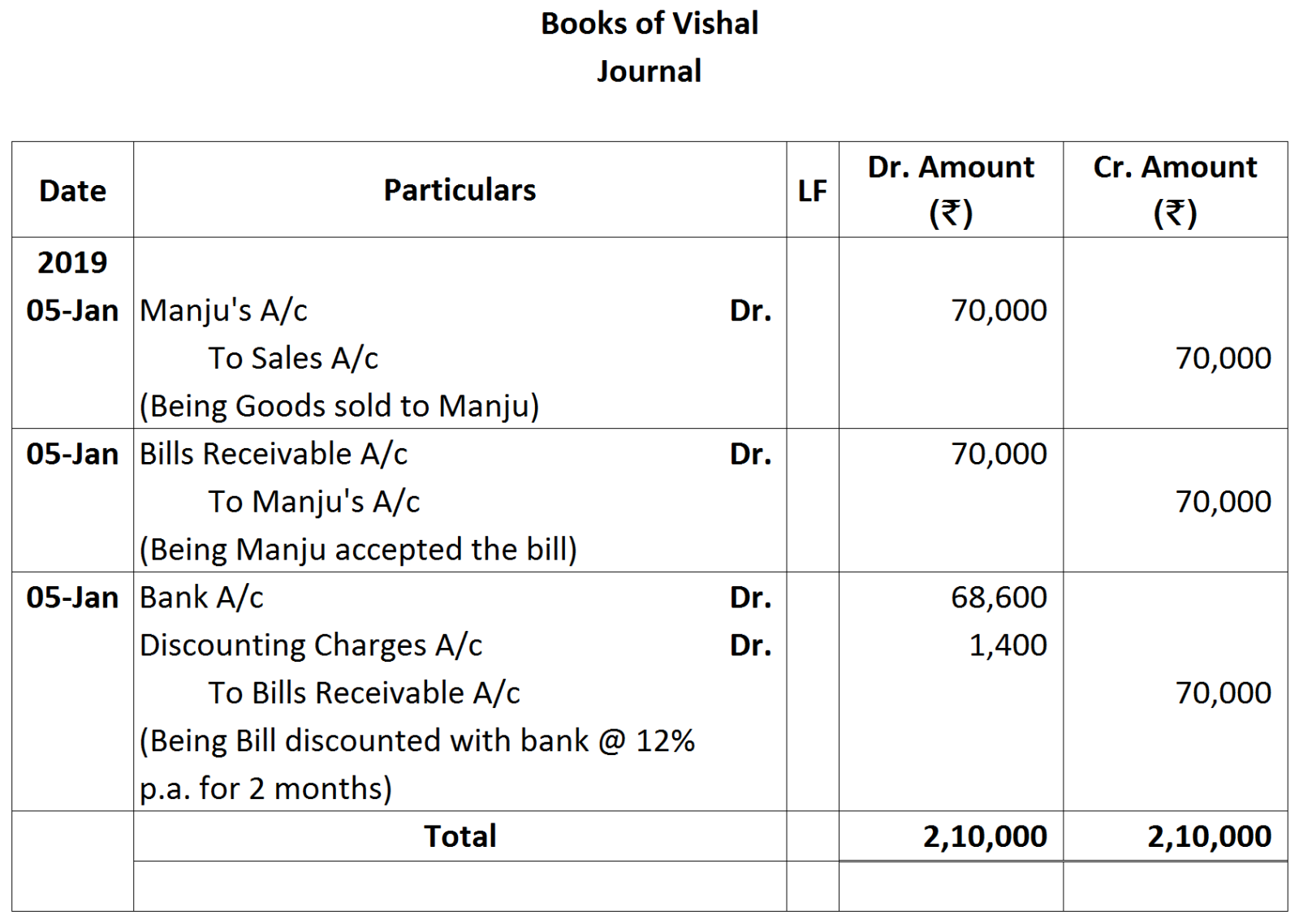
Vishal sold goods for ₹ 70,000 to Manju on Jan. 5, 2019 and drew upon her a bill of exchange payable after 2 months. Manju accepted Vishal's draft and handed over the same to Vishal after acceptance. Vishal immediately discounted the bill with his bank @ 12% p.a. On the due date Manju met her acceptance. Journalise the above transactions in the books of Vishal and Manju.
Answer


Working Note:
Calculation of Discounting Charges,
Discounting Charges $=7,000\times\frac{12}{100}\times\frac{2}{12}=₹\ 140$
View full question & answer
Question 184 Marks
On 20th March, 2019, Naresh sold goods to Kailash to the value of ₹ 1,250, taking a bill at 3 months for the amount. On maturity, the bill was dishonoured. Naresh paid ₹ 10 as noting charges. On 1st July, Kailash cleared his account by paying ₹ 1,260.
Make the entries in the books of both the parties to record the above transactions.
View full question & answer
Question 194 Marks
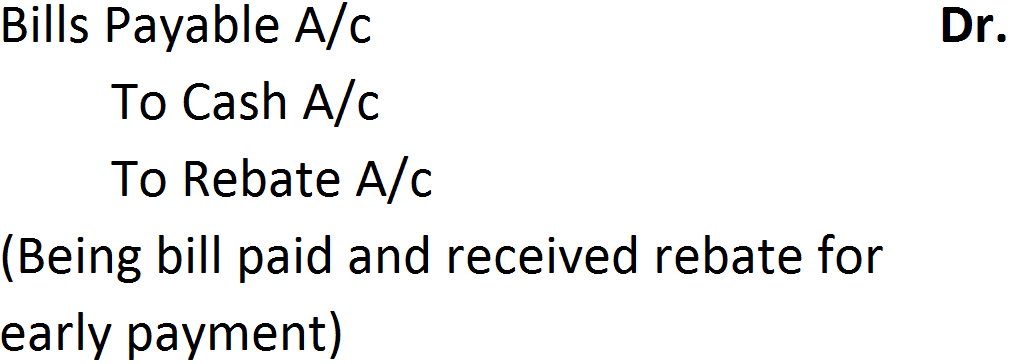
What is retirement of a bill of exchange?
Answer
When the drawer of the bill pays off the amount of the bill before the maturity of the bill it is called retirement of the bill. Holder of the bill may give discount for such earlier payment which is called as ‘rebate’.
Entry in the books of the holder of the bill.

Entry in the books of the accceptor (drawer) of the bill.
View full question & answer
Question 204 Marks
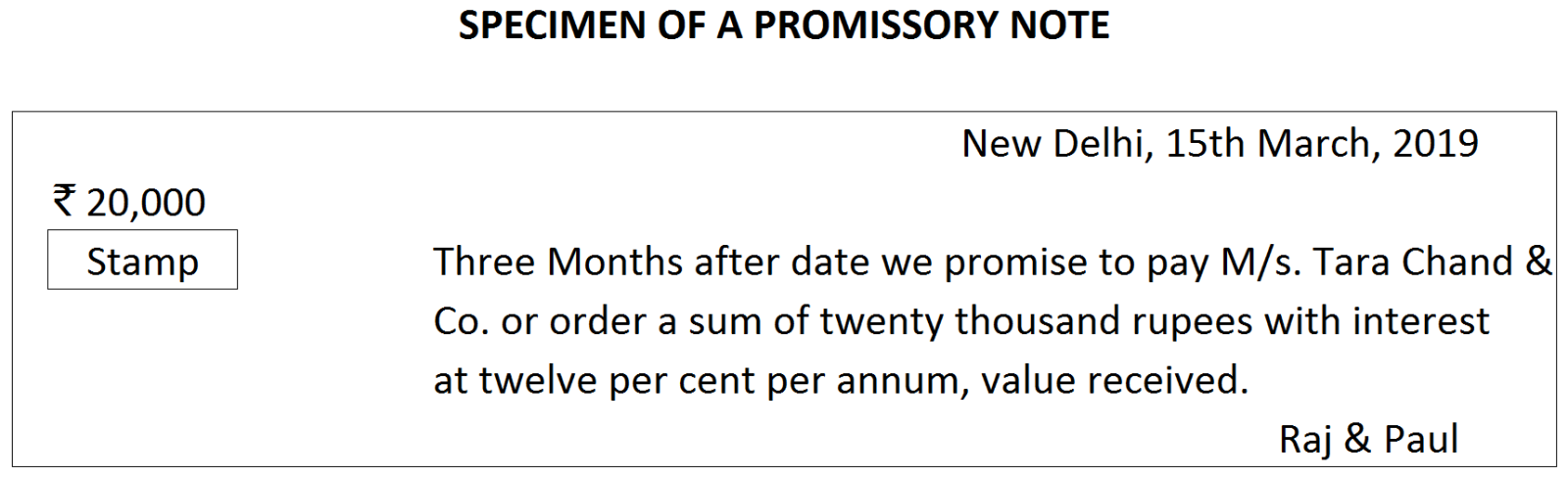
Prepare an imaginary specimen of a promissory note.
Answer
A Promissory Note has two parties namely:
  1. Maker: Maker is the person who makes the promise to pay the amount. It is a person who has availed the credit.
  2. Payee: Payee is the person to whom payment is to be made. It is a person who has granted the credit.

In the example, M/s. Raj & Paul is the maker or a promisor and M/s. Tara Chand & Co. is the payee.
View full question & answer
Question 214 Marks
On 1st July, 2019, A drew a bill for ₹ 5,000 on B payable after 3 months. A discounted it with the Bank for ₹ 4,850. On maturity, B failed to pay the amount of his acceptance and the bank had to pay ₹ 50 as noting charges.
Pass the necessary Journal entries in the books of A and B.
View full question & answer
Question 224 Marks
Write a note on the following:
  1. Dishonour of Bill.
  2. Endorsement of Bill.
Answer
  1. Dishonour of a Bill: Dishonour means that the bill is not paid by the Drawee on its due date. It arises when the acceptor refuses or is unable to pay the amount of the bill, i.e., Bill of Exchange, Promissory Note or cheque, (say because of insolvency).
  2. Endorsement of Bill: Endorsement means transfer of Bill of Exchange or Promissory Note to another person. The person receiving the Bill of Exchange or Promissory Note becomes authorised to receive the payment. The person who transfers the Bill of Exchange in favour of other person is called endorser. The person to whom the Bill of Exchange is endorsed is called the endorsee.
View full question & answer
Question 234 Marks
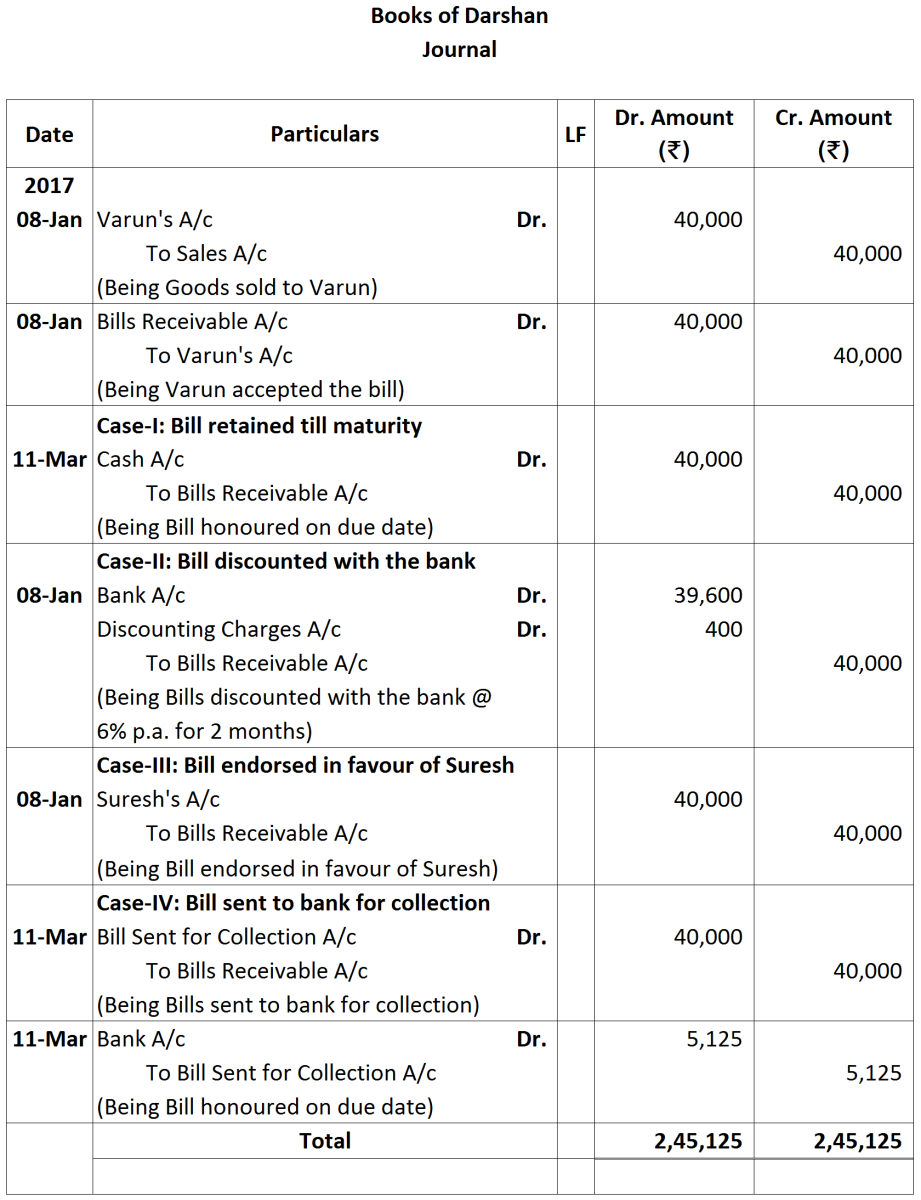
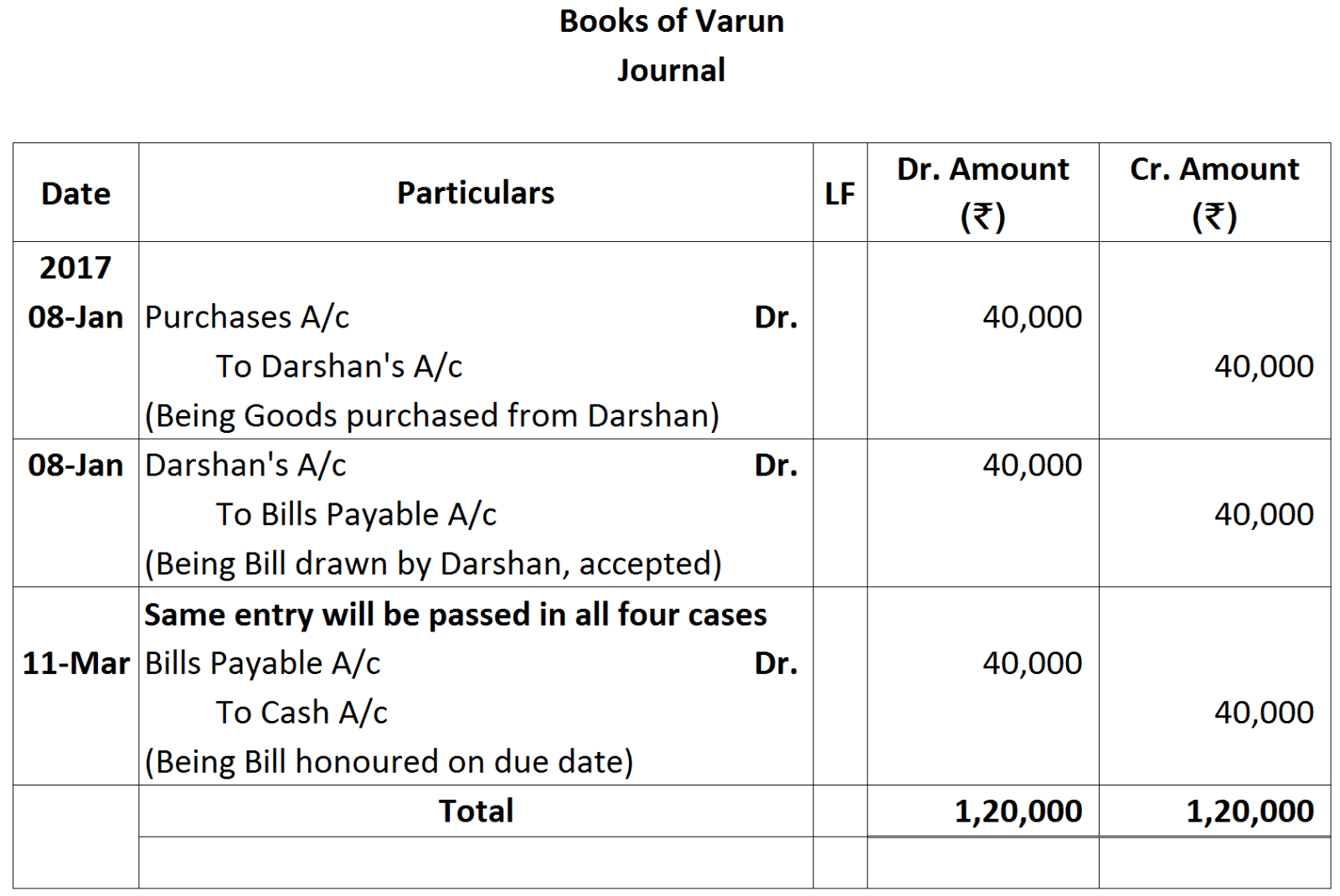
Darshan sold goods for ₹ 40,000 to Varun on 8.1.2017 and drew upon him a bill of exchange payable after two months. Varun accepted the bill and returned the same to Darshan. On the due date the bill was met by Varun. Record the necessary Journal entries in the books of Darshan and Varun in the following circumstances:
When the bill was retained by Darshan till the date of its maturity.
When Darshan immediately discounted the bill @6% p.a. with his bank.
When the bill was endorsed immediately by Darshan in favour of his creditor Suresh.
When three days before its maturity, the bill was sent by Darshan to his bank for collection.
Answer


Working Note:
Calculation of Discounting Charges,
Discounting Charges $=40,000\times\frac{6}{100}\times\frac{2}{12}=₹\ 400$
View full question & answer
Question 244 Marks
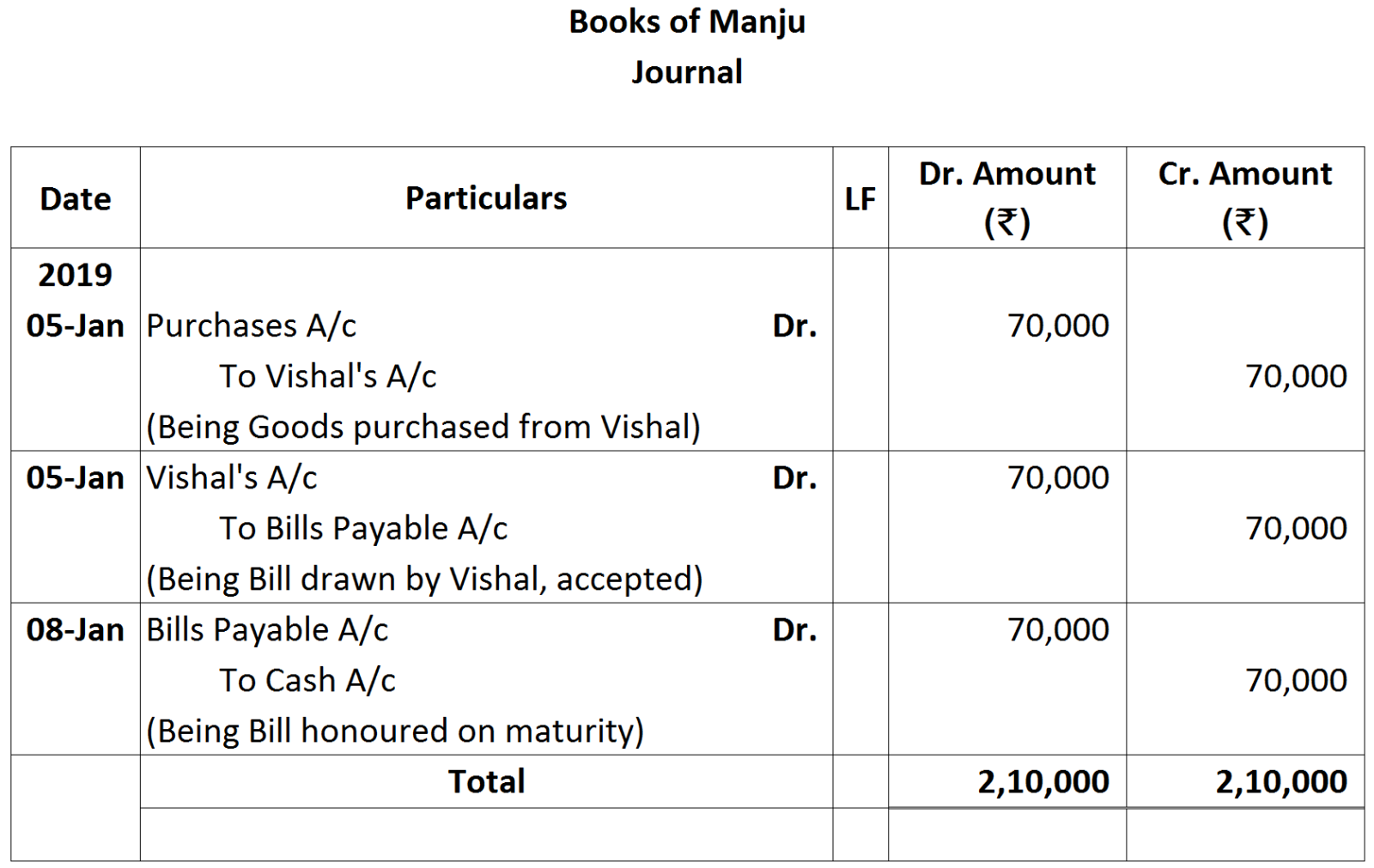
On 1st January, 2019, X sold goods to Y for ₹ 25,000 and immediately received from Y ₹ 10,000 by cheque and drew a bill on Y at three months for the balance amount. Bill is accepted by Y. Bill was dishonoured on the due date and Y paid ₹ 150 as noting charges. Ten days later, Y pays the due amount to X. Pass the Journal entries in the books of both the parties.
View full question & answer
Question 254 Marks
Ram draws a bill for ₹ 2,000 on Shyam on 15th September, 2018 for 3 months. On maturity, Shyam failed to honour the bill.
Pass the necessary Journal entries in the books of Ram and Shyam.
View full question & answer
Question 264 Marks
Distinguish between Bills of Exchange and Promissory note on the following basis:
  1. Order or Promise and Parties.
  2. Acceptance.
  3. Parties.
  4. Noting.
Answer
Differences between a Bill of Exchange and a Promissory Note.
 
Basis
Bill of Exchange
Promissory Note
1.
Orther/ Promise
It is an order to pay.
It is a promise to pay.
2.
acceptance
It needs acceptance by the Drawee.
It does not need acceptance by the Drawee.
3.
Parties
It has three paeties namely-Drawer, Drawee and Payee.
It has two parties namely-Promisor and Payee.
4. Noting Noting become very important in the case when the bill of exchange is dishonoured. Nothing is important in the case when the promissory note is dishonoured.
View full question & answer
Question 274 Marks
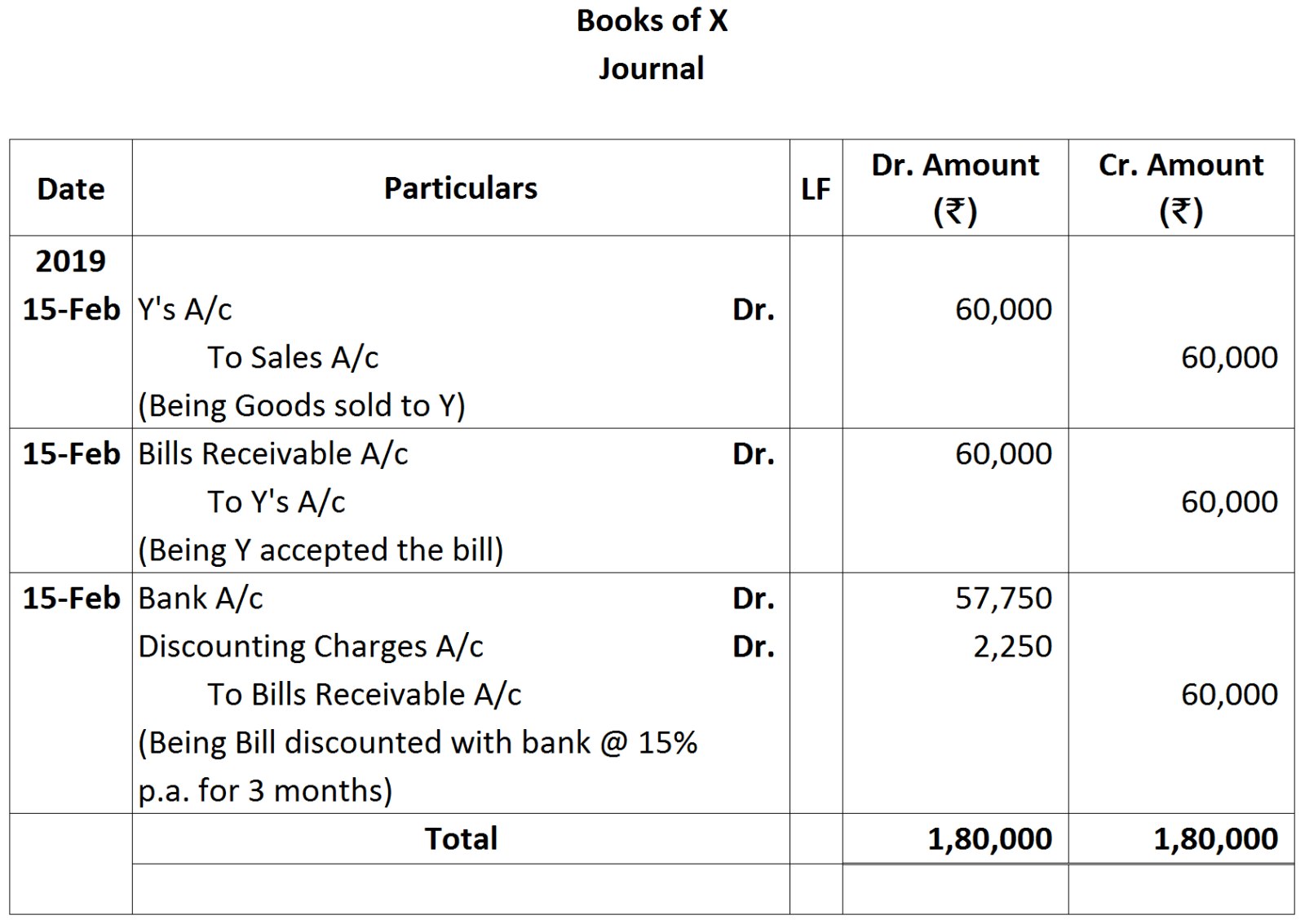
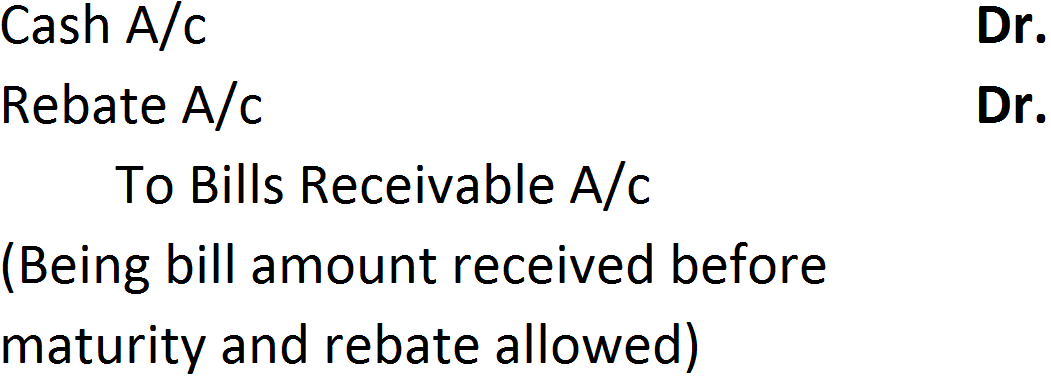
On 15th February, 2019, X sold goods to Y for ₹ 60,000. On the same day, Y accepted a bill drawn upon him by X for three months for ₹ 60,000. X immediately discounted the bill at 15% p.a. at his bank and Y met the bill on maturity. Make Journal entries in the books of both the parties.
Answer


Working Note:
Calculation of Discounting Charges,
Discounting Charges $=6,000\times\frac{15}{100}\times\frac{3}{12}=₹\ 225$
View full question & answer
Question 284 Marks
Y owes X ₹ 4,000. On 1st January, 2019, Y accepts a 3 months bill for ₹ 3,900 in satisfaction of his full claim. On the same date, it was endorsed by X to Z in satisfaction of his claim of ₹ 3,980. The bill is dishonoured on the due date. Give the Journal entries in the books of X.
View full question & answer
Question 294 Marks
What is meant by acceptance of a bill of exchange?
Answer
A bill is drawn in favour of a person from whom the amount is due. In other words, a bill of exchange is drawn by the creditors on his/ her debtors to make payment of specific amount, on a mentioned date. Generally, a bill is drawn by a seller to a purchaser. Purchaser accepts the bill for the amount due on account of the credit sales. The bill may be accepted for the amount due other than credit purchases, such as commission payable, salary outstanding, etc. A bill cannot come into existence without the acceptance of a debtor.
View full question & answer
Question 304 Marks
On 15th June, 2019, Mohan sold goods to Sohan valued at ₹ 2,000. He drew a bill at 3 months for the amount and discounted the same with his bank for ₹ 1,960. On the due date the bill was dishonoured and Mohan paid to the bank the amount due plus the noting charges of ₹ 10.
Draft the Journal entries in the books of all parties.
View full question & answer
Question 314 Marks
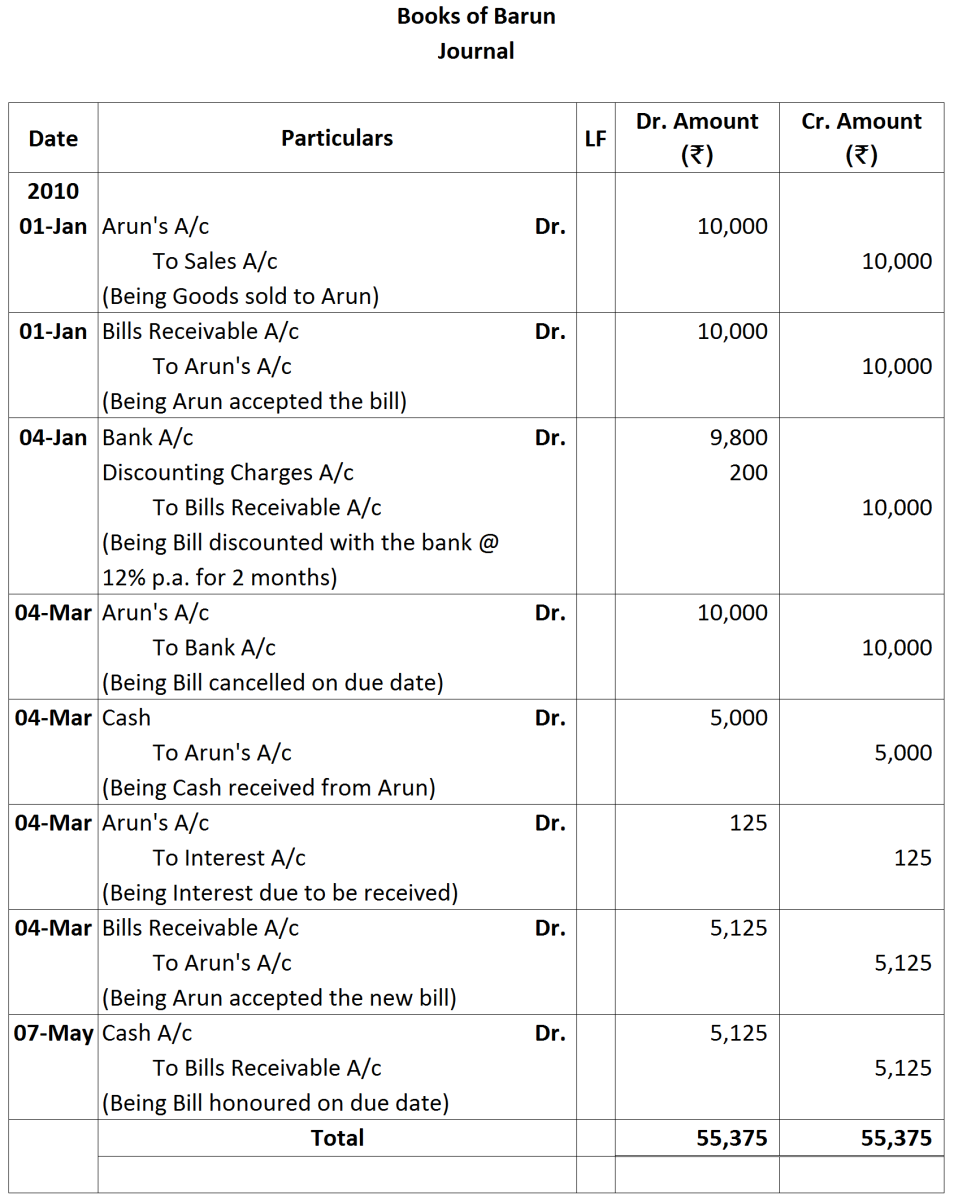
On 1st January, 2010, Arun purchased from Barun goods invoiced at ₹ 10,000. On the same date, Barun drew upon Arun a bill for the amount at 2 months and Arun accepted the same. On 4th January, 2010, Barun got the bill discounted with his bank @12% per annum. On due date, Arun told Barun that he was not in a position to pay the full amount and requested Barun to accept ₹ 5,000 in cash and draw a fresh bill at 2 months for the remaining amount plus interest at 15% per annum, Barun agreed. The second bill was duly met on the due date.
Give journal entries to record the above transactions in the books of Barun.
Answer

Working Note:
WN 1: Calculation of Discounting Charges,
Discounting Charges $=10,000\times\frac{12}{100}\times\frac{2}{12}=₹\ 200$
WN 2: Calculation of amount of Interest,
Amount of Interest $=5,000\times\frac{15}{100}\times\frac{2}{12}=₹\ 125$
View full question & answer
Question 324 Marks
B owed ₹ 20,400 to A. On 15th January, 2019, he accepted a bill for ₹ 20,000 for two months drawn by A in full settlement of his debt. On 18th January, 2019, A endorsed the bill to his creditor C. The bill was duly met on the date of maturity. Pass Journal entries in the books of A, B and C.
View full question & answer
Question 334 Marks
On 1st January, 2019, A draws a bill on B for ₹ 1,000 payable after 3 months. Immediately after its acceptance, A sends the bill to his bank for collection. On the due date, the bill was dishonoured. Record the transactions in the Journals of A and B.
View full question & answer
Question 344 Marks
Journalise the following in the books of Hari.
Sohan informs Hari that Mohan's acceptance for ₹ 13,000, endorsed in favour of Sohan by Hari, has been dishonoured. Sohan agrees to accept ₹ 3,000 in cash and an acceptance at 3 months together with interest @ 12% per annum.
View full question & answer
4 Marks Question - Account STD 11 Commerce Questions - Vidyadip