Questions

3 Marks Question

🎯

Test yourself on this topic

44 questions · timed · auto-graded

Question 13 Marks
Write the various Assets in order of liquidity in a Balance Sheet.
Answer
In the Order of Liquidity:
Current Assets:
  • Cash in Hand
  • Cash at Bank
  • Bills Receivable
  • Short Term Investments
  • Sundry Debtors/ Book Debts
  • Closing Stock
  • Prepaid Expenses
  • Accrued Income
Long Term Investments
Non-Current Assets:-
  • Furniture
  • Loose Tools
  • Motor Vehicle
  • Plant and Machinery
  • Land and Buildings
  • Patents and Trade Marks
  • Goodwill
View full question & answer
Question 23 Marks
What is meant by Indirect Expenses? Give two examples.
Answer
Indirect expenses are those expenses that are incurred to operate a business as a whole or a segment of a business, and so cannot be directly associated with a cost object, such as a product, service, or customer. A cost object is any item for which you are separately measuring costs. Examples of indirect expenses are:
  1. Accounting, audit, and legal fees.
  2. Business permits.
  3. Office expenses.
  4. Rent.
View full question & answer
Question 33 Marks
State whether the following expenses are capital or revenue in nature:
  1. Expenses on whitewashing and painting of a building purchased to make it ready for use.
  2. ₹ 10,000 spent on constructing platform for a new machine.
  3. Repair expenses of ₹ 25,000 incurred for whitewashing of factory building.
  4. Insurance premium paid as renewal premium.
  5. Purchased a new car.
Answer
  1. Capital Expenditure: Paid to make an asset ready to use.
  2. Capital Expenditure: Paid to make an asset ready to use.
  3. Revenue Expenditure: Made for the maintenance of asset.
  4. Revenue Expenditure: Part of normal operating cost.
  5. Capital Expenditure: Used in business for a number of years.
View full question & answer
Question 43 Marks
What is meant by Operating Profit?
Answer
Operating Profit: Operating Profit is the profit earned through normal operating activities of the business. It is arrived at by deducting the operating expenses from gross profit. Expenses which are related to the main or normal activities of the business are called operating expenses. They include office and administrative expenses and selling and distribution expenses, discount, bad-debts etc. Operating Profit is also called 'Earning. Before Interest & Tax or EBIT'.
View full question & answer
Question 53 Marks
State with reasons whether the following are Capital or Revenue Expenses:
  1. Excise duty paid on purchase of new machine.
  2. Wages paid to install a machine.
  3. Repairs carried out on existing car.
  4. Office block of building repainted for ₹ 50,000.
  5. Paid telephone bill ₹ 2,500.
Answer
  1. Capital Expenditure: Paid for the acquisition of new asset.
  2. Capital Expenditure: Paid to make the asset ready to use.
  3. Revenue Expenditure: Paid for the running and maintenance of car.
  4. Revenue Expenditure: Paid for the maintenance of Building.
  5. Revenue Expenditure: Part of normal operating cost.
View full question & answer
Question 63 Marks
Explain the concept of cost of goods sold?
Answer
Cost of goods sold (COGS) is the cost of merchandise that is sold to the customers. It includes cost of raw materials purchased, direct expenses incurred, value of opening stock, i.e., the value of the last year’s unsold stock and excludes closing stock if any, i.e., the value of current year’s unsold stock. The formula to calculate COGS is:
Cost of Goods Sold = Opening Stock + Purchases + Direct Expenses - Closing Stock.
View full question & answer
Question 73 Marks
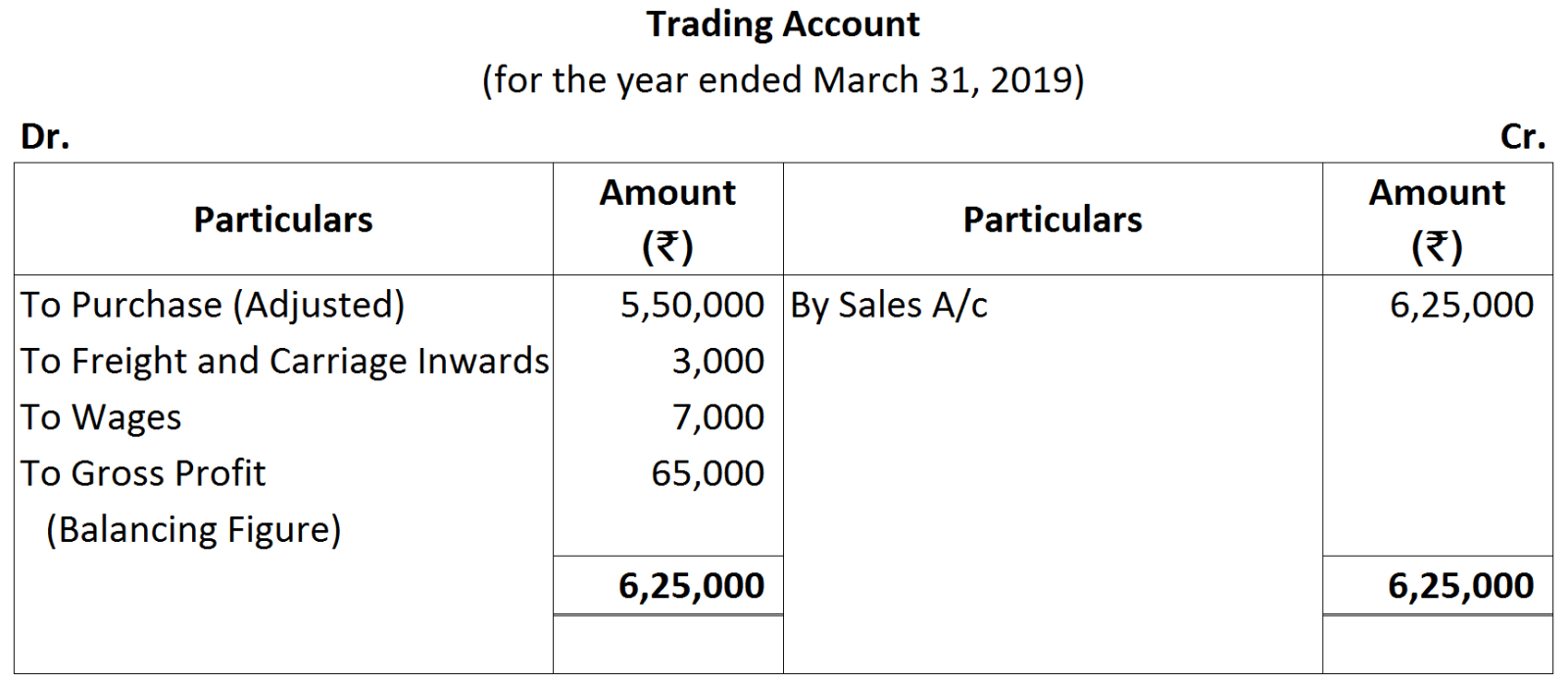
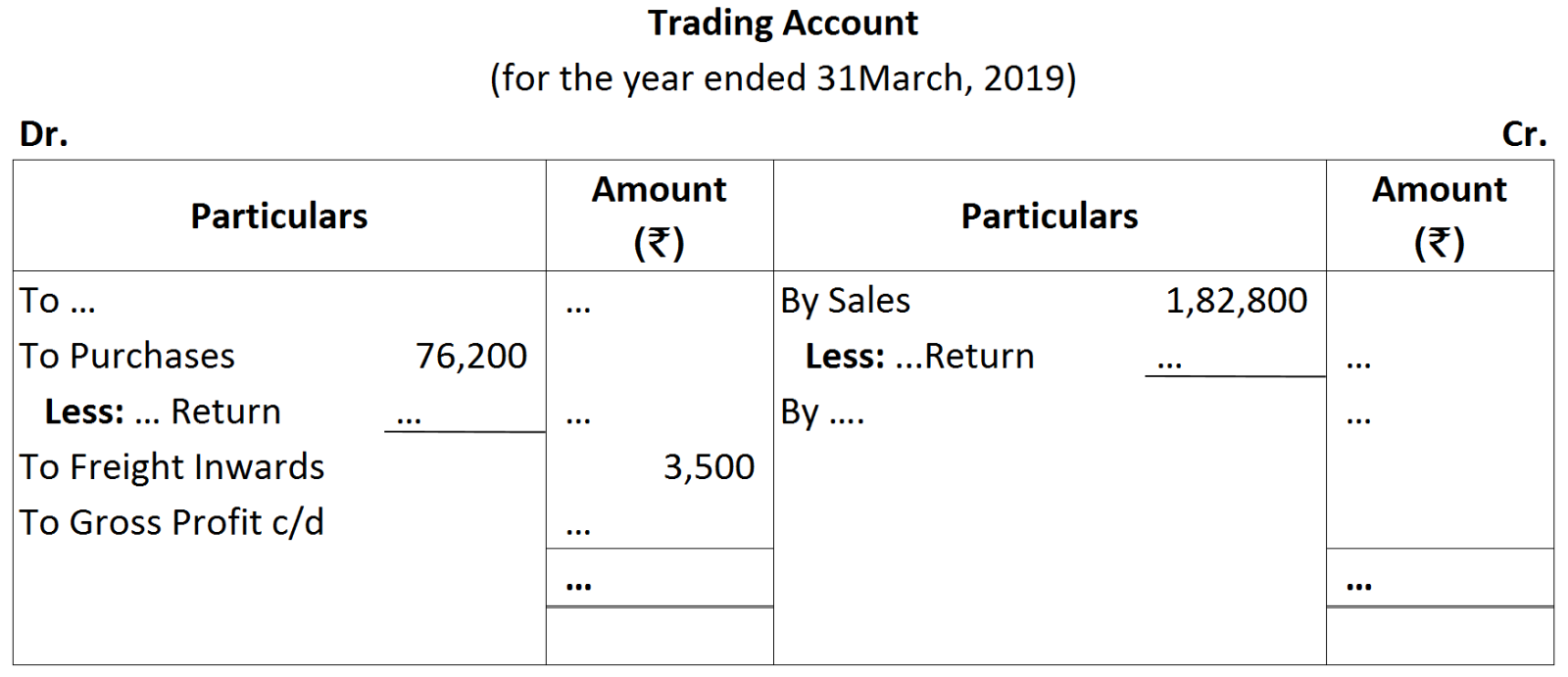
From the following information, prepare Trading account for the year ended $31^{st}$​​​​​​​ March,$ 2019:$
Adjusted Purchases ₹ $5,50,000$; Sales ₹ $6,25,000$; Freight and Carriage Inwards ₹ $3,000$; Wages ₹ $7,000$; Freight and Cartage Outwards ₹ $2,500$; Closing Stock ₹ $50,000.$
Answer

Notes:
  1. Freight and Carriage Outwards are indirect expenses, therefore it is not recorded in the Trading Account.
  2. Closing Stock (i.e. ₹ 50,000) is not recorded in the Trading Account as it is already adjusted in the amount of Adjusted Purchases.
View full question & answer
Question 83 Marks
Calculate cost of goods sold from the following:
   
Opening Stock 40,000 Wages & Salaries 10,000
Net Purchases 50,000 Rent Paid 15,000
Net Sales 1,90,000 Closing Stock 15,000
Answer
Cost of Goods Sold = Opening Stock + Purchases + Direct Expenses - Closing Stock

Cost of Goods Sold = 40,000 + 50,000 + 10,000 - 15,000 = ₹ 85,000
View full question & answer
Question 103 Marks
Why balance in GST Accounts is shown in the Balance Sheet?
Answer
The balance in GST Accounts means either GST recoverable, if it has a debit balance or GST Payable, if it has a credit balance. Thus, it is neither revenue nor expense. Therefore, it is shown in the Balance Sheet.
View full question & answer
Question 113 Marks
State with reasons whether the following are capital or revenue expenditures:
  1. A new machine is purchased for ₹ 60,000, ₹ 800 were spent on its carriage and ₹ 1,500 were paid as wages for its installation.
  2. A sum of ₹ 10,000 was spent on painting the new factory.
  3. ₹ 5,000 paid for the erection of a new machine.
  4. ₹ 2,000 were spent on repairs before using a second hand generator purchased recently.
  5. ₹ 1,500 were spent on the repair of a machinery.
  6. ₹ 10,000 was paid as brokerage on issue of shares and other expenses of issue were ₹ 25,000.
Answer
  1. Purchase of new machinery is a capital expenditure as it will result in increasing the earning capacity of the firm. Cost of installation will also be capitalized as it’s spent before machinery is put to use.
  2. Since, the factory is been painted for the first time it will be treated as a capital expenditure.
  3. Cost of erection of new machine will also be capitalized as it’s spent before machinery is put to use.
  4. It is a capital expenditure as repairs are done before the generator is put to use.
  5. Repairs are done on regular basis that is why it will be treated as revenue expenditure.
  6. Expenses incurred on raising the capital will be treated as capital expenditure. Therefore, brokerage and other issue expenses are capital in nature.
View full question & answer
Question 123 Marks
Calculate gross profit and cost of goods sold from the following information:
Net Sales ₹ 12,000
Gross Profit $33\frac{1}{3}\%$ on Sales
Answer
Gross Profit = $33\frac{1}{3}\%$ on Sales $=\frac{100}{3\times100}\times12,00,000$= ₹ 4,00,000
Cost of Good Sold = Sales - Gross Profit
= 12,00,000 - 4,00,000
= ₹ 8,00,000
View full question & answer
Question 133 Marks
Explain the term 'Deferred Revenue Expenditure' with the help of an example.
OR
Give any one example of 'Deferred Revenue Expenditure'.
Answer
Deferred Revenue Expenditure is that expenditure that is revenue in nature but the benefit of which extends beyond the accounting year in which it is incurred.
Example of Deferred Revenue Expenditure: Large expenditure incurred on advertising to introduce a new product in the market.
View full question & answer
Question 143 Marks
Calulate closing stock and cost of goods sold:
Opening Stock ₹ 5,000; Sales ₹ 16,000; Carringe Inwards ₹ 1,000. Sales Return ₹ 1,000; Gross Profit ₹ 6,000; Purchases ₹ 10,000; Purchases Return ₹ 900.
Answer
Cost of Goods Sold = Net Sales (i.e., Sales - Sales Return) - Gross Profit
= ₹ 15,000 - ₹ 6,000 = ₹ 9,000.
Cost of Goods Sold = Opening Stock + Net Purchases + Carriage Inwards - Closing Stock
₹ 9,000 = ₹ 5,000 + ₹ 9,100 (i.e., ₹ 10,000 - ₹ 900) + ₹ 1,000 Closing Stock
Closing Stock = ₹ 6,100.
View full question & answer
Question 153 Marks
Calculate Gross Profit on the basis of the following information:
 
Purchases
6,80,000
Return Outwards
30,000
Carriage Inwards
20,000
Carriage Outwards
15,000
Wages
50,000
$\frac{3}{4}$ of the goods are sold for ₹ 6,00,000.
Answer
Cost of Good Sold = Opening Stock + Net Purchase + Direct Expenses - Closing Stock
Net Purchases = Purchases - Purchase Returns
= 6,80,000 - 30,000 = 6,50,000
Direct Expenses = Carriage Inwards + Wages
= 20,000 + 50,000 = 70,000
$\therefore$ Cost of Good Sold = 0 + 6,50,000 + 70,000 - 0
= ₹ 7,20,000
$\frac{3}{4}\text{th}$ of the Goods are Sold for 6,00,000
cost of $\frac{3}{4}\text{th}$ of the Good sold = $\frac{3}{4}\times7,20,000=5,40,000$
Gross Profit = Net Sales - Cost of Good Sold
= 6,00,000 - 5,40,000
= ₹ 60,000
View full question & answer
Question 163 Marks
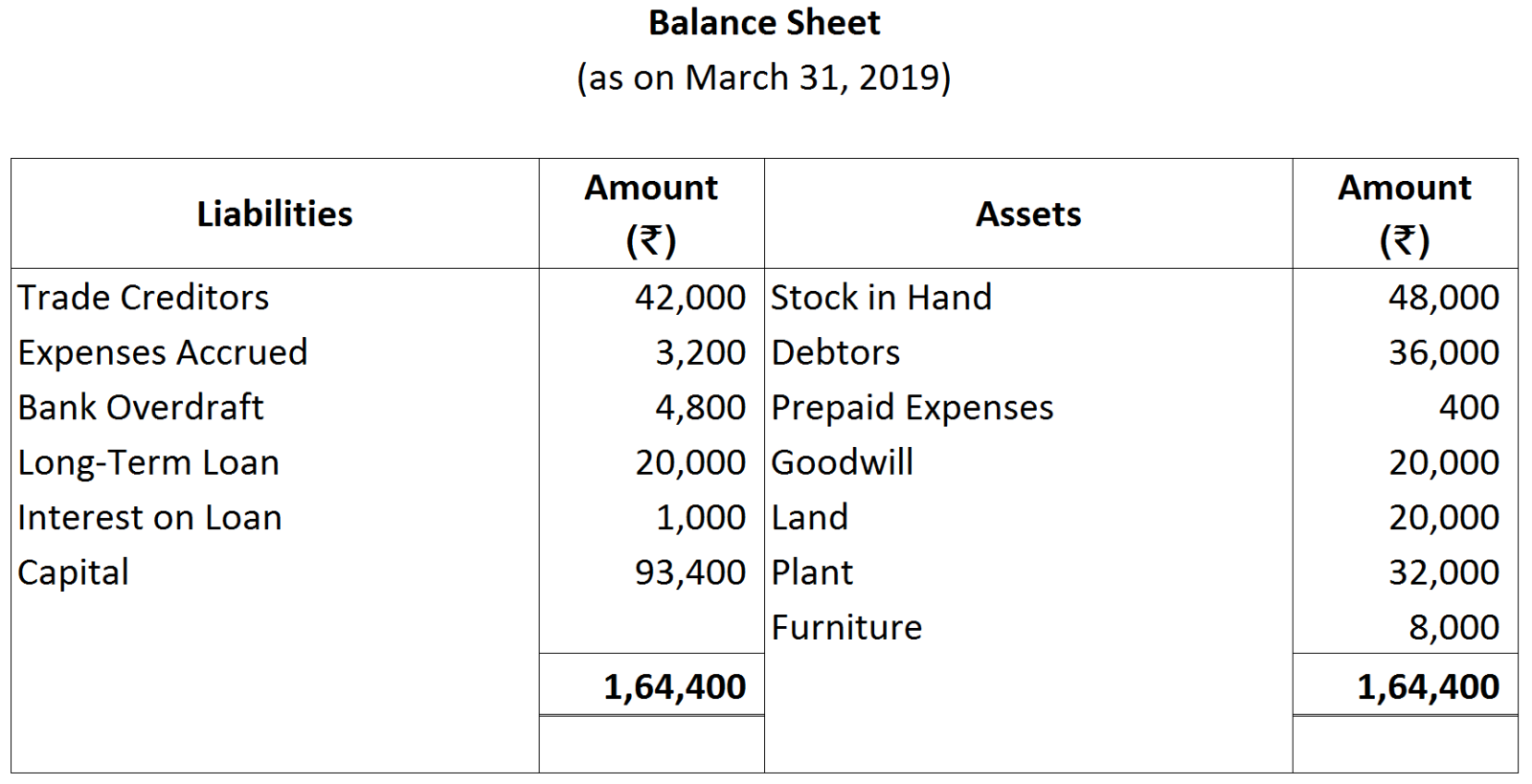
From the Balance Sheet given below, calculate:
  1. Fixed Assets.
  2. Current Assets.
  3. Current Liabilities.
  4. Working Capital.
BALANCE SHEET as at $31^{st}$​​​​​​​ March, $2019$:
Answer
  1. Fixed Assets = Land + Plant + Furniture + Goodwill
$= ₹ 20,000 + ₹ 32,000 + ₹ 8,000 + ₹ 20,000 = ₹ 80,000$
  1. Current Assets = Stock + Debtors + Prepaid Expenses
$= ₹ 48,000 + ₹ 36,000 + ₹ 400 = ₹ 84,000$​​​​​​​
  1. Current Liabilities = Creditors + Expenses Accrued + Bank Overdraft + Interest on Loan
$= ₹ 42,000 + ₹ 3,200 + ₹ 4,800 + ₹ 1,000 = ₹ 51,000$​​​​​​​
  1. Working Capital = Current Assets - Current Liabilities
$= ₹ 84,400 - ₹ 51,000 = ₹ 33,400.$
View full question & answer
Question 173 Marks
What do you mean by 'Contingent Liabilities’? Give its two examples.
Answer
Contingent Liabilities: These are the liabilities which will become payable 1 only on the happening of some specific event, otherwise not. The best example would be amount to be paid as compensation to some party if the company in question loses a certain case in court (ex-case related to extra payments to labourers). In this situation, two things may happen:
  1. If the company loses the case, it will have to pay the compensation.
  2. If it wins, no compensation will be paid,
Thus since the amount cannot be treated with certainty as liabilities (the compensation amount), it will be shown as contingent liabilities as a footnote in the balance sheet.
View full question & answer
Question 183 Marks
Calculate Closing Stock and Cost of Goods Sold:
Opening Stock ₹ 5,000; Sales ₹ 16,000; Carriage Inwards ₹ 1,000; Sales Returns ₹ 1,000; Gross Profit ₹ 6,000; Purchase ₹ 10,000; Purchase Returns ₹ 900.
Answer
Cost of Good Sold = Net Sales - Gross Profit
= 15,000 - 6,000
= ₹ 9,000
Cost of Good Sold = OPening Stock + Net Purchase + Direct Expenses - Closing Stock
9,000 = 5,000 + (10,000 - 900) + 1,000 - Closing Stock
Closing Stock = 15,100 - 9,000
= ₹ 6,100
View full question & answer
Question 193 Marks
Calculate operating profit from the following:
 
Net Profit
5,00,000
Dividend Received
6,000
Loss on sale of Furniture
12,000
Loss by Fire
50,000
Salaries
1,20,000
Interest on Loan from Bank
10,000
Rent Received
24,000
Donation
5,100
Answer
Operating Profit = Net Profit − Non-Operating Income + Non-Operating Expenses Non-Operating Income = Dividend Received + Rent Received = 6,000 + 24,000 = 30,000 Non-Operating Expenses = Loss on Sale of Furniture + Loss by Fire + Interest on Loan + Donation = 12,000 + 50,000 + 10,000 + 5,100 = ₹ 77,100 ∴ Operating Profit = 5,00,000 − 30,000 + 77,100 = ₹ 5,47,100 Note: Salary being an operating expense was already taken into account while determining net profit, thus, it will be ignored now.
View full question & answer
Question 203 Marks
Arrange assets in the order of permanence:
Sundry Debtors, Stock, Investment, Land and Building, Cash in Hand, Motor Vehicle, Cash at Bank, Goodwill, Plant and Machinery, Furniture, Loose Tools, Marketable Securities.
Answer
Assets in the order of Permanence:
  1. Goodwill.
  2. Land and Building.
  3. Plant and Machinery.
  4. Motor Vehicle.
  5. Loose Tools.
  6. Furniture.
  7. Investment (Long-term).
  8. Stock.
  9. Sundry Debtors.
  10. Marketable Securities (Short-term).
  11. Cash at Bank.
  12. Cash in Hand.
View full question & answer
Question 213 Marks
Calculate gross profit and cost of goods sold from the following information:
Net Sales ₹ 8,00,000
Gross Profit is 40% on Sales.
Answer
Gross Profit = 40% on Sales
$=\frac{40}{100}\times8,00,000$
= ₹ 3,20,000
Cost of Good Sold = Sales - Gross Profit
= 8,00,000 - 3,20,000
= ₹ 4,80,000
View full question & answer
Question 223 Marks
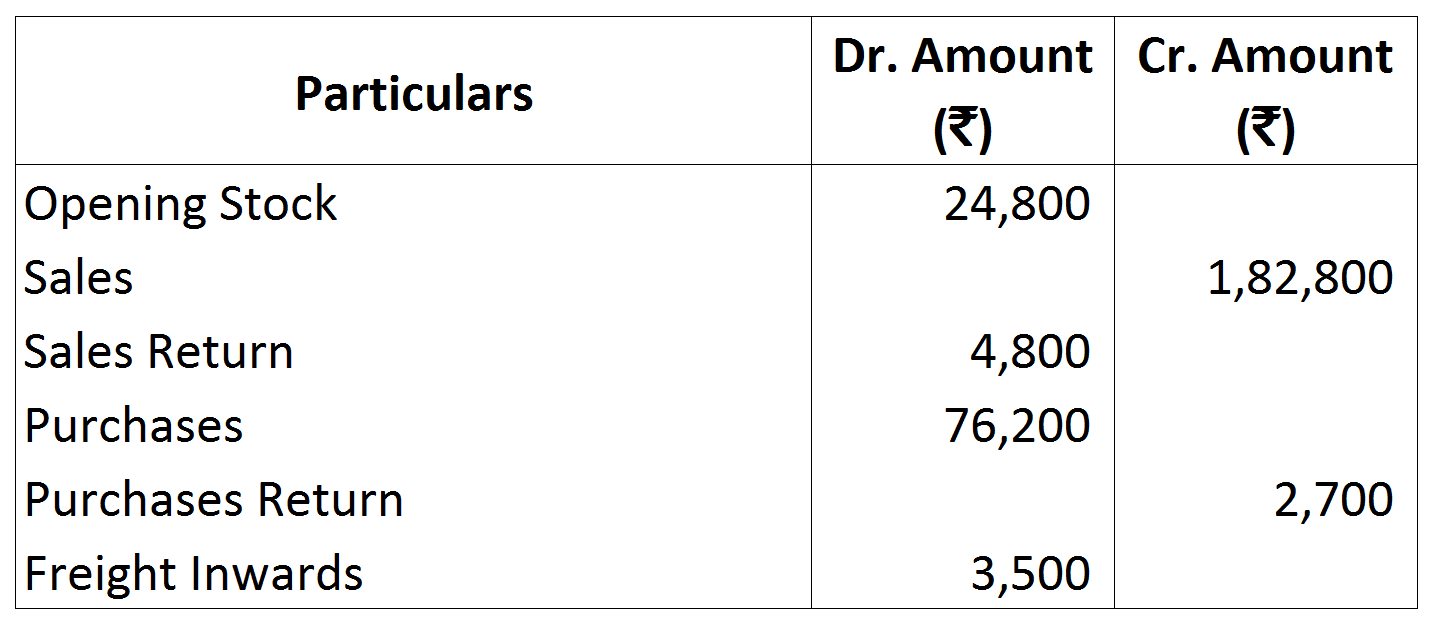
The Trial Balance of a retail trader on $31^{st}$​​​​​​​ March, $2019$, includes the following selected account:

The closing stock on $31^{st}​​​​​​​$​​​​​​​March, $2019,$ is valued at ₹ $30,500.$
You are required to complete the missing values.
View full question & answer
Question 233 Marks
Ascertain the value of closing stock from the following:
 
Opening Stock
1,20,000
Purchases during the year
9,30,000
Sales during the year
15,60,000
Rate of Gross Profit
40% on Sales
 
Answer
Gross Profit = 40% on Sales
$=\frac{40}{100}\times15,60,000$
= ₹ 6,24,000
Cost of Good Sold = Net Sales - Gross Profit
= 15,60,000 - 6,24,000
= ₹ 9,36,000
Cost of Good Sold = Opening Stock + Net Purchase + Direct Expenses - Closing Stock
9,36,000 = 1,20,000 + 9,30,000 + 0 - Closing Stock
Closing Stock = 10,50,000 - 9,36,000
= ₹ 1,14,000
View full question & answer
Question 243 Marks
Ascertain cost of Goods Sold and Gross Profit from the following:
 
Opening Stock
32,000
Purchases
2,80,000
Direct Expenses
20,000
Indirect Expenses
45,000
Closing Stock
50,000
Sales
4,00,000
Sales Returns
8,000
Answer
Gross Profit = Net Sales - Cost of Good Sold
Cost of Good Sold = Opening Stock + Net Purchases + Direct Expenses - Closing Stock
= 32,000 + 2,80,000 + 20,000 - 50,000
= ₹ 2,82,000
Net Sales = Sales - Sales Return
= 4,00,000 - 8,000
= 3,92,000
$\therefore$ Gross Profit = 3,92,000 - 2,82,000
= ₹ 1,10,000
View full question & answer
Question 253 Marks
List the assets in order of permanence:
Sundry Debtors, Stock, Land and Building, Plant and Machinery, Furniture, Investments, Cash in Hand and Cash at Bank.
Answer
List in order of permanence:
  • Land and Building.
  • Plant and Machinery.
  • Furniture.
  • Investments.
  • Stock.
  • Sundry Debtors.
  • Cash at Bank.
  • Cash in Hand.
View full question & answer
Question 263 Marks
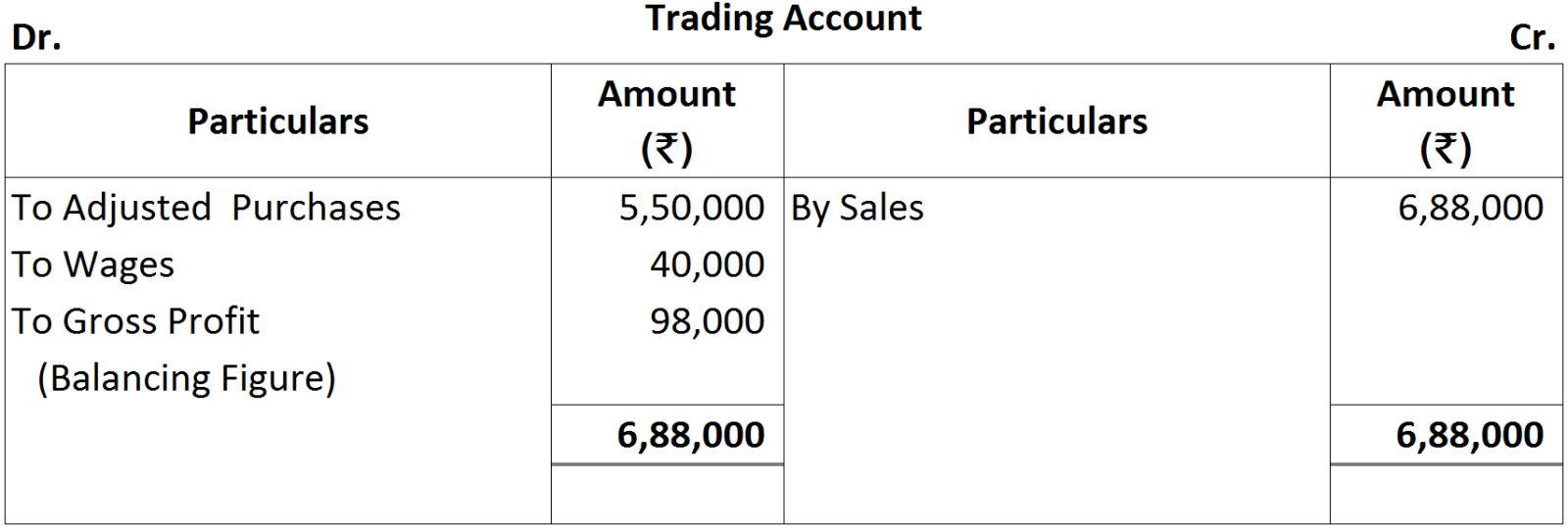
Calculate Gross Profit from the following information:
 
Closing Stock
70,000
Wages
40,000
Salary
30,000
Sales
6,88,000
Adjusted Purchase
5,50,000
Answer

As adjusted purchases is given, it means opening and closing stock are already adjusted. So, these two stocks will not be considered while calculating Gross Profit.
View full question & answer
Question 273 Marks
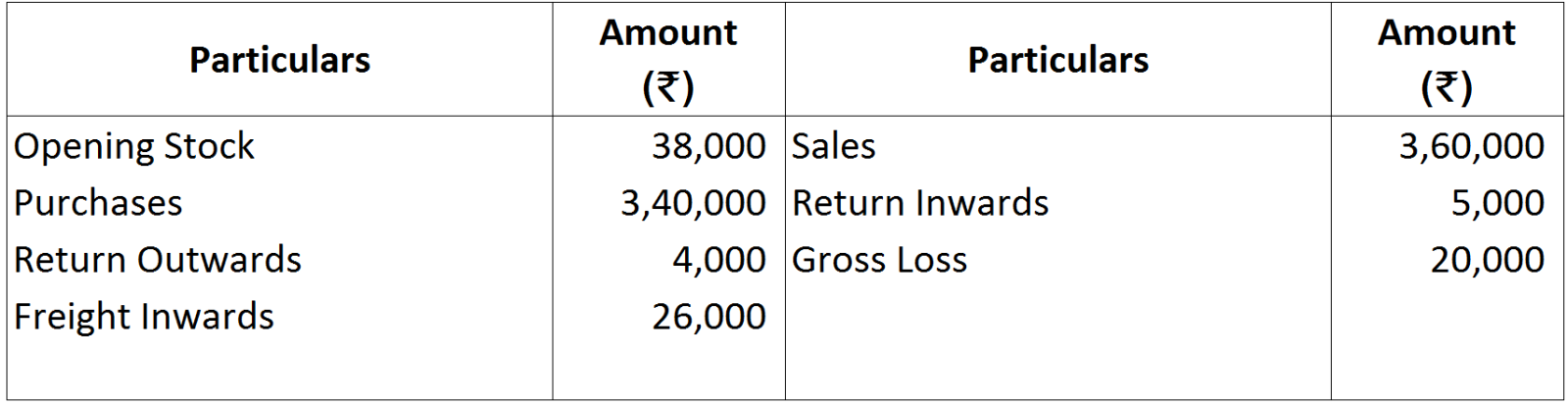
Calculate Closing Stock from the following:
Answer
Cost Of Gold Sold = Net Sales + Gross Loss
= (3,60,000 - 5,000) + 20,000
= ₹ 3,75,000
Cost of Good Sold = Opening Stock + Net Purchase + Direct Expenses - Closing Stock
3,75,000 = 38,000 + (3,40,000 - 4,000) + 26,000 - Closing Stock
Closing Stock = 4,00,000 - 3,75,000
= ₹ 25,000
View full question & answer
Question 283 Marks
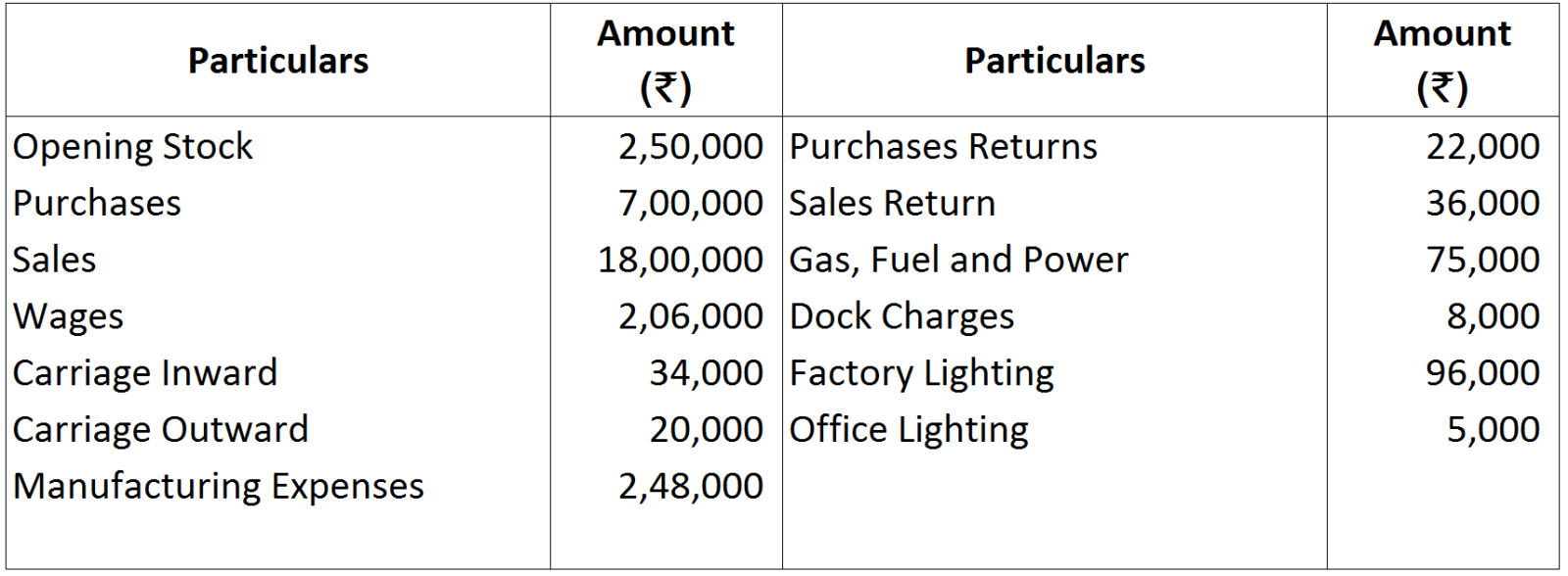
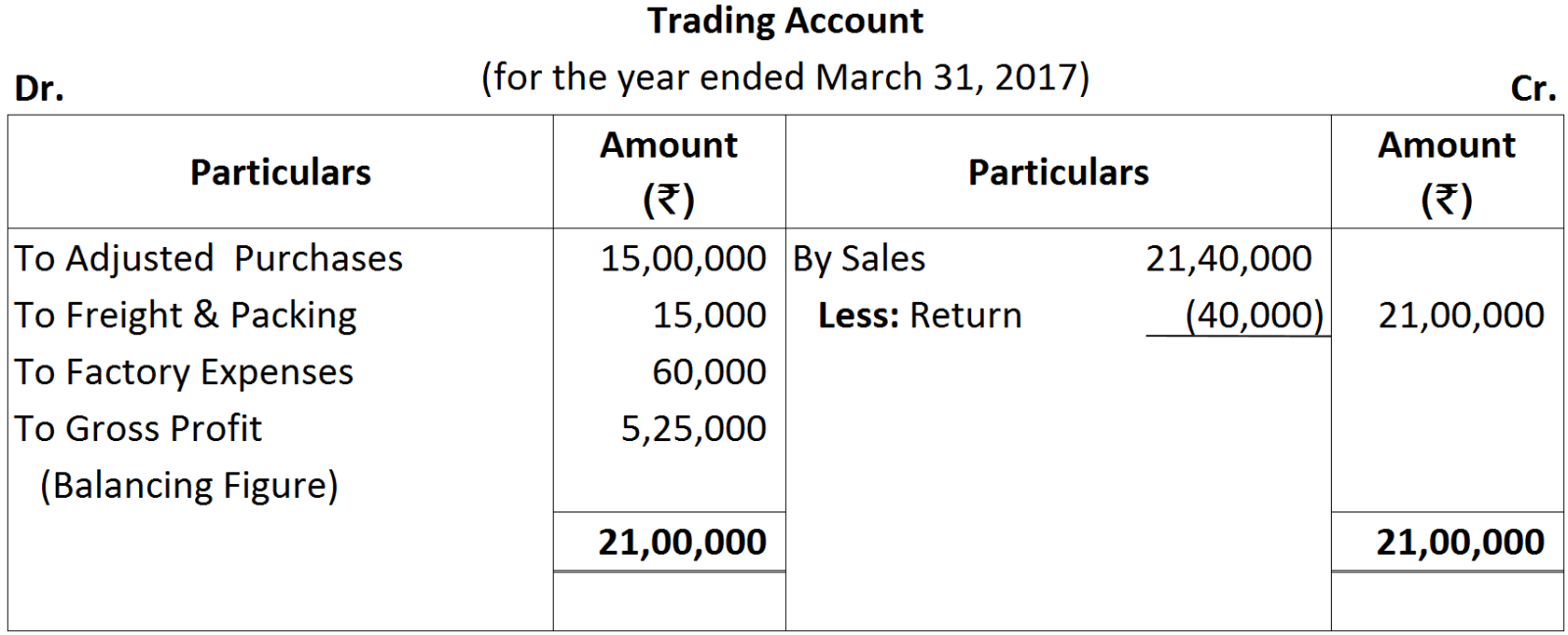
From the following information, prepare the Trading Account for the year ended 31st March, 2017:
Adjusted Purchases ₹ 15,00,000; Sales ₹ 21,40,000; Returns Inwards ₹ 40,000; Freight and Packing ₹ 15,000; Packing Expenses on Sales ₹ 20,000; Depreciation ₹ 36,000; Factory Expenses ₹ 60,000; Closing Stock ₹ 1,20,000.
Answer

Note: Closing Stock will not be shown on the Credit side of Trading Account since it has already been adjusted while calculating adjusted purchases.
Adjusted Purchases = Opening Stock + Net Purchases - Closing Stock
View full question & answer
Question 293 Marks
What is a Trading Account and why is it prepared?
Answer
Preparation of Trading Account is the first stage of preparing final accounts. It is the financial statement which shows result of buying and selling of goods and/ or services during an accounting period.
It is credited with sales, services rendered and closing stock or inventory. Opening stock or inventory, net purchases and other direct expenses are debited in the account. The difference in two sides is either Gross Profit or Gross Loss.
View full question & answer
Question 303 Marks
Following information was taken from an Income Statement:
Opening Stock ₹ 5,000; Sales ₹ 16,000; Carriage Inwards ₹ 1,000; Sales Return ₹ 1,000; Gross Profit ₹ 6,000; Purchases ₹ 10,000; and Purchases Return ₹ 900.
Calculate Closing Stock and the Cost of Goods Sold.
Answer
Net Sales = Sales - Sales Return = ₹ 16,000 - ₹ 1,000 = ₹ 15,000
Cost of Goods Sols = Net Sales - Gross Profit = ₹ 15,000 - ₹ 6,000 = ₹ 9,000
Cost of Goods Sols = Opening Stock + Purchases - Purchases Return + Carriage Inwards - Closing Stock,
₹ 9,000 = ₹ 5,000 + ₹ 10,000 - ₹ 900 + ₹ 1,000 - Closing Stock
Closing Stock = ₹ 15,100 - ₹ 9,000 = ₹ 6,100.
View full question & answer
Question 313 Marks
What are Indirect Expenses? Give two examples.
Answer
Indirect Expenses are those expenses which are not directly associated with manufacturing or sale of goods. They include administrative, selling and distribution expenses such as salaries, rent and taxes, postage and stationery, insurance, depreciation, interest paid, office lighting, advertising, packing, carriage outwards, etc. Losses include items like loss by fire, loss by theft, etc.
View full question & answer
Question 323 Marks
State with reasons whether the following receipts would be treated as Capital or Revenue:
  1. ₹ 5,000 received from a customer whose account was previously written off as bad.
  2. ₹ 20,000 received from sale of old machine.
  3. ₹ 2,60,000 received from sale of stock-in-trade.
  4. ₹ 5,00,000 is contributed by a partner as capital.
  5. Took a loan of ₹ 10 Lac from Punjab National Bank.
  6. Received ₹ 4 Lac as subsidy from State Government.
  7. Received ₹ 8 Lac as grant from State Government for the construction of quarters for the staff.
Answer
  1. It is a revenue receipt as it is received in normal course of business.
  2. It is a capital receipt as it is a capital gain which arose by selling of machinery.
  3. It is a revenue receipt as it is received in normal course of business over exchange of goods.
  4. It is a capital receipt as it will improve the financial position of the company of the company.
  5. It is a capital receipt as it will enhance the productivity of the company.
  6. It is a revenue receipt as it is received regularly from the government.
  7. It is a capital receipt as it is received for construction and will it will result in increasing the earning capacity of the firm.
View full question & answer
Question 333 Marks
List the following assets in order of liquidity:
Sundry Debtors, Stock, Land and Building, Plant and Machinery, Furniture, Investments, Cash in Hand and Cash at Bank.
Answer
List in order of liquidity:
  • Cash in Hand.
  • Cash at Bank.
  • Sundry Debtors.
  • Stock.
  • Investments.
  • Furniture.
  • Plant and Machinery.
  • Land and Building.
View full question & answer
Question 343 Marks
What is an operating profit?
Answer
A profit from business operations (gross profit operating expenses) before deduction of interest and taxes.
According to Investopedia> Operating profit is the profit earned from a firm's normal core business operations. This value does not include any profit earned from the firm's investments (such as earnings from firms in which the company has partial interest) and the effects of interest and taxes.
Also known as "earnings before interest and tax" (EBIT) or "operating income".
View full question & answer
Question 353 Marks
Calculate closing stock from the following details:
 
Opening Stock
4,80,000
Purchase
13,60,000
Sales
19,50,000
G.P is 30% on Cost.
Answer
Gross Profit = 30% on Cost
Let the Cost Of Cost of Goods Sold be 'x'
Gross Profit = $\frac{30}{100}\text{x}$
Cost Of Good Sold = Sales - Gross Profit
$\text{x}=19,50,000-\frac{30}{100}\text{x}$
$\text{x}+\frac{30}{100}\text{x}=19,50,000$
$\frac{100\text{x}+30\text{x}}{100}=19,50,000$
$\text{x}=\frac{19,50,000\times100}{130}$
= ₹ 15,00,000
Cost of Good Sold = Opening Stock + Net Purchase + Direct Expenses - Closing Stock
15,00,000 = 4,80,000 + 13,60,000 + 0 - Closing Stock
Closing Stock = 18,40,000 + 15,00,000
= ₹ 3,40,000
View full question & answer
Question 363 Marks
Does Profit and Loss Account show the financial position of the enterprise?
Answer
Profït and Loss Account does not show the financial position of an enterprise. It shows the financial performance, i.e., net profit earned or net loss incurred by an enterprise during a particular period.
View full question & answer
Question 373 Marks
Classify the following into Capital, Revenue and Deferred Revenue expenditure, stating reasons in each case:
  1. A sum of ₹ 32,000 has been spent on a machine as follows: (i) ₹ 20,000 for addition to double the output, (ii) ₹ 5,000 for repairs necessitated by negligence and (iii) ₹ 7,000 for replacement of worn-out parts.
  2. Total expenditure on a cinema building during the year was ₹ 2,00,000 out of which 20% related to repairs and 80% represented improvements and additions.
  3. Compensation paid to a retrenched employee for the loss of employment.
  4. Second-hand furniture worth ₹ 40,000 was purchased and repairing of this furniture cost ₹ 15,000. The furniture was installed by own workmen-wages for this being ₹ 5,000.
  5. A person was injured by the motor car of the company. ₹ 10,000 was paid to him by way of compensation.
  6. Advertisement expenditure in special advertisement drive.
Answer
  1. ₹ 20,000 is capital expenditure as it will result in double output of the firm. Repairs and replacement of worn out parts is revenue in nature as it is done on regular basis.
  2. Repairs of ₹ 40,000 is revenue in nature as it is done on regular basis and ₹ 1,60,000 is done on improvements which will give future benefits, therefore its capital expenditure.
  3. Compensation and remuneration to employees are done in normal course of business, therefore it is revenue expenditure.
  4. It is a capital expenditure. Any expenses incurred on bringing the asset into operation will be capitalized.
  5. Compensation and remuneration to employees are done in normal course of business, therefore it is revenue expenditure.
  6. It is deferred revenue expenditure as the benefit will be derived over a number of years.
View full question & answer
Question 383 Marks
Rearrange the following assets in order of liquidity:-
  1. Debtors
  2. Bills Receivable
  3. Goodwill
  4. Closing Stock
  5. Prepaid insurance
  6. Cash in hand
  7. Short-term Investments
  8. Loose Tools
  9. Cash at bank
  10. Plant
Answer
  1. Cash in hand
  1. Cash at bank
  1. Bills Receivable
  1. Short-term Investments
  1. Debtors
  1. Closing Stock
  1. Prepaid insurance
  1. Loose Tools
  1. Plant
  1. Goodwill
View full question & answer
Question 393 Marks
From the following balances taken from the books of Simmi and Vimmi Ltd. for the year ending March 31, 2017, calculate the gross profit.
 
Closing stock
2,50,000
Net sales during the year.
40,00,000
Net purchases during the year.
15,00,000
Opening stock.
15,00,000
Direct expenses.
80,000
View full question & answer
Question 403 Marks
What do you mean by posting?
Answer
The process of transferring the transaction written in the Journal to a Ledger is called posting. In other words, the process of transferring of debits and credits from the Journal to the Ledger Accounts is called posting. Posting is necessary as it summarises all transactions relating to the account at one place and also shows how transactions have changed the account balances.
View full question & answer
Question 413 Marks
Explain the Current Assets and Non-Current Assets.
Answer
  1. Current Assets: Current Assets are those which are either in the form of cash or can be easily converted into cash within one year of the date of Balance Sheet. In the words of Hovard & Upton:
'The Current Assets are usually defined as those assets which are convertible into cash through the normal course of business within a short time ordinarily in a year.'

Current Assets include Cash, Bills Receivable, Short Term Investments, Debtors, Prepaid Expenses, Accrued Income, Closing Stock etc. While valuing these assets, Closing Stock is valued at cost or realisable value whichever is less and a reasonable provision for doubtful debts is deducted out of Sundry Debtors.
  1. Non-Current Assets: Non-Current Assets are those which are acquired for continuous use and last for many years such as Land and Building, Plant and Machinery, Motor Vehicles, Furniture etc. According to Finney and Miller:
“Non-Current Assets are assets of a relatively permanent nature used in the operations of business and not intended for sale”.

As the purpose of keeping such assets is not to sell but use them, changes in their market values are ignored and these are always shown in the Balance Sheet at cost less depreciation.
View full question & answer
Question 423 Marks
Closing Stock will never appear in the Trial Balance. Say Yes or No with reasons.
Answer
Closing Stock may appear in the Trial Balance if an adjustment entry relating to Closing Stock is already passed. If the Closing Stock appears in the Trial Balance it will be shown only on the assets side of the Balance Sheet.
View full question & answer
Question 433 Marks
Operating profit earned by M/s Arora & Sachdeva in 2016-17 was ₹ 17,00,000. Its non-operating incomes were ₹ 1,50,000 and non-operating expenses were ₹ 3,75,000. Calculate the amount of net profit earned by the firm.
Answer
Net profit = operating profit + Non-operating Income - Non-operating expenses
= 17,00,000 + 1,50,000 - 3,75,000
= ₹ 14,75,000
Net profit earned by M/s Arora and sachdeva in 2016-17 is ₹ 14,75,000.
View full question & answer
Question 443 Marks
Calculate Net Sales and G.P. from the following:
 
Cost of Goods Sold
4,50,000
G.P.
25% on Sales
Answer
Gross Profit = 25% on Sales or $\frac{1}{4}$ on Sales
$\frac{1}{4}$ on Sales = $\frac{1}{3}\text{rd}$ on Cost
Gross Profit $=\frac{1}{3}\times4,50,000$
= ₹ 1,50,000
Cost of Good Sold = Sales - Gross Profit
4,50,000 = Sales - 1,50,000
Sales = ₹ 6,00,000
View full question & answer
3 Marks Question - Account STD 11 Commerce Questions - Vidyadip