Questions · Page 1 of 2

1 Marks Question

🎯

Test yourself on this topic

50 questions · timed · auto-graded

Question 11 Mark
If Depreciation reduces profit, reduces Book Value of assets and also reduces capital of the proprietor, then why do enterprises provide Depreciation?
Answer
Depreciation is allocation of cost of fixed assets in a systematic manner over their estimated useful life. It is thus, a cost. Financial Statements must show true and fair view of the financial performance and position of the business. If Depreciation is not provided, both fixed asset and profit will be shown at higher amounts.

View full question & answer
Question 21 Mark
Is CGST and SGST or IGST paid on purchase Input GST or Output GST? Why?
Answer
It is Input GST because it is paid on purchases and can be set-off against GST Collected.
View full question & answer
Question 31 Mark
Unearned Income is credited to Profit and Loss Account. Do you agree with the statement?
Answer
No, because Unearned Income means amount that has been received against which goods will be sold or services will be rendered in the next year.
View full question & answer
Question 41 Mark
Rahul's Trial Balance as on 31st March, 2019 has the following information:
Additional Information:
  1. Salary for the month of March, 2019 is yet to be paid.
  2. Electricity Bill for March, 2019 amounted to ₹ 5,200 was received on 2nd April, 2019.
Determine the amount of Salary and Electricity Expenses to be provided and show how the two amounts will be shown in the Final Accounts?
Answer
Coming Soon
View full question & answer
Question 51 Mark
Sanjiv's Trial Balance as on 31st March, 2019 shows the following information:
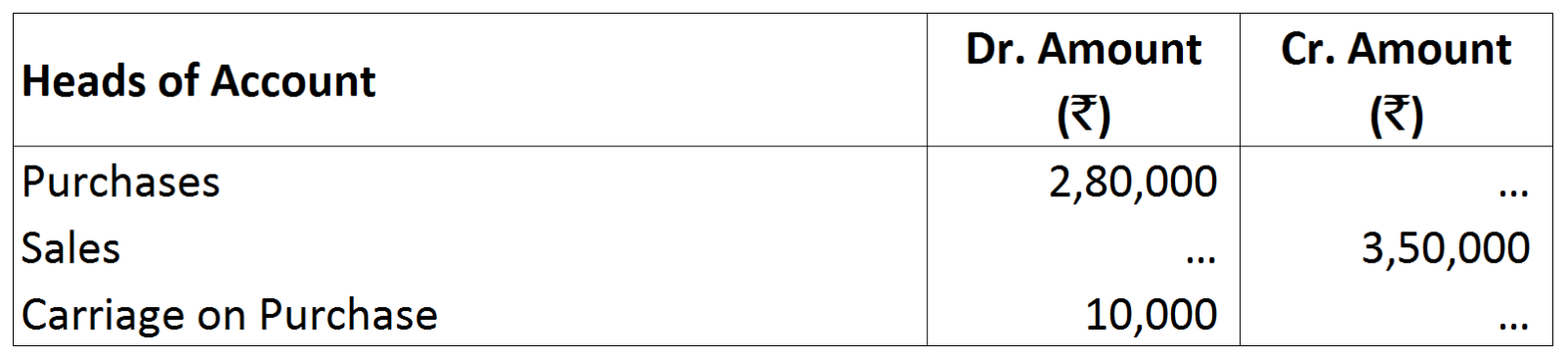
Sanjiv took goods costing ₹ 20,000 for his personal use but entry was not passed in the books of account. Show the treatment in the Final Accounts.
Answer
Coming Soon
View full question & answer
Question 61 Mark
Ramesh's Trial Balance as on 31st March, 2019 gives the following information:
Show how the above items would appear in the Profit and Loss Account and Balance sheet.
Answer
Coming Soon
View full question & answer
Question 71 Mark
When R.D.D. is given in Trial balance, it is known as_______________.
  1. Old R.D.D.
  2. New R.D.D.
  3. Both of the above
  4. None of the above
Answer
  1. Old R.D.D.
Explanation:

Doubtful debts are those debts whose recovery is doubtful. It is not certain whether they will be recovered or not. It is anticipated loss. Therefore, suitable provisions should be made for bad and doubtful debts, so as to calculate true net profit of the business. Provision for doubtful debts is created on debtors balance (not on bad debts) at a fixed percentage. Firms make provisions for expected losses base on their prior experience. Provision for doubtful debts is made to cover for possible losses from debtors going bad. If RDD already exists in the trial balance, then the same is credited to profit and loss account since this is the old R.D.D and needs to be reversed. The effect for R.D.D appearing as an adjustment are as follows:

A. Profit and loss A/c-Debt side (add to old bad debts)

B. Balance Sheet-Asset side (deduct from sundry debtors)

The journal entry for same is as follows:

Reserve for Doubtful Debts A/c Dr.

To Sundry Debtors A/c
View full question & answer
Question 91 Mark
What is Unearned Income? How is it adjusted in the Final Accounts?
Answer
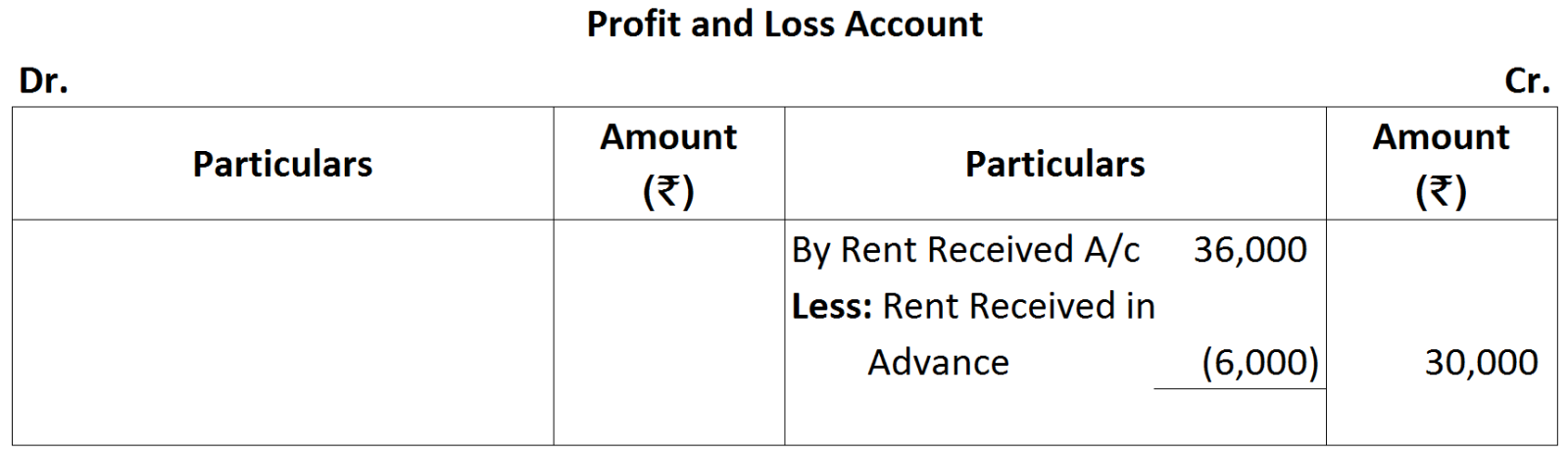
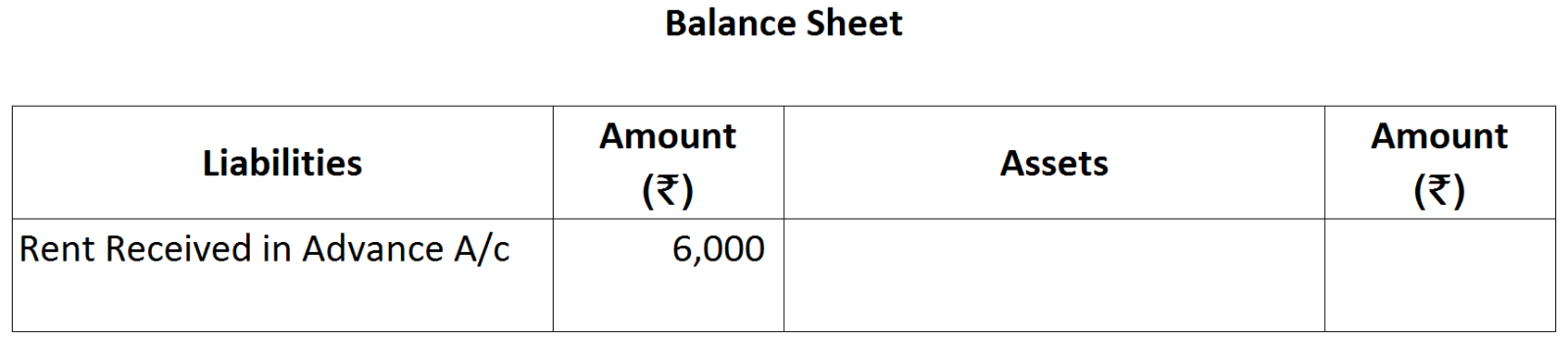
Unearned Income means an income that has not been earned but is received in advance. Sometimes an amount is received during a year in respect of an income that relates partially or fully to the next year. For example, rent for the month of April, 2019 is received in March, 2019. It is an income for the year ending on 31st March, 2020 but is received in the current year, it is Unearned income or Income received in advance. It adjusted in the Final Accounts: Example: Rent received during the year ₹ 36,000 including ₹ 6,000 for the is next year. Rent Received Account (₹ 30,000) is closed by transferring to the credit side of the Profit and Loss Account and Rent Received in Advance (₹ 6,000) will be shown as a liability in the Balance Sheet. This is shown as below:
View full question & answer
Question 101 Mark
Provision for Discount on Debtors is calculated before deducting the Provision for Doubtful Debts from debtors. Comment.
Answer
No, Provision for Discount on Debtors is calculated after deducting Provision for Doubtful Debts. It is so because discount is not allowed on debtors which are doubtful of recovery.
View full question & answer
Question 111 Mark
At what value are the goods distributed as sample accounted and why?
Answer
They are accounted at purchase cost because it is not a sale but advertisement expense.
View full question & answer
Question 121 Mark
Rahul of Chennai sold goods to Reva of Chennai of ₹ 10,000. Whether he will charge CGST and SGST or IGST? Why?
Answer
The sale is intra-state sale, therefore, both CGST and SGST will be charged.
View full question & answer
Question 131 Mark
Following are the Extracts of Trial Balance:
Sundry Debtors (including a B/R for ₹ 5,000 received from Giriraj)
 
 
Bad Debts
1,20,000
 
Provision for Doubtful Debts
3,000
1,800
Giriraj became insolvent and only 40% could be realised from his estate. You are required to make a provision of 5% for doubtful debts. What will be the annount of provision?
Answer
Provision for Doubtful Debts $=\frac{5}{10}$ on (1,20,000 - 5,000) = ₹ 5,750.
View full question & answer
Question 141 Mark
A Manager is entitled to a commission of 10% on net profit before charging the commission. Net profit before charging the commission is ₹ 1,00,000. Find the commission payable to the Manager.
Answer
Manager’s Commission:
Net Profit before charging Commission $\times\frac{\text{Percentage of Commission}}{100}$
$=1,00,000\times\frac{10}{100}$
$=10,000$
View full question & answer
Question 151 Mark
Following is the extract of Trial Balance as on 31st March, 2019:
Adjustment: Create a provision for Doubtful Debts @ 5% on Debtors. Pass necessary entry and show these items in the Profit and Loss Account and the Balance Sheet.
Answer
Coming Soon
View full question & answer
Question 161 Mark
At what value are the goods taken for personal use recorded in the books of account and why?
Answer
They are recorded at purchase cost because it is not a sale but drawing.
View full question & answer
Question 171 Mark
Cost of obtaining licence to carry out business is a Capital Expenditure or Revenue Expenditure?
Answer
Capital Expenditure because it is taken only at the time of starting a business.
View full question & answer
Question 181 Mark
Why is Accrued Income credited to the Profit and Loss Account and shown as current asset in the Balance Sheet?
Answer
Accrual Concept of accounting requires that revenue be recognised when goods or services have been sold whether the amount has been received or not. Since income is credited to Profit and Loss Account. it is credited to the Profit and Loss Account. And since, the amount is due to the enterprise, it is shown as a current asset in the Balance Sheet.
View full question & answer
Question 191 Mark
Why is Closing Stock valued at lower of cost or net realisable value (market value)?
Answer
Closing Stock is valued at lower of cost or net realisable value (market value) because of the Prudence Concept of accounting, whereby anticipated losses are accounted while anticipated profits are not.
View full question & answer
Question 201 Mark
Net profit of a firm before charging manager's commission is ₹ 21,000. If the manager is entitled to 5% commission after charging such commission, calculate the cornmission payable to the manager.
Answer
₹ 1,000
View full question & answer
Question 211 Mark
Lalit of Delhi purchased goods of ₹ 720,000 from Mehar of Kanpur. Whether IGST OF CGST and SGST will be charged by Mehar? Why?
Answer
Mehar will charge IGST because it is inter-state sale.
View full question & answer
Question 221 Mark
Ramesh's Trial Balance gives the following information:
Depreciation is provided @ 10% p.a. on the fixed assets. Show how will be shown in the Profit and Loss Account.
Answer
Coming Soon
View full question & answer
Question 231 Mark
Arun is a trader. While preparing his final accounts on 31st March. 2018, he made a provision for doubtful debts @ 4% of the sundry debtors amounting to ₹ 42,000. During the year ended 31st March, 2019, doubtful debts amounted to ₹ 3,400. On 31st March, 2019, sundry debtors were ₹ 56,500 and the provision for doubtful debts was maintained at the same rate.
Show the entries to record the above matters in Arun's Ledger Accounts.
Answer
Coming Soon
View full question & answer
Question 241 Mark
On 31st March, 2019, a firm's debtors were ₹ 63,000 and its provision for Doubtful Debts was ₹ 3,200. It was decided to write off as irrecoverable debts of ₹ 2,600 and provide for Doubtful Debts @ 5% on Debtors.
Prepare Provision for Doubtful Debts Account and pass the entries in the Profit and Loss Account, and the entry for debtors in the Balance Sheet as at 31st March, 2019.
Answer
Coming Soon
View full question & answer
Question 251 Mark
How would you treat goods given away as charity while preparing financial statements of an organisation.
Answer
Deducted from Purchases in Trading Account and shown on Dr. side of Profit & Loss Account.
View full question & answer
Question 271 Mark
Kapil's Trial Balance provides the following information:
Depriciation is privided @ 10% p.a. on the fixed assets. show how this will be shown in the Profit and Loss Account.
Answer
Coming Soon
View full question & answer
Question 281 Mark
Manager of a firm is entitled for a commission of 6%. The profit after the commission is ₹ 4,70,000. What is the amount of profit before commission?
Answer
If Profit after commission is ₹ 94, profit before commission was ₹ 100.
If Profit after commission is ₹ 4,70,000, profit before commission was,
$\frac{4,70,000\ \times\ 100}{94}=₹\ 5,00,000$
View full question & answer
Question 291 Mark
What is the necessity of doing adjustments? Give four adjustment entries with their explanations.
Answer
Need of Adjustment:
  1. To ascertain the true Net Profit or loss of the business.
  2. To ascertain the true financial position of the business.
  3. To make a record of the transactions omitted from the books.
  4. To rectify the errors committed in the books of accounts.
  5. To make a record of such expenses which have accrued but have not been paid.
  6. To make a record of such incomes which have accrued but have not been received
  7. To provide for depreciation and other provisions.
View full question & answer
Question 301 Mark
Sundry debtors in a Trial Balance are ₹ 90,000. Write off ₹ 5.000 as bad debts and make a Provision for Doubtful Debts @ 10% on sundry debtors. Pass necessary Journal entries.
Answer
Coming Soon
View full question & answer
Question 311 Mark
Manish has paid salaries of ₹ 1,50,000 for the year ended 31st March, 2019. Salaries include ₹ 20,000 paid in advance for the year ending 31st March, 2020. Show how it will be shown in the Profit and Loss Account and the Balance Sheet.
Answer
Coming Soon
View full question & answer
Question 321 Mark
Why are Prepaid Expenses segregated from current year's expenses and taken to Balance Sheet as a current asset?
Answer
Prepaid Expenses are segregated from current year's expenses and taken to Balance Sheet as a current asset because such expenses relate to next year, which have been paid in advance.
View full question & answer
Question 341 Mark
Why Provision of Outstanding Expenses is required?
Answer
Outstanding Expenses are provided following the Accrual Concept of Accounting, i.e., expenses for the year, whether paid or not, should be accounted.
View full question & answer
Question 361 Mark
The debts written off as bad, if recovered subsequently, are credited to the Debtor's Account. Is it correct? Why?
Answer
No, because Bad Debts when written off are debited to Bad Debts Account by crediting Debtor's Account and the Debtor's Account is closed. Therefore, when Bad Debts are recovered, they are credited to Bad Debts Recovered Account and becomes an income.
View full question & answer
Question 381 Mark
Give the adjustment entry and the treatment in Final Accounts of the following:
  1. Accrued Income.
  2. Unearned Income.
Answer
    adjustment entry Treatment in P & L A/C Treatment in Balance Sheet
i. Accrued Income.   Added in income on credit side of Profit & Loss A/c. Shown on the Assets side.
ii. Unearned Income.   Deducted from income on the credit side of Profit & Loss A/c. Shown on the Liabilities side.
View full question & answer
Question 391 Mark
What adjustment is made of outstanding expenses while preparing final accounts?
Answer
On the one hand, they will be added to the concerned expenses on the debit side of Trading or Profit and Loss Account and on the other hand, will also be shown on the Liabilities side of the Balance Sheet.
View full question & answer
Question 411 Mark
State the meaning of:
Accrued income.
Answer
Accrued Income: This refers to those incomes which have been earned during an accounting period but have not been actually realised in the current period. These are also called earned incomes.
View full question & answer
Question 421 Mark
Why Input GST (CGST and SGST or IGST) Account is credited when proprietor takes the goods for personal use?
Answer
It is credited because GST credit is allowed only when goods are sold. Goods taken by proprietor is not a sale but drawings.
View full question & answer
Question 431 Mark
What are the methods of recording Depreciation?
Answer
Methods of recording depreciation are:
  1. Depreciation being credited to respective Asset Account.
  2. Depreciation credited to Provision for Depreciation Account.
View full question & answer
Question 441 Mark
What are prepaid expenses?
Answer
These are the expenses which have been paid in advance for the next period during the current period itself. In other words, benefit of such payments will be available in the next accounting period.
View full question & answer
Question 461 Mark
Give an example of capital expenditure treated as revenue expenditure.
Answer
Wags include ₹ 10,000 spent on the installation of New Machine, In order to rectify the mistake, ₹ 10,000 will be deducted from Wages and added in Machinery.
View full question & answer
Question 471 Mark
The accountant of a firm desires that adjustments for outstanding expenses and prepaid expenses should not be made while preparing financial statements.
  1. What will be the effect on financial statements?
  2. Which accounting concept will be violated?
Answer
  1. Profit and Loss Account will not show correct profit or loss and Balance Sheet will not show true financial position.
  2. Accrual Concept and Matching Concept will be violated.
View full question & answer
Question 481 Mark
What are outstanding expenses?
Answer
These are the expenses which have been incurred during the year but have been left unpaid on the date of preparing the final accounts.
View full question & answer
Question 501 Mark
How are Outstanding Expenses shown in the Final Accounts?
Answer
Outstanding Expenses are added to the relevant expense and shown either in the Trading Account or the Profit and Loss Account. They are also shown in the Balance Sheet on the Liabilities side under the main head Current Liabilities.
View full question & answer
1 Marks Question - Account STD 11 Commerce Questions - Vidyadip