Questions

3 Marks Question

🎯

Test yourself on this topic

22 questions · timed · auto-graded

Question 13 Marks
What is the use of Financial Statements for Potential Investors?
Answer
Investors: They can assess the short-term and long-term financial soundness and earning capacity of the business with the help of financial statements. They can also study the trend of sales, trend of profits, shortcomings and the prospects of future growth of the enterprise.
View full question & answer
Question 23 Marks
Write the various Assets in order of liquidity in a Balance Sheet.
Answer
In the Order of Liquidity:
Current Assets:
  • Cash in Hand
  • Cash at Bank
  • Bills Receivable
  • Short Term Investments
  • Sundry Debtors/ Book Debts
  • Closing Stock
  • Prepaid Expenses
  • Accrued Income
Long Term Investments
Non-Current Assets:-
  • Furniture
  • Loose Tools
  • Motor Vehicle
  • Plant and Machinery
  • Land and Buildings
  • Patents and Trade Marks
  • Goodwill
View full question & answer
Question 33 Marks
What is meant by Indirect Expenses? Give two examples.
Answer
Indirect expenses are those expenses that are incurred to operate a business as a whole or a segment of a business, and so cannot be directly associated with a cost object, such as a product, service, or customer. A cost object is any item for which you are separately measuring costs. Examples of indirect expenses are:
  1. Accounting, audit, and legal fees.
  2. Business permits.
  3. Office expenses.
  4. Rent.
View full question & answer
Question 43 Marks
What is meant by Operating Profit?
Answer
Operating Profit: Operating Profit is the profit earned through normal operating activities of the business. It is arrived at by deducting the operating expenses from gross profit. Expenses which are related to the main or normal activities of the business are called operating expenses. They include office and administrative expenses and selling and distribution expenses, discount, bad-debts etc. Operating Profit is also called 'Earning. Before Interest & Tax or EBIT'.
View full question & answer
Question 53 Marks
Calculate cost of goods sold from the following:
   
Opening Stock 40,000 Wages & Salaries 10,000
Net Purchases 50,000 Rent Paid 15,000
Net Sales 1,90,000 Closing Stock 15,000
Answer
Cost of Goods Sold = Opening Stock + Purchases + Direct Expenses - Closing Stock

Cost of Goods Sold = 40,000 + 50,000 + 10,000 - 15,000 = ₹ 85,000
View full question & answer
Question 73 Marks
Calculate gross profit and cost of goods sold from the following information:
Net Sales ₹ 12,000
Gross Profit $33\frac{1}{3}\%$ on Sales
Answer
Gross Profit = $33\frac{1}{3}\%$ on Sales $=\frac{100}{3\times100}\times12,00,000$= ₹ 4,00,000
Cost of Good Sold = Sales - Gross Profit
= 12,00,000 - 4,00,000
= ₹ 8,00,000
View full question & answer
Question 83 Marks
Calculate Gross Profit on the basis of the following information:
 
Purchases
6,80,000
Return Outwards
30,000
Carriage Inwards
20,000
Carriage Outwards
15,000
Wages
50,000
$\frac{3}{4}$ of the goods are sold for ₹ 6,00,000.
Answer
Cost of Good Sold = Opening Stock + Net Purchase + Direct Expenses - Closing Stock
Net Purchases = Purchases - Purchase Returns
= 6,80,000 - 30,000 = 6,50,000
Direct Expenses = Carriage Inwards + Wages
= 20,000 + 50,000 = 70,000
$\therefore$ Cost of Good Sold = 0 + 6,50,000 + 70,000 - 0
= ₹ 7,20,000
$\frac{3}{4}\text{th}$ of the Goods are Sold for 6,00,000
cost of $\frac{3}{4}\text{th}$ of the Good sold = $\frac{3}{4}\times7,20,000=5,40,000$
Gross Profit = Net Sales - Cost of Good Sold
= 6,00,000 - 5,40,000
= ₹ 60,000
View full question & answer
Question 93 Marks
What do you mean by 'Contingent Liabilities’? Give its two examples.
Answer
Contingent Liabilities: These are the liabilities which will become payable 1 only on the happening of some specific event, otherwise not. The best example would be amount to be paid as compensation to some party if the company in question loses a certain case in court (ex-case related to extra payments to labourers). In this situation, two things may happen:
  1. If the company loses the case, it will have to pay the compensation.
  2. If it wins, no compensation will be paid,
Thus since the amount cannot be treated with certainty as liabilities (the compensation amount), it will be shown as contingent liabilities as a footnote in the balance sheet.
View full question & answer
Question 103 Marks
Calculate Closing Stock and Cost of Goods Sold:
Opening Stock ₹ 5,000; Sales ₹ 16,000; Carriage Inwards ₹ 1,000; Sales Returns ₹ 1,000; Gross Profit ₹ 6,000; Purchase ₹ 10,000; Purchase Returns ₹ 900.
Answer
Cost of Good Sold = Net Sales - Gross Profit
= 15,000 - 6,000
= ₹ 9,000
Cost of Good Sold = OPening Stock + Net Purchase + Direct Expenses - Closing Stock
9,000 = 5,000 + (10,000 - 900) + 1,000 - Closing Stock
Closing Stock = 15,100 - 9,000
= ₹ 6,100
View full question & answer
Question 113 Marks
Calculate operating profit from the following:
 
Net Profit
5,00,000
Dividend Received
6,000
Loss on sale of Furniture
12,000
Loss by Fire
50,000
Salaries
1,20,000
Interest on Loan from Bank
10,000
Rent Received
24,000
Donation
5,100
Answer
Operating Profit = Net Profit − Non-Operating Income + Non-Operating Expenses Non-Operating Income = Dividend Received + Rent Received = 6,000 + 24,000 = 30,000 Non-Operating Expenses = Loss on Sale of Furniture + Loss by Fire + Interest on Loan + Donation = 12,000 + 50,000 + 10,000 + 5,100 = ₹ 77,100 ∴ Operating Profit = 5,00,000 − 30,000 + 77,100 = ₹ 5,47,100 Note: Salary being an operating expense was already taken into account while determining net profit, thus, it will be ignored now.
View full question & answer
Question 123 Marks
Arrange assets in the order of permanence:
Sundry Debtors, Stock, Investment, Land and Building, Cash in Hand, Motor Vehicle, Cash at Bank, Goodwill, Plant and Machinery, Furniture, Loose Tools, Marketable Securities.
Answer
Assets in the order of Permanence:
  1. Goodwill.
  2. Land and Building.
  3. Plant and Machinery.
  4. Motor Vehicle.
  5. Loose Tools.
  6. Furniture.
  7. Investment (Long-term).
  8. Stock.
  9. Sundry Debtors.
  10. Marketable Securities (Short-term).
  11. Cash at Bank.
  12. Cash in Hand.
View full question & answer
Question 133 Marks
Calculate gross profit and cost of goods sold from the following information:
Net Sales ₹ 8,00,000
Gross Profit is 40% on Sales.
Answer
Gross Profit = 40% on Sales
$=\frac{40}{100}\times8,00,000$
= ₹ 3,20,000
Cost of Good Sold = Sales - Gross Profit
= 8,00,000 - 3,20,000
= ₹ 4,80,000
View full question & answer
Question 143 Marks
Ascertain the value of closing stock from the following:
 
Opening Stock
1,20,000
Purchases during the year
9,30,000
Sales during the year
15,60,000
Rate of Gross Profit
40% on Sales
 
Answer
Gross Profit = 40% on Sales
$=\frac{40}{100}\times15,60,000$
= ₹ 6,24,000
Cost of Good Sold = Net Sales - Gross Profit
= 15,60,000 - 6,24,000
= ₹ 9,36,000
Cost of Good Sold = Opening Stock + Net Purchase + Direct Expenses - Closing Stock
9,36,000 = 1,20,000 + 9,30,000 + 0 - Closing Stock
Closing Stock = 10,50,000 - 9,36,000
= ₹ 1,14,000
View full question & answer
Question 153 Marks
Ascertain cost of Goods Sold and Gross Profit from the following:
 
Opening Stock
32,000
Purchases
2,80,000
Direct Expenses
20,000
Indirect Expenses
45,000
Closing Stock
50,000
Sales
4,00,000
Sales Returns
8,000
Answer
Gross Profit = Net Sales - Cost of Good Sold
Cost of Good Sold = Opening Stock + Net Purchases + Direct Expenses - Closing Stock
= 32,000 + 2,80,000 + 20,000 - 50,000
= ₹ 2,82,000
Net Sales = Sales - Sales Return
= 4,00,000 - 8,000
= 3,92,000
$\therefore$ Gross Profit = 3,92,000 - 2,82,000
= ₹ 1,10,000
View full question & answer
Question 163 Marks
Calculate Gross Profit from the following information:
 
Closing Stock
70,000
Wages
40,000
Salary
30,000
Sales
6,88,000
Adjusted Purchase
5,50,000
Answer

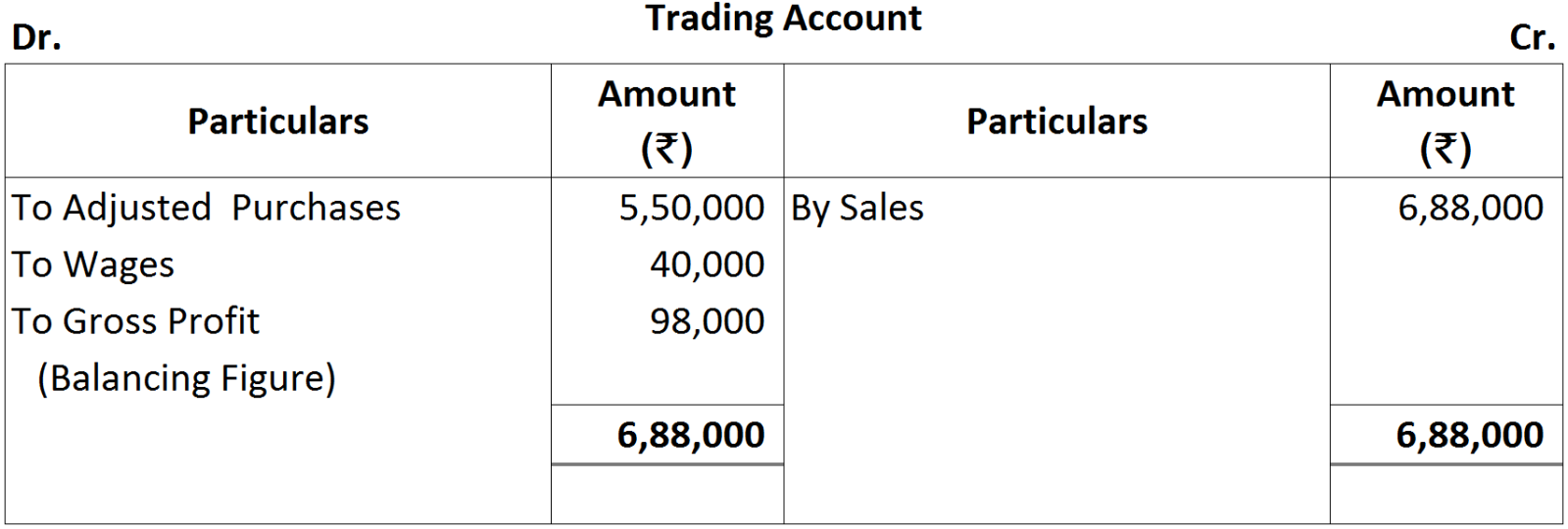
As adjusted purchases is given, it means opening and closing stock are already adjusted. So, these two stocks will not be considered while calculating Gross Profit.
View full question & answer
Question 173 Marks
Calculate Closing Stock from the following:
Answer
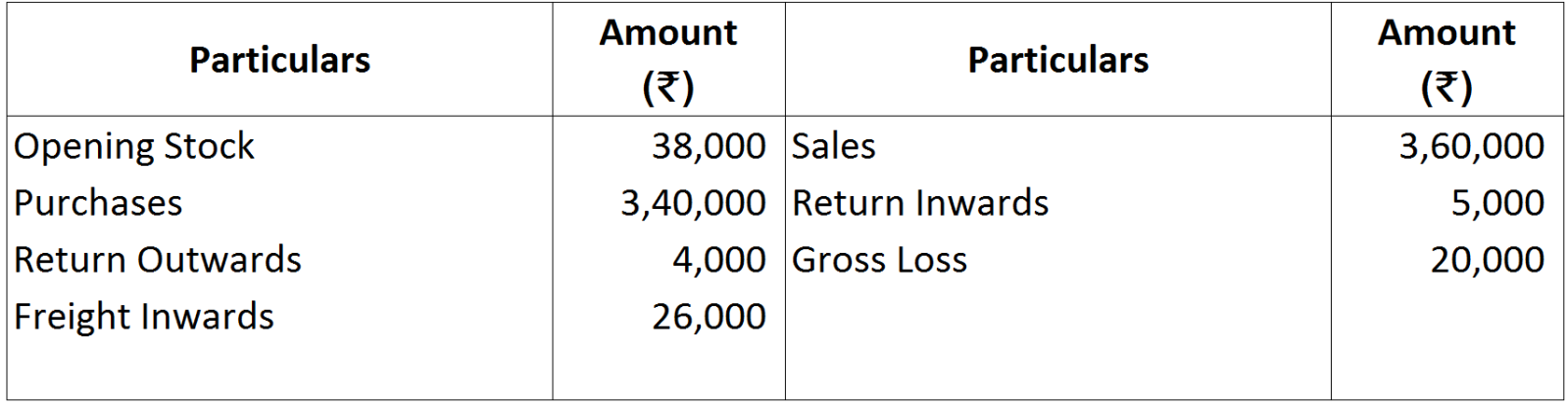
Cost Of Gold Sold = Net Sales + Gross Loss
= (3,60,000 - 5,000) + 20,000
= ₹ 3,75,000
Cost of Good Sold = Opening Stock + Net Purchase + Direct Expenses - Closing Stock
3,75,000 = 38,000 + (3,40,000 - 4,000) + 26,000 - Closing Stock
Closing Stock = 4,00,000 - 3,75,000
= ₹ 25,000
View full question & answer
Question 183 Marks
From the following information, prepare the Trading Account for the year ended 31st March, 2017:
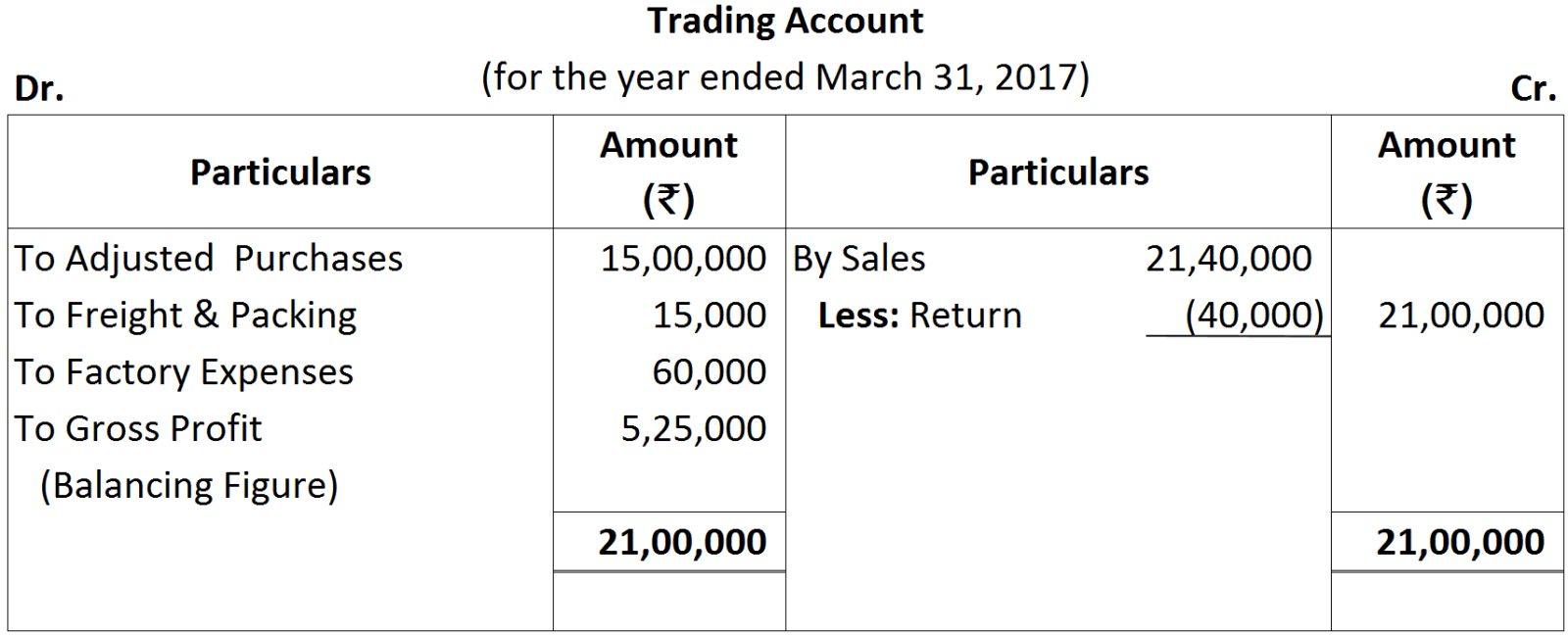
Adjusted Purchases ₹ 15,00,000; Sales ₹ 21,40,000; Returns Inwards ₹ 40,000; Freight and Packing ₹ 15,000; Packing Expenses on Sales ₹ 20,000; Depreciation ₹ 36,000; Factory Expenses ₹ 60,000; Closing Stock ₹ 1,20,000.
Answer

Note: Closing Stock will not be shown on the Credit side of Trading Account since it has already been adjusted while calculating adjusted purchases.
Adjusted Purchases = Opening Stock + Net Purchases - Closing Stock
View full question & answer
Question 193 Marks
Calculate closing stock from the following details:
 
Opening Stock
4,80,000
Purchase
13,60,000
Sales
19,50,000
G.P is 30% on Cost.
Answer
Gross Profit = 30% on Cost
Let the Cost Of Cost of Goods Sold be 'x'
Gross Profit = $\frac{30}{100}\text{x}$
Cost Of Good Sold = Sales - Gross Profit
$\text{x}=19,50,000-\frac{30}{100}\text{x}$
$\text{x}+\frac{30}{100}\text{x}=19,50,000$
$\frac{100\text{x}+30\text{x}}{100}=19,50,000$
$\text{x}=\frac{19,50,000\times100}{130}$
= ₹ 15,00,000
Cost of Good Sold = Opening Stock + Net Purchase + Direct Expenses - Closing Stock
15,00,000 = 4,80,000 + 13,60,000 + 0 - Closing Stock
Closing Stock = 18,40,000 + 15,00,000
= ₹ 3,40,000
View full question & answer
Question 203 Marks
Rearrange the following assets in order of liquidity:-
  1. Debtors
  2. Bills Receivable
  3. Goodwill
  4. Closing Stock
  5. Prepaid insurance
  6. Cash in hand
  7. Short-term Investments
  8. Loose Tools
  9. Cash at bank
  10. Plant
Answer
  1. Cash in hand
  1. Cash at bank
  1. Bills Receivable
  1. Short-term Investments
  1. Debtors
  1. Closing Stock
  1. Prepaid insurance
  1. Loose Tools
  1. Plant
  1. Goodwill
View full question & answer
Question 213 Marks
Explain the Current Assets and Non-Current Assets.
Answer
  1. Current Assets: Current Assets are those which are either in the form of cash or can be easily converted into cash within one year of the date of Balance Sheet. In the words of Hovard & Upton:
'The Current Assets are usually defined as those assets which are convertible into cash through the normal course of business within a short time ordinarily in a year.'

Current Assets include Cash, Bills Receivable, Short Term Investments, Debtors, Prepaid Expenses, Accrued Income, Closing Stock etc. While valuing these assets, Closing Stock is valued at cost or realisable value whichever is less and a reasonable provision for doubtful debts is deducted out of Sundry Debtors.
  1. Non-Current Assets: Non-Current Assets are those which are acquired for continuous use and last for many years such as Land and Building, Plant and Machinery, Motor Vehicles, Furniture etc. According to Finney and Miller:
“Non-Current Assets are assets of a relatively permanent nature used in the operations of business and not intended for sale”.

As the purpose of keeping such assets is not to sell but use them, changes in their market values are ignored and these are always shown in the Balance Sheet at cost less depreciation.
View full question & answer
Question 223 Marks
Calculate Net Sales and G.P. from the following:
 
Cost of Goods Sold
4,50,000
G.P.
25% on Sales
Answer
Gross Profit = 25% on Sales or $\frac{1}{4}$ on Sales
$\frac{1}{4}$ on Sales = $\frac{1}{3}\text{rd}$ on Cost
Gross Profit $=\frac{1}{3}\times4,50,000$
= ₹ 1,50,000
Cost of Good Sold = Sales - Gross Profit
4,50,000 = Sales - 1,50,000
Sales = ₹ 6,00,000
View full question & answer
3 Marks Question - Account STD 11 Commerce Questions - Vidyadip