Questions

6 Marks Question

🎯

Test yourself on this topic

24 questions · timed · auto-graded

Question 16 Marks
Journalise the following transactions in the books of Ashok:
  1. Received ₹ 11,700 from Hari Krishan in full settlement of his account for ₹ 12,000.
  2. Received ₹ 11,700 from Shyam on his account for ₹ 12,000.
  3. Received a first and final dividend of 70 paise in the rupee from the official receiver of Rajagopal who owed us ₹ 7,000.
  4. Paid ₹ 2,880 to A.K. Mandal in full settlement of his account for ₹ 3,000.
  5. Paid ₹ 2,880 to S.K. Gupta on his account for ​₹ 3,000.
View full question & answer
Question 26 Marks
State Whether the following accounts will a debit or credit balances:
  1. Rent Received.
  2. Bank Overdraft.
  3. Wages.
  4. Land and Building.
  5. Commission Received.
  6. Commision Paid.
  7. Rent Outstanding.
  8. Cash in Hand.
  9. M/s. Gupta Traders (Supplliers).
  10. Drawings.
  11. Capital.
  12. Prepaid Rent.
  13. Input IGST.
  14. Output SGST.
Answer
Debit Balance:
  1. Wages.
  1. Land and Building.
  1. Commision Paid.
  1. Cash in Hand.
  1. Drawings.
  1. Prepaid Rent.
  1. Input IGST.
Credit Balance:
  1. Rent Received.
  1. Bank Overdraft.
  1. ​​​​​​​Commision Received.
  1. Rent Outstanding.
  1. M/s. Gupta Traders.
  1. Capital.
  1. Output SGST.
View full question & answer
Question 36 Marks
Journalise the following transactions in the books of Bhushan Agencies:
  1. Received from Bharat cash ₹ 20,000, allowed him discount of ₹ 500.
  2. Received from Vikas ₹ 35,000 by cheque, allowed him discount of ₹ 750.
  3. Received from Akhil ₹ 38,000 in settlement of his dues of ₹ 40,000 in cash.
  4. Received from Amrit ₹ 50,000 by cheque on account against dues of ₹ 60,000.
  5. Paid cash ₹ 40,000 to suresh, availed discount of 2%.
  6. Paid by cheque ₹ 25,000 to Mehar and settled her dues of ₹ 26,000.
  7. Paid ₹ 25,000 to Yogesh by cheque on account.
  8. Purchased goods costing ₹ 1,00,000 against cheque and availed discount of 3%.
  9. Purchased goods costing ₹ 60,000 from Akash & Co., paid 50% immediately availing 3% discount.
  10. Sold goods of ₹ 30,000 against cheque allowing 2% discount.
  11. Sold goods of ₹ 60,000 to Vimal received 50% of due amount allowing 2% discount.
View full question & answer
Question 46 Marks
Journalise the following transactions:
 
 
(i)
Shyam became insolvent. A first and final compensation of 75 paise in a rupee was received from his Official Receiver. He owed us
10,000
(ii)
Received cash for bad debts written off last year.
5,000
(iii)
Rent due to landlord.
8,000
(iv)
Salaries due to clerks.
10,000
(v) Placed an order with Rakesh Mohan for the supply of goods of the list price of ₹ 1,00,000. In this connection, Raman paid 10% of the list price as an advance by cheque.  
View full question & answer
Question 56 Marks
What is an Opening Entry? Give an example.
Answer
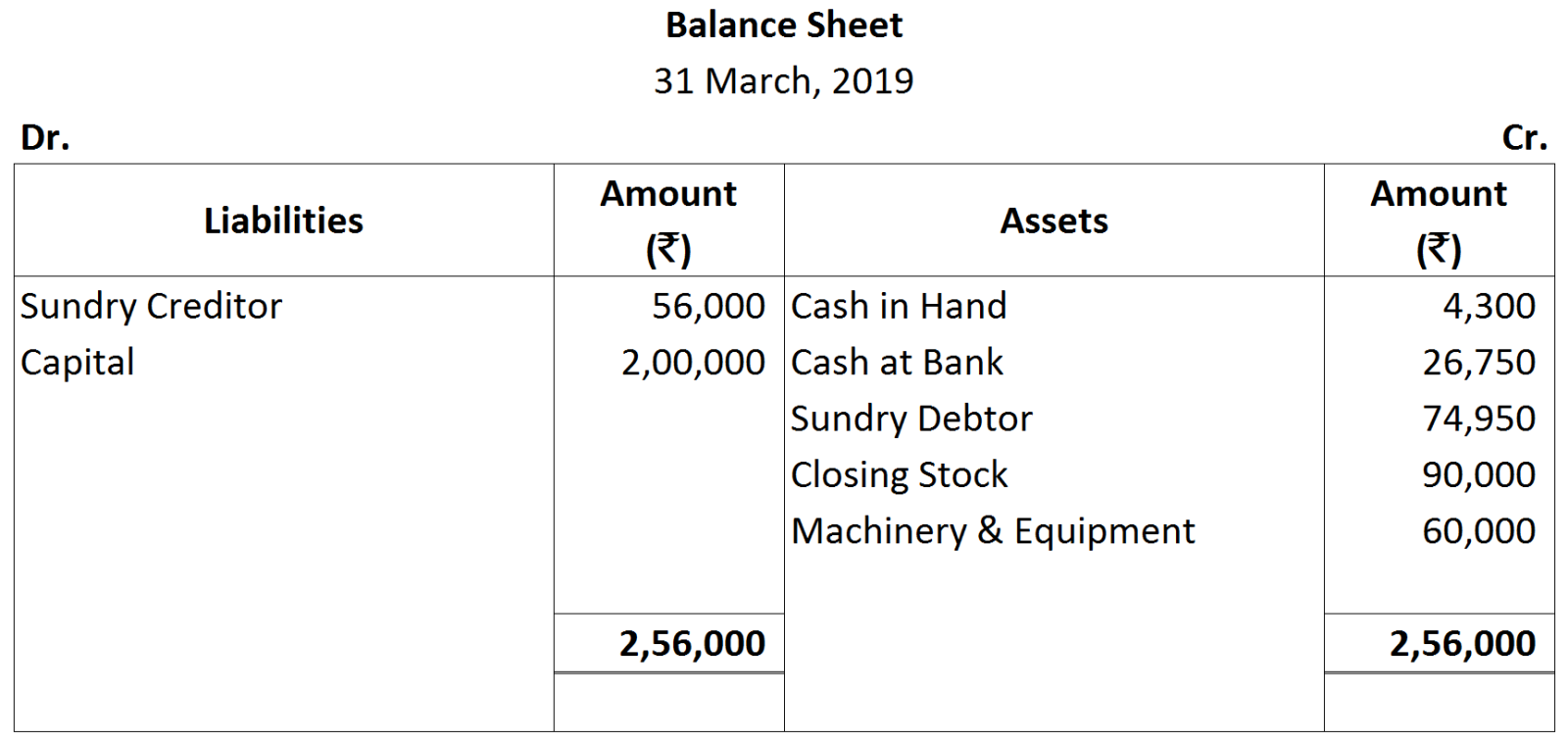
Enterprises close their books of account at the end of each year. In this process nominal accounts are closed by transferring them to Profit and Loss Account. The balances of Personal and Real Accounts (under Traditional Approach for classification of accounts) and Asset, liability and Capital Accounts (under Modern Approach for classification of accounts) are carried forward to the next year. These balances become the opening balances of the next year. The first entry in the Journal is passed to record closing balances of the previous year. It is called Opening Entry. Following example will make it more clear:
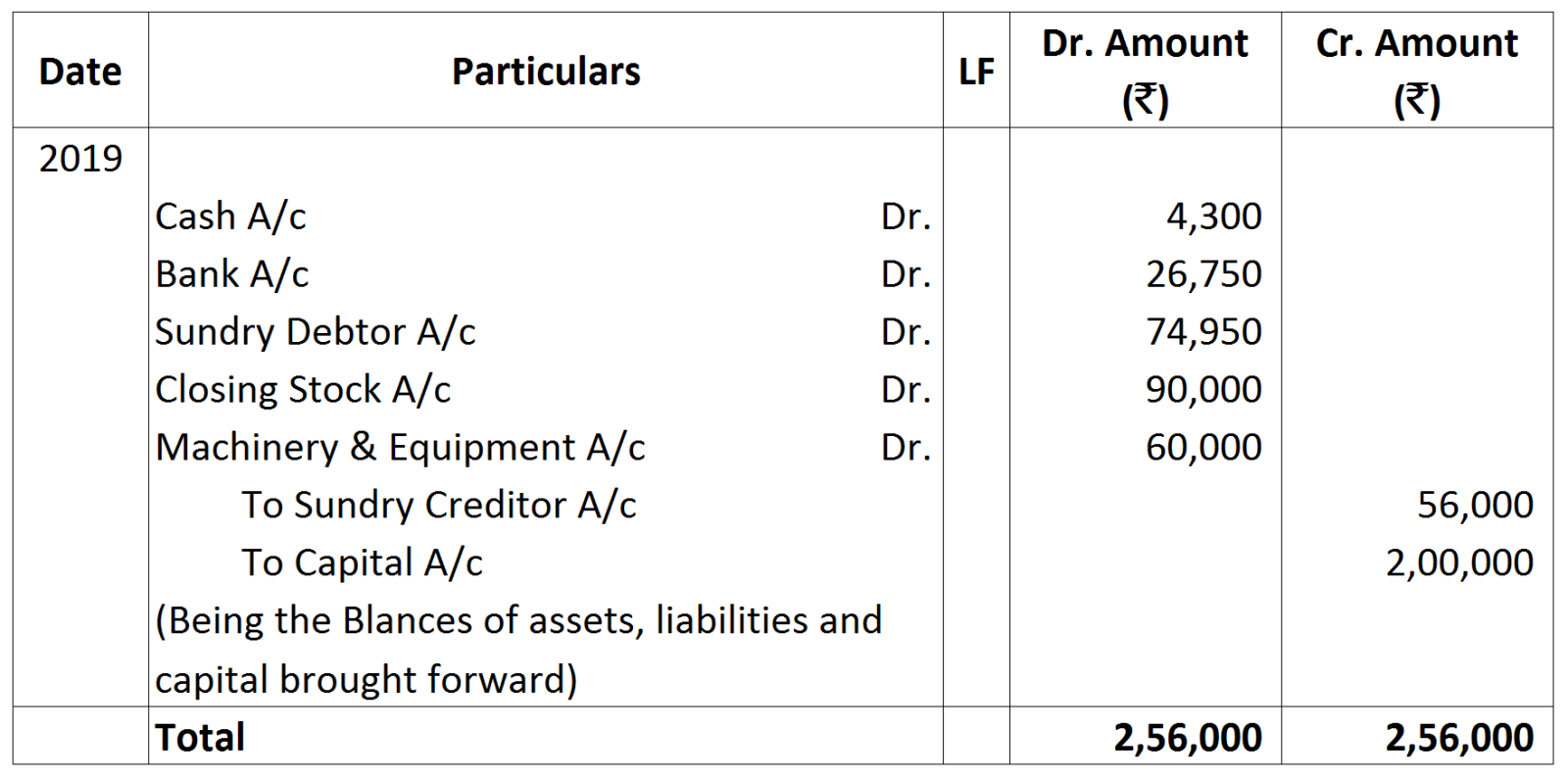
Based on the above Balance Sheet, the Opening Entry will be:
View full question & answer
Question 66 Marks
Journalise the following transactions in the books of Manoj Store:
  1. Purchased goods from Ramesh ₹ 20,000 less Trade Discount at 20% plus IGST @ 12% .
  2. Sold goods costing ₹ 7,000 to Krishna for ₹ 9,000 plus IGST @ 12%.
  3. Sold goods for ₹ 10,000 and charged IGST @ 12% against cheque.
  4. ₹ 5,000 were deposited into Savings Account.
  5. Machinery costing ₹ 4,00,000 for which order was placed earlier paying advance of ₹ 40,000. The balance amount was paid as follows:
  6. An old machine (personal) valued at ₹ 30,000 was given in exchange:
  1. Issued a cheque from his savings account for ₹ 1,30,000.
  2. Balance by issue cheque from firm's bank account.
  3. Paid wages ₹ 2,500 for installation of machine.
View full question & answer
Question 76 Marks
Journalise the following transactions of Singh Enterprises, Delhi:
2018
 
June 1
Started business with cash
50,000
June 2
Deposited cheque from Savings Account in firm's account
2,00,000
June 3
Received cash from Ram
50,000
June 4
Purchased goods for cash
15,000
June 11
Sold goods to M/s. Hari Sales, Delhi
12,000
June 13
Paid to Ramavtar
40,000
June 17
Received from M/s. Hari Sales
10,000
June 20
Bought furniture from S.R. Furnishers against Cash
22,400
June 27
Paid rent
28,000
June 30
Paid salary
50,000
View full question & answer
Question 86 Marks
Following transactions of Ramesh for April, 2019 are given below. Journalise them.
2019
 
April 1
Ramesh started business with cash
1,00,000
April 2
Paid into bank
20,000
April 3
Bought goods for cash
50,000
April 4
Drew cash from bank for office use
10,000
April 13
Sold goods to Krishna
15,000
April 20
Bought goods from Shyam
22,500
April 22
Krishna returned goods
2,000
April 24
Received from Krishna
12,500
 
Allowed him discount
500
April 28
Paid cash to Shyam
21,500
 
Discount received
1,000
April 30
Cash sales for the month
80,000
April 30
Paid rent
5,000
April 30
Paid salary
10,000
View full question & answer
Question 96 Marks
Journalise the following transactions of Satish, Noida (UP):
2019
 
Jan 1
Started business with cash
40,000
Jan 2
Opened Bank Account by cheque from Savings Account
60,000
Jan 3
Bought goods from M/s. S. Singh & Co., Delhi
20,000
Jan 4
Introduced additional capital by cheque
5,000
Jan 4
Purchased computer against cheque from Computer Mart, Noida
15,000
Jan 6
Paid for postage stamps
150
Jan 8
Sold goods for cash
4,000
Jan 9
Sold goods to M/s Sharda & Co., Delhi
10,000
Jan 15
Paid the due amount to M/s S. Singh & Co. after availing discount of ₹ 400
 
Jan 25
Sold goods to M/s Ray & Co., Kolkata
5,600
Jan 27
Received cheque from M/s Sharda & Co. in full settlement of amount due from them
11,000
Jan 31
Paid for electricity charges
1,000
Jan 31
Paid rent of building by cheque. Half of the building is used by the proprietor for residential use.
5,000
Jan 31
Drew for personal use
3,500
View full question & answer
Question 106 Marks
Journalise the following in the books of Amit Saini, Gurugram (Haryana):
  1. Goods of ₹ 5,000 were taken by him for personal use.
  2. ₹ 2,000 due from Sohan were bad debts.
  3. Goods of ₹ 6,000 were destroyed by fire and were not insured.
  4. Paid ₹ 4,000 in cash as wages on installation of machine. (GST is not to be levied).
  5. Sold goods to Arjun of Delhi of list price ₹ 20,000. Trade discount @ 10% and cash discount of 5% was allowed. He paid the amount on the same day and availed the cash discount.
  6. Received ₹ 2,000 from Ramesh, whose account was written off as bad debts.
  7. Goods costing ₹ 1,000 given as charity.
  8. Received ₹ 9,750 from Ramesh in full settlement of his account of ₹ 10,000.
  9. Paid rent in advance ₹ 4,000.
​CGST and SGST is to be levied on intra-state sale @ 6% each and IGST @ 12% on inter-state sale.
View full question & answer
Question 116 Marks
Briefly state the rules of debiting and crediting accounts classified on the basis of Accounting Equation.
Answer
Under Double Entry System of accounting each transaction has two aspects. One aspect is debit, i.e., receiving or incoming aspect. Another aspect is credit, i.e., giving or outgoing aspect. Debit and credit aspects of a transaction form the basis of Double Entry System.
Rules of Double Entry or Rules of Debit and Credit are formed on the basis of these two aspects in each of the business transactions. There are two approaches for deciding when to write on the debit side of account and when to write on the credit side of an account, i.e., which account is to be debited and which account is to be credited. The rules on the basis of which such decision is taken are called Rules of Debit and Credit.
Classified on the basis of Accounting Equation:
Under this approach all the accounts are classified into the following five categories:
  1. Asset Accounts: Asset accounts are those accounts which relate to the economic resources of an enterprise such as Land and Building, Plant and Machinery, Furniture, Patents, Inventory, Bank and Cash, etc.
  1. Liability Accounts: Liability accounts are accounts of lenders, creditors for goods, outstanding expenses, etc.
  1. Capital Accounts: These are the accounts of proprietors/ partners who have invested amount in the business. It includes both Capital and Drawings Account.
  1. Revenue Accounts: These are accounts of incomes and gains. Examples are: Sales, Discount received, Interest received, commission received, bad debts recovered, etc.
  1. Expense Accounts: These are the accounts of expenses or losses incurred n carrying the business. Examples are: Purchases, Wages, salaries, Depreciation, Discount allowed and Rent, etc.
 
Types of Account
Accounts to be Debited
Accounts to be Credited
1.
Assets Accounts
Increase
Decrease
2.
Liability Accounts
Decrease
Increase
3.
Capital Accounts
Decrease
Increase
4.
Revenue Accounts
Decrease
Increase
5.
Expenses Accounts
Increase
Decrease
View full question & answer
Question 126 Marks
Journalise the following transactions in the books of Mohan, Delhi:
  1. Raj of Alwar, Rajasthan who owed Mohan ₹ 25,000 became insolvent and received 60 paise in a rupee as full and final settlement.
  2. Mohan owes to his landlord ₹ 10,000 as rent.
  3. Charge depreciation of 10% on furniture costing ₹ 50,000.
  4. Salaries due to employees ₹ 20,000.
  5. Sold to Sunil goods in cash of ₹ 10,000 less 10% trade discount plus CGST and SGST @ 6% each and received a net of ₹ 8,500.
  6. Provided interest on capital of ₹ 1,00,000 @ 10% per annum.
  7. Goods lost in theft ₹ 5,000, which were purchased paying IGST @ 12% from Alwar, Rajasthan.
View full question & answer
Question 136 Marks
Journalise the following entries:
  1. Goods costing ₹ 500 given as charity.
  2. Sold goods to Mayank of ₹ 1,00,000, payable 25% by cheque at the time of sale and balance after 30 days of sale.
  3. Received ₹ 975 from Harikrishna in full settlement of his account of ₹ 1,000.
  4. Received a first and final dividend of 60 paise in a rupee from the Official Receiver of Rajan, who owed us ₹ 1,000.
  5. Charge interest on Drawings ₹ 1,500.
  6. Sold goods costing ₹ 40,000 to Anil for cash at a profit of 25% on cost less 20% trade discount and paid cartage ₹ 100, which is not to be charged from customer.
View full question & answer
Question 146 Marks
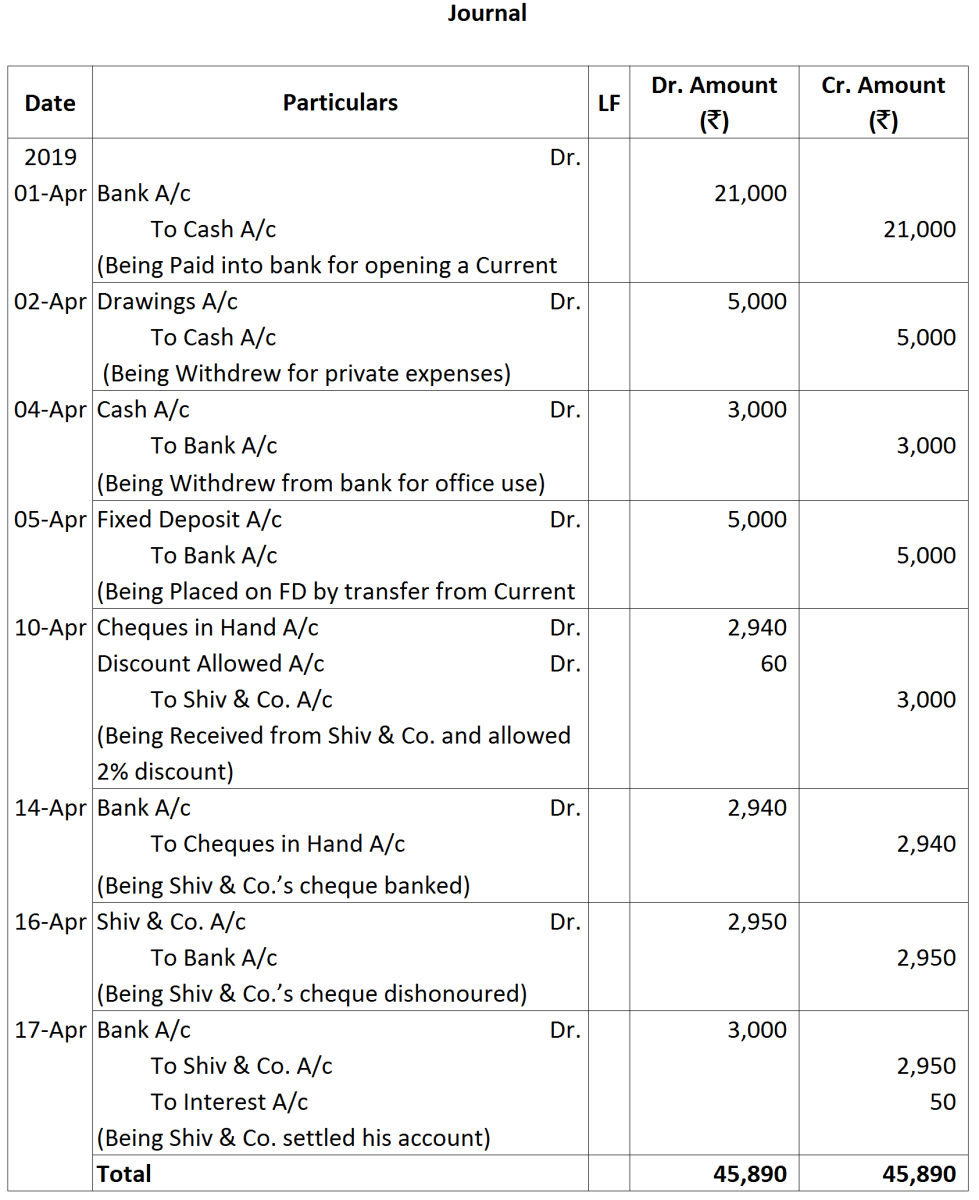
Journalise the following transactions:
2019
 
April 1
Paid into bank ₹ 21,000 for opening a Current Account.
April 2
Withdrew for personal expenses ₹ 5,000.
April 4
Withdrew from bank ₹ 3,000.
April 5
Placed an amount in Fixed Deposit at Bank by transfer from Current Account ₹ 5,000.
April 10
Received a cheque from Shiv & Co. to whom goods were sold for ₹ 3,000 last year. Allowed him 2% discount.
April 14
Shiv & Co.'s cheque deposited into bank.
April 16
Shiv & Co.'s cheque dishonoured (Bank charges ₹ 10)
April 17
Shiv & Co. settled his account by means of a cheque for ₹ 3,000, ₹ 40 being interest charged.
Answer

Note for Apr 17: Cheque of ₹ 2,940 dishonoured. Bank charged ₹ 10 (to be recovered from Shiv & Co.). Total due from Shiv & Co. ₹ 2,950. New cheque received for ₹ 3,000, so interest charged should be ₹ 50 (not ₹ 40, as given in the book).
View full question & answer
Question 156 Marks
Journalise the following transactions of Rakesh Agencies, Delhi (Proprietor Shri Rakesh):
2019
 
Jan 1
Rakesh commenced business with cash
50,000
Jan 2
Purchased goods for cash
10,000
Jan 5
Purchased goods from Mohan, Delhi
6,000
Jan 7
Opened bank account with Bank of India
10,000
Jan 10
Purchased furniture for office
2,000
Jan 15
Sold goods for cash
8,000
Jan 20
Sold goods to Ram, Delhi
5,000
Jan 25
Cash sales
3,500
Jan 27
Paid to Mohan on account
3,000
Jan 28
Ram returns goods costing
500
Jan 31 Paid Salaries 9,000
Jan 31
Rejected and returned 10% of goods supplied by Mohan
 
View full question & answer
Question 166 Marks
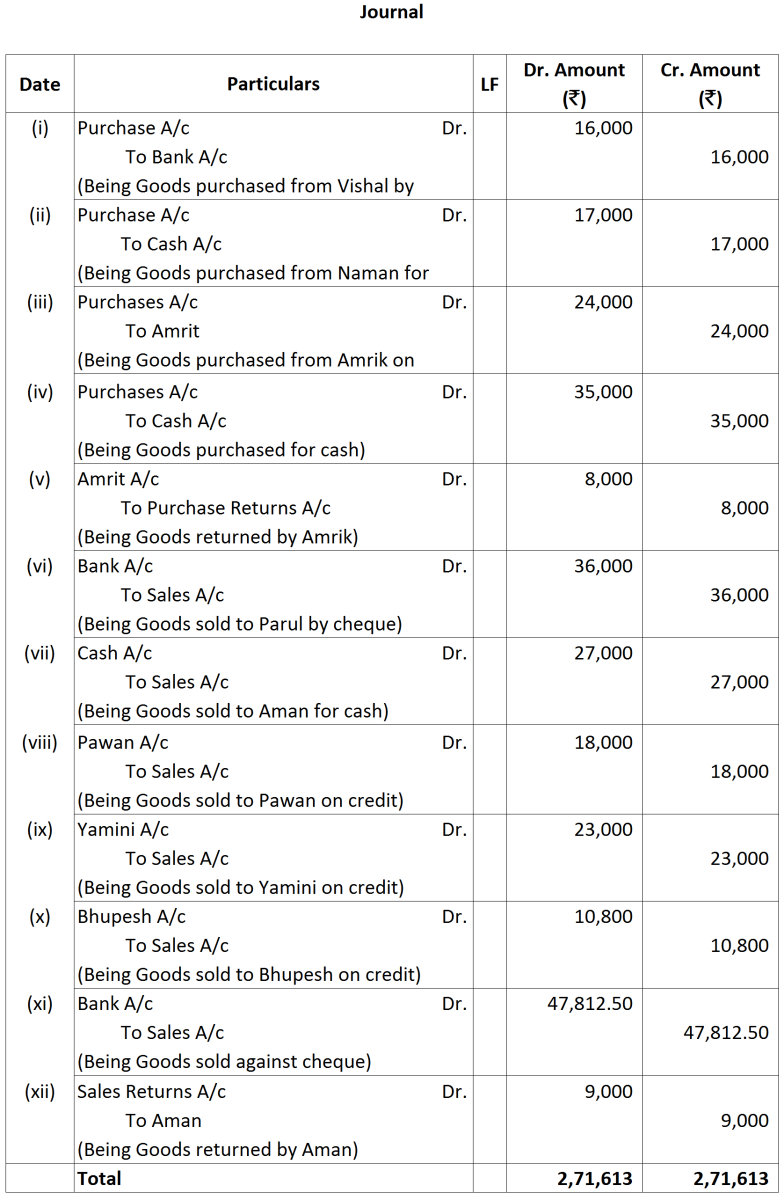
Journalise the following transactions in the books of M/s. R.K. & Co:
  1. Purchased goods of list price of ₹ 20,000 from Vishal at 20% trade discount against cheque payment.
  2. Purchased goods of list price of ₹ 20,000 from Naman at 15% trade discount against cash.
  3. Purchased goods of list price of ₹ 30,000 from Amrit at 20% trade discount.
  4. Purchased goods of list price of ₹ 40,000 for ₹ 35,000 for cash.
  5. Goods returned of list price ₹ 10,000 purchased from Amrit.
  6. Sold goods to Parul of list price of ₹ 40,000 at 10% trade discount against cheque payment.
  7. Sold goods to Aman of list price of ₹ 30,000 at 10% trade discount against cash.
  8. Sold goods to Pawan of list price of ₹ 20,000 at 10% trade discount.
  9. Sold goods to Yamini of list price of ₹ 25,000 for ₹ 23,000.
  10. Sold goods costing ₹ 10,000 at cost plus 20% less 10% trade discount to Bhupesh.
  11. Sold goods purchased at list price of ₹ 50,000 less 15% trade discount sold at a profit of 25% less 10% trade discount against cheque.
  12. Aman returned goods of list price of ₹ 10,000 sold to him at 10% trade discount.
Answer

Working Notes:
WN 1:
Calculation of Sales price (point no. x)
Sales Price = (10,000 + 20% = 12,000 - 10%) = ₹ 10,800
WN 2:
Calculation of Purchase price and Sales price (point no. xi)
Purchase Price = (50,000 - 15%) ₹ 42,500
Sales Price = (42,500 + 25% = 53,125 - 10%) = ₹ 47,812.5
View full question & answer
Question 186 Marks
Pass Journal entries in the books of Puneet, Delhi for the following:
  1. Received an order from Karan & Co. for supply of goods of ₹ 50,000.
  2. Received an order from AK & Co. for goods of ₹ 1,00,000 along with a cheque for ₹ 25,000 as advance.
  3. Paid to staff ₹ 40,000 against outstanding salary of ₹ 60,000.
  4. Sold goods to Bharat, Kaithal (Haryana) of ₹ 10,000 plus IGST @ 12% out of which 1/5th were returned being defective.
  5. Cheque of ₹ 20,000 issued by Feroz was dishonoured.
  6. Received 40 paise in a rupee from Feroz against the above dues.
  7. Received a cheque of ₹ 25,000 from Mohan after banking hours.
  8. Purchased goods from Barun of Chandigarh of ₹ 10,000 plus IGST @ 12% and sold them to Arun of Shimla (HP) at ₹ 22,400, including IGST @ 12%.
  9. Arun returned goods of ₹ 6,720, including IGST which were returned to Barun.
  10. ABC & Co. purchased 10 TV sets @ ₹ 20,000 per set and paid IGST @ 12%. It sold all the sets @ ₹ 25,000 per set plus CGST and SGST @ 6% each.
  11. Paid insurance of ₹ 12,000 plus CGST and SGST @ 6% each for a period of one year.
  12. Sold personal car for ₹ 1,00,000 and invested the amount in the firm.
  13. Goods costing ₹ 1,00,000 were destroyed in fire. Insurance company admitted the claim for ₹ 75,000. These goods were purchased within Delhi.
  14. Purchased machinery for ₹ 56,000 including IGST of ₹ 6,000 and paid cartage thereon ₹ 5,000 and installation charges ₹ 10,000.
  15. Goods costing ₹ 40,000 sold to Mr. X at a profit of 20% on sales less 10% Trade Discount plus CGST and SGST @ 6% each and received a cheque under 2% cash discount.
  16. Purchased machinery from New Machinery House for ₹ 50,000 and paid it by means of a bank draft purchased from bank. Paid charges ​₹ 500.
View full question & answer
Question 206 Marks
Journalise the following transactions of Mr. Rahul:
2019
 
Jan. 1
Rahul started business with cash
1,00,000
Jan. 2
Paid into bank
60,000
Jan. 3
Bought goods from M/s. Singh & Co.
20,000
Jan. 3
Paid cartage
300
Jan. 4
Purchased furniture
2,000
Jan. 4
Placed an order for HP Printers for ₹ 15,000, amount advanced
5,000
Jan. 4
Purchased calculator
1,000
Jan. 4
Purchased computer through cheque
13,000
Jan. 6
Paid for postage
150
Jan. 8
Sold goods for cash
4,000
Jan. 9
Sold goods to M/s. Sharda & Co.
10,000
Jan. 9
Paid cartage
200
Jan. 15
Paid to M/s Singh & Co. on account
17,500
Jan. 25
Sold goods to M/s. Ray & Co.
5,600
Jan. 27
Received cheque from M/s. Sharda & Co. in full settlement of amount due from them
9,750
Jan. 31
Paid for electricity charges
1,000
Jan. 31
Paid salary
1,500
Jan. 31
Paid rent of building by cheque, half of the building is used by the proprietor for residential use
5,000
Jan. 31
Drew for private use
3,500
View full question & answer
Question 216 Marks
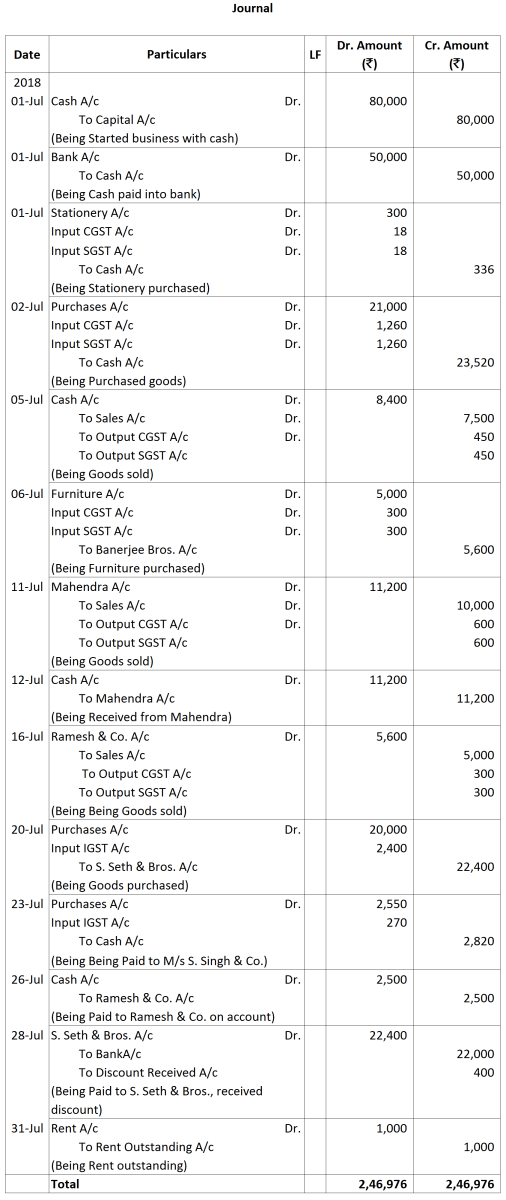
Following are the transactions of R.Singh & Co., Kanpur (UP) for the month of July, 2018. You are required to Journalise them:
2018
 
July 1
Started business with cash
80,000
July 1
Cash paid into bank
50,000
July 1
Bought stationery of ₹ 300 plus CGST and SGST @ 6% each
 
July 2
Bought goods of ₹ 21,000 plus CGST and SGST @ 6% each
 
July 5
Sold goods of ₹ 7,500 plus CGST and SGST @ 6% each
 
July 6
Bought office furniture of ₹ 5,000 plus CGST and SGST @ 6% each from Banerjee Bros.
 
July 11
Sold goods of ₹ 10,000 plus CGST and SGST @ 6% each to Mahendra
 
July 12
Received cheque from Mahendra for the amount due
 
July 16
Sold goods of ₹ 5,000 plus CGST and SGST @ 6% each to Ramesh & Co
 
July 20
Bought goods of ₹ 20,000 plus IGST @ 12% from S. Seth & Bros., Delhi
 
July 23
Bought goods of ₹ 2,250 plus IGST @12 % for cash from S. Narain & Co., Ludhiana (Punjab)
 
July 26
Ramesh & Co. paid on account
2,500
July 28
Paid to S. Seth & Bros. by cheque in full settlement
22,000
July 31
Rent is due to S. Sharma but not yet paid.
1,000
Answer
Solution is as follows.
View full question & answer
Question 226 Marks
Record the following transactions in the Journal of Ashoka Furniture Traders, Ludhiana (Punjab):
2019
 
Jan.1
Started business with cash
50,000
Jan.2
Opened a Current Account by personal cheque
3,50,000
Jan.10
Purchased machinery against cheque
1,00,000
Jan.15
Paid wages for installation of machinery
2,000
Jan.20
Purchased timber from Singh & Co., Ludhiana (Punjab) of the list price of ₹ 20,000 at 10% trade discount
 
Jan.25
Out of the above, timber used for furnishing the office
5,000
Jan.31
Sold timber to Rakesh of the list price of ₹ 10,000 and allowed him 10% trade discount
 
Feb.10
Issued to Singh & Co. a cheque in full settlement
20,000
Feb.15
Received from Rakesh in full and final settlement
10,000
Feb.20
Paid Wages
15,000
Feb.28 Issued a cheque for ₹ 5,000 in favour of the landlord for rent of February  
CGST and SGST is levied @ 6% each on intra-state sale and purchase. IGST is levied @ 12% on inter-state sale and purchase.
View full question & answer
Question 236 Marks
Enter the following transactions in the Journal of Suresh, Delhi who trades in ready-made garments:
2019
 
April 1
Suresh paid into bank as Capital*
60,000
April 2
He bought goods and paid by cheque
24,000
April 3
Sold goods to Mukand & Co., Delhi
6,700
April 4
Sold goods for cash
10,900
April 5
Paid sundry expenses in cash*
3,000
April 8
Paid for office furniture and fittings by cheque
4,000
April 9
Bought goods from Ramesh & Bros., Faridabad (Haryana)
10,600
April 11
Returned goods to Ramesh & Bros.
1,500
April 12
Issued cheque to Ramesh & Bros. in full settlement*
9,500
April 30
Bank charged interest*
200
April 30
Borrowed from Ridhi @ 10% per annum interest*
50,000
April 30
Received from Mahendra on account*
6,000
April 30
Sold household furniture and paid the amount into business*
2,000
April 30
Sold goods costing ₹ 5,000 to Anita for cash at a profit of 20% on cost, less 20% trade discount
 
April 30
Sold goods costing ₹ 20,000 to Sunil at a profit of 20% on sale less 20% Trade Discount and paid cartage ₹ 150 (to be charged from customer).
 
CGST and SGST is levied @ 6% each on intra-state sale and purchase. IGST is levied @ 12% on inter-state sale and purchase. Out of the above, transactions marked with (*) are not subject to levy of GST.
[Hint: Household furniture is personal asset. When it is sold GST will not be levid. Since amount realised is invested in the firm, Suresh's Capital Account will be credited.}
View full question & answer
Question 246 Marks
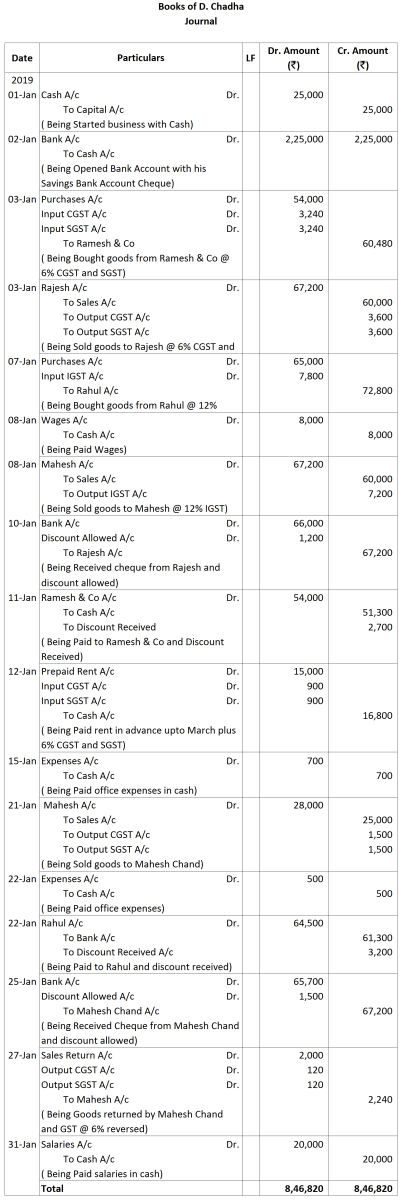
D.Chadha, Delhi commenced business on 1st January, 2019. His transactions for the month are given below. Journalise them. He will close his books on 31st March each year.
2019
 
Jan.1
Commenced business with Cash
25,000
Jan.2
Opened Bank Account with cheque from his Savings Account
2,25,000
Jan.3
Bought goods from Ramesh & Co., Delhi, plus CGST and SGST @ 6% each
54,000
Jan.3
Sold goods to Rajesh of ₹ 60,000, charged CGST and SGST @ 6% each
 
Jan.7
Bought goods from Rahul, Chennal, plus IGST @ 12%
65,000
Jan.8
Paid wages in cash (GST not levied)
8,000
Jan.8
Sold goods to Mahesh, Kochi of ₹ 60,000; charged IGST @ 12%
 
Jan.10
Received cheque from Rajesh (Discount allowed ₹ 1,200)
66,000
Jan.11
Paid to Ramesh & Co. (Discount received ₹ 2,700)
51,300
Jan.12
Paid rent @ ₹ 15,000 per month for three months up to March, plus CGST and SGST @ 6% each
 
Jan.15
Paid office expenses in cash
700
Jan.21
Sold to Rakesh, Delhi goods of ₹ 25,000, charged CGST and SGST @ 6% each
 
Jan.22
Paid office expenses in cash
500
Jan.22
Paid to Rahul by cheque (discount ₹ 3,200)
61,300
Jan.25
Received cheque from Mahesh Kochi (discount ₹ 1,500)
65,700
Jan.27
Rakesh, Delhi returned goods (being not as per sample)
2,000
Jan.31
Paid salaries for the month
20,000
Answer
Solution is as follows:
View full question & answer
6 Marks Question - Account STD 11 Commerce Questions - Vidyadip