Questions

6 Marks Question

🎯

Test yourself on this topic

6 questions · timed · auto-graded

Question 16 Marks
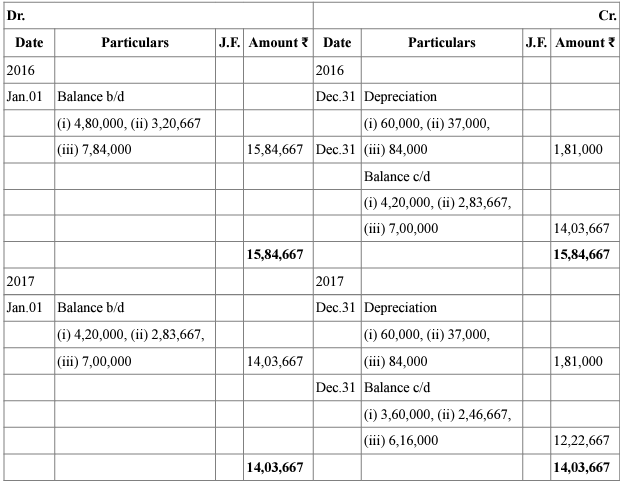
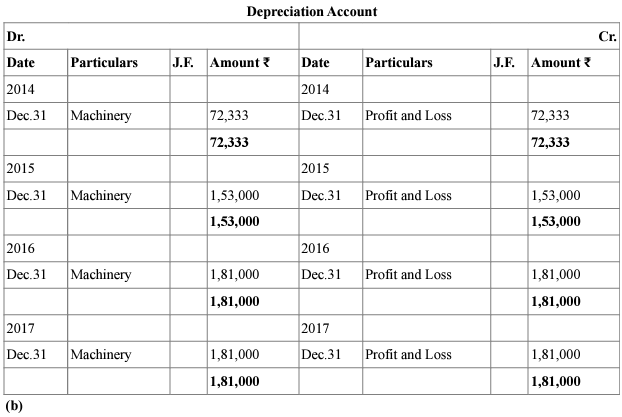
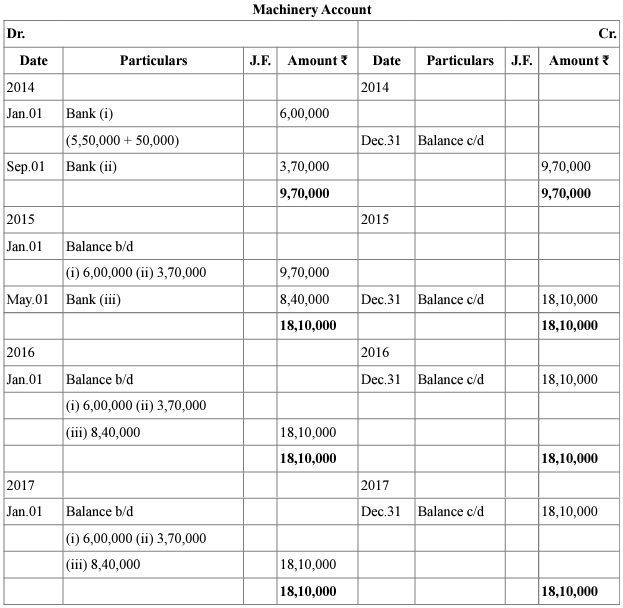
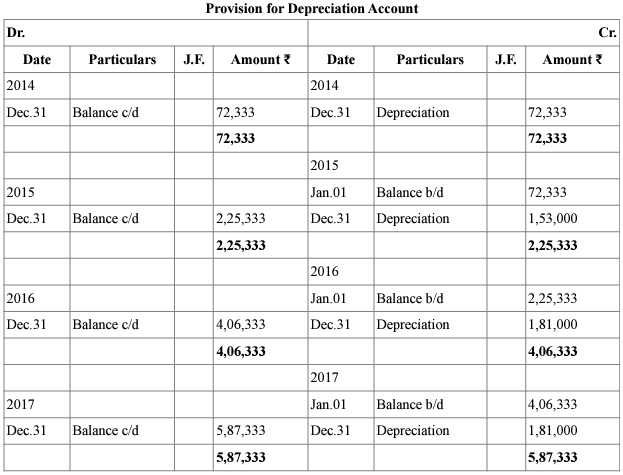
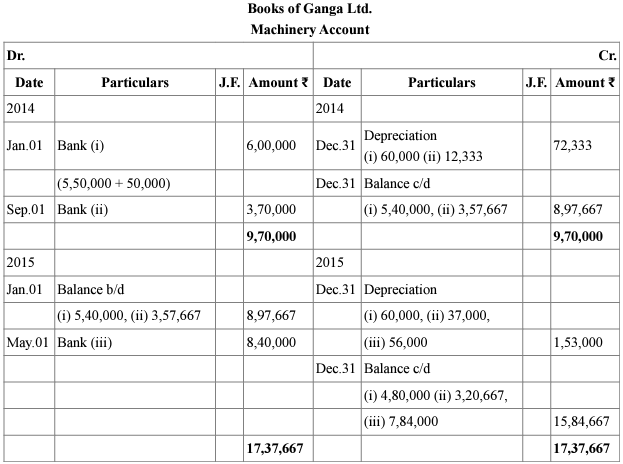
Ganga Ltd. purchased a machinery on January 01,2014 for ₹ $5,50,000$ and spent ₹ 50,000 on its installation. On September 01, 2014 it purchased another machine for ₹ $3,70,000$. On May 01,2015 it purchased another machine for $₹ 8,40,000$ (including installation expenses). Depreciation was provided on machinery @10\% p.a. on original cost method annually on December 31. Prepare:
i. Machinery account and depreciation account for the years 2014, 2015, 2016 and 2017.
ii. If depreciation is accumulated in provision for Depreciation account then prepare machine account and provision for depreciation account for the years 2014, 2015,2016 and 2017.
View full question & answer
Question 26 Marks
On 1st January 2011, Hari Om purchased 6 machines @ Rs 15,000 each. His accounting year ends on 31 st December. Depreciation at the rate of $10 \%$ on the original cost was to be charged.
On 1st January 2012, one machine was sold for Rs 12,500 and on 1st January 2013, a second machine was sold for Rs 12,500 . An improved model which cost Rs 28,000 was purchase on 1st July 2012. Show Machine account till 2013.
View full question & answer
Question 36 Marks
Rectify the following errors:
i. Goods for ₹ 5,500 were purchased from Royal Traders on credit, but no entry has yet been passed.
ii. Purchase Return for ₹ 1,500 not recorded in the books.
iii. Goods for ₹ 2,000 sold to Sita Traders on Credit were entered in the sales book as ₹ 200 only.
iv. Goods of the value of ₹ 1,800 returned by Suraj & Co. were included in stock, but no entry was passed in the books.
v. Goods purchased for ₹ 900 , entered in the purchases book as ₹ 9,000
vi. An invoice for goods sold to X was overcast by ₹ 100
View full question & answer
Question 46 Marks
During the course of an accounting year, an Accountant found a difference in the trial balance. He puts this difference in a newly opened suspense account. Subsequently, he located the following errors in his books of account:
i. Goods purchased from Satyam for ₹ 10,000 , but entered in the sales book.
ii. Received a bill receivable for ₹ 18,000 from Gopal, but recorded in bills payable book.
iii. An item of ₹ 4,000 in respect of purchases returns, wrongly debited to purchases account.
iv. An item of ₹ 2,000 relating to the pre-paid salary account omitted to be brought forward.
v. Paid ₹ 1,000 on account of repair of furniture, but wrongly debited to furniture account.
Pass journal entries to rectify the above-mentioned errors and prepare suspense account assuming that no error remained undetected.
View full question & answer
Question 56 Marks
Journalise the following transactions of Ram, Delhi :

2018


Rs.

Jan-01

Ram commenced business with cash

30,000

Jan-02

Opened a bank account with Union Bank by cheque from savings account

21,000

Jan-03

Purchased goods from Rahul in Cash

10,000

Jan-07

Withdrew cash from bank for office use

3,000

Jan-10

Sold goods to Hari, Delhi on credit

5,000

Jan-15

Purchased goods from Shyam, Meerut (UP)

15,000

Jan-20

Cash sales

3,000

Jan-25

Paid to Shyam

14,750


Discount Received

250

Jan-31

Paid Salaries

10,000

CGST and SGST is levied @ $6 \%$ each on intra-state sale and purchase. IGST is levied @ $12 \%$ on inter-state sale and purchase.

View full question & answer
Question 66 Marks
The following balances appeared in the books of Sumit Stores on 1st April, 2023: Assets: Cash ₹ 15,000 ; Bank balance ₹ 5,000 ; Stock ₹ 40,000; Furniture ₹ 3,600 ; Debtors ₹ 24,000 ( X ₹ 6,000 ; Y ₹ 8,000 and Z ₹ 10,000 ).
Liabilities Bank Loan ₹ 10,000 ; Creditors ₹ 12,500 (Ajit ₹ 5,000 , Vinay ₹ 7,500 ). Following transactions took place during April 2023:

April
2

Bought goods from Karim for ₹ 20,000 at a trade discount of 10% and
cash discount of 2%. Paid 60% amount immediately

April
4

Sold goods to X for ₹ 9,000.

April
5

Received ₹ 14,800 from X in full settlement of his account.

April
6

Cash deposited into bank ₹ 10,000.

April
8

Cheque received from Y for ₹ 7,850 in full settlement of his account. This
cheque was immediately deposited into bank.

April
10

Received a cheque from Z ₹ 2,000.

April
12

Cheque received from Z deposited into bank.

April
15

Cheque received from Y dishonoured.

April
16

Cash sales ₹ 15,000; Out of this amount ₹ 12,000 deposited into bank.

April
16

Amount due to Ajit paid by Cheque.

April
18

Old newspapers sold ₹ 50.

April
18

Old furniture sold ₹ 750.

April
20

Z became insolvent and 40 paise in a rupee could be received from his

April
22

Purchased goods from Govind and paid by cheque ₹ 8,000.

April
24

Sold half of the above goods to Chandu at a profit of 30% on cost.

April
25

Proprietor withdrew for private use ₹ 2,000 from office and ₹ 3,000 from
the bank.

April
30

Paid salary to Moti by Cheque ₹ 2,000.

April
30

Paid Rent by cheque ₹ 1,500.

April
30

Paid trade expenses ₹ 500.

View full question & answer