Questions

3 Marks Question

🎯

Test yourself on this topic

19 questions · timed · auto-graded

Question 13 Marks
It is right on moral grounds to give some special incentives to small scale industries. Do you agree? Justify your answer.
Answer
Yes, I agree. There are many problems with SSIs.Major problems faced by the small scale industries are:
  1. Finance.
  2. Raw Material.
  3. Idle Capacity.
  4. Technology.
  5. Marketing.
  6. Infrastructure.
  7. Under Utilization of Capacity.
  8. Project Planning.
Small scale industries play a vital role in the economic development of our country. This sector can stimulate economic activity and is entrusted with the responsibility of realizing various objectives, i.e., generation of more employment opportunities with less investment, reducing regional imbalances etc. Small scale industries are not in a position to play their role effectively due to various constraints. If government provides certain incentives in the form of incentives on land, power, tax holiday etc, it can grow well and can be able to compete with large scale enterprises.
View full question & answer
Question 23 Marks
What role does SIDBI play in promoting SSIs?
Answer
Following points will help in revealing the role of SIDBI in context of promotion of SSIs:
  1. It initiates steps for technololgy adoption, io technology exchange, transfer, upgradation and modernisation of existing units.
  2. It participates in the equity, type of loans on soft terms, term loan, etc.
  3. It facilitates timely flow of credit for both term loans and working capital to SSI, in collaboration with commercial banks.
  4. It enlarges marketing capabilities of the products of SSIs in both domestic and international markets.
  5. It directly discounts and rediscounts bills with a view to encourage bills culture and helping the SSI units to realise their sale proceeds of capital goods/ equipments and components, etc.
  6. It promotes employment oriented industries especially in semi-urban areas to create more employment.
View full question & answer
Question 33 Marks
Identify any six major industries that are grouped in the small scale sector of India.
Answer
Six major industries are as follows:
  1. Food product.
  2. Chemical and chemical products.
  3. Leather and leather products.
  4. Hosiery and garments.
  5. Repair services.
  6. Beverages, tobacco and tobacco products.
View full question & answer
Question 43 Marks
Small Scale Industries are widespread in the country. Give some examples of SSIS operational in different parts of the country.
Answer
Examples of Small Scale Industries (SSIs) operational in different parts of the country are as follows:
  1. Hosiery factories in Ludhiana.
  2. Scientific instrument making factories in Ambala.
  3. Carpet making factories in Panipat.
  4. Radio and TV, manufacturing factories in Delhi.
View full question & answer
Question 53 Marks
Which industries are classified as Small Scale Industries? Also give the main features of these industries.
Answer
Small scale industries are those industries in which investment in plant and machinery does not exceed ₹ 5 crore.The main features of Small Scale Industries are:
  1. Labour is kept on wages. Unlike cottage industries, where owners work themselves, in SSIs owners employ workers, who work for them.
  2. Machines are used.
  3. Machines are run on electricity.
View full question & answer
Question 63 Marks
Write a short note on WASME.
Answer
World Association for Small and Medium Enterprises (WASME) is a global non governmental organization headquartered at Noida, India. It has been spearheading the cause and development of Small and Medium Enterprises (SMEs) world over since its inception in 1980. It has emerged, over the years, as one of the most representative, effective and leading international organizations, working towards the promotion of SMEs. The vision behind establishment of WASME was to build a world private community of small business, their supporting and financial institutions as a non-governmental organization, not influenced by any government(s). WASME has members, associates and network partners in different countries across the world. It enjoys consultative/ observer status with concerned agencies in UN system such as ECOSOC, UNCTAD, WIPO, UNIDO, UNICITRAL, UNESCAP, ITC and ILO. It also cooperates actively with several intergovernmental and international organizations such as WCO, OECD, ICSB, APCTT, etc.
View full question & answer
Question 73 Marks
What are intellectual property rights?
Answer
Intellectual property rights are the rights given to persons over the creations of their minds. They usually give the creator an exclusive right over the use of his/her creation for a certain period of time.Intellectual property rights are customarily divided into two main areas:
  1. Copyright and rights related to copyright: The rights of authors of literary and artistic works (such as books and other writings, musical compositions, paintings, sculpture, computer programs and films) are protected by copyright, for a minimum period of 50 years after the death of the author.
Also protected through copyright and related (sometimes referred to as "neighbouring") rights are the rights of performers (e.g. actors, singers and musicians), producers of phonograms (sound recordings) and broadcasting organizations. The main social purpose of protection of copyright and related rights is to encourage and reward creative work.
  1. Industrial property: Industrial property can usefully be divided into two main areas: One area can be characterized as the protection of distinctive signs, in particular trademarks (which distinguish the goods or services of one undertaking from those of other undertakings) and geographical indications (which identify a good as originating in a place where a given characteristic of the good is essentially attributable to its geographical origin).
View full question & answer
Question 83 Marks
What is the definition used by Government of India for Small Scale Industries?
Answer
The definition used by the Government of India to describe small industries is based on the investment in plant and machinery.
Industries where the amount invested in the fixed assets (particularly plant and machinery) is less than Rs. 1 crore are regarded as small-scale industries.
However, export-oriented units that use modern production techniques are considered as small-scale industries if their investment does not exceed Rs. 5 crore.
View full question & answer
Question 93 Marks
Explain the concept of entrepreneurship development.
Answer
Entrepreneurship development refers to the process of enhancing entrepreneurial skills and knowledge through structured training and institution building programmes. It focuses on individual who wishes to start or expand a business. The whole point of entrepreneurship development is to increase number of entrepreneurs and to create entrepreneurship culture within society. One trained entrepreneur can guide other on how to start their own enterprises. Now-a-days it is treated as an important tool of industrialisation and a solution of unemployment in country.
View full question & answer
Question 103 Marks
Why is there more scope for small scale industries in developing countries like India?
Answer
Developing countries face the shortage of finance and there is an abundance of labour. Small scale industries prefer techniques of production which require less finance and more labour. Thus, there is more scope for small scale industries in India and the government is also doing favours for such industries.
View full question & answer
Question 113 Marks
Classify, on the basis of size, the business enterprises.
Answer
On the basis of size, business enterprises in manufacturing sector can be classified as:
  1. Small Scale Industries: It means those industrial units whose investment in plant and machinery does not exceed ₹ 5 crore.
  2. Medium Scale Industries: It means those industrial units whose investment in plant and machinery is more than ₹ 5 crore, but does not exceed ₹ 10 crore.
  3. Large Scale Industries: It means those industrial units whose investment in plant and machinery is more than ₹ 10 crore.
View full question & answer
Question 123 Marks
What is the eligibility for startups?
Answer
To become eligible as a startup, the entity should be the one which aims to develop and commercialise, a new product or service or process or a significantly improved existing product or service or process that will create or add value for customers or workflow.Products, services or process, which do not have potential for commercialisation or is undifferentiated or have no or limited incremental value will not be considered under the Scheme. To be considered as eligible as startup the entity, should be supported by a recommendation (with regard to innovative nature of business), in a format specified by DIPP, from an Incubator established in a post-graduate college in India. An incubator, which is funded (in relation to the project) from Gol as part of any specified scheme to promote innovation a recommendation (with regard to innovative nature of business), in a format specified by DIPP, from an Incubator recognized by Gol or be funded by an Incubation Fund Angel Fund Private Equity Fund/ Accelerator/ Angel Network duly registered with SEBI that endorses innovative nature of the business or be funded by Government of India as part of any specified scheme to promote innovation or have a patent granted by the Indian Patent and Trademark Office in areas affiliated with the nature of business being promoted.
View full question & answer
Question 133 Marks
Explain the areas where small businesses feel threatened from global competition.
Answer
Given below are the areas where small businesses feel threatened from global competition:
  1. It is difficult to maintain quality standards, technological skills, financial credit worthiness, managerial and marketing capabilities of the large industries and MNCs.
  2. They have to face competition from giant sized MNCs along with medium and large scale enterprises. It brings cut throat competition for them.
  3. There is limited access to markets of developed countries because of stringent requirements of quality certification like ISO : 9000 etc.
View full question & answer
Question 143 Marks
Which business units are constituted under the tiny sector? This sector enjoys state patronage bilelaager in which areas?
Answer
Only those business enterprises are constituted under the tiny sector whose investment in plant and bo to me machinery is presently upto ₹ 25 lakh, but it is to be raised further shortly. This sector enjoys state patronage continuously in the form of:
  1. Land allotment.
  2. Electricity connection.
  3. Technology upgradation.
  4. Monetary help from financial institutions.
  5. Getting priority in the list of government purchases orders.
View full question & answer
Question 153 Marks
What is the purpose of NABARD?
Answer
The main functions of NABARD pertain to policy development, coordination, research, training, etc., relating to rural credit. It provides refinance to cooperatives, regional rural banks, etc. Moreover it makes loans and advances to state governments for a period not exceeding more than 20 years to enable them to subscribe directly or indirectly to share the capital of cooperative credit societies. It also promotes research in agriculture and rural development through its research and development fund. It undertakes inspection of co-operative banks and RRBs and advises the government on related matters.
NABARD undertakes monitoring and evolution of the projects financed by it. The NABARD maintains two funds: The National Rural Credit Fund (long-term operations) and the National Rural Credit Fund (Stabilization).
The central and state governments contribute to the fund. The NABARD operates throughout the country through its 16 regional offices located in the capitals of all the major states and 3 sub offices, the paid-up capital of NABARD stood at ₹ 2000 crore as on March 31, 2010. The profit after tax amounted to ₹ 1558 crore during the year 2009-10 as against ₹ 1390 crore during the year 2008-09.
NABARD had a paid-up share capital of ₹ 100 crore, since this has been raised through stages to ₹ 5,000 crore. The NABARD is empowered to borrow from central government.
It is also permitted to borrow foreign currency. It can also borrow long-term loans from any other authority or organisation or institution approved by the Board. It is empowered to issue bonds, debentures and other financial instruments.
View full question & answer
Question 163 Marks
Small scale industrial units can be of different forms. State them.
Answer
The different forms of small scale industrial units are as follows:
  1. Tiny units.
  2. Ancillary units.
  3. Micro-business units.
  4. Small scale units owned and managed by women entrepreneurs.
  5. Export-oriented units.
  6. Cottage and rural units.
View full question & answer
Question 173 Marks
Explain the meaning of small scale industry with its different categories.
Answer
In Indian economy small-scale and cottage industries occupy an important place, because of their employment potential and their contribution to total industrial output and exports. Government of India has taken a number of steps to promote them. However, with the recent measures, small-scale and cottage industries facing both internal competition as well as external competition. There is no clear distinction between small-scale and cottage industries. However it is generally believed that cottage industry is one which is carried on wholly or primarily with the help of the members of the family. As against this, small-scale industry employs hired labour. Moreover industries are generally associated with agriculture and provide subsidiary employment in rural areas. As against this, small scale units are mainly located in urban areas as separate establishments. Definition: Small scale industry is defined as a unit in which investment in original value of plant and machinery should not exceed ₹ 1.5 crore. However, to facilitate technology upgradation and enhance competitiveness, the investment limit has been raised to ₹ 5 crore in respect of 71 high tech export oriented items in drugs, pharmaceuticals, hand-tools and knitwear sectors, etc.Different categories include:
  1. Micro and tiny industries.
  2. Women enterprises.
  3. Cottage industries.
  4. Village industries.
View full question & answer
Question 183 Marks
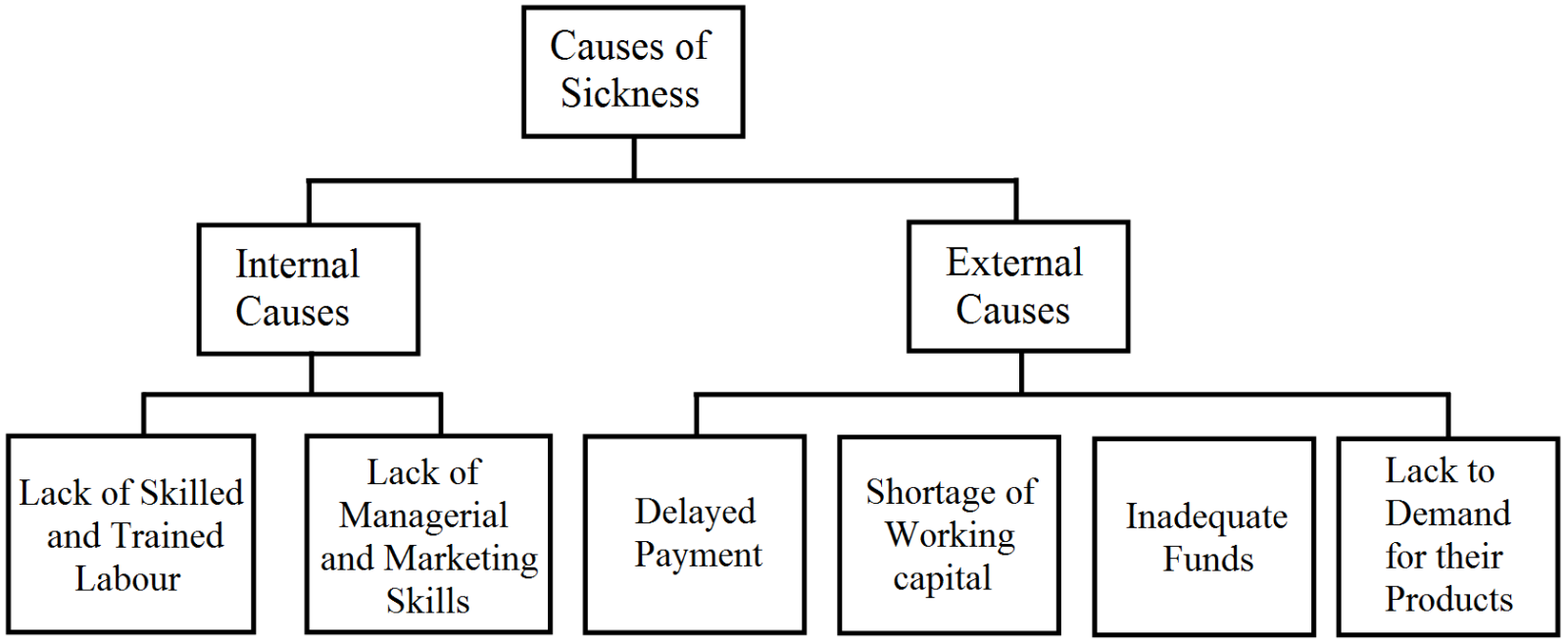
What are the causes of sickness in small industries?
Answer
Causes of sickness in SSIs can be classified into internal as well as external categories.
View full question & answer
Question 193 Marks
Which industries are classified as Small Scale Industries? Also give the main features of these industries.
Answer
Small scale industries are those industries in which investment in plant and machinery does not exceed ₹ 5 crore.The main features of Small Scale Industries are:
  1. Labour is kept on wages. Unlike cottage industries, where owners work themselves, in SSIs owners employ workers, who work for them.
  2. Machines are used.
  3. Machines are run on electricity.
View full question & answer
3 Marks Question - Business Studies STD 11 Commerce Questions - Vidyadip