Questions

3 Marks Question

🎯

Test yourself on this topic

10 questions · timed · auto-graded

Question 13 Marks
Given below is a cost and revenue schedule of a producer. At what level of output is the producer in equilibrium? Give reasons for your answer.
Output (Units)Total Revenue (₹)Marginal Cost (₹)
11514
21624
31730
41851
51975
Answer
The producer is in equilibrium when 4 units of output are produced. It is here that the difference between TR and TC is maximum, along with the fact that MR = MC, and MC is rising
View full question & answer
Question 23 Marks
Find producer's equilibrium from the following table given below:
Output (Units)Total Revenue (₹)Marginal Cost (₹)
1915
2188
3279
43610
54511
Answer
Producer is in equilibrium when 3 units of output are produced, as it is here that MR = MC, and MC is rising
View full question & answer
Question 33 Marks
Complete the following table:
Output (Units)Total Revenue (₹)Marginal Cost (₹)
11415
23012
3449
4485
5526
Answer
Profit is maximum when output level=3 units are produced, as it is here that the difference between TR and TVC is maximised. TVC = ΣΜC
View full question & answer
Question 43 Marks
Complete the following table:
Output (Units)Total Revenue (₹)Total Cost (₹)Profit (₹)
168-
2-9- 1
310-0
41211-
5148-
Answer
TR: 6, 8, 10, 12, 14; TC: 8, 9, 10, 11, 8; Profit: -2, -1, 0, 1, 6
View full question & answer
Question 53 Marks
Calculate the profit from the following:
Output (Units)Total Revenue (₹)Total Cost (₹)
178
2510
3412
4215
5116
Answer
Profit = 1, 2, 4, 3, 3
View full question & answer
Question 63 Marks
Find out profit of the producer, when total revenue is ₹ 400, total variable cost is ₹ 270, average fixed cost is ₹ 25 per unit and 4 units of output are produced.
Answer
Profit ₹ 30
View full question & answer
Question 73 Marks
Using your judgement as an entrepreneur, would you agree with the following statement?
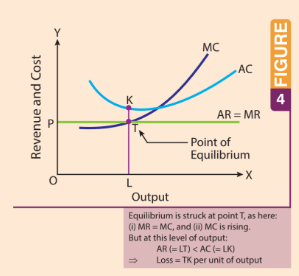
"Maximisation of profit implies equilibrium, but equilibrium does not always imply maximisation of profit."
Answer

Image
Yes, we do agree with the statement that maximisation of profit implies equilibrium, but equilibrium does not always imply maximisation of profit. Profit is maximised when the difference between total revenue and total cost is maximum. But equilibrium can be struck even in the state of losses, when the two conditions are satisfied, ie, (i) MR=MC and
(ii) MC is rising.
View full question & answer
Question 83 Marks
Imagine yourself a producer (in a perfectly competitive market structure), focusing on profit maximisation. Will you prefer striking an equilibrium in a state of increasing returns?
Answer
Striking an equilibrium in a state of increasing returns to a factor (when MP is rising or MC is falling) is absolutely ruled out. Because it is a situation when every additional unit of output adds more and more to total profits. Reason: While MR is constant (under perfect competition) MC is falling (owing to increasing returns), so that the difference between MR and MC tends to rise. It is only when the difference (MR-MC) starts shrinking, and is finally eliminated, that the profits are maximised. This happens only in a state of diminishing returns when MP is falling or MC is rising.
View full question & answer
Question 93 Marks
Do you think it is rational for a producer to strike equilibrium when MC is rising, not when it is falling?
Answer
Yes, it is rational for a producer to strike equilibrium when MC is rising, not when it is falling. When MC is falling, cost of producing an additional unit tends to fall. Other things remaining constant, it would lead to a rise in total profits. Why should a producer stop production when total profits are rising? It would not be a rational decision. The equilibrium will, therefore, be struck only when MC is rising, and is equal to MR.
View full question & answer
Question 103 Marks
As a producer, how would you adjust your level of output when MR and MC are not equal? Assume that, price of your product is constant for you, and the law of variable proportions is operative.
Answer
Constant price means, AR is constant. If AR is constant, AR=MR. Both AR and MR are, therefore, indicated by a horizontal straight line, parallel to X-axis. When the law of variable proportions is operative, MC curve tends to be U-shaped: MC tends to decline corresponding to increasing returns, and it tends to rise corresponding to diminishing returns.
I will strike my equilibrium at a point when:
  (i) MR=MC, and (ii) MC is rising.
I may face two situations:
(i) MR > MC, and (ii) MR < MC.
How will I adjust my output?
For me, MR is constant in both the situations. So that the equality between MR and MC will be achieved only through changes in MC.
In situation 1, when MR > MC:
I would like to increase the level of output. This would cause increase in MC. The process of increasing output is to be continued till MR = MC.
In situation 2, when MR < MC:
I would like to decrease the level of output. This would cause decrease in MC. The process of decreasing output is to be continued till MR = MC.
View full question & answer
3 Marks Question - Economics STD 11 Commerce Questions - Vidyadip