Question 14 Marks
Given the price of a good, how will a consumer decide as to how much quantity to buy of that good? Explain.
Answer
View full question & answer→Given the price of a good, a consumer decided how much quantity of that good to buy, on the basis of the following conditions
$\text { MUM }=\text { Price, i.e. } \frac{M U_x}{M U_M}$
A consumer is in a state of equilibrium when he maximizes his satisfaction by spending his given income on different goods and services. Any deviation or change in the allocation of income under the given circumstance will lead to a fall in total satisfaction. For one-commodity case: Rupee worth of satisfaction actually received by the consumer is equal to the marginal utility of money as specified by the consumer himself. Condition 1 : $MU ($ of good X $)= MU$ (of money) OR , PRICE (of good X $)= MU$ (of money) Reason: Price paid by the consumers should be exactly equal to the money value of MU that he derives. In case $P ($ of X $)$ is lesser than the MU (of money), he should be prompted to buy more of good X. Higher consumption will lead to a fall in MU. The consumption of good X would stop only when $P ($ of good X $)$ will be equal to $MU ( in$ terms of money). Likewise, if $P ($ of X $)$ is greater than MU (in terms of money), the consumer will be prompted to buy less of good X , leading to a fall in MU.
Condition 2: Marginal utility of money remains constant.
Condition 3: Law of marginal utility holds good.
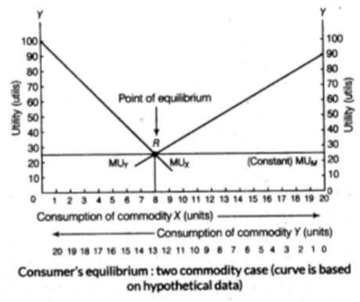
For two-commodity case: Rupee worth of marginal utility of money should be the same across good X and good Y, and equal to the marginal utility of money.
Reason: In case rupee worth of satisfaction (MU of good X/ price of good X) is greater for good X than good Y, the consumer will be prompted to buy more of good X and less of good Y. This would lead to a fall in the marginal utility of good X and a rise in the marginal utility of good Y. This process would continue till MU(of good X)/ Price of good X = MU(OF GOOD Y)/ Price of good Y = MU(of money). In case rupee worth of satisfaction (MU of good Y/ price of good Y) is greater for good Y than good X, the consumer will be prompted to buy more of good Y and less of good X. This would lead to a fall in the marginal utility of good Y and a rise in the marginal utility of good X.
$\text { MUM }=\text { Price, i.e. } \frac{M U_x}{M U_M}$
A consumer is in a state of equilibrium when he maximizes his satisfaction by spending his given income on different goods and services. Any deviation or change in the allocation of income under the given circumstance will lead to a fall in total satisfaction. For one-commodity case: Rupee worth of satisfaction actually received by the consumer is equal to the marginal utility of money as specified by the consumer himself. Condition 1 : $MU ($ of good X $)= MU$ (of money) OR , PRICE (of good X $)= MU$ (of money) Reason: Price paid by the consumers should be exactly equal to the money value of MU that he derives. In case $P ($ of X $)$ is lesser than the MU (of money), he should be prompted to buy more of good X. Higher consumption will lead to a fall in MU. The consumption of good X would stop only when $P ($ of good X $)$ will be equal to $MU ( in$ terms of money). Likewise, if $P ($ of X $)$ is greater than MU (in terms of money), the consumer will be prompted to buy less of good X , leading to a fall in MU.
Condition 2: Marginal utility of money remains constant.
Condition 3: Law of marginal utility holds good.
For two-commodity case: Rupee worth of marginal utility of money should be the same across good X and good Y, and equal to the marginal utility of money.
Reason: In case rupee worth of satisfaction (MU of good X/ price of good X) is greater for good X than good Y, the consumer will be prompted to buy more of good X and less of good Y. This would lead to a fall in the marginal utility of good X and a rise in the marginal utility of good Y. This process would continue till MU(of good X)/ Price of good X = MU(OF GOOD Y)/ Price of good Y = MU(of money). In case rupee worth of satisfaction (MU of good Y/ price of good Y) is greater for good Y than good X, the consumer will be prompted to buy more of good Y and less of good X. This would lead to a fall in the marginal utility of good Y and a rise in the marginal utility of good X.