Question 13 Marks
How is the optimal amount of labour determined in a perfectly competitive market?
Answer
View full question & answer→A profit maximising firm will employ labour up to the point where the extra cost incurred by employing the last unit of labour (wage) equals the additional benefit it earns by employing that unit of labour. In other words, The perfectly competitive firm’s profitmaximizing labour-demand decision is to hire workers up to the point where the marginal revenue product of the last worker hired is just equal to the market wage rate, which is the marginal cost of this last worker.
That is, the Marginal cost of labour = Marginal benefit by labour
Or, Wage rate $=$ Marginal Revenue Product
Or, w = MQP
Or, $w = MR \times MP _{ L }\left(\right.$ as $\left.MRPL = MR \times MP _{ L }\right)$
Or, w $= P \times MP _{ L }$ (in Perfect Competition Price $= MR$ )
Or, $w= VMP _{ L }$ (because $VMP _{ L }= P \times MP _{ L }$ )
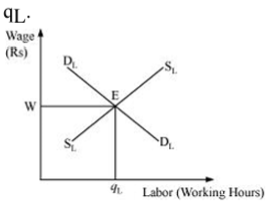
The demand for labour is derived from $VMP _{ L }$ and the supply of labour is positively sloped. The equilibrium exists at E, where the demand for labour and the supply of labour intersect each other. The equilibrium wage rate is w and the optimal amount of labour is
That is, the Marginal cost of labour = Marginal benefit by labour
Or, Wage rate $=$ Marginal Revenue Product
Or, w = MQP
Or, $w = MR \times MP _{ L }\left(\right.$ as $\left.MRPL = MR \times MP _{ L }\right)$
Or, w $= P \times MP _{ L }$ (in Perfect Competition Price $= MR$ )
Or, $w= VMP _{ L }$ (because $VMP _{ L }= P \times MP _{ L }$ )
The demand for labour is derived from $VMP _{ L }$ and the supply of labour is positively sloped. The equilibrium exists at E, where the demand for labour and the supply of labour intersect each other. The equilibrium wage rate is w and the optimal amount of labour is