Questions

4 Marks Question

🎯

Test yourself on this topic

4 questions · timed · auto-graded

Question 14 Marks
Discuss briefly the various sources of data.
Answer
There are two sources of Collection of data:
i. Primary source: Primary source of data implies Collection of data from its source of origin. It offers you first hand quantitative information relating to your statistical study.
ii. Secondary Source: It implies Collection of data from some agency or institution which already happens to have collected the data through statistical survey. It does not offer you first hand information relating to your statistical study. You are to rely on the information which is already existing.
View full question & answer
Question 24 Marks
In a trip, organised by a college, there were 80 people, each of whom paid Rs. 15.50 on an average. There were 60 students, each of whom paid Rs. 16. Members of teaching staff were charged at a higher rate, the number of servants (all males) were 6 and they were not charged anything. The number of females were 20% of the total and there was only one female staff member. Tabulate this information.
Answer
From the information given in the question, we have
Total participants $=80$
Number of students $=60$
Number of servants $=6$
$\therefore$ Number of teaching staff $=80-(60+6)=14$
It is given that the number of female teaching staff $=1$
$\therefore$ Number of male teaching staff $=14-1=13$
It is also given that the number of females is $20 \%$ of the total.
Therefore, total number of females $=80 \times 20 \%=\frac{30 \times 3}{100}=16$.
Number of female students $=16-1=15$ (since no. of female teaching staff is 1 , we deduct that from the total no. of females to get the no. of female students).
Total contribution $=80 \times 15.50=$ Rs. 1240
Contribution from students $=60 \times 16=$ Rs. 960
Contribution from teaching staff $=1240-960=$ Rs. 280
$\therefore$ Contribution per head from teaching staff $=\frac{290}{14}=$ Rs. 20
Now, this information can be tabulated as below
ParticipantsSexTotalContribution Per HeadTotal contribution
MalesFemales
Students45156016960
Teaching Staff1311420280
Servants6-6--
Total64168015.501240
View full question & answer
Question 34 Marks
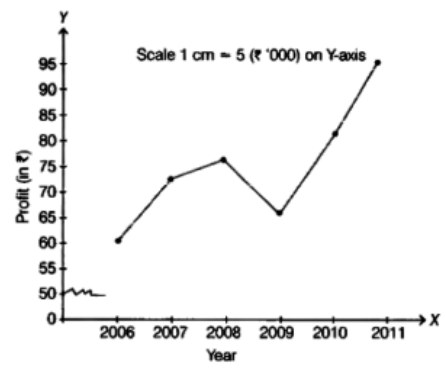
Show the annual profit figures of a firm with the help of a time series graph.
YearProfit (in Rs. '000)
200660
200772
200875
200965
201080
201195
View full question & answer
Question 44 Marks
Differentiate between spatial and chronological classification with example.
Answer
Spatial Classification: In spatial classification, data are classified according to geographical areas."
Example: State wise classification of production of food grains in India: State Production of food grains (in tonnes)
StateProduction of food grains (in tons)
Orissa
A. P
U. P
Assam
3,00,000
2,50,000
22,00,000
1,00,00,000
(ii) Chronological classification.
In this type of classification, the data are classified according to different time periods.
Example: Population of India for different time periods.
Profits of a business establishment over different years.
YearPopulation (in crores)
1921
1931
1941
1951 
24.8
27.3
31.8
35.6
View full question & answer
4 Marks Question - Economics STD 11 Commerce Questions - Vidyadip