Questions

6 Marks Question

🎯

Test yourself on this topic

32 questions · timed · auto-graded

Question 16 Marks
Elaborate three main features of monopolistic competition form of market.
Answer
The three features of monopolistic competition are:
  1. Large number of buyers and sellers: There are large number of firms selling closely related, but not homogeneous products. Each firm has a limited share/ limited control over market. Large number of firms lead to competition in the market. There are large number of buyers who have choices to buy from a variety of goods.
  2. Free entry and exit of firms: Under monopolistic competition, firms are free to enter into or exit from the industry at any time they wish. It ensures that there are neither abnormal profits nor abnormal losses to a firm in the long run. However, it must be noted that under monopolistic competition is not as easy and free as under perfect competition.
  3. Product differentiation: Product differentiation in monopolistic competition implies that buyers treat products of various firms as different. This is because the products are similar and not the same. As a result, the buyers are willing to pay different prices for the products of different firms. Actually, it is the product differentiation which gives power to an individual firm to influence the market price on its own.
View full question & answer
Question 26 Marks
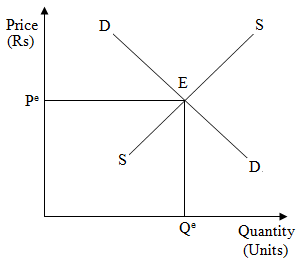
If the monopolist firm of Exercise $3$, was a public sector firm. The government set a rule for its manager to accept the goverment fixed price as given (i.e. to be a price taker and therefore behave as a firm in a perfectly competitive market), and the government decide to set the price so that demand and supply in the market are equal. What would be the equilibrium price, quantity and profit in this case?
Answer
If the government sets a rule for the public sector firm to accept the fixed price, then, the monopoly firm will have to behave like a perfectly competitive firm and will be a price taker. In this case, the price fixed $(P^e)$ as set by the government, will equate the demand and the supply, which will determine the equilibrium point ‘E’. At the price $P^e$^, the firm earns normal profit, i.e. zero economic profit.
Equilibrium price $= P^e$​​​​​​​^ (fixed by the government) Equilibrium quantity $= Q^e $Profit = Normal profit.
View full question & answer
Question 36 Marks
Elaborate three main features of monopoly form of market.
Answer
Features of monopoly form of market:
  1. Single seller: There is a single producer of a commodity therefore the difference between firm and industry disappears. The firm has full control over supply of the commodity.
  2. No close substitutes: The product offered by a monopolist has no close substitute. So, the monopoly firm has no fear of competition from new or existing rivals.
  3. Restriction on entry: There exist strong barriers to entry of new firm under monopoly. As a result, a monopoly firm can manipulate the market and earn abnormal profits in the long run too.
View full question & answer
Question 46 Marks
Compare between perfect competition and monopoly.
Answer
S. No
Basis
Perfect Competition
Monopoly
1.
Meaning
It refers to a market situation where there are very large number of buyers and sellers dealing in a homogeneous product at a price fixed by the market.
Monopoly refers to a market situation where there is a single seller selling a product which has no close substitutes.
2.
Number of Sellers
There are very large number of sellers and no individual seller has control over activities of other firms.
There is a single seller and the monopolist has full control over the supply.
3.
Nature of Product
The products sold are homogeneous. So, buyers are willing to pay the same price for all products, which leads to uniform price in the market.
There are no close substitutes of the product. So, there is no competition from new and existing products.
4.
Entry and Exit
Any firm can freely enter or exit from this kind of market. It leads to absence of abnormal profits and abnormal losses in the long run.
There is restriction on entry and exit. So, a firm can earn abnormal profits in the long run.
5.
Price Maker/ Taker
In perfect competition, industry is price maker, firm is price taker because of homogeneous goods.
Monopolist is a price-maker as firm and industry are one and the same thing.
6.
Level of Knowledge
Buyers and sellers have perfect knowledge about market conditions.
Sellers and buyers do not have perfect knowledge.
7.
Demand Curve
Demand curve is perfectly elastic as price remains the same at all levels of output.
Demand curve slopes downwards as more output can be sold only at less price.
8.
Selling Cost
No selling costs are incurred as buyers and sellers have perfect knowledge about market conditions.
Selling costs are incurred for informative purposes due to lack of perfect knowledge.
View full question & answer
Question 56 Marks
Compare between monopoly and monopolistic competition.
Answer
S. No
Basis
Monopoly
Monopolistic Competition
1.
Meaning
Monopoly refers to a market situation where there is a single seller selling a product which has no close substitutes.
Monopolistic Competition refers to a market situation in which there are large number of firms selling closely related but differentiated products.
2.
Number of Sellers
There is a single seller and the monopolist has full control over the supply.
There are large number of sellers. So, a firm does not have much impact on activities of other firms.
3.
Nature of Product
There are no close substitutes of the product. So, there is no competition from new and existing products.
Products are differentiated on the basis of brand, size, colour, shape etc. So, a firm is in a position to influence the price.
4.
Entry or Exit
There is restriction on entry and exit. So, a firm can earn abnormal profits in the long run.
Although there is freedom of entry and exit but it is possible only for a competitive firm to enter or leave the industry.
5.
Price
Monopolist is a price-maker as firm and industry are one and the same thing.
Firm is neither a price-taker nor a price maker but has partial control over price due to product differentiation.
6.
Demand Curve
Downward sloping demand curve is less elastic due to absence of close substitutes.
Downward sloping demand curve is more elastic due to presence of close substitutes.
7.
Selling Cost
Low selling costs are incurred.
Heavy selling costs are incurred on sales promotion.
View full question & answer
Question 66 Marks
Distinguish between perfect competition and monopolistic competition on the basis of following:
  1. Number of sellers.
  2. Nature of product.
  3. Selling cost.
Answer
Distinction between Perfect Competition and Monopolistic Competition
  1. Number of sellers: Perfect competition and monopolistic competition, both the markets consists of large number of sellers but there is lesser number of sellers in monopolistic competition as compared to the number of sellers in perfect competition.
  2. Nature of product: Under perfect competition product is homogeneous. Whereas In monopolistic competition products are differentiated on the basis of brand, size, colour etc.
  3. Selling cost: Under perfect competition, products are homogeneous in nature therefore there is no selling cost required whereas under monopolistic competition, products are differentiated. Therefore, huge selling costs are required to be incurred to attract consumers.
View full question & answer
Question 76 Marks
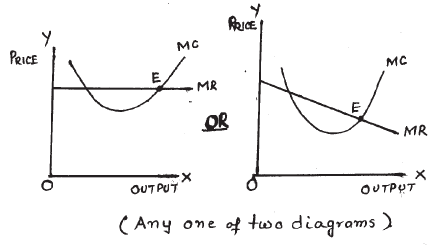
What is producer's equilibrium? Explain the conditions of producer's equilibrium through the 'marginal cost and marginal revenue' approach. Use diagram.
Answer
Producer’s equilibrium refers to that price and output combination which brings the producer maximum profit.
Equilibrium Conditions (Statements):
  1. MC=MR at point E.
  2. MC>MR after equilibrium i.e. after point E.
Equilibrium Conditions (Explanation):
So long as MR is greater than MC, the producer continues to produce because every new unit produced adds to profits. As he continues to produce, at some level of output MR becomes equal to MC. This maximises profits. After MC=MR level, if MC is greater than MR, every new unit produced is sold at a loss. So, he will not produce more units.
View full question & answer
Question 86 Marks
  1. Define price elasticity of demand.
  2. If the price of a commodity rises by 40% and its quantity demanded falls from 150 units to 120 units, calculate coefficient of price elasticity of demand for the commodity.
Answer
  1. Price elasticity of demand is the measure of the degree of responsiveness of change in quantity demanded for a good due to given change in its price.
  2. $\text{Ed}=\frac{\text{% change in quantity demanded}}{\text{% chang in price}}$
$\text{% change in quantity demanded}=\frac{\triangle\text{Q}}{\text{Q}}\times100$

$=\frac{30}{150}\times100$

= 20% fall in the quantity demanded

$\text{Ed}=\frac{20\%}{40\%}=0.5$
View full question & answer
Question 96 Marks
Giving reasons, state whether the following statements are true or false:
  1. A monopolist can sell any quantity he likes at a price.
  2. When equilibrium price of a good is less than its market price, there will be competition among the sellers.
Answer
  1. False. A monopolist can sell more quantity only by lowering the price because the monopolist controls only the supply and not the demand.
  2. True, because when the prevailing market price is higher than the equilibrium price there will be excess supply, and since the sellers will not be able to sell all they want to sell, there will be competition among sellers.
View full question & answer
Question 106 Marks
From the following total cost and total revenue schedule of a firm, find out the level of output, using marginal cost and marginal revenue approach, at which the firm would be in equilibrium. Give reasons for your answer.
Output (units) ₹ Total Revenue ₹ Total Cost ₹
1 10 8
2 18 15
3 24 21
4 28 25
5 30 33
Answer
Output
AC
TC
MC
MR = AR
1
8
10
8
10
2
15
18
7
8
3
21
24
6
6
4
 
25
 
28
 
4
 
4 Equilibrium
 
5
33
30
8
2
The conditions for producer’s equilibrium are:
  1. MC = MR and
  2. Beyond the level of output at which MC = MR, MC must be greater
    than MR.
Both these conditions are satisfied at 4 units of output.So the producer is in equilibrium, when he produces 4 units.
View full question & answer
Question 116 Marks
Explain why will a producer not be in equilibrium if the conditions of equilibrium are not met.
Answer
The equilibrium conditions are:
  1. MC = MR and,
  2. MC > MR after equilibrium.
Suppose MC = MR condition is not met. Let MC > MR. In this, it will be profitable for the firm to produce more or less depending upon the relative changes in MC and MR till MC = MR. Similarly, if MC < MR it will also be profitable to produce more till MC = MR.
Now Suppose 'MC > MR after equilibrium condition is not met' and MC < MR after equilibrium. In this case, the firm will not be in equilibrium because it can increase its profits by producing more.
View full question & answer
Question 126 Marks
From the following information about a firm, find the firms equilibrium output in terms of marginal cost and marginal revenue. Give reasons. Also find profit at this output.
Output
(Units)
Total Revenue
(₹)
Total Cost
(₹)
1 7 8
2 14 15
3 21 21
4 28 28
5 35 36
Answer
Output TR TC MR MC
1 7 8 7 8
2 14 15 7 7
3 21 21 7 7
4 28 28 7 7
5 35 36 7 8
The producer is in equilibrium at 4 units of output:
Reasons:
  1. MC = MR
  2. MC > MR after equilibrium.
Profit = TR - TC = 28- 28 = 0.
View full question & answer
Question 136 Marks
Using marginal cost and marginal revenue approach, find out the level of output at which producer will be in equilibrium. Give reasons for your answer.
Output (Units) 1 2 3 4 5 6
Average Revenue (Rs.) 20 20 20 20 20 20
Total Cost (Rs.) 22 42 60 76 96 120
Answer
Output
AR(=MR)
TC
MC
1
20
22
22
2
20
42
20
3
20
60
18
4
20
76
16
5
 
20
 
96
 
20 Equilibrium
 
6
20
120
24
The producer is in equilibrium at 5 unit of output because it fulfills the following two conditions of producer’s equilibrium.
  1. MC = MR
  2. MC is greater than MR beyond equilibrium.
View full question & answer
Question 146 Marks
Given below is the cost schedule of a product produced by a firm. The market price per unit of the product at all levels of output is Rs. 12. Using marginal cost and marginal revenue approach, find out the level of equilibrium output. Give reasons for your answer:
Output (Units)
1
2
3
4
5
6
Average Cost (Rs.)
12
11
10
10
10.4
11
Answer
Output
AC
TC
MC
MR = AR
1
12
12
12
12
2
11
22
10
12
3
10
30
8
12
4
10
40
10
12
5
 
10.4
 
52
 
12
 
12 Equilibrium
 
6
11
66
14
12
The producer is in equilibrium at 5 units of output, because it fulfills the following two conditions of producer’s equilibrium.
  1. MC = MR
  2. MC is greater than MR beyond equilibrium.
View full question & answer
Question 156 Marks
Will the monopolist firm continue to produce in the short run if a loss is incurred at the best short run level of output?
Answer
In the short run of a firm incurs loss the continuation to produce determined given below.
  1. If a this level of output MC curve cuts the MR curve from above or Me curve is negatively sloped then the firm will continue to produce in the short run if a loss is incurred Beyond this level of output firm may earn profit as Me is sloping downward.
  2. If at this level of output MC curve cuts the MR curve from below or Me curve is rising then the firm will not continue to produce in the short run it a loss is incurred.
View full question & answer
Question 166 Marks
From the following table find out the level of output at which the producer will be in equilibrium (use marginal cost and marginal revenue approach). Give reasons for your answer.
Output (units) 1 2 3 4 5
Total Revenue (₹) 16 30 42 52 60
Total Cost (₹) 14 27 39 49 61
Answer
Output
TR TC MR MC
1 16 14 16 14
2 30 27 14 13
3 42 39 12 12
4
 
52
 
49
 
10
 
10 Equilibrium
 
5
60 61 8 12
The conditions of producer’s equilibrium are:
  1. MC = MR
  2. Beyond the level of output at which MC = MR, MC must be greater than MR.
  • Both these conditions are satisfied at 4 units of output.
  • So the producer is in equilibrium at 4 units of output.
View full question & answer
Question 176 Marks
Explain the implications of the following in an oligopoly market:
  1. Inter-dependence between firms.
  2. Non-price competition.
Answer
  1. Interdependence between firms: In an oligopoly market implies that an individual firm takes into consideration the likely reaction of its rival firms before making a move to change price or output, It is possible because it is assumed that rival firms may react.
  2. Non-price competition: Means competition between firms by means other than changing price, like free gift, home service, customer care, etc. The firms in oligopoly do so to avoid price-war because the firm who starts the price-war may be the ultimate loser.
View full question & answer
Question 186 Marks
State three characteristics of monopolistic competition. Which of the characteristics separates it from perfect competition and why?
Answer
Characteristics of monopolistic competition:
  1. Many Sellers: In monopolistic competition market, there are large number of firms producing the same commodity. An individual firm is not able to affect the market because the share of single firm is very minute proportion of total supply of the market. But the number of firms in this market is comparatively less than perfect competition market.
  2. Close Substitute Goods (Product Differentiation): In monopolistic competition market close substitutes of the commodity are available in the market. The commodity produced by different firms are similar but not identical. We can see the difference between commodities of different firms, in colour, taste, shape, size, brand name, trademark, etc. Due to this a firm can distinguish its product from others. In this market we can see a personal attachment by consumers to a particular firm.
In monopolistic competition market a large number of firms produces the similar commodity. Every firm spends huge amount of monetary resources on advertisements, selling techniques, posters, banners etc. in order to increase their sales. This cost plays an important role in their sales.
  1. Free Entrance and Exit: In monopolistic competition market there is free entrance and exit of the firm. There is no barrier or restrictions on them just like perfect competition market. In monopolistic competition market the firm will receive only normal profit in long run period due to free entrance and exit of the firm. If in short run period the firms are getting super-normal profit, then some new firms will attracts towards the market and as the number of firms increases in the market, the supply of commodity also increases, which results in fall in price and this process will continue until AR becomes equal to AC and vice-versa. Therefore firms will receive normal profit in long run.
  BASIS Perfect Competition Monopolistic Competition
1 Selling Cost In this market selling cost is absent because goods produced by firms are homogenous. Firm did not get direct response from the consumers. So it is a wasteful expenditure from firms part. In this market selling cost exist and plays an important part in determination of sales of particular firm because the commodity produced by different film is similar but not identical i.e. close substitute to each other. So they spent huge amount of money on sale promotions.
2 AR and MR In this market AR = MR and both these curves are parallel to X axis because firms are price takers means they are following dependent price policy. They are charging same They are charging lesser amount of a mount of money for every additional unit of the commodity. Therefore MR remains constant and AR equivalent to MR. In this market AR > MR and both these curves are downward sloping because firms are price makers means they are following independent price policy. They are charging lesser amount of money for every additional unit of the commodity in order to increase their sales to increase their profit. Therefore MR decreases and AR also decreases but AR is greater than MR.
3 Demand curve In this market demand curve is perfectly elastic because on large number of sellers and homogenous goods. In this market demand curve is elastic because of many sellers and many sellers and many close substitute goods.
View full question & answer
Question 196 Marks
If duopoly behaviour is one that is described by Cournot, the market demand curve is given by the equation q = 200 – 4p, and both the firms have zero costs, find the quantity supplied by each firm in equilibrium and the equilibrium market price.
Answer
Market demand curve Q = 200 - 4p When the demand curve is a straight line and total cost is zero At P = Rs. 0, market demand is Q = 200 - 4(0) = 200 units If firm B does not produce anything, then the market demand faced by firm A is 200 units. The supply of firm A = 1/2 × 200 = 100 units In the next round. the portion of market demand faced by firm B is 200 - 200/2 = 200 - 100 = 100 units Firm B would supply 1/2 × ( 200 – 200/2) = 50 units Thus, firm B has changed its supply from zero to 50 units. To this firm A would react accordingly and the demand faced by firm A will be 200 - 1/2 × (200 - 200/2) = 200 - 50 = 150 units Firm A would supply = 150/2 = 75 units The quantity supplied by firm A and firm B is represented in the table below.
Round Firm Quantity Supplied
1. B 0
2. A $\frac{1}{2}\times200=\frac{200}{2}=100$
3. B $\frac{1}{2}\Big[200-\frac{1}{2}\times200\Big]=\frac{200}{2}-\frac{200}{4}$
4. A $\frac{1}{2}\Big[200-\frac{1}{2}\Big(200-\frac{1}{2}\times20\Big)\Big]=\frac{200}{2}-\frac{200}{4}+\frac{200}{8}$
5. B $\frac{1}{2}\Big\{200-\frac{1}{2}\Big[200-\frac{1}{2}\Big(200-\frac{1}{2}\times200\Big)\Big]\Big\}=\frac{200}{2}-\frac{200}{4}+\frac{200}{8}-\frac{200}{16}$
Therefore, the equilibrium output supplied by firm A$=\frac{200}{2}-\frac{200}{4}+\frac{200}{8}-\frac{200}{16}+\frac{200}{32}-\frac{200}{64}+\frac{200}{128}-\frac{200}{256}+.....=\frac{200}{3}\text{ units}$
Similarly. the equilibrium output supplied by firm $\text{B}=\frac{200}{3}\text{ units}.$ Market supply = Supply by firm A + Supply by firm B$=\frac{200}{3}+\frac{200}{3}$
Equilibrium output or market supply = $\text{Q}=\frac{400}{3}\text{ units}-(1)$ For Equilibrium Price Q = 200 - 4p 4p = 200 - Q$\text{p}=50-\frac{\text{Q}}{4}$
$\text{p}=50-\frac{1}{4}\Big(\frac{400}{3}\Big)$
$\text{p}=50-\frac{100}{3}$
$\text{p}=\frac{150-100}{3}$
$\text{p}=₹\frac{50}{3}$
$\therefore\ \text{Equilibrium output}=\frac{400}{3}$
$ \text{Equilibrium price}=\frac{50}{3}$
View full question & answer
Question 206 Marks
Explain the features of monopoly market.
Answer
"Monopoly is a market situation in which there is a single seller. There are no close substitutes of the commodity it produces, there are barriers to entry"
Features of monopoly:
  1. One Seller and Large Number of Buyers:
The monopolist’s firm is the only firm; it is an industry. But the number of buyers is assumed to be large.
  1. No Close Substitutes:
There shall not be any close substitutes for the product sold by the monopolist. The cross elasticity of demand between the product of the monopolist and others must be negligible or zero.
  1. Difficulty of Entry of New Firms:
There are either natural or artificial restrictions on the entry of firms into the industry, even when the firm is making abnormal profits.
View full question & answer
Question 216 Marks
From the following data find out the level of output that will give the producer maximum profit (use marginal cost and marginal revenue approach). Give reasons for your answer.
Output (units) 1 2 3 4 5
Total Cost 9 17 24 29 36
Total Revenue 11 20 27 32 35
Answer
Output
TC
TR
MC MR
1 9 11 9 11
2 17 20 8 9
3 24 27 7 7
4
 
29
 
32
 
5
 
5 Equilibrium
 
5 36 35 7 3
This conditions of producer’s equilibrium are:
  1. MC = MR
  2. Beyond the level of output at which MC = MR, MC must be greater than MR.
The producer is in equilibrium when he produces 4 units as at this level of output both the conditions of producer’s equilibrium are satisfied.
View full question & answer
Question 226 Marks
From the following schedule find out the level of output at which the producer is in equilibrium, using marginal cost and marginal revenue approach. Give reasons for your answer.
Price per unit

(Rs.)
Output

(units)
Total cost

(Rs.)
8 1 6
7 2 11
6 3 15
5 4 18
4 5 23
Answer
OUTPUT
(Units)
PRICE
(Rs.)
TC
(Rs.)
TR
(Rs.)
MC
(Rs.)
MR
(Rs.)
1 8 6 8 6 8
2 7 11 14 5 6
3 6 15 18 4 4
4 5 18 20 3 2
5 4 23 20 5 0
3 Units will be produced because at this level of output MC=MR and after this level of output MC>MR.
View full question & answer
Question 236 Marks
Why is the equality between marginal cost and marginal revenue necessary for a firm to be in equilibrium? Is it sufficient to ensure equilibrium? Explain.
Answer
The producer's equilibrium conditions are:
  1. MC = MR and,
  2. MC > MR after equilibrium.
Suppose MC > MR. In this situation, it will be profitable for the firm to produce more or less depending upon relative changes in MC and MR till MC = MR. Suppose MC < MR. It will be profitable for the producer to produce more till MC = MR.
MC = MR is not a sufficient condition to ensure equilibrium. Given MC = MR, suppose the behaviour of MC and MR is such that if one more unit is produced. MC becomes less than MR.
Then in this case it will be profitable for the firm to produce more. Therefore, in this case, though MC = MR the producer is not in equilibrium. However, if after MC = MR output MC becomes greater than MR, it will be most advantageous for the firm to produce only up to MC = MR.
View full question & answer
Question 246 Marks
Elaborate three main features of oligopoly form of market.
Answer
The following are the features of Oligopoly:
  1. Few Large Firms: There exists few but large and dominating firms. These firms account for majority of market supply, thereby control the market price and quantity of the output.
  2. Mutual Dependence: There exists a very high degree of mutual interdependence between the firms in an oligopoly market. The price and the quality decisions of a particular firm are dependent on the price and the quality decisions of the rival (other) firms. Hence, a firm must take into consideration the probable rival reactions, while formulating its own price and output decisions.
  3. Restricted Entry: As there exists a cut-throat competition among the firms, so it is very difficult for any new firm to enter into the industry. Moreover, as the existing firms are the only giants in the market, so it narrows the scope for a new entrant to enter the industry due to high cost associated with the entry.
View full question & answer
Question 256 Marks
Define oligopoly. Explain the features of oligopoly.
OR
Elaborate three main features of oligopoly form of market.
Answer
Oligopoly is a market structure characterised by the presence of a few large firms (producing homogeneous or differentiated products) intensely competing against each other and recognising interdependence in their decision-making. In India, oligopoly is seen in industries such as automobiles, computers, A.C., photocopiers, etc. The features of Oligopoly are:
  1. Few firms. There are few sellers of the commodity and each sells a substantial portion of the output of the industry. Each firm is aware that it possesses a large degree of monopoly power.
  2. Homogeneous or differentiated product. Some oligopoly firms may sell homogeneous products (such as cement, steel, aluminium, LPG cylinders) or differentiated products (such as cars). Former one's are known as perfect oligopoly and the latter one is known as imperfect oligopoly.
  3. Interdependence of decisions. There is interdependence of firms, as business decision of a single seller will have a substantial impact on the product price, output and profits of the rival firms, e.g., there is interdependence of decision between Pepsi and Coke, Hindustan Times and Times of India. Since the number of sellers is small, each firm has to take into consideration the possible reaction of rivals, when making business decisions.
  4. Heavy selling and advertising costs. Due to cut throat competition, firms incur heavy selling and advertising costs to counter the rival firm's action, to ensure their survival and growth in the industry.
  5. Price rigidity. Normally firms are afraid of competing with each other by lowering the price. It may start a price war and the firm who starts the price war may ultimately loose. Each rival firm reacts immediately to the changed price, due to which the price remains rigid in this market.
  6. Group behaviour. Normally group behaviour is observed in the form of collective decisions and mutual cooperation by the firms.
  7. Barriers to entry. This market is characterised by the presence of substantial barriers to entry of new firms in the industry. These barriers can be natural like requirements of huge capital or operating at minimum average cost due to economies of scale) or artificial (like patent rights, product differentiation barriers) which prevents entry of new firms in the industry and therefore enables the oligopolistic firms to earn profit in the long run.
  8. Indeterminate demand curve. Due to high degree of interdependence and uncertainty among oligopolistic firms, sales and profits of the firm are affected by the rivals' firms' actions. The firm does not sometimes know how his rival firm will react to its decision regarding change in its variables. The demand curve facing an oligopoly firm keeps on shifting as rival firms react to changes made by this firm. Therefore, demand curve facing an oligopoly firm is indeterminate (i.e., not possible to determine)
View full question & answer
Question 266 Marks
Explain briefly the three features of perfect competition.
Answer
  1. Large number of buyers and sellers: In perfect competition, there must be large number of buyers and sellers. Each buyer buys a small quantity of the total amount. Each seller is so large that no single buyer or seller can influence the price and affect the market. According to Scitovsky buyers and sellers are price takers in the purely competitive market. Each seller (or firm) sells its products at the price determined by the market. Similarly, each buyer buys the commodity at the price determined by the market.
  2. Homogeneous products: In this case, all sellers produce homogeneous i.e. perfectly identical products. All products are perfectly same in terms of size, shape, taste, colour, ingredients, quality, trade marks, etc. This ensures the existence of single price in the market.
  3. Perfect Knowledge: On the front of both, buyers and sellers, perfect knowledge regarding market and pricing conditions is expected. So, no buyer will pay price higher than market price and no seller will charge lower price than market price.
View full question & answer
Question 276 Marks
Explain the implications of the following:
  1. Freedom of entry and exit of firms under perfect competition.
  2. Non-price competition under oligopoly.
Answer
  1. In long run peiod a perfect competitive firm always receives normal profit due to free entrance and exit of firms. In short run period if there is a situation of abnormal profits or super normal profits (AR > AC), then it will attracts new firms to the industry and existing firms try to expand their production process. New firms will easily enter into the market because of free entrance. Due to entrance of new firms, number of firms operating in the market will increases. It will increases the competition in the market. Due to this, supply of the commodity in the market will also increases, which will lower the prices and profits. This condition will continue until the price (AR) becomes equal to AC. So supernormal profit will converts into normal profit in long run period due to free entrance of firms in the market and vice versa.
  2. In oligopoly market there are few firms producing same commodity. Goods produced by them are either homogenous or Differentiated (close substitute). They tend to avoid the price war because each firm ultimately loses huge amount of money in such conditions. So they try to focus on non price competition i.e. competition other than price. They spent huge amount of money on sale promotions, such as in India different firms are selling soft drinks in the market. To promote their sales they are spending huge money on advertisements, running different schemes to promote sales, sponsor different games and sports.
Due to all these reasons the amount of selling tends to be very high and in certain cases it even becomes more than cost of production. So as a result its market price tends to be very high. It is considered as wastage of resourses and reduction in social welfare.
View full question & answer
Question 286 Marks
Explain the implications of the following:
  1. Interdependence between firms in oligopoly.
  2. Large number of sellers in perfect competition.
Answer
  1. Interdependence between firms: In an oligopoly market implies that an individual firm takes into consideration the likely reactions of its rival firms before making a move to change price or output. It is possible because it is assumed that rival firms may react.
  2. Large number of sellers: Means that number of firms are large enough so that contribution to total output of the industry by any individual firm is negligible. So, no single firm is in a position to influence the market price on its own by changing its own output. Thus, Price remains unchanged.
View full question & answer
Question 296 Marks
Explain the implications of the following in an oligopoly market:
  1. Barriers to entry of new firms.
  2. A few or a few big sellers.
Answer
  1. The main implication of barriers to entry is that such barriers allow only a limited number of firms into oligopoly industries. Such barriers may be in the form of huge capital requirments, patent rights, availability of crucial raw materials, etc.
  2. A few or few big sellers has the implication that each contributes a fairly large share of total output. This individual seller the power of influencing the market changing its own output gives an price by changing its own output.
View full question & answer
Question 306 Marks
Distinguish between perfect oligopoly and imperfect oligopoly. Also explain the "interdependence between the firms" feature of oligopoly.
Answer
In oligopoly market, if the product is homogeneous then it is called Perfect oligopoly. When the product is hetrogeneous then it is called imperfect oligopoly.
Under oligopoly, firms are interdependent. There are only a few firms in such a market. If some firm changes its decision regarding its output or price, it will affect other firms. They react, so the firm while taking decision about price and output keeps in mind the reaction of other firms.
View full question & answer
Question 316 Marks
Compare between perfect competition and monopolistic competition.
Answer
S. No
Basis
Perfect Competition
Monopolistic Competition
1.
Meaning
It refers to a market situation where there are very large number of buyers and sellers dealing in a homogeneous product at a price fixed by the market.
It refers to a market situation in which there are large number of firms selling closely related but differentiated products.
 
2.
Nature of Product
The products sold are homogeneous. So, buyers are willing to pay same price for all products, which leads to uniform price in the market.
Products are differentiated on the basis of brand, size, colour, shape etc. So, a firm is in a position to influence the price.
3.
Demand Curve
Demand curve is perfectly elastic as price remains the same at all levels of output.
Demand curve slopes downwards as more output can be sold only at less price.
4.
Price
Firm is a price-taker as price is determined by the industry.
Firm is neither a price-taker nor a price-maker but has partial control over price due to product differentiation.
5.
Level of Knowledge
Buyers and sellers have perfect knowledge about market conditions.
Sellers and buyers do not have perfect knowledge due to product differentiation and selling costs incurred by the sellers.
6.
Selling Cost
No selling costs are incurred as buyers and sellers have perfect knowledge about market conditions.
Heavy selling costs are incurred on sales promotion due to lack of perfect knowledge among buyers and sellers.
View full question & answer
Question 326 Marks
Explain the conditions of producer’s equilibrium with the help of a numerical example. Use marginal cost and marginal revenue approach.
Answer
Output
MR
MC
1
10
12
2
10
10
3
10
8
4
 
10
 
10 Equilibrium
 
5
10
12
The conditions for the producer to be in equilibrium are:
  1. MR and MC must be equal.
  2. Beyond the level at which MC = MR, MC must be greater than MR.
In the above example, the producer is in equilibrium when he produces 4 units.
View full question & answer
6 Marks Question - Economics STD 11 Commerce Questions - Vidyadip