In accounting language, give another name used for cash book.
Question types
Business Finance and Arithmetic question types
169 questions across 4 question groups — pick any mix to generate a Entrepreneurship paper with step-by-step answer keys.
169
Questions
4
Question groups
5
Question types
Sample Questions
Business Finance and Arithmetic questions
One sample from each question group in this chapter. Select any group above to see the full set with answer keys.
View full solution →
What do you understand by unit cost/ variable cost/ cost of goods sold?
Cash flow projection is thought to be an important management tool. Why?
'Unit of sale' is an important tool of managements. Why?
Is profit earned by a business an inflow for the business?
Give the distinct features of 'direct tax'. Also give examples of direct tax.
Classify the following into fixed cost and variable cost.
- Rent of a godown.
- Minimum telephone bill.
- Interest on capital invested by an entrepreneur.
- Salary to permanent staff.
- Cost of raw-material payment of transportation of goods.
- Daily wages of sweepers.
- Telephone charges beyond the minimum.
What are credit transactions? Give two forms of credit transactions.
Difference between cash flow statement and cash flow projection.
What do you understand by income statement? Also give its generic format.
Akshata, who was working in a canteen decides to start her of own coffee vending business as she was getting ₹ 300 per day while working in the canteen.
Helpers wages ₹ 100 per day.
Rent ₹ 20 per day
Interest ₹ 4
Own wages ₹ 400 per day.
Calculate:
- To start the new business she needs to arrange some items like Cart, Gas Stove, Gas Cylinder, one big thermos flask and one small thermo flask, etc. at ₹ 12,000.
- Now she required the material ingredients to make coffee: Milk, sugar, coffee powder and disposable cups at ₹ 1000.
- She Borrowed ₹ 12,000 from her friend and decided to pay ₹ 4 per day as interest. Akshata knows that she needs to recover the initial investment of ₹ 12,000/- over a period of time and remaining requirement of money she managed from her savings.
- The cost of producing one cup coffee is as follows:
|
one and half litre milk
|
₹ 45
|
|
Two liter water
|
₹ 4.45
|
|
sugar
|
₹ 40
|
|
Coffee Powder
|
₹ 22
|
|
Fuel
|
₹ 8
|
|
Total Amount
|
₹ 119.50
|
-
In total she can make 30 cups.
Helpers wages ₹ 100 per day.
Rent ₹ 20 per day
Interest ₹ 4
Own wages ₹ 400 per day.
Calculate:
- Fixed Cost Per Day
- Unit Price per cup
- Total Variable Cost per cup
- Variable cost per cup
- BEP (in units)
- Prepare an Income Statement (daywise) from the above given information.
Geetanjali runs a children day care centre (Zhoolaghar). The main clients are working parents, who pay a fixed amount of 100 per child for the whole day. Children at the centre learn through play and engaged in different activities like art, music, dance, physical education, handwriting and values education. The business is open for an average of 22 days each month.
|
S.No.
|
Capacity
|
25 Children per day
|
|
1.
|
Unit Price
|
₹100
|
|
2.
|
Material Requiremant per child
|
₹10
|
|
3.
|
Rent
|
₹3000
|
|
4.
|
Salary
|
₹5000
|
|
5.
|
Administrative Expenses
|
₹300
|
|
6.
|
Electricity charges
|
₹700
|
From the above given information calculate:
- Total Fixed Cost.
- Calculate Break-even Point (in Units ) and BEP (in sales per month)
- Show TR = TC concept.
Mr. Abhijeet & Co. owns and operates a tyre company called “Strong Tyres”. The company has been in business for 6 years and sells only one type of Tyres (two wheelers). Abhijeet buys the tyres from a wholesaler in Chennai and sells them at retail to consumers all across the country.
Each computer costs ₹ 4,300 (including transportation costs). The company sells each computer for ₹ 5,600.
Abhijeet forecasted the following operating expenses for his upcoming business year. Assume all operating expenses are considered fixed costs.
Each computer costs ₹ 4,300 (including transportation costs). The company sells each computer for ₹ 5,600.
Abhijeet forecasted the following operating expenses for his upcoming business year. Assume all operating expenses are considered fixed costs.
Explain Cost, Expenses and Expenditure.
Sapna runs a sandwich stall outside a shopping mall. Following information given below regarding the cost and revenue.
Total Fixed Cost:
|
S.No.
|
Capacity
|
200 sandwiches per day
|
|
1.
|
Demand
|
150 sandwiches per day
|
|
2.
|
Unit Price
|
35 per sandwiches
|
|
3.
|
Ingredients and Material Requirement per sandwiches
|
₹ 15 per sandwiches
|
|
4.
|
Rent
|
₹ 2000
|
|
5.
|
Salary
|
₹ 2400
|
|
6.
|
Other fixed overhead expenses
|
₹ 1600
|
|
7.
|
Electricity
|
₹ 500
|
- Calculate Break-even Point (in Units) per month.
- Calculate new BEP(in units ) and (in sales) if Fixed overhead expenses increased by 100.
- Show TR = TC concept.
Mr. Varun started an enterprise of shoes and other footwear, with an Cash balance of are one lakh rupees and a bank balance of fifty thousand rupees.
- On 4th December, 2013, he purchased shoes and sandles worth ₹ 15,000.
- gth December, 2013 Adda Enterprises paid a cheque of ₹ 12,000 for buying stock on a large extend in the previous month.
- On 12th December, 2013 bought cabinet and extra furniture worth ₹ 20,000.
- On 13th December, 2013 sold shoes worth ₹ 30,000.
- On 14th December, 2013 sold sandles worth ₹ 10,000.
- On 16th December, 2013 sold sleepers worth ₹ 10,000 and cheque received.
- On 18th December, 2013 purchased slippers and sandles from Bombay Shoes co. worth ₹ 20,000.
- On 19th December, 2013 paid carriage ₹ 300.
- On 28th December, 2013 paid rent ₹ 15,000 (by cheque).
- On 29th December, 2013 paid salary to workers of 7,000.
- On 30th December, 2013 half amount paid through cheque to Bombay Shoes co.
- On 30th December, 2013 Deposited in bank ₹ 5000.
Transactions for the month of August, 2016 of M/s Pee Kay Co. are given below. You are required to enter the same in an appropriate cash book.
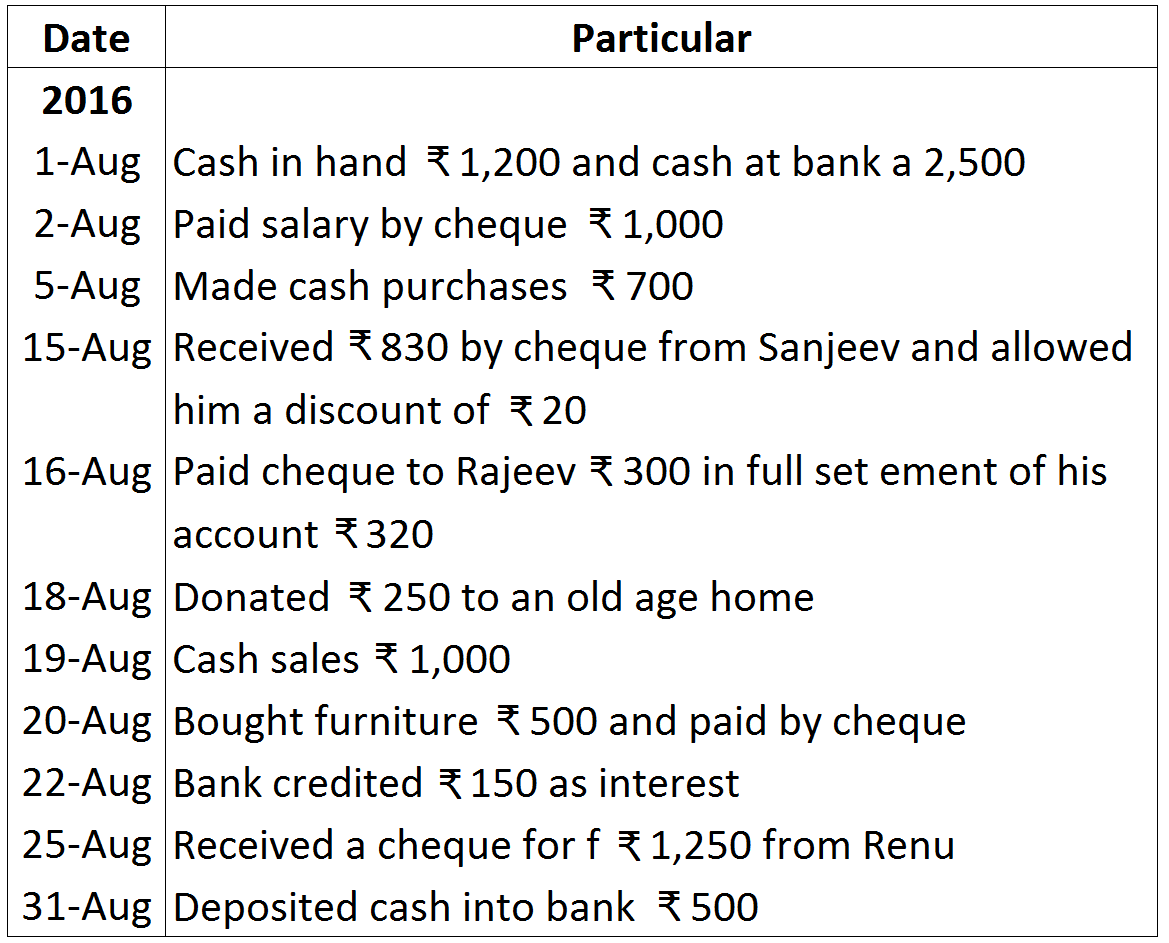
Also identify any one value communicated by M/s Pee Kay Co.
Also identify any one value communicated by M/s Pee Kay Co.
What is a cash register? Why is it important for a business to maintain a cash register? In how many forms can a cash register be maintained? Give the generic format of any one form.
Explain in detail the various types of cost.
From the following information prepare a Cash Register:
View full solution →- Ms. Keerti commenced business with $₹ 5,00,000.$
- Bought furniture worth $₹ 2,00,000$ and paid freight of $₹ 5,600.$
- Sold to us by Mr. Martin for cash :
- $5$ coloured $TV @10,000$ each.
- $5 \text{LED} @ 18,000$ each.
- Sold to $M/ s$ Nehal for cash: $2$ colour $TV @ 20,000$ each.
- Returned $1 \text{LED TV}$ to Mr. Martin as it was defective and received payment.
- Received commission of $₹ 3,000$
- Paid $3$ months rent $₹ 30,000.$
- Paid salary to Mohan $₹ 2000.$
- Sold to Neerja for cash :
- $3$ colour $TV$ for $20,000.$
- $3 \text{LED}$ of $18,000$ each for $₹ 25,000.$
- Paid electricity bill of $₹ 800.$
- Depreciation charged on furniture $@ 5\%$ p.a.
- Paid income tax of $₹ 3,000$ and Sales Tax of $₹ 2000.$
Generate a Business Finance and Arithmetic paper free
Pick question groups from the list above, set marks and difficulty, and export a branded PDF with step-by-step answer keys. First 3 chapters free — no signup.