Questions

5 Marks Question

🎯

Test yourself on this topic

8 questions · timed · auto-graded

Question 15 Marks
Define mnemonics? Suggest a plan to improve your own memory.
Answer
Mnemonics are strategies for improving memory. There are different plans to improve memory. One of such plans is as follows:Engaging in deep level processing: If one wants to memories any information well, he should engage himself in deep level processing. Craik and Lockhart have demonstrated that processing information in terms of meaning that they convey leads to better memory as compared to attending to their surface features. Deep processing would involve asking as many questions related to the information as possible, considering its meaning and examining its relationships to the facts one already knows. In this way, the new information will become a part of his existing knowledge framework and the chances that it will be remembered are increased.
View full question & answer
Question 25 Marks
Differenciate between declarative and procedural memories?
Answer
Declarative memories: All information pertaining to facts, names, dates, such as a rickshaw has three wheels or that India became independent on August 15 1947 or a frog is an amphibian or you and your friend share the same name, are part of declarative memory. Facts retained in declarative memory are amenable to verbal description.Procedural memories: Procedural memory, on the other hand, refers to memories relating to procedures for accomplishing various tasks and skills for example- how to ride a bicycle, how to make tea or play basketball etc. The contents of procedural memory cannot be described easily.
View full question & answer
Question 35 Marks
Match List I with List II and select the correct answer using the codes given below the lists.
S. No.
List I (Affected by)
S. No.
List II (Theory of)
a.
Decay
i.
Intervening activities
b.
Interference
ii.
Perceptions
c.
Trace Change
iii.
Time factors
d.
Forgetting as retrieval failure
iv.
Different conditions
Answer
S. No.
List I (Affected by)
S. No.
List II (Theory of)
a.
Decay
iii.
Time factors
b.
Interference
i.
Intervening activities
c.
Trace Change
ii.
Perceptions
d.
Forgetting as retrieval failure
iv.
Different conditions
View full question & answer
Question 45 Marks
What evidence do we have to say that ‘memory is a constructive process’?
Answer
  1. He used the method of “serial reproduction” in which the participants of his experiments recalled the memory materials reportedly at varying time intervals.
  • While engaging in this method of learning material, his participants committed a wide variety of errors which Bartlett considered useful in understanding the process of memory construction.
  1. Using meaningful materials such as texts, folk tales, fables etc.
  • He attempted to understand the manner in which content of any specific memory gets affects by a person’s knowledge, goals, motivation, preferences and various other psychological process.
  1. Schemas play an important role in the process of memorization. Schemas refer to an organization of past experiences and knowledge which influence the way in which incoming information is interpreted, stored and later retrieved.
  • Memory, therefore becomes encoded and is stored in terms of a person’s understanding and within his/ her previous knowledge and expectations.
View full question & answer
Question 55 Marks
Describe the concept of eye witness memory and false memory.
Answer
  1. Eye witness memory:
  • Court procedures followed in criminal trials use the testimony given by the eyewitness of the offense. It is considered to be the most reliable evidence for or against the accused.
  • The experimental procedure was done by “Loftus and her colleagues".
  • A film clipping of a car accident was shown to the participant.
  • This was followed by some questions, which interferes with encoding of the event.
  • One of the questions was “how fast were the cars going when they smashed into each other."
  • In another question the verb “smashed" was replaced with the verb contained.
  • Those who were asked the first question estimated the speed of the car as 40.8mph. Those who were given the second question estimated that the speed of the car was only 31.8mph. Clearly the nature of leading questions changed the memory.
  1. False Memory: An interesting phenomena called false memory can be induced by powerful imagination of events that did not take play at all. One study was carried out by Garry, Manning and Loftus” in 1986 to understand the features of false memory. Initially they presented before participants a list of events that could have occurred in their lives.
  • First phase: They related the likelihood that each of these events actually took place in their lives to the best of their childhood memories.
  • Second phase: They were invited again to the laboratory and were asked to imagine those events and visualize as if they actually happened to them. In particular, events which were rated low in terms of their likelihood of occurrence were chosen for the task of visualizing and imagining.
  • Third phase: The experimenters pretended that they had misplaced the event likelihood rating which they had obtained during the first phase and therefore requested the participant to respond to the list once again.
  • Events which were rated low on likelihood in the first phase but were later visualized and imagined as real were now rated high. The participants reported that those events actually took place in their lives.
  • These findings suggest that memory can be induced and implemented through imagination inflation -a finding that provides useful insight into memory processes.
View full question & answer
Question 65 Marks
Describe the hierarchical organisation in long-term memory?
Answer
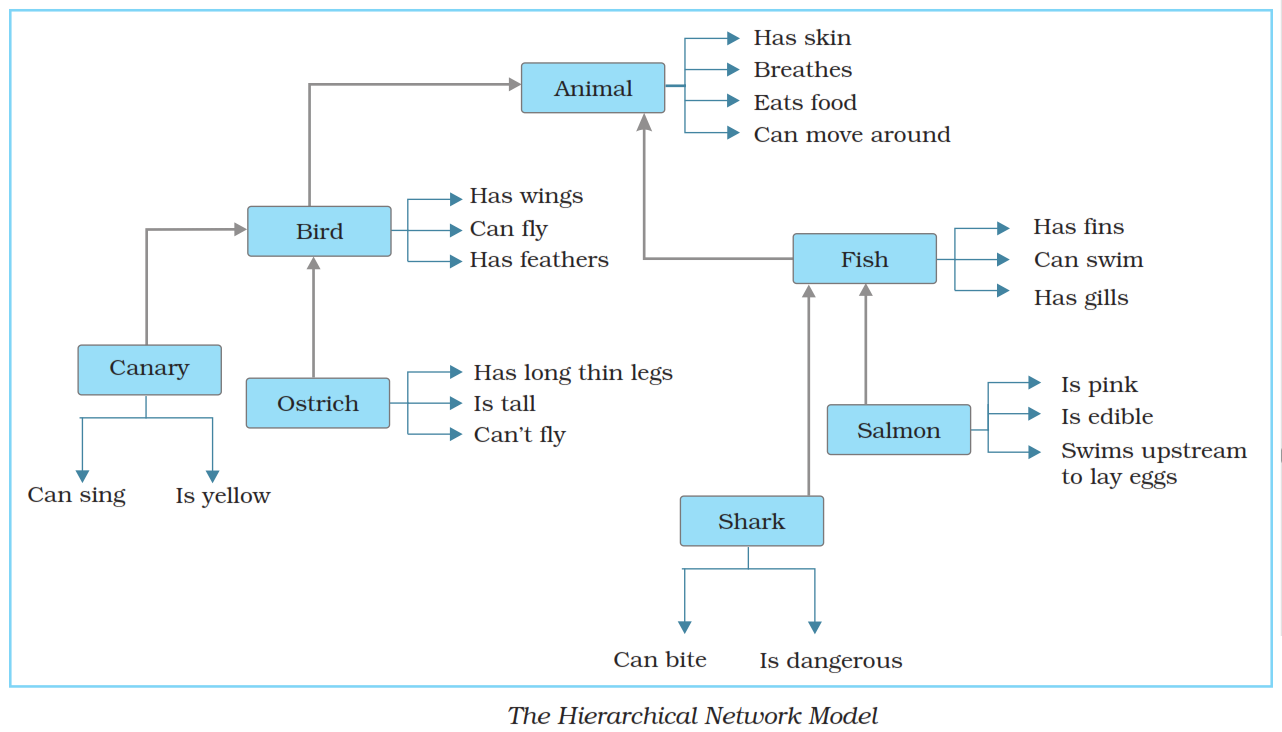
Depending upon how much time people take in responding to questions, the nature of organization in long-term memory, has been inferred.The most important unit of representation of knowledge in long-term memory is a concept. Concepts are mental categories for objects and events, which are similar to each other in one or in more than one way. Concepts may also get organized in schemas which are mental frameworks which represent our knowledge and assumptions about the world.
In the year 1969, Allann Collins and Ross Quillian suggested that knowledge in long-term memory is organized hierarchically and assumes a network structure. Elements of this structure are called nodes. Nodes are concepts while connections between nodes are labeled relationships, which indicate category membership or concept attributes.
View full question & answer
Question 75 Marks
How is information processed through sensory, short-term and long-term memory systems?
Answer
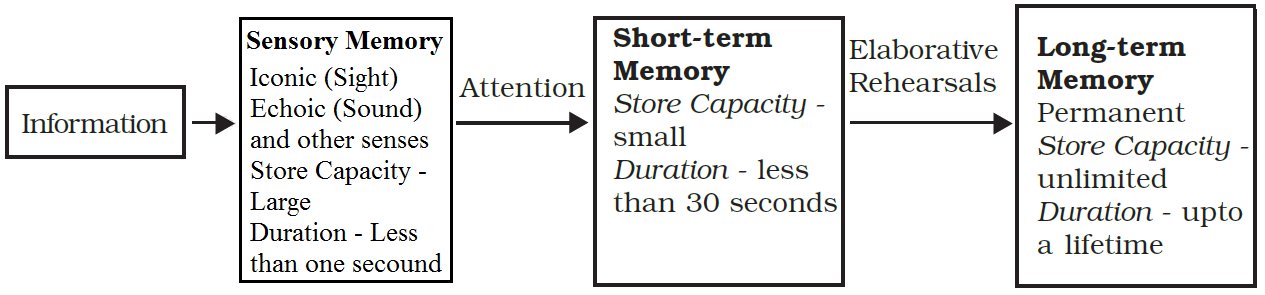
Atkinson and Shiffrin model of memory also known as stage model of memory.This proposes the existence of three separate but sequentially linked memory systems, the sensory memory, the short-term memory and the long-term memory.
  • The sensory memory: contains a fleeting impression of a sensory stimulus (a sight or a sound). It is initial process that preserves brief impression of stimuli. It has a large capacity. It is of very short duration that is less than a second.
  • The short-term memory: a limited recollection of recently perceived stimuli (a telephone number or an order of drinks). It holds small amount of information for a brief periocfof time i.e. less than 30 seconds. It is primarily encoded acoustically.
  • The long-term memory: a more or less permanent store of memories for later retrieval (e.g. our telephone numbers). In this stage information’s are encoded semantically and storage capacity is unlimited.
Each of these memory systems is seen as differing in the way they process information, how much information they can hold and for how long they can hold that information.
The model can be expressed in the following diagram:
View full question & answer
Question 85 Marks
Why does forgetting take place?
Answer
Each one of us has experienced forgetting and its consequences almost routinely. There are some reasons because of which we forget:
  1. It is because the information we commit to our long term memory is somehow lost.
  2. It is because we did not memorize it well enough.
  3. It is because we did not encode the information correctly or it is because during storage, it got distorted or misplaced.
There are theories which have been developed to explain forgetting:
  1. Theory of forgetting developed by Hermann Ebbinghaus:
According to him the rate of forgetting is maximum in the first nine hours, particularly during the first hour. After that, the rate slows down and not much is forgotten even after many days.
  1. Forgetting due to Trace decay:
  1. Trace theory (also called disuse theory) is the earliest theory of forgetting.
  2. The assumption here is that memory leads to modification in the central nervous system, which is akin to physical changes in the brain called “memory traces”. When these memory traces are not used for a long time, they simply fade away and become unavailable.
Drawbacks:
  • If forgetting takes place because memory traces decay due to disuse, then people who go to sleep after memorizing should forget more compared to those who remain awake.
  • Those who remain awake after memorizing show greater forgetting than those , who sleep.
Forgetting due to interference:
  • The interference theory suggests that forgetting is due to interferences between various information’s that the memory store contains.
  • Interference comes about at a time of retrieval when these various sets of associations compete with each other for retrieval.
There are two kinds of interferences that may result in forgetting.
  1. Proactive (forward moving): Proactive means what you have learnt earlier interferes with the recall of your subsequent learning. In other words, in proactive interference past learning interferes with the recall of later learning, e.g. If you know English and you find it difficult to learn French it is because of proactive interference.
  2. Retroactive (backward moving): Retroactive refers to difficulty in recalling what you have learnt earlier because of learning a new material. In retroactive interference the later learning interferes with the recall of past learning.e.g. If you cannot recall English equivalents of French words that you are currently memorizing then it is because of retroactive interference.
 
Experimental Designs for Retroactive and Proactive Interference
Retroactive Interference
Phase 1
Phase 2
Testing Phase
Experimental participant /group
Learns A
Learns B
Recallls A
Control participant /group
Learns A
Rests
Recallls A
Proactive Interference


Experimental participant /group
Learns A
Learns B
Recallls B
Control participant /group
Rests
Learns B
Recallls B
Forgetting due to retrieval failure:
  • Forgetting can also occur because at the time of recall, either the retrieval cues are absent or they are inappropriate.
  • Retrieval cues are aids which help us in recovering information stored in the memory.
  • This view was advanced by “Tulving and his associates” who carried out several experiments to show that recall of content become poor either due to absence or inappropriateness of retrieval cues that are available /employed at the time of recall.
  • Without getting any cues one may recall a couple of them only but if the learner get cues like category names then the recall improves significantly.
  • Category names may act as retrieval cues.
View full question & answer