Questions

2 Marks Question

🎯

Test yourself on this topic

3 questions · timed · auto-graded

Question 12 Marks
How biological motive differs from psychological motives?
Answer
The differences between biological and psychological motives are:Biological motives:
  1. They are guided mostly by the physiological mechanisms of the body.
  2. Focuses on the innate, biological causes of motivation like hormones, neurotransmitters brain structures.
  3. Concerned with the functions performed by various body parts, such as, hypothalamus, limbic systems etc.
For example: Hunger, thirst, sex etc.
Psychological motives:
  1. These are primarily learned from the individual's interaction with the various environmental factors.
  2. They focus on the factors (social and environmental) and how they interact with each other to produce motivation.
  3. They are not concerned with functions of various parts of the body.
For example: Need for power, achievement, affiliation etc.
View full question & answer
Question 22 Marks
What is anxiety? How will you distinguish between trait anxiety from state anxiety?
Answer
Anxiety refers to the internal conflicts of an individual while dealing with different possibilities.It is anticipated ill:
  • Trait Anxiety is viewed as a relatively enduring disposition to be anxious in many different situations. It represents the degree to which people vary in the degree of anxiety proneness.
  • State anxiety is the anxiety as individual experiences in a specific situation at a specific time.
  • It is characterized by feelings of tension, nervousness and worry.
View full question & answer
Question 32 Marks
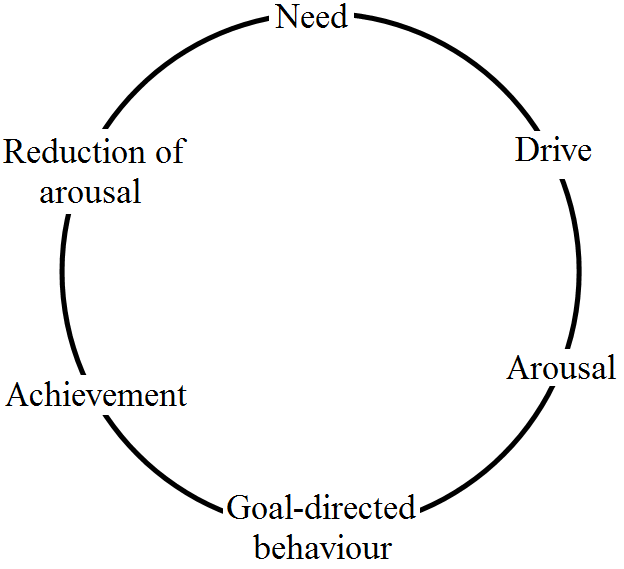
Explain the motivational cycle with the help of an example.
Answer
The motivational cycle starts with a need which lacks or is deficit in some necessity leading to the state of arousal, also known as the drive state.
  • Behaviour is pushed toward goals by driving states within the person or animal.
  • When aroused, the individual is pushed to engage in behaviour which will lead to a goal that reduces the intensity of the driving state or toward the goal-directed behaviour.
  • When the appropriate goal is achieved it reduces the arousal and balance is regained.
  • For example when we feel hungry a state of uneasiness arises and we are compelled to eat something to satisfy the hunger.
  • After having something we feel relieved and gain the initial balanced stage.
  • The cycle of motivation continues like this.
View full question & answer
2 Marks Question - Psychology STD 11 Humanities Questions - Vidyadip