Questions

5 Marks Question

🎯

Test yourself on this topic

12 questions · timed · auto-graded

Question 15 Marks
Match List I with List II and select the correct answer using the codes given below the lists.
S. No.
List I (Motive)
S. No.
List II (Goal)
a.
Power
i.
Striving for success
b.
Achievement
ii.
Controlling people and activities
c.
Affiliation
iii.
Having executive privileges
d.
Status
iv.
Maintaining Harmonious relationship
Answer
S. No.
List I (Motive)
S. No.
List II (Goal)
a.
Power
ii.
Controlling people and activities
b.
Achievement
i.
Striving for success
c.
Affiliation
iv.
Maintaining Harmonious relationship
d.
Status
iii.
Having executive privileges
View full question & answer
Question 25 Marks
How does culture influence the expression of emotions?
Answer
Emotional expression involves posture, facial expression, actions, words and even silence.
  • Cultural similarities in the facial expression of emotions such as anger, fear, disgust, sadness, happiness etc. have been observed. It must however, be noted that facial expression can, in some cases, be also misleading.
  • The display rules that regulate emotional expression and emotional vocabulary do vary across cultures.
  • It has been found that children would cry when distressed, shake their heads when defiant and smile when happy.
  • Despite similarities in expressions of certain basic emotions, cultures do vary in why and how they express emotions.
View full question & answer
Question 35 Marks
Explain the frustration-aggression hypothesis proposed by Dollard and Miller.
Answer
Frustration occurs when an anticipated desirable goal is not attained and the motive is blocked. This often results in a variety of behavioural and emotional reactions like fixation, escape, avoidance, cries including anger. It is in connection with this that Dollard and Miller proposed this theory of frustration aggression. This theory states that frustration produces aggression which is often directed toward the self or blocking agent or substitute. Direct aggressive acts may be inhibited by the threat of punishment.One could find the main sources of frustration in:
  1. Environmental forces: Physiological object, constraining situations or even other people who prevent a passion from reaching a particular goal.
  2. Personal factors like inadequacies or lack of resources that make it difficult or impossible to reach goals and Conflict between motives.
View full question & answer
Question 45 Marks
Discuss the management of negative emotions and enhancement of positive ones.
Answer
Emotions are an integral part of our lives and it is important to maintain a balance between emotions.
  • By enhancing one's self awareness and knowing one's own self better and gaining insight into own's feelings.
  • Objective approach in evaluating an event that matters. Objectively appraising the situation is very important.
  • Taking into account your past accomplishments, emotional and physical states increases the faith in yourself and lead to enhanced feeling of wellness and contentment. Recalling past performance and using it as an inspiration and motivation to perform better in future.
  • Perceptual reorganization and cognitive restructuring. Restructuring thoughts to enhance positive and reassuring feelings and eliminate negative thought.
  • Be Creative and innovative. Keep yourself engaged in something that interests you.
  • Nurturing good relationship and meaningful ones also enhances self worth and lend support to deal with problems in life.
  • Community service: helping others is also positive in its effect. Gaining insight into other's problem also helps in understanding your own problems, situations in a better way.
  • Developing personality traits of optimism, hopefulness, happiness and a positive self-regard.
  • Looking positively at things and finding positive meaning in difficult situations.
  • Emotions (negatives) are very common in our day-to-day life event.
  • Over time we experience one emotion or the other. A positive interpretation of such events is necessary.
  • Finally if some has faith in himself he can do anything, can face any adverse situation, living a life of purpose, hope is all that is needed.
  • In the end it can be said emotions are very common experience in life; they vary in intensity and strength and is important to maintain a balance of emotion. Reduction of negative emotions is very essential in ensuring positive well-being.
View full question & answer
Question 55 Marks
How do the needs for achievement, affiliation, and power influence the behaviour of adolescents? Explain with examples.
Answer
The needs for achievement, affiliation and power influence the behaviour of adolescents as they shape the motives that result from their interaction with environment.
  • The need for affiliation is aroused when individuals feel threatened, helpless or happy. For example, adolescents face a lot of peer pressure to be popular. They are motivated to interact socially to gain popularity.
  • Individuals are motivated towards achievement by tasks that are difficult and challenging. They have a strong desire for feedback on their performance to achieve their goal. The adolescents want to achieve good marks in examinations in order to experience the sense of achievement.
  • The need for power refers to the ability of a person to take control over others. An adolescent who wants to become a “head student” is motivated to get power in the school and exercise control over the rest of the students.
View full question & answer
Question 65 Marks
How to manage anger?
Answer
Anger is negative emotion in which the person loses control on behavioural functions. The major source of anger is the frustration of motives. However, anger is not a reflex, rather it is a result of our thinking, and therefore it is controllable by one's own thought only.Certain key points for anger management:
  • Recogniging the power of one’s own thought.
  • Realiging that the individual himself can control it.
  • Avoiding “self-talk that burns". One should not magnify negative feeling.
  • Resist having irrational believes about people and events.
  • Avoiding being judgemental.
  • Trying to find constructive ways of expression ones anger.
  • Control on the degree and duration of anger.
  • Look inward not outward for anger control.
  • Always create gap between the anger provoking stimulus and your reaction.
View full question & answer
Question 75 Marks
What is the role of positive emotions and what are the ways to enhance positive emotions?
Answer
Positive emotions give us a greater ability to cope with adverse circumstances and quickly return to a normal state. They help us set up long-term plans and goals, and form near relationships.Various ways of enhancing positive emotions are given below:
  1. Personality traits of optimism, hopefulness, happiness and positive self-regard.
  2. Finding positive meaning in difficult circumstances.
  3. Sharing quality relationship with others and a supportive network of close relationships.
  4. Choosing a pastime and gaining mastery in it.
  5. Positive approach to life and having faith in oneself and leading a life of purpose.
  6. Positive as interpretation of most daily events.
View full question & answer
Question 85 Marks
Is it important to consciously interpret and label emotions in order to explain them? Discuss giving suitable examples.
Answer
Yes, it is important to consciously interpret and label emotions in order to explain them as the expression of emotions varies from culture to culture. There are some basic emotions that are common to all cultures and yet there are other emotions that are culture specific. The identification and experience of emotions also vary across cultures and display rules exist to modify the intensity of expression of emotions. For example, the Tahitian language has 46 labels for anger that may be used in different contexts. The North Americans can produce up to 40 different facial expressions for anger while the Japanese have 10 labels for various facial expressions of happiness and 8 levels to express anger. While some emotions like love, anger, grief and wonder are deemed to be universal and present across Indian, Chinese and Western cultures, other emotions like surprise, contempt and shame are not considered as basic to everyone and the degree of their presence varies individually as well as culturally.
Therefore, it is important to interpret and label emotions in order to understand and explain them.
View full question & answer
Question 95 Marks
Why is it important to manage negative emotions? Suggest ways to manage negative emotions.
Answer
It is important to manage negative emotions because negative emotions act as an obstruction towards viewing things clearly and taking rational decisions. For instance, anxious individuals find it difficult to concentrate or to make decisions even for small matters. Negative emotions also affect the psychological and physical health of an individual and may result in decreased ability to think or concentrate, and loss of interest in personal or social activities. Thus, managing emotions effectively is integral to effective social functioning.The ways to suggest negative emotions are:
  1. Enhancing self-awareness and being creative.
  2. Appraising the situation objectively, without bias or preconceptions.
  3. Self monitoring by constant evaluation of accomplishments and various experiences.
  4. Engaging in self modeling by evaluating one’s best performance and using them as inspiration.
  5. Perceptual reorganization and cognitive restructuring.
  6. Developing and nurturing good relations and having empathy for others.
  7. Participating in community service.
View full question & answer
Question 105 Marks
What is the basic idea behind Maslow’s hierarchy of needs? Explain with suitable examples.
Answer
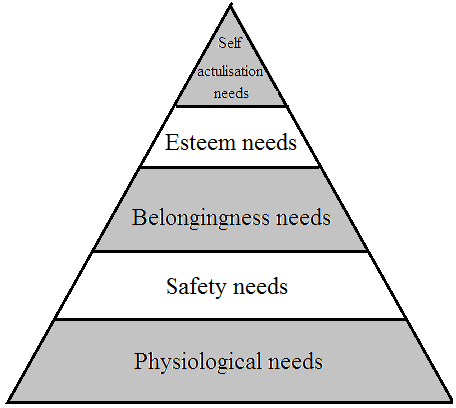
Maslow proposed his view about human motivation. He attempted to portray a picture of human behaviour by arranging the various needs in a hierarchy. His viewpoint about motivation is popularly known as ‘Theory of self-actualization’.
  1. Maslow’s model can be conceptualized as a pyramid in which the bottom of this hierarchy represents basic physiological or biological needs which are basic to survival such as hunger thirst etc. Only when these needs are met, the need to be free from threatened danger arises. This refers to the safety needs of physical and psychological nature.
  2. Next comes the need to seek out other people, to love and to be loved. After these needs are fulfilled, the individual strives for esteem, i.e. the need to develop a sense of self-worth. The next higher need in the hierarchy reflects an individual’s motive towards the fullest development of potential, i.e., self-actualization. A self-actualized person is self-aware, socially responsive, creative, spontaneous, open to novelty, and challenge. She/ he also has a sense of humor and capacity for deep interpersonal relationships.
  3. Lower level needs (physiological) in the hierarchy dominate as long as they are unsatisfied. Once they are adequately satisfied, the higher needs occupy the individual’s attention and effort. However, very few people reach the highest level because most people are concerned more with the lower level needs.

Maslow’s Hierarchy of Needs.
View full question & answer
Question 115 Marks
What are the biological bases of hunger and thirst needs?
Answer
Hunger:
  • The stimuli of hunger include stomach contractions, which signify that the stomach is empty.
  • A low concentration of glucose in the blood
  • A low level of protein and the amount of fats stored in the body.
  • The liver also responds to the lack of bodily fuel by sending nerve impulses to the brain.
  • The aroma, taste or appearance of food may also result in a desire to eat.
  • They all in combination act with external factors (such as taste, colour by observing other’s eating, and the smell of food, etc.) to the help one understands that she/ he is hungry.
Thirst: When we are deprived of water for a period of several hours, the mouth and throat become dry, which leads to dehydration of body tissues.
  • Drinking water is necessary to wet a dry mouth.
  • The processes within the body itself control thirst and drinking of water.
  • Water must get into the tissues sufficiently to remove the dryness of mouth and throat.
  • Motivation to drink water is mainly triggered by the conditions of the body.
  • Loss of water from cells and reduction of blood volume.
  • When Water is lost by bodily fluids, water leaves the interior of the cells. The anterior hypothalamus contains nerve cells called ‘osmoreceptors’, which generate nerve impulses in case of cell dehydration. These nerve impulses act as a signal for thirst and drinking.
  1. View:
  • The mechanism which explains the intake of water is responsible for stopping the intake of water.
  1. View:
  • The role of stimuli resulting from the intake of water in the stomach have something to do with stopping of drinking water.
  • The precise physiological mechanisms underlying the thirst drive are yet to be understood.
View full question & answer
Question 125 Marks
Does physiological arousal precede or follow an emotional experience? Explain.
Answer
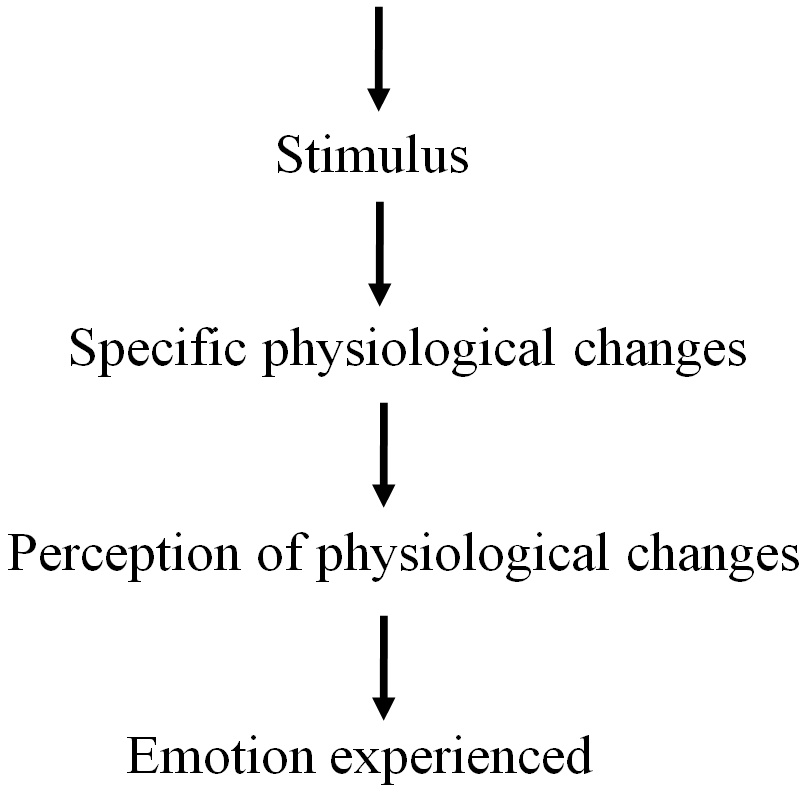
  • William James and Carl Lange argued that the perception about bodily changes, like rapid breathing, a pounding heart and running legs following an event, – brings forth emotional arousal.
  • This theory of emotion holds that body’s reaction to a stimulus produces emotional reaction.
  • The theory suggests that environmental stimuli elicit physiological responses from viscera (the internal organs like heart and lungs), which in turn, are associated with muscle movement.
  • James-Lange theory argues that your perception about your bodily changes, like rapid breathing, a pounding heart, and running legs, following an event, brings forth emotional arousal
  • The theory can be expressed in the following hierarchy:

Canon and Bard contradicted to the James-Lange theory.
  • According to this theory, felt emotion and the bodily reaction in emotion are independent of each other; both get triggered simultaneously.
  • This theory of emotion holds that bodily changes and the experience of emotion occurs simultaneously.
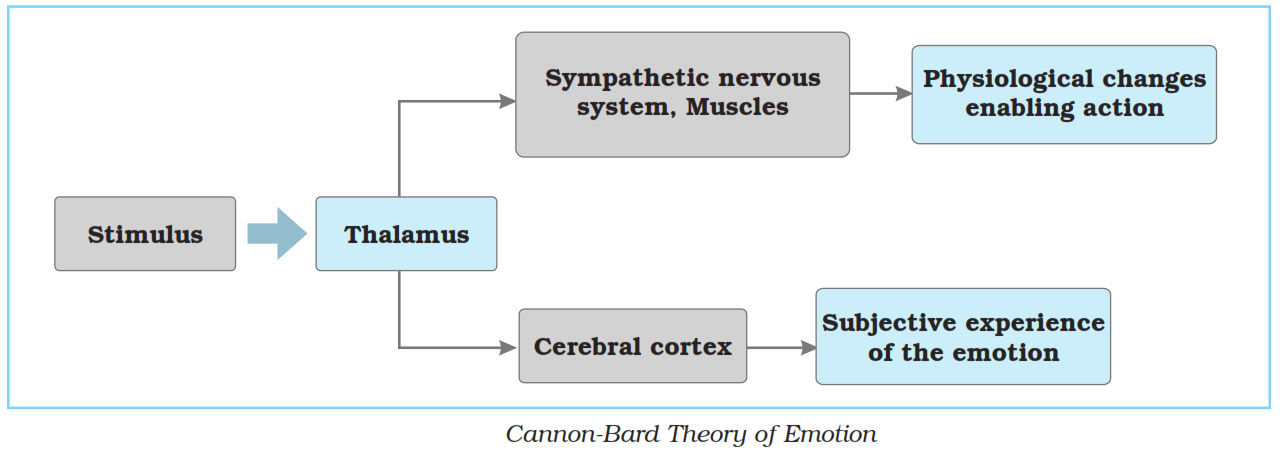
  • Theory claims that the entire process of emotion is governed by thalamus.
  • Thalamus conveys the information simultaneously to the cerebral cortex and to the skeletal muscles and sympathetic nervous system.
  • The cerebral cortex then determines the nature of the perceived stimulus. By referring to the past experiences. This determines the subjective experience of emotion. Simultaneously the sympathetic nervous system and the muscles provide physiological arousal and prepare the individual to take action.
  • Following diagram shows the CANNON-BARD theory of emotion:
  • As proposed by the theory we first perceive potential emotion-producing situation which leads to activity in the lower brain region such as the hypothalamus which in turn sends output in two directions:
  1. To internal body organs, external muscles to produce bodily expressions.
  2. To cerebral cortex where the pattern of discharge from the lower brain areas is perceived as felt emotion.
View full question & answer
5 Marks Question - Psychology STD 11 Humanities Questions - Vidyadip