Questions

4 Marks Questions

🎯

Test yourself on this topic

16 questions · timed · auto-graded

Question 14 Marks
For a certain distribution, $\Sigma x_i=20, \Sigma x_i^2=100$ and $\Sigma x_i^3$ $=1500$, and $n=10$, find coefficient of skewness.
Answer
Here, we calculate raw moments
$
\begin{array}{l}
\mu_1^{\prime}=\frac{\Sigma x_i}{n}=\frac{20}{10}=2 \\
\mu_2^{\prime}=\frac{\Sigma x_i^2}{n}=\frac{100}{10}=10 \\
\mu_3^{\prime}=\frac{\Sigma x_i^3}{n}=\frac{1500}{10}=150
\end{array}
$
Now, we calculate central moments
$\mu_2=\sigma^2=\mu_2^{\prime}-\left(\mu_1^{\prime}\right)^2$
$=10-(2)^2=10-4=6$
or, $\sigma=\sqrt{6}$
and $\mu_3=\mu_3^{\prime}-3 \mu_2^{\prime} \mu_1^{\prime}+2\left(\mu_1^{\prime}\right)^3$
$\begin{array}{l}=150-3(10)(2)+2(2)^3 \\ =150-60+16 \\ =106\end{array}$
Therefore,
Skewness, $S_k=\frac{\mu_3}{\sigma^3}=\frac{106}{(\sqrt{6})^3}$
$=\frac{106}{6 \sqrt{6}}=7.212$. (Approx.)

View full question & answer
Question 24 Marks
Find the first four moments about zero for the set of the number $1,3,5,7$.
Answer
The first four moment about zero means, first four raw moments about origin
XX$X^2$$X^3$$X^4$
11111
3392781
5525125625
77493432401
$\Sigma X=16$$\Sigma X^2=84$$\Sigma X^3=496$$\Sigma X^4=3108$
$\begin{array}{ll}\text { Here, } & n=4 \\ \therefore & \mu_1^{\prime}=\frac{\Sigma X}{n}=\frac{16}{4}=4\end{array}$
$\begin{array}{l}\mu_1^{\prime}=\frac{\Sigma X^2}{n}=\frac{84}{4}=21 \\ \mu_3^{\prime}=\frac{\Sigma X^3}{n}=\frac{496}{4}=124 \\ \mu_4^{\prime}=\frac{\Sigma X^4}{n}=\frac{3108}{4}=777\end{array}$
View full question & answer
Question 34 Marks
The first four raw moments of a distribution are $2,136,320$ and 40000 . Find out coefficient of skewness and kurtosis.
Answer
Given that, $\mu_1^{\prime}=2, \mu_2^{\prime}=136, \mu_3^{\prime}=320$ and $\mu_4^{\prime}=$ 40000
First of all we have to calculate the first four central moments
$\begin{aligned} \mu_1 & =\mu_1^{\prime}-\mu_1^{\prime}=0 \\ \mu_2 & =\mu_2^{\prime}-\left(\mu_1^{\prime}\right)^2=136-(2)^2=132 \\ \mu_3^{\prime} & =\mu_3^{\prime}-3 \mu_2^{\prime}+\left(2 \mu_1^{\prime}\right)^3 \\ & =320-3 \times 136 \times 2+2(2)^3 \\ & =320-816+16=-480 \\ \mu_4 & =\mu_4^{\prime}-4 \mu_1^{\prime} \mu_3^{\prime}+6 \mu_2^{\prime}\left(\mu_1^{\prime}\right)^2-3\left(\mu_1^{\prime}\right)^4 \\ & =40000-4 \times 2 \times 320+6 \times 136 \\ & \quad \times(2)^2-3 \times(2)^4 \\ & =40000-2560+3264-48 \\ & =40656\end{aligned}$
$\begin{aligned} \text { Skewness, } \beta_1 & =\frac{\mu_3^2}{\mu_2^3}=\frac{(-480)^2}{(132)^3}=0.10017 \\ & =0.1002 \text { (Approx.) } \\ \text { Kurtosis, } \beta_2 & =\frac{\mu_4}{\mu_2^2}=\frac{40656}{(132)^2}=2.333 . \text { (Approx.) }\end{aligned}$
The value of $\beta_2$ is less than 3 , hence the curve platykurtic.
View full question & answer
Question 44 Marks
Find the mean and standard deviation using short-cut method.
$x_i$606162636465666768
$f_i$21122925121045
Answer
Let $y_i=\frac{x_i-a}{i}=x_i-64[\because i=1$ and ' $a$ ' is assumed to be 64$]$
$x_i$$f_i$$y_i=x_i-64$$f_i y_i$$y_i^2$$f_i y_i^2$
602-4-81632
611-3-399
6212-2-24448
6329-1-29129
64250000
6512112112
6610220440
674312936
6854201680
Total100 060286
Here,
$\quad \begin{aligned} \text { Mean, } \bar{x} & =64+\frac{\sum f_i y_i}{\sum f_i} \\ & =64+0 \\ & =64\end{aligned}$
Variance,
$
\begin{aligned}
\sigma^2 & =\frac{1}{\sum f_i}\left[\sum f_i y_i^2-n \bar{y}^2\right] \\
& =\frac{1}{100}[286]=2.86 \\
\sigma & =\sqrt{2.86}=1.69 . \text { (Approx.) }
\end{aligned}
$
View full question & answer
Question 54 Marks
If $\bar{x}$ is the mean and $\sigma^2$ is the variance of $n$ observations $x_1, x_2, x_3, \ldots, x_n$, then prove that the mean and variance of the observations $a x_1, a x_2, \ldots$, $a x_n$ are $a \bar{x}$ and $a^2 \sigma^2$ respectively $(a \neq 0)$.
Answer
We know :
$
\text { Mean, } \bar{x}=\frac{x_1+x_2+\ldots+x_n}{n}
$
and, mean of $a x_1, a x_2, \ldots, a x_n$
$
\begin{array}{l}
=\frac{a x_1+a x_2+\ldots+a x_n}{n} \\
=a \cdot \frac{x_1+x_2+\ldots+x_n}{n} \\
=a \cdot \bar{x}
\end{array}
$
Also, Variance, $\quad \sigma^2=\frac{\sum\left(x_i-\bar{x}\right)^2}{n}$
$\begin{array}{l}\text { Variance of } a x_1, a x_2, a x_3, \ldots, a x_n \\ \qquad=\frac{\sum\left(a x_i-a \bar{x}\right)^2}{n}\end{array}$
$\begin{array}{l}=\frac{\left(a x_1-a \bar{x}\right)^2+\left(a x_1-a \bar{x}\right)^2+\ldots+\left(a x_n-a \bar{x}\right)^2}{n} \\ =\frac{a^2\left(x_1-\bar{x}\right)^2+a^2\left(x_1-\bar{x}\right)^2+\ldots+a^2\left(x_n-\bar{x}\right)^2}{n} \\ =a^2 \frac{\sum\left(x_1-\bar{x}\right)^2}{n} \\ =a^2 \sigma^2\end{array}$
$\therefore$ New mean $=a x_1$ and new variance $=a^2 \sigma^2$.
View full question & answer
Question 64 Marks
Find the mean, variance and standard deviation of first 10 multiples of 4 .
Answer
Here, the variables are $
4,8,12,16,20,24,28,32,36,40
$
Here, $N =10$,
So,
Mean, $\bar{x}=\frac{4+8+\ldots+40}{10}$
$\begin{array}{l}=\frac{4(1+2+\ldots 10)}{10} \\ =\frac{4}{10} \cdot \frac{10(10+1)}{2} \\ =2 \times 11 \\ =22\end{array}$
$x_i$ $x_i-\bar{x}$ $\left(x_i-\bar{x}\right)^2$
4 -18 324
8 -14 196
12 -10 100
16 -6 36
20 -2 4
24 2 4
28 6 36
32 10 100
36 14 196
40 18 324
Total $\sum\left(x_i-\bar{x}\right)=0$ $\sum\left(x_i-\bar{x}\right)^2=1320$
We have $n=10, \sum\left(x_i-\bar{x}\right)^2=1320$
$\therefore$ Variance, $\sigma^2=\frac{1}{n} \sum\left(x_i-\bar{x}\right)^2=\frac{1}{10} \times 1,320=132$
and
$
\sigma=\sqrt{132}=11.49
$
$\therefore$ Mean $=22$, Variance $=132$ (Approx.) and Standard deviation $=11.49$ (Approx.).

View full question & answer
Question 74 Marks
Co-efficient of variation of two distributions are 50 and 60 and their arithmetic means are 30 and 25 respectively. Find the difference of their standard deviation.
Answer
Given,
$
\begin{aligned}
C . V_1 & =50, C . V_{\cdot}=60 \\
\bar{x}_1 & =30, \bar{x}_2=25
\end{aligned}
$
We know :
$
\begin{array}{l}
\text { C.V. }=\frac{\sigma}{\bar{x}} \times 100 \\
\Rightarrow \quad \bar{x}=\frac{\sigma}{C . V .} \times 100 \\
\therefore \quad \bar{x}_1=\frac{\sigma_1}{C . V_{\cdot}} \times 100 \\
\Rightarrow \quad 30=\frac{\sigma_1}{50} \times 100 \\
\Rightarrow \quad \sigma_1=15 \\
\text { and } \quad \bar{x}_2=\frac{\sigma_2}{C . V_{\cdot 2}} \times 100 \\
\Rightarrow \quad 25=\frac{\sigma_2}{60} \times 100 \\
\Rightarrow \quad \sigma_2=25 \times \frac{3}{5} \\
\Rightarrow \quad \sigma_2=15 \\
\Rightarrow \text { Required difference }=\sigma_1-\sigma_2 \\
\therefore \quad=15-15 \\
=0 \text {. }
\end{array}
$
View full question & answer
Question 84 Marks
The mean and SD for $a, b$ and 2 are 3 and $2 \sqrt{3}$, respectively. Find value of $a b$.
Answer
Given,
$
\begin{aligned}
\text { mean } & =3 \\
\text { S.D. } & =2 \sqrt{3}
\end{aligned}
$
Given numbers are: $a, b$, and 2
$
\begin{array}{ll}
\therefore & \text { mean }=\frac{a+b+2}{3} \\
\Rightarrow & a+b+2=9
\end{array}
$
$
a+b=7 \qquad\ldots(i)
$
$
\begin{aligned}
\text { Standard Deviation } & =\sqrt{\frac{\Sigma(x-\text { mean })^2}{n}} \quad[\because n=3] \\
2 \sqrt{3} & =\sqrt{\frac{\Sigma(x-\text { mean })^2}{3}}
\end{aligned}
$
Squaring both sides, we get
$
\begin{aligned}
12 & =\frac{\sqrt{\Sigma(x-\text { mean })^2}}{3} \\
\Rightarrow \quad 36 & =\sqrt{\Sigma(x-\text { mean })^2}
\end{aligned}
$
Now,
$
\Sigma(x-\text { mean })^2=(a-3)^2+(b-3)^2+(2-3)^2
$
$
\begin{array}{l}
\Rightarrow \quad 36=\left(a^2+9-6 a\right)+\left(b^2+9-6 b\right)+1 \\
\Rightarrow \quad 36=a^2+b^2-6(a+b)+19 \\
\text { Using } \quad(a+b)^2=a^2+b^2+2 a b \\
\Rightarrow \quad 36=(a+b)^2-2 a b-6(a+b)+19 \\
\Rightarrow \quad 36=(7)^2-2 a b-6(7)+19 \\
\Rightarrow \quad 2 a b=49-42+19-36 \\
\Rightarrow \quad 2 a b=68-78 \\
\Rightarrow \quad a b=-5 .
\end{array}
$
View full question & answer
Question 94 Marks
Find the mean deviation about the mean for the following data :
Image
Answer
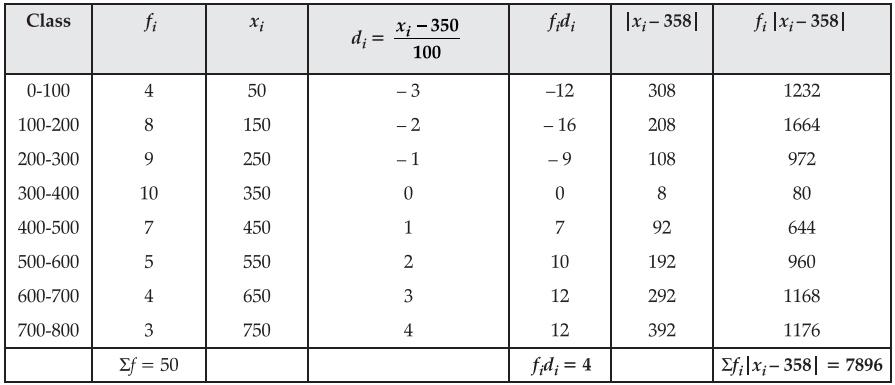
Let us calculate Mean deviation.
Image
Here, $\qquad$ Mean $(x)=$ assumed mean $+\frac{\Sigma f_i d_i}{\Sigma f_i} \times h$
$\begin{array}{l}=350+\frac{4}{50} \times 100 \\ =358\end{array}$
$\therefore$ Mean deviation about mean $(x)$,
$
\text { M.D. }(\bar{x})=\frac{\Sigma f_i\left|x_i-\bar{x}\right|}{\Sigma f_i}=\frac{7896}{50}=157.92 .
$
View full question & answer
Question 104 Marks
Find the mean deviation about the median for the following data :
$x_i$579101215
$f_i$862226
Answer
$x_i$$f_i$$c.f.$$\left|x_i-M\right|=\left|x_i-7\right|$$f_i\left|x_i-7\right|$
588216
761400
921624
1021836
12220510
15626848
$\Sigma f=26$ $\Sigma f_i\left|x_i-M\right|=84$
Here, $N=26$, which is even.
Median observation are $\left(\frac{26}{2}\right)^{\text {th }}$ and $\left(\frac{26}{2}+1\right)^{\text {th }}$ observations
i.e., $13^{\text {th }}$ and $14^{\text {th }}$ Observations
i.e., 7 and 7.
Median $=\frac{7+7}{2}=7$
$\therefore$ Mean deviation about median $(M)$
$
\begin{aligned}
\text { M.D. }(M) & =\frac{\Sigma f_i\left|x_i-M\right|}{\Sigma f_i} \\
& =\frac{84}{26} \\
& =3.23 . \text { (Approx.) }
\end{aligned}
$
View full question & answer
Question 114 Marks
If $\bar{x}$ is the mean and M.D $\bar{x})$ is mean deviation from mean then find the number of observations lying between $\bar{x}$-M.D. $(\bar{x})$ and $\bar{x}+$ M.D. $(\bar{x})$. Use the data $22,24,30,27,29,31,25,28,41,42$.
Answer
Let us first arrange the data in ascending order :
$22,24,25,27,28,29,30,31,41,42$
Mean,
$
\begin{aligned}
\bar{x} & =\frac{22+24+25+27+28+29+30+31+41+42}{10} \\
& =\frac{299}{10} \\
& =29.9
\end{aligned}
$
and
Mean deviation from mean,
M.D. $(\bar{x})=\frac{\sum_{i=1}^{10}\left|x_i-\bar{x}\right|}{10}$
$\begin{aligned} & |22-29.9|+|24-29.9|+|25-29.9|+|27-29.9| \\ = & \frac{+|28-29.9|+|29-29.9|+|30-29.9|+|31-29.9|+|41-29.9|+|42-29.9|}{10} \\ = & \frac{7.9+5.9+4.9+2.9+1.9+0.9+0.1+1.1+11.1+12.1}{10}\end{aligned}$
$\begin{array}{l}=\frac{48.8}{10} \\ =4.88 \\ =4.9 \text { (approx.) }\end{array}$
$
\begin{array}{ll}
\therefore & \bar{x}-\text { M.D. }(\bar{x})=29.9-4.9=25 \\
\text { and } & \bar{x}+\text { M.D. }(\bar{x})=29.9+4.9=34.8
\end{array}
$
Observations lying between 25 and 34.8 are 27, 28, 29, 30, 31 .
View full question & answer
Question 124 Marks
Find the quartile deviation and its coefficient for the marks obtained by 10 students :
$
56,48,65,35,42,75,82,60,55
$
Answer
After arranging the marks in an ascending order of magnitude, we get
$
35,42,48,50,55,56,60,65,75,82
$
First quartile $\left( Q _1\right)=\left(\frac{n+1}{4}\right)^{\text {th }}$ observation
$
\begin{array}{l}
=\left(\frac{10+1}{4}\right)^{\text {th }} \text { observation } \\
=2.75^{\text {th }} \text { observation } \\
=2^{\text {nd }} \text { observation }+0.75
\end{array}
$
$\times$ (difference between the third and the $2^{\text {nd }}$ observation)
$
\begin{array}{l}
=42+0.75 \times(48-42) \\
=46.50
\end{array}
$
Third quartile $\left(Q_3\right)=\frac{3(n+1)}{4}$ th observation
$=3\left(\frac{10+1}{4}\right)^{\text {th }}$ observation
$=8.25^{\text {th }}$ observation
$=65+0.25 \times$ (difference between $9^{\text {th }}$ and $8^{\text {th }}$ observation)
$\begin{aligned} & =65+0.25 \times 10 \\ & =65+2.5=67.50 \\ \text { Quartile Deviation } & =\frac{Q_3-Q_1}{2} \\ & =\frac{67.50-46.50}{2} \\ & =10.50\end{aligned}$
Coefficient of quartile deviation
$
\begin{array}{l}
=\frac{Q_3-Q_1}{Q_3+Q_1} \times 100 \\
=\frac{67.50-46.50}{67.50+46.50} \times 100 \\
=18.42
\end{array}
$
View full question & answer
Question 134 Marks
Find the percentage of workers who earned more than ₹ 10200 from the following data :
Income in ₹7000 - 80008000 - 90009000 - 1000010000 - 1100011000 - 12000
No. of workers48963
Answer
Let $x \%$ workers earn upto ₹ 10200
$\therefore P_x$= ₹ 10200, n=30, i=1000
Setting the data in tabular form, we have
Class intervalFrequencyCumulative frequency
7000 - 80004 4
8000 - 9000812
9000 - 10,000921
10,000 - 11,0006$27 \leftarrow P_x$
11,000 - 12,000330
Obviously, $P_x$ lies in the interval 10000-11000.
$\therefore$ $10,200=10,000+\frac{\frac{30 \times x}{100}-21}{6} \times 1000$
$\Rightarrow$ $200 \times 6=300 x-21000$
$\Rightarrow$ $300 x=22200 \Rightarrow x=74 \%$
$\Rightarrow$ $74 \%$ workers earn upto ₹ 10,200.
Hence, 26% workers earn more than ₹10,200.
View full question & answer
Question 144 Marks
Following is the distribution of marks obtained by 50 students in a class test :
Marks more then01020304050
No. of students50423828163
(i) If $60 \%$ of the students pass the test, find the minimum marks obtained by a pass student.
(ii) Find the percentage of students who scored more than 33 marks.
Answer
First we prepare the following cumulative frequency table :
Image
Here, $n=50$
(i) As $60 \%$ students pass the test, it means that $40 \%$ students get less than minimum passing marks. minimum passing marks are $P_{40}$.
Now, $P_{40}=\frac{40 n}{100}$ th value
$=\frac{40 \times 50}{100}$ th value
$=20$ th value, which lies in class $20-30$
$\therefore \quad P_{40}=l+\left(\frac{\frac{40 n}{100}-c}{f}\right) \times i$
$=20+\frac{20-12}{10} \times 10=28$.
Hence, minimum passing marks are 28 .
(ii) Let us assume that $r \%$ students score less than 33 marks than $P_r=33$. As 33 lies in the class $30-40$, we get
$P_{ r }=l+\frac{\frac{r n}{100}-c}{f} \times i$
$\Rightarrow \quad 33=30+\frac{\frac{r \times 50}{100}-22}{12} \times 10$
$\Rightarrow \quad \frac{r}{2}-22=\frac{3 \times 12}{10}=3.6 \Rightarrow \frac{r}{2}=25.6 \Rightarrow r=51.2$
Thus, $51.2 \%$ students scored less than 33 marks.
Hence, $100-51.2$ i.e., $48.8 \%$ students scored more than 33 marks.
View full question & answer
Question 154 Marks
Find the value of $a$ and $b$ from the following data :
Image
Given that the third decile is 11.
Answer
We construct the cumulative frequency table as under :
Marks0-55-1010-1515-2020-25
No. of students7a2530b
Cumulative frequency77+ a32 + a62 + a62 + a + b
As the total number of students is 100,
$62+a+b=100 \Rightarrow a+b=38$
Third decide, $D_3$ is $\frac{3}{10}$ of $100^{\text {th }}$ i.e., $30^{\text {th }}$ value. Given third decile is 11 , so it lies in the class $10-15$.
Using formula,
$D_3=l+\frac{\frac{3}{10} n-c}{f} \times i$, we get
$\Rightarrow \quad 11=10+\frac{30-(7+a)}{25} \times 5$
$\Rightarrow \quad 1=\frac{23-a}{5} \Rightarrow 5=23-a \Rightarrow a=18$
From eq. (i), $b=38-a=38-18=20$
Hence, $a=18$ and $b=20$.
View full question & answer
Question 164 Marks
The heights (to nearest cm ) of 60 students of a certain school are given in the following frequency distribution table:
Image
Find the (i) median (ii) lower quartile (iii) upper quartile (iv) inter quartile range.
Answer
The given variates are already in ascending order. We construct the cumulative frequency table as under :
Variate
(Height)
Frequency (No. of students)Cumulative frequency
15166
152410
1531121
154930
1551646
1561258
157260
(i)
$\begin{aligned} \text { Median } & =\frac{n+1}{2} \text { th item } \\ & =\frac{60+1}{2} \text { th item } \\ & =30.5 \text { th item }\end{aligned}$
$\begin{array}{l}=\frac{30 th \text { item }+31 \text { th item }}{2} \\ =\frac{154+155}{2}=154.5 cm .\end{array}$
(ii)
$\begin{aligned} Q_1 & =\frac{n+1}{4} \text { th value } \\ & =\frac{60+1}{4} \text { th value } \\ & =15.25 \text { th value }\end{aligned}$
$=153 cm$ (as both 15th and 16th value are 153)
(iii)
$\begin{aligned} Q_3 & =\frac{3(n+1)}{4} \text { th value } \\ & =\frac{3(60+1)}{4} \text { th value }\end{aligned}$
$\begin{array}{l}=45.75 th \text { value } \\ =155 cm \text { (as both 45th and 46th } \\ \quad \text { values are } 155)\end{array}$
(iv)
Interquartile range $=Q_3-Q_1=155-153=2 cm$
View full question & answer